
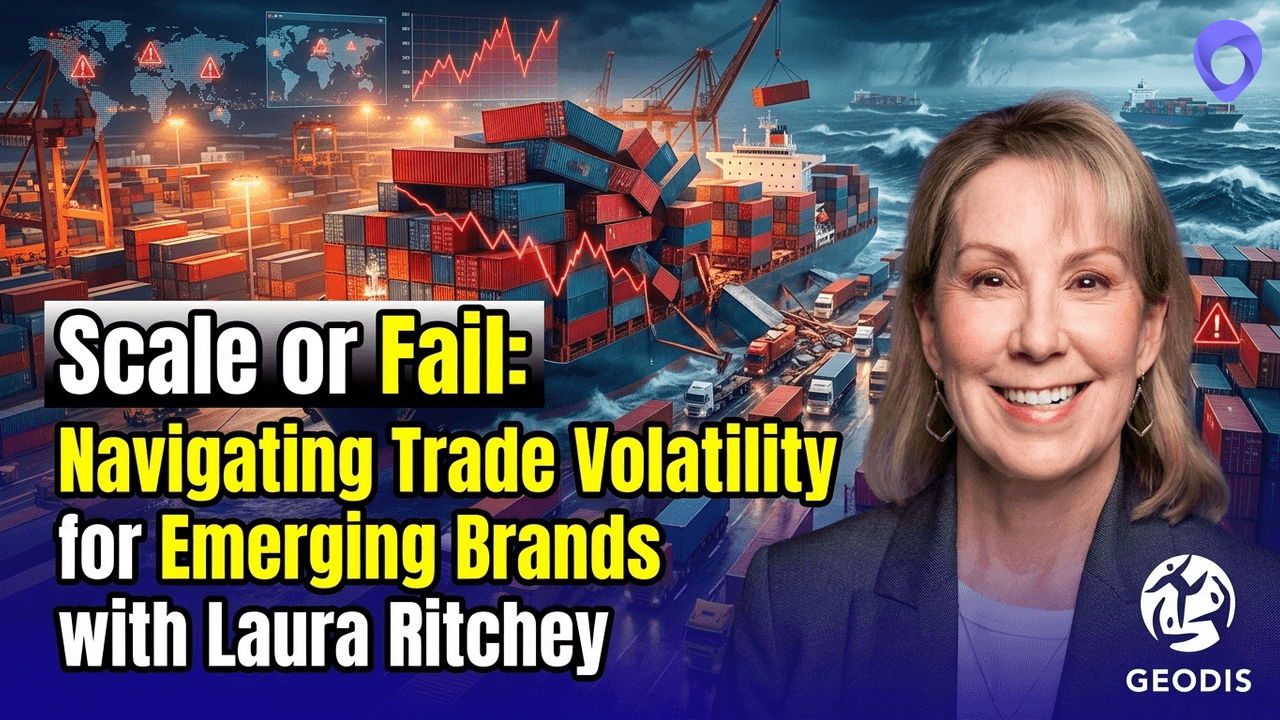
In “Scale or Fail: Navigating Trade Volatility for Emerging Brands”, Joe Lynch speaks with President and CEO of the Americas region of GEODIS, Laura Ritchey, about how emerging brands can navigate trade volatility, manage inventory, and build scalable, resilient supply chains.
About Laura Ritchey
Laura Ritchey joined GEODIS in July 2025 as President and Chief Executive Officer (CEO) of the Americas region. Laura is responsible for overseeing the region’s freight forwarding, contract logistics and transportation business units along with engineering and technology, IT, ProVenture (U.S.-based subsidiary of GEODIS focusing on industrial real estate) and Material Handling Resources (one of the country’s leading material handling distributors owned by GEODIS). In total, Laura oversees GEODIS Americas’ expansive operations including nearly 20,000 employees and more than 230 sites across eight countries. Laura brings over 30 years of experience to GEODIS, with 15 focused on supply chain management in both retail and third-party logistics. Laura began her career in finance before transitioning to supply chain operations, including sourcing, distribution and strategic transformation. Prior to her current role, Laura was most recently CEO at Radial, Inc., a leader in e-commerce fulfillment solutions, where she drove revenue growth and profitability through operational excellence. At Radial, she led the North American P&L for a $1.4B e-commerce logistics division, responsible for relationships with over 170 clients across four service lines. Before joining Radial, she held leadership positions at L Brands, FullBeauty Brands and Centric Brands. Laura is on the Dean’s Advisory Council at Fisher College of Business at The Ohio State University and is an active board member of the Federal Reserve Bank of Atlanta’s Nashville Branch. Additionally, she is actively involved with C200 whose mission is to inspire, educate, support and advance current and future women leaders. Laura earned her J.D., MBA and bachelor’s degree from The Ohio State University. Additionally, Laura is accredited as a certified public accountant and admitted to the bar in Ohio.
About GEODIS
GEODIS is a leading global logistics provider acknowledged for its expertise across all aspects of the supply chain. As a growth partner to its clients, GEODIS specializes in four lines of business: Global Freight Forwarding, Global Contract Logistics, Distribution & Express Transport, and European Road Network. The Group operates a global network spanning nearly 170 countries and 48,000 employees. In 2025, GEODIS generated €10.6 billion in revenue. GEODIS is a company owned by SNCF group.
Key Takeaways: Scale or Fail: Navigating Trade Volatility for Emerging Brands
- Beware the “10K Order Trap” During Rapid Growth: Scaling operations from 1,000 to 10,000 monthly orders often breaks a business before demand stalls. Emerging brands must build strong foundational supply chain building blocks early—such as maintaining clean master data (accurate dimensions and weights) and choosing a 3PL capable of global growth—to avoid costly operational failures when reaching inflection points.
- Adopt a Hybrid Inventory Strategy to Balance JIT and JIC: Shifting strictly between “Just in Time” (JIT) and “Just in Case” (JIC) risks either stockouts or trapped working capital. A balanced, hybrid approach—keeping adequate stock of fast-moving core basics while tightly controlling slow-moving seasonal items—helps protect cash flow without sacrificing availability.
- Re-evaluate the “Amazon Effect” and Recommerce to Protect Margins: High-speed, free shipping creates an illusion of necessity that drives up last-mile costs. Brands should focus on order delivery certainty over pure speed while implementing circular economy strategies (recommerce) to rehabilitate and resell returned apparel, which often recovers up to 95% of inventory value.
- Mitigate Sourcing Risks Beyond Single-Factory Bets: Diversifying supply chains requires going all the way back to raw material inputs rather than simply relocating assembly plants. Navigating evolving global tariffs requires nearshoring flexibility, dual-sourcing critical SKUs, and re-orchestrating supply chain flows across regional hubs.
- Understand True Landed Costs to Avoid Margin Shock: Delegating freight forwarding and customs clearance entirely to overseas manufacturers often leads to hidden markups and supply chain delays. Leveraging an end-to-end global provider with licensed customs brokerage capabilities ensures clear visibility into total landed costs and regulatory compliance.
- Leverage Global Scale with Curated, End-to-End Execution: Supported by a global network spanning nearly 170 countries, over 48,000 employees, and €10.6 billion (USD $12.35 billion) in revenue (2025), GEODIS provides emerging and established brands with an agile, end-to-end “launchpad for global growth” across contract logistics, freight forwarding, and transportation.
- Avoid the “Set It and Forget It” Supply Chain Mindset: Ongoing volatility, regulatory shifts, and geopolitical friction require continuous evaluation of supply chain networks. Taking a cautious, practical approach to emerging technologies like AI (for labor forecasting and route planning) ensures operational stability while safeguarding proprietary data.
Learn More About Scale or Fail: Navigating Trade Volatility for Emerging Brands
The Logistics of Logistics Podcast
Joe Lynch: [00:00:00] Hello, friends. Welcome to Logistics of Logistics. My name is Joe Lynch. Thank you so much for joining us today. Today’s topic is Scale or Fail: Navigating Trade Volatility for Emerging Brands with my friend Laura Ricci. How’s it going, Laura?
Laura Ritchey: It’s great, Joe. Thank you so much for having me. I’m excited to be here today
Joe Lynch: I’ve been waiting a long time to interview you. You and your team have been working hard to get this to happen. So Laura, please introduce yourself and your company and where you’re [00:00:30] calling from today.
Laura Ritchey: Sure. My name is Laura Richie. I am the CEO of the Americas for Geodis, which is a, a global third-party logistics company, top 10, maybe top 11. And, we focus on really helping customers all the way from freight forwarding through warehousing and transportation. And I’m in our headquarters in Brentwood, Tennessee, so growing Nashville and really enjoying my new role.
Joe Lynch: I love it. I love it. So before we hit [00:01:00] record, I was on Google Gemini, I was googling, I was on your website a lot, and I always knew G-Geodis was one of the biggest companies, but I didn’t realize the significance of its global footprint. Give us a sense for the size and the scale of what you guys do, and also, if you don’t mind, some of the main pillars that your business
Laura Ritchey: Absolutely. Yeah, so if you think about it we’re obviously present across the Americas, Europe, Asia region. We have over 50,000 [00:01:30] employees serving customers across locations in 160 countries. So quite, quite a large global footprint, yet we still once in a while find a country where we aren’t that a customer would like to go with us.
So that global footprint really helps customers of all sizes though, right? Sometimes we might be working with a customer in the United States and they’ll think, “Oh, maybe that scale isn’t necessary for me.” And then the next thing their business takes off, and they’re looking for that global partner [00:02:00] as they wanna expand into Europe or Asia.
So it’s nice to be able to have that, that scale to offer customers.
Joe Lynch: Yeah. So give us a sense for some of your verticals, customer segments
Laura Ritchey: we focus a lot on retail and luxury, healthcare. We have a big defense business, industrial manufacturing are focuses for us. And then obviously I’d be remiss not to say data centers where we all are leaning into supporting both the [00:02:30] construction of the facilities, but then the operation of them more long term.
Joe Lynch: I love it. I love it. I also see you guys do some healthcare and pharma, and I always think that’s significant because right now we have a lot of cargo theft, cybersecurity issues, and usually companies that do healthcare and pharma, the bar has been a lot higher for longer. So that cargo theft, those cybersecurity issues were with pharma and healthcare 20 years early, I’m guessing
Laura Ritchey: [00:03:00] Yes. And obviously they still persist, right? But having built the compliance capabilities how we think about protecting loads. And then also, obviously a big piece of pharma is managing the cold chain as that has become more significant, particularly all the GLP-1s have to ship with cold chain and the rise of imports of pharma from external to, to the Americas region specifically.
Joe Lynch: Cold chain and pharma, anything healthcare, the compliance, as you mentioned, is– the bar is [00:03:30] much higher. And I think, I always say this to people who are selecting third-party logistics providers. I always say it’s a really good sign if they’re working with customers that are require high security. And, 10 years ago, if we talked about cargo theft, it was very opportunistic.
Now it’s gotten very sophisticated, and it’s run by professional crime syndicates. It’s a different, it’s a different form of theft
Laura Ritchey: Yeah, it sure is. And I [00:04:00] think about, now with AI, the ability to create simulations of people and voices and documentation that ma- that becomes almost undetectable, right? So having relationships with people that you know and trust becomes, the, the most important thing, where we had per- ha- perhaps moved a little bit more transactional over time.
Joe Lynch: Yep. And today we’re gonna talk about, I know we could go into any number of the, your verticals, but we’re gonna talk about [00:04:30] the trade volatility for emerging brands. And that has been huge over the last year or so, and not easy to manage. So there’s a lot of 3PLs out there, and I’m not dissing anybody, but if you have a global supply chain and you go to your 3PL and say, “Hey, help me,” and they have four locations so they can do same day, next day, that’s [00:05:00] great, but they don’t have the capability or the experience to say, “Yes, let us help you with your supply chain.”
And supply chain isn’t just trucks and warehouses. There’s actually brands out there, and you come from that background, so you understand what these brands are looking for.
Laura Ritchey: Yeah, absolu- absolutely. I think, as, as you– we, our tagline is, we think about ourselves as the l- launchpad for global growth, right? So we focus on the [00:05:30] end-to-end supply chain, the orchestration from where the products are made, in transit, getting them im- imported into the country where they need to be, and then ultimately to that end customer.
And, I think we go through these cycles where people outsource and then they insource because they think it’s cheaper. And we are seeing a bit, both in the emerging brands but also with some of the larger businesses, where they’re shifting a bit back to more of that strategic partnership and saying, “I need to be f- [00:06:00] focused on the product, particularly with tariffs and, disruption of raw materials, and I really need a partner that knows what they’re doing and has the agility to move with us quickly.”
And so we see a lot more of those conversations happening as I think we enter into a cycle where all we can do is react and try to be as predictive as possible around the volatility, but it’s just a new normal for us.
Joe Lynch: Yeah, and we’re gonna get into a whole bunch of issues like [00:06:30] just in time versus just in case, and reverse logistics eating your margin. We’ll get into some of that in a minute. But tell us a little bit about you. Where’d you grow up? Where’d you go to school? Some career highlights before you joined the juggernaut Geodis.
And please don’t say Ohio State on my podcast, if you don’t mind.
Laura Ritchey: I already told you I might even do the O-H-I-O. So yeah, so I was born in Ohio, born and raised in Ohio. My father was an Ohio State Highway patrolman, so that meant we moved quite a lot. So I went to [00:07:00] school between K and 12 at about five different schools, which was, an interesting way to grow up, a little bit like a military family would experience with moving around with as-assignments.
But, although I hated it at the time, I do cr-look back and credit, my parents for helping us adjust to those moves. It makes you pretty resilient if you have to pick up between your junior and senior year of high school and and make new friends and graduate from a different high school that you started with.
So I did go to [00:07:30] the Ohio State University. Couldn’t figure out what I wanted to be when I grew up for a little bit, so spent about eight years there getting my undergrad MBA and my law degree, and then actually decided rather than going into law, that I would go more into consulting. So started in the big five consulting firms at the time and the accounting firms, and really learned a ton about business before I, I went to work for a customer, Cardinal Health, which is located in Columbus, Ohio.
So [00:08:00] that was a great experience. And then moved to Limited Brands, also staying in Columbus, Ohio. So you can tell I wanted to keep my kids in the same school that they started in. But that’s really where I learned a ton about retail, right? So a great opportunity to work at L Brands and with Victoria’s Secret, Bath & Body Works, and some of the other brands that were divested over time.
And I think that helped really cement my view of the customer journey. So a lot of what I brought to 3PL now as I’ve moved [00:08:30] to Radiao, which is an e-commerce third-party logistics company, and now on to Geodis as the CEO of the Americas, is that customer understanding and thinking more about the customer back.
So it’s super important for a 3PL to be efficient because our customers don’t wanna overpay for what we do. But at the end of the day, it’s really about customer service, and if we’re not part of that journey with them and helping them be successful, then it really doesn’t work for either of us.
So it’s been a, a fun ride. Excited. I’ve been at [00:09:00] Geodis about a year. I joined last July and, I’ve made some some changes in our leadership team, which has been great to, to complement our team with some external talent, and we’re really seeing a lot of traction in 2026. So somebody just asked me if I was bullish on ’27, and I said, “I’m hesitant to say because I said that about ’26, and now I’m half bullish.”
But I do see a lot of opportunity that we can continue to support our existing and new customers.[00:09:30]
Joe Lynch: Yeah. You worked in a lot of those brands, and again, Limited Brands, ha- has… I don’t know how many they had right now, but they always had a ton of stores. And I say stores, they were traditional stores originally. So if you went to the mall you grew up in, not the one you go to today, th- those are all Limited Brands stores.
A lot of them were, I should say. And I used to always think that’s a really tough business. You have to ship product out every week. You have to kinda [00:10:00] figure out what sold and what do we think is gonna sell. Will these sweaters sell in late April, or is it too late? God you’re from the Midwest, so you understand the weather thing.
And I was explaining to my nephew, who’s 21, but he grew up in warm places around the world, and now he’s back. He lives in Michigan again. And he’s– I said, “Oh, you can get a, you get a super good deal at this store.” He goes, “Why is that?” I go, “‘Cause it’s, they’re selling fleeces and it’s April.” [00:10:30] And he goes, “Why is that better?”
And I was– and my sister goes, “Yeah, you can tell a kid who’s never lived in the winter ’cause he doesn’t have a sense for that.” But anyway, that was really tough business in the olden days, and that was before somebody said, “We now need to sell on Amazon and Walmart, and we’re gonna sell on TikTok, and we’re gonna sell on our own website and walmart.com.”
The, the, the explosion of [00:11:00] outlets that you can sell from, and you have to somehow manage s- the unmanageable. So please talk about that ’cause you come from there.
Laura Ritchey: Yeah. I always start with retail fundamentals, and that’s the first thing I learned, when I joined Limited Brands is this cycle of we got our results on Sunday night, you reviewed to see what happened the prior week. You sent your questions to the team. You prepared all of Monday, and then typically around 6:00 PM, we would have [00:11:30] these Monday night meetings, and you would go until you’re done, right?
And you’re talking about those results, and you’re talking about did the sweater sell in this store in Michigan? What happened in Aventura Mall in Miami? And you’re then meeting on Tuesday mornings to take action so that you have things in the store by Thursday to execute, whether that was changing a promotion, whether it was delaying a floor set, replenishing certain product.
And so that discipline, I think has [00:12:00] been, an amazing experience to have. My team doesn’t love it now when I look at the results on Sunday night and, and I have that same cadence. But what that allows you to do then is with the addition of all these channels, so whether it’s TikTok or Amazon, it’s just more signals to add to the mix.
And thankfully, the technology has come along, since the olden days as well to be able to look at that a little bit better. But you’re still looking for those same customer signals. Is there a style or [00:12:30] a color that we didn’t expect to be big and it’s big, and how do we chase back into it? Is there a product we thought was gonna be big, it’s not big?
What are we gonna do to make sure we don’t have too much of it in the end state? And so I still enjoy with the Geodis customers, many of whom are retail, having those same conversations to say, “What are you seeing from your customer?” So maybe we used to go to the mall and see what shopping bags you were carrying.
Now we’re saying, “Are you shopping on Amazon, TikTok, and [00:13:00] our native website, and what do we do to capture more of your wallet?”
Joe Lynch: Yeah it’s gotten h- it’s gotten very difficult. But it’s also, let’s face it, we as consumers, we’re all consumers, we know how we wanna buy. And Amazon has set the bar, and we’ll talk a little bit more about that in a minute. But we all have expectations that I can buy that any time, and it’s gonna show up here very quickly, and it’s gonna be the right order.
A- and not easy. Not an easy [00:13:30] biz. Anyway I wrote down some points with your team before we hit the record button, and so I wanna talk about five things. So the first one is the 10K order trap, 10K orders. Why growth breaks your operation before demand does. And this is when you start off, you get 1,000 orders a month, and you go, “Hallelujah, we’re trying to grow.
We wanna get to 10,000 orders a month.” And then somewhere before you get to [00:14:00] 10,000, the business goes haywire, and maybe you disappoint a whole bunch of customers, and you don’t get the chance to be a 10K order business anymore. Please talk about that
Laura Ritchey: So one of the things it’s funny when you talk about that. So I talked to a CEO a short while ago of a business who is actually quite large now and continues to struggle, and his answer was, “I was so focused on the product and the channels and the things [00:14:30] that I needed to acquire, whether that was licenses for partnerships that we were doing, that I totally ignored the supply chain.”
So you under-invested in technology. You weren’t really paying attention to whether you were making it in low-cost countries or higher-cost countries ’cause you were just worried about getting it fast from wherever you could get it. So what we tell people is, just think about the building blocks now.
You don’t have to build this big elaborate infrastructure of [00:15:00] technology, which, oh, by the way, you can’t afford anyway ’cause you’re trying to spend all your money on marketing and new customer acquisition. But don’t forestall the ability to do that later. So think about, yes, I’m in a low-cost country now, or I’m in a higher-cost country.
What should that look like? And just start to think ahead, and we can help with that scenario planning because, we’ll talk later about the tariffs, but it wasn’t like these just started last year, right? The some of this started back in 2016, and so [00:15:30] just with the insights of an experienced partner who can say, “These are the things that are going to happen.
Your website may not actually be able to handle the traffic, and you’re gonna have queues, and you’re gonna have lost orders before they even get to your third-party logistics pro- to be fulfilled. Have you thought about that? Do you have a master data?” So we just launched a customer, and every piece of master data they sent us was wrong: the dimensions, the weights, the everything, right?
And so we can help them fix that, but if your [00:16:00] data is not, coming in clean, let alone what AI will do to that. But you have to just do a few building blocks that don’t require a ton of money, but it’s just a little bit of discipline to make that pain. ‘Cause as you said, Joe, customers give you one chance, maybe two if you’re lucky, so you’ve gotta be ready for that inflection point and then just have a few things settled to make sure that you don’t go sideways.
Joe Lynch: Yep. I say it all the time on this podcast, but it’s, it is– The reason I say it all the time is because [00:16:30] it’s so true. You used the term “strategic partnership,” and I always say, you’re not dating your 3PL. You’re not engaged to your 3PL. You’re married to that 3PL.” You need to go out and make sure they’re the right one.
Go through a process. And you don’t pick a tiny little 3PL and say, “Oh, hopefully they’ll grow with us.” Now, a lot of companies I talk to, logistics companies say, “Oh, we grew with our customers.” Great. I love that for you. But if you’re a brand that ex- [00:17:00] ex– says, “I’m gonna sell everywhere and we’re fast-growing,” don’t start with somebody who can’t grow across the country with you and across the world with you.
I’ve said this, I helped a big 3PL select… I’m sorry, a big shipper. They spend like $100 million a year. I helped them select a 3PL. This is years ago. And I remember I s- what I always say, “Don’t let them learn on your dime.” “I don’t want this to be the first time they’ve delivered to a skyscraper.”
And they’re like, “Oh, yeah, that’s a good point.” [00:17:30] I was like, “There’s a whole bunch of salespeople who are gonna be very charming and convince you we’ll be able to serve you forevermore. But that might not be the case.” So much resources online to go find the right 3PL. Find it before you need it.
Laura Ritchey: But I think the challenge too, though, is sometimes the bigger 3PLs haven’t been set up to manage the smaller businesses, right? As you start to scale and develop the efficiencies, there’s a complexity that comes with that. So we have been very [00:18:00] mindful of saying, “We aren’t gonna get perfect data from customers.
They aren’t gonna be clear on whether they need one, one location or two. They don’t know all their harmonized tariff codes to import, and so we need to do that due diligence.” And you almost end up creating a bit more of a curated experience for those customers that are earlier in their growth stage, just to support the fact that they don’t have an army of people, to help on the master data side, a- and just being aware of [00:18:30] that, ’cause I do think that’s what’s off-putting for some of these brands that are earlier in their stage, is it just feels so overwhelming.
You get these massive data requests, and they’re like, I’ve doubled every year or tripled every year for the last three years. I don’t have historical data to give you. I don’t… i’m grow- you know, my SKU growth has exploded. I don’t know what that means to, the number of locations that I need or how I’m gonna transport it.
I’ve never worked with Walmart or Nordstrom before. I don’t I’m not– I [00:19:00] don’t know what my chargebacks could be,” right? So it really is important to have those honest conversations too, and say you know what you know and find that partner who does know, as you called out
Joe Lynch: Yeah. Yeah, it’s, it is difficult. And you pointed out something that’s interesting is a lot of 3PLs don’t want to work with smaller brands. And during COVID there was an explosion of companies that just started and say, “We’re gonna start selling this.” And a number of 3PLs that would say to me, [00:19:30] “We can work with small companies.”
And I was like I don’t think you can.” Not unless they grow. And over time I was right. It is difficult. And so you, you’re– Everybody wants to start off and be excellent, and that’s not the nature of business.
Laura Ritchey: Right. I do think you have to think about it as a slightly different track though, because if you don’t it’s just gonna be a really difficult relationship. And we don’t always do it perfectly. So but I think we [00:20:00] continue to learn, how to keep that level of ability to scale, but actually, meet the customers where they are in their journey.
And it’s so fun, right? I think one of the reasons, that I enjoy 3PL is exactly that. It’s great to work with the big customers, and certainly we love the volume, but it’s really fun to be part of these journeys of c- of new brands or new businesses and watch them explode and see how customers react.
Joe Lynch: Yep. [00:20:30] And speaking of the order trap, the second point I wanna talk to you about is inventory. The inventory tightrope, which is escaping the cash trap between just in time and just in case. And so talk for, first about what is the difference between just in time and just in case for people who don’t do it every day, and then talk…
what the what is that trap?
Laura Ritchey: Yeah. COVID is a great example of this, right? So we, pre-COVID, people had been trying to optimize inventory and maximize working [00:21:00] capital and cash flow. So you were saying maybe I would have 10 weeks of supply on hand, and that’s my kind of just in time, and I make sure that, when I drop below 10 weeks, more inventory comes, and you have this flow that’s happening either supported by your vendor partners or you’re managing that yourself.
Then COVID hit, and we didn’t have enough of anything, and so we– and you couldn’t get it. So we started to do– And this is cyclical, right? We started to do this just in case, [00:21:30] which meant, yes, I need ten weeks of supply, but now I’m gonna hold sixteen because I don’t know if I can get a ship to sh- to bring it here.
I don’t know if it’s gonna get stuck in, in one of the ports, and I don’t know if my warehouse can get it out of the building if all my stores are closed and the warehouses are overrun with e-commerce volume. And so then everyone tried to go back at the end of twenty twenty-two and twenty twenty-three to just in time, and we continue to experience these shocks, whether they’re [00:22:00] weather-related or geopolitical.
And so now I think we’re gonna have to create something in between just in time and just in case, ’cause you can’t afford to carry that much inventory, particularly if it’s stock that’s seasonal and you– but you can’t afford to be just in time anymore. And so figuring out really what’s the right way to manage and think about and plan your inventory.
And then I think make your bets on your– some of your core stock. I do think where some of the smaller brands have maybe [00:22:30] gone a little bit astray is, you get super excited about this new pink color, and so you double down on all the inventory. And when you do that, you run out of your core basic, black, white, which is what everyone’s always buying.
And so it also is being very deliberate down to that level of detail about what core replenishment looks like, what seasonal fashion looks like, how much do I need? And then sometimes it’s okay to sell out, right? Like we, we have the ability to redirect customers. [00:23:00] You can actually create buzz by saying, “We ran out, and now it’s back,” right?
So I’m not a marketer, so I don’t wanna speak to all of that but I do think there’s a lot, that you can do to kinda manage the inventory trap. My biggest thing now is when customers come to me and say, we just need to save some money. We’re spending a lot, and our fees are going up,” I’ll gesture to the warehouse and say, “This is your working capital.
We need to sell it,” right? You need to make sure that you’re turning your inventory on the right cadence. And we have so much of [00:23:30] that information. How do we help you figure out what that is?
Joe Lynch: Yep. Yeah, and I know I’m just looking at some of my notes here, that you guys have this hybrid strategy that you push some of your customers to, which is for your fast movers, let’s keep a little I guess it’s a little extra and make sure we’re not gonna ever be in trouble. And for the slower moving…
Am I getting that right or am I getting that backwards?
Laura Ritchey: No, you’re right. You’re right that for, yeah, for, you definitely want to be replenishing [00:24:00] your fast movers- Yeah … right? And keeping an eye on the slower movers. But also you’ve seen a lot of people, so I won’t name na- name names, but there’s a bunch of announcements recently about SKU rationalization, where people are saying, I’m gonna look at that sm- slow movers,” or the tail as we call it, “and maybe I’m gonna chop off the bottom 25% because it’s not moving the needle, it’s not part of my related selling, they’re not buying it with core items, and I’m gonna double down on, what I’m good [00:24:30] at or things that are adjacent to what I see selling better.”
Joe Lynch: Yeah. I say this all the time on my podcast, probably too much, but I can’t help myself. I listened to the Acquired podcast not so long ago, and they were talking about Costco, which is one of their best episodes. And I think they have 3,800 SKUs. There is always f- under 4,000. And boy, business gets a lot easier if you have f- that few SKUs.
Now, but of course, I look at Walmart or Meijer here in the Midwest. [00:25:00] I go there because they have over 100,000 SKUs, and I, not so long ago… I don’t always go to– I normally go to Meijer, but right across the street is Walmart. I needed to buy a bed frame. I bought a bed frame and groceries at the same place, and that’s Walmart.
Much harder to manage 100,000 SKUs than it is to manage the 4,000 SKUs over at Costco. But I’ll say one other thing. That always [00:25:30] low price, that means they don’t ever have to worry about selling way more umbrellas on March 15th. They know how many umbrellas they sold in every store for the last 20 years on March 15th, and that’s a superpower
Laura Ritchey: It is. And also how you work with your vendors, right? They don’t … The way they flow their inventory across those 100,000 SKUs is very different, right? How they use their regional warehouses to do that. But yeah, that is the [00:26:00] highest level of sophistication for sure.
Joe Lynch: Laura, if we started a store, we would want 4,000 SKUs.
Laura Ritchey: Yes, definitely would. I definitely would. Maybe 2,500. Yeah.
Joe Lynch: And by the way, the fastest-growing grocery store is Aldi. I take my mom there. My mom loves Aldi, and very few SKUs relative to a regular supermarket. Trader Joe, they have their own supply chain but very few SKUs relative to the regular s- grocery stores, and built-in inconvenience and built-in we don’t have it.[00:26:30]
Laura Ritchey: Yeah. And creating a cachet was, like if you want that, then you can get that somewhere else. But what makes us special are these things, right? The Trader Joe’s tote was a hot item, so
Joe Lynch: Oh, yeah. Yeah it’s funny because I have two daughters, and when they come to town, they’re always like, “Oh, let’s go to Trader Joe’s. Let’s go to Trader Joe’s.” I don’t have one by my house. I have to drive. And I remember I was with my mother, who’s 92, and my mom was like, “Why do the girls like Trader Joe’s?”
And I was like, “It’s not for you, [00:27:00] Mom. It’s really, it’s for the kids.” She goes, “They don’t have this. They don’t…” I was like, “They love it. Leave it alone.”
Laura Ritchey: Yeah. And it’s cool stuff, right? So
Joe Lynch: oh yeah
Laura Ritchey: cachet around it for sure
Joe Lynch: And, again, I think the– there’s the front end with the merchandising, and then there’s the back end, which is, the reason these, all those brands are very successful is because it their front of the building or front of the storefront, matches the back
Laura Ritchey: And they spend a lot of time doing that purposefully, [00:27:30] right? Which is, goes back to our comments earlier on the kind of the emerging brands is just make sure you have some bones around that so you anticipate where you’re gonna go.
Joe Lynch: Yep. So the next thing I wanna talk about is the Amazon effect illusion, which is fast, free, and fleeced by reverse logistics. I always hear the term Amazon effect, which means I want it right now. I ordered it today. It should be here today or later tomorrow, right? So talk about why [00:28:00] this is an illusion for some brands and what they can do about it
Laura Ritchey: It’s an illusion for multiple reasons. One, it’s not free, right? So you’re either paying for it through an increase in price or an increase in your membership that you’re subscribing to. But I think what we confuse now is speed with certainty. So for so many people yes, maybe I need it today, but mostly I don’t.
They’re just offering it me- to me today, and I’m saying, “Okay if you’re gonna [00:28:30] give it to me free today, then I will.” If you would’ve said, “You can have it in two days from now, between 10:00 and 3:00,” I probably would’ve s- been fine with that too. So I think for brands it’s figuring out, what– how does your delivery promise become a part of your product?
And if it is something, that they might need in some accelerated basis, then certainly you should do that. But we still see a lot of companies that are successful with still offering express shipping [00:29:00] options where people are willing to pay $15 to $20 to have it the next day. And because they need it, right?
They need it the next day, and they want that convenience. So I think for us, what we talk to our customers about and how we actually run the physical operations is what is the customer’s expectation? How do you give them certainty about when it will come, visibility to what’s happening? There’s nothing more annoying when you’re checking the tracking, and it’s like, “Not found.
Not found,” right? Because [00:29:30] somebody created a label and didn’t put it or d- didn’t get it out of the warehouse yet. So for us, we focus a lot more on that certainty making sure that you have options for people that need something accelerated. Because I do think that now we are hearing shippers talk a lot more about cost, which is why you’re hearing people talk more again about micro-fulfillment or having warehouses closer to customers so that you’re reducing that last mile transportation cost.
And with the [00:30:00] continued increases that we’re seeing from USPS your options for the last mile are just getting more expensive and shippers have to hit margins just like the rest of us. So it’s a, it’s an interesting Jenga, and so that’s why we’ve pivoted to try to say, how do you offer that certainty at a speed that’s reasonable, right?
The, the old five to eight-day promise isn’t gonna cut it anymore. But then also just give that customer the optionality.
Joe Lynch: Yep. I joked on my podcast that ev- anytime [00:30:30] somebody uses the term free shipping, a venture capitalist gets a gray hair. And and I’m, I… It hasn’t been a– It’s been a while, but some, some supermodel called me, and I thought that was fake. When somebody says a supermodel’s calling, you’re like, “Yeah, sure.”
But she was… had this ice cream substitute. I forget what she called it. It was like no, no dairy, no this, no that. But… And she was selling it in Florida where she lives, and she wanted to e- extend out. And I was like, “Ooh, that’s gonna be [00:31:00] really challenging to ship it, e-commerce.” And she s- she said, “Why?”
I go, “Because you’re gonna have to raise the price of your product significantly. Otherwise, it’s gonna be I got $30 worth of ice cream, and it cost me $80 to receive it.” And so I remember going through that. I introduced her to a friend, and he said, “It’s not gonna work. It’s just not gonna work.” There are brands, I think Salt and Straw out of [00:31:30] Portland or Seattle, they raised the price of their ice cream significantly, which people will pay that premium for them, and they ship it, but it’s not free.
Laura Ritchey: It’s not. It’s like people that ship seafood, right? So if you wanna get your Maine lobster and you ship that down. It will be interesting to see though with, like we mentioned earlier, the proliferation of the GLP-1s and the fact that they have to be cold chained whether people will be able maybe to ride along on that infrastructure, right?
Joe Lynch: Yeah, and so talk about the [00:32:00] return rates. So if I’m a fast-growing brand and I say, “Okay, I wanna offer this Amazon,” and now I have a whole bunch of returns, does that just blow up my business?
Laura Ritchey: It depends on the product. We talk a lot about the return rate, but we don’t really talk as much about the resell rate. I think people don’t wanna talk about that so much. So we do see a typical e-commerce return rate’s gonna be vary widely between 15 and 30%, [00:32:30] right? The, the lower the price of the product, some people just won’t take the time to bother th- with the return.
Or if somebody’s charging 7.95 or something for return shipping, then, they may not buy it in the first place, or they may not have a propensity re-return. But if you look at a typical apparel cycle, you’re receiving back, say, those 25% returns. They typically are going to the warehouse from whence they came or to some warehouse in the network, and they’re actually being rehabilitated [00:33:00] or evaluated to put back in commerce.
So when I was in retail, we would put back 95% to be resold it to a customer, which really helps protect the margin. So it is a problem because you have to figure out the entire … do you wanna charge? How do you wanna get them back? You obviously have to process them and give the credit to the customer.
But on an all-in basis, being able to resell it, hopefully not at a markdown price, can protect you. [00:33:30] So it is about creating that, that idea of reuse, and I think it’s been a secret we haven’t talked about with more of the circular economy and sustainability. I think people can get more comfortable because, we are looking to say it’s not worn, and it is, as good as new to be able to put it back to stock to resell.
So it’s a dilemma, but it’s a s- a solvable issue that I think you can help by using really the recommerce strategies.
Joe Lynch: So give me your two cents on [00:34:00] bracketing. First describe what bracketing is and then as an old brand manager, how do you manage that?
Laura Ritchey: I think you’re referring to the different levels, right? Of how we think-
Joe Lynch: the size bra- size bracketing where I ordered a small and a medium and then three colors.
Laura Ritchey: Yeah. And that drives the SKU complexity, right? So as you and I talked about, that’s what we’ve been challenging people is saying, if you’re gonna use absolute sizing, so two, four, six, eight in a typical sizing kind of genre for women, or [00:34:30] if you’re gonna use…
think about if you’re selling shoes where you have to do all the different shoe sizes across all of the different shoe styles. Again, you’re gonna see where you have this tail. So you’re– we’re really focusing on, like, where are you selling or, in women’s shoes, are you typically selling between a size, five and a half and a seven and a half, and let’s focus on that piece of it, and then let’s really watch the tail of what else we carry.
Or, sometimes if you have physical stores, what do you put in the stores versus what [00:35:00] do you make available on e-commerce? And then you can do this whole kind of assuming the shoes aren’t worn right, you can put them back into commerce. So size complexity is a thing, but I often lump that into how we think about SKU proliferation in general.
Joe Lynch: And I would love to see more brands do this, and I think they’ve gotten much better over the last decade. Get better at helping me pick the right thing. I keep mentioning my mom today, but my mom was, always has Home Shopping Network on in the [00:35:30] background, and I’ve watched it. And it’ll be a woman come out and she says, “I’m Joan, and I’m 57, and I’m– This is a large and this is small, and I’m five foot seven, 150 pounds.”
And then somebody shorter comes in, somebody taller. And my mom said, “When you order from there, it always fits.” And she goes, “Women’s clothes are really hard to buy online.” But it’s driven me crazy. I remember ordering three different shirts, same [00:36:00] size, and you get them, they just fit completely different.
And so I end up two, sending two back and, but the one that I did I ordered a whole bunch because I knew they fit. And I think the brands can do a better job on their website. Put some videos up. And I think some of them now are saying true to size, and you actually see reviews on that. I love that
Laura Ritchey: Yes. Yeah. I think you can do that. Some of the websites are more sophisticated that if you shopped on them before, they know your history and [00:36:30] they’ll say, “I suggest this size for you.” So I think that helps. Obviously, there’s measurements on there, but a lot of people don’t go get a tape measure. So I think to your point, using the models and saying, “This is the description.”
The hard thing in women’s, they’re always like s- 5’9″ and smalls, so I don’t know how representative that is of the population,
Joe Lynch: Shopping Network has real people on there as opposed to, yeah, I’m six foot tall and 110 pounds and I’m wearing a medium.
Laura Ritchey: They do. But I think, that’s part of the reason though that [00:37:00] people have gotten tougher on returns, so some customers have added a, a, a charge for returns. Some shippers will look and say, “Do I have a recidivist returner who’s returning all the time?” Like a serial person, and they’ll actually cut them off.
So I do think there’s also, just ways that, that shippers can watch sort of the return behavior. If you’re seeing … If we have high return rates on something, we have some customers where we share that, right? Like you’re outside of the boundaries of returns, which [00:37:30] tells us you either have a product issue or you have a size issue, and how can you fix that go forward?
Joe Lynch: I love that. So you guys are telling them “You’re an outlier. We need to help you.”
Laura Ritchey: Absolutely. Yeah, absolutely, because that’s, you’ve gotta read those signals. Some things, unfortunately in apparel they don’t use the same forms for how they develop the apparel, so we’re never gonna solve that, a size eight is a size eight. But I think having the ability to read the signals
Joe Lynch: Yeah that’s always been an [00:38:00] issue with women’s clothing. It’s almost like oh, I fit into a small.” And you’re like, “I know I’m not a small, but I fit into it and I’m happy.” And the same thing’s happening with men’s clothes there from what I understand.
Laura Ritchey: Yeah, they’re calling that vanity sizing now, right? Where it’s like, “Oh, I’m a small. Yay.” And you’re
Joe Lynch: You know what’s my favorite part of this brand is that I’m slim.
Laura Ritchey: Yes. Yeah. Yeah. It is psychologically challenging to have to get a bigger size, so
Joe Lynch: Yeah, it’s it’s one of those things I [00:38:30] feel like you can help yourself on the return stuff a little bit, but it also helps to have a good partner who can tell you, “Hey, we have– we work with thousands of brands, and you are an outlier. Here’s how we suggest you fix this problem.” Switching gears a little bit, I wanna talk about the single source, single point of failure, the danger of the single factory bet.
So that’s sourcing. Tell me about… first off, most warehousing companies, now you guys are way more than a warehousing company. [00:39:00] Most of the warehousing companies I talk to can’t talk about sourcing, ’cause that’s in the deep end, and they stay in the shallow end.
Laura Ritchey: Yeah, I think… Yeah, go ahead
Joe Lynch: So I was gonna say, so what do you guys do to help with people who have made a big bet on a, a factory that might now be getting tariffs for that country?
Laura Ritchey: Yeah. I think we’ve– like I said, I think since this has become, challenges, we saw increased tariffs, particularly on Chinese goods starting back in 2016, [00:39:30] there was already a lot of movement around, what can we do around a single factory? I think what we don’t talk enough about is the fact that you’re vertically integrated, and that’s act-actually the difficulty, right?
So it’s not like you can just say, “I’m gonna pick up my factory and move it to another country,” if all your raw materials are still coming from that original country, because now all you’re doing is adding lead time and cost and complexity. So that’s been kind of the challenge for people, is [00:40:00] thinking about what do I need?
If I’m doing apparel, do I need to have all the raw material, the fabric, the buttons, the zippers? If I’m doing a more industrial product, do I need to have the silicone or the chips or whatever I’m gonna need to be able to do that? So we, what we talk is, you really have to go all the way back to your inputs to say, where should I be?
Where should I move? And understanding that if we’re in the area of tariffs, you’re gonna pay them, so [00:40:30] what else do you have to do in your supply chain to manage that, right? Where do you have to look for costs elsewhere? Where can you reprice to customers? We’ve seen a lot of pricing adjustments right over the last 18 months as people have had to, raise their prices to offset the incremental costs.
So it is sometimes even a more complex problem to solve than your supply chain or your warehousing supply chain is to really think about sourcing. When I was at Victoria’s Secret, we spent [00:41:00] 20-some years building that vertical supply chain that then was, shifting over time, and it takes a l- a lot of thinking and effort to make it happen.
Joe Lynch: Yeah, and by the way, the tariff stuff isn’t just the US. So some people are under the impression that this is just one place it’s happening. We see Europe trying to do something very similar to the US, which is let’s bring some of the production work back here. Now, all of it can’t move back here, so we’re not going to start making…
I don’t know if you’ve ever heard some politicians say this. [00:41:30] They’ll buy T-shirts and somebody will go, “You want jobs back here, but all your T-shirts are made in India or China.” We don’t do T-shirts here because it’s we’re too expensive with the labor. But certain things that we’re gonna automate we will be able to do, and certain supply chains are gonna be here because of security, because of we don’t want long supply chains.
And we’ve seen the shock. We saw it during COVID. And, this is very, this is a [00:42:00] separate conversation, but we’re not going to have drones and robots and cars that were made in China ’cause there’s– we’re frenemies with them.
And by the way, they don’t want, they don’t want our stuff over there either.
Although I s- When I worked in China, we sold a lot of American cars. So we have– we’re gonna move sometimes to dual sourcing, and I’ll s-say when I was a young engineer many moons ago, I worked at H-Honda Automotive Manufacturing down in Ohio, and I was down [00:42:30] there for supplier day, and we were 30% of the volume, and there…
Maybe 20% of the volume, and then there was a m- supplier that had 70%. So basically what Honda said is, “In case something happens with our big supplier, we always have the capability to keep production going.” And even like we built, even though we only sold it for th- 20 or 30% of the volume, we could facilitize up very quickly to 40, 50, 60% if we [00:43:00] needed to.
And they did that, and that was obviously for a high-selling product. You can’t do that for everything. But if you have a SKU that is critically important to your business, it doesn’t hurt to say, we got some guys in the US that provide some of it, and maybe another company overseas that provides the other part of it.”
Laura Ritchey: Yeah. And I think that’s actually what’s gonna happen, right? Like we’re talking about re-orchestrating flows to– so to your point, we may actually be manufacturing some [00:43:30] components or pieces of products, shipping them to India to get assembled into finished products, bringing them back to the US to sell.
We’ll see how the nearshoring continues to develop. Obviously, between Mexico, Canada, and the US, there’s a significant amount of automated automotive that is happening. So I think it’s that’s also the, the positive of using a 3PL, right? Is if you’ve invested assets in location A and B, you’re a little more tied to that, where we’re looking [00:44:00] across a network, and we have the flexibility to say, we have a customer now who’s saying I think I need less space here, but I need more here.”
And we have the ability to say, “Fine, we’ll take that extra space, and we’ll give you some, some space where else you need.” So it is a, an entire time, I think, of resetting, where are the raw materials coming from? Where do we make the finished goods? Where are we supplying that to be sold, right?
So now with the tariffs on certain countries and not on others, I have to be more specific about I’m making [00:44:30] these goods in this country to go to these countries. And and that’s a lot to manage, particularly like on customs and freight forwarding and everything.
Joe Lynch: Y-yeah, and this I think we’ll see more stuff made in Latin America, which is we– they’re our neighbors obviously, but it is not always easy t-to work. Latin America’s a tough market ’cause it’s not one market, it’s 30 markets still. And but it’s close and they’re in our time zone. I work with people in Colombia every day and they’re very easy to [00:45:00] work with.
Yeah, and same with Mexico. We are going to see some of that happen, but for some stuff it’s just not gonna be as that easy. The, the supply chains exist w-for where they are at for a reason, usually because they were cheaper and they had pretty good quality
Laura Ritchey: Yeah, and it’s gonna take time, for that to continue to shift. Yeah.
Joe Lynch: I say this all the time when people go, “Oh, we’re gonna remove automotives back.” It’s like, it takes– it’s closer to a decade than to a year. Y-first off, you have to open up a factory, which means you have to convince [00:45:30] somewhere that we’re gonna build a massive factory here, which they don’t want.
And then their state is gonna have to agree to some sort of tax abatement. Workforce development is enormous. You just can’t start these things overnight. And certain things in our supply chain, you go, “There’s capacity here. Easy. We have it here. We, see, we have it in Mexico, we have it in Canada.”
That’s not all supply chains. Easier said than done
Laura Ritchey: Yeah. And I think the labor is gonna be a constraint, right?
Joe Lynch: Yes.
Laura Ritchey: We don’t see, [00:46:00] we don’t see the US population growing, with the decline in immigration, and so where are those workers coming from? And everyone’s like, “Oh they’ll all be robots.” And I’m like, yes, we’ve seen some experiences with fully dark facilities, and it just doesn’t work that way, right?
There’s just always gonna be a need for some type of intervention, at least in the near future.
Joe Lynch: Yeah. And also being a wealthy country there’s options for people. So if, 30, 40 years ago, it was just like, [00:46:30] “Hey you need a degree or you’re not gonna have a good career.” Nobody’s saying that anymore. And running a warehouse for GEODIS is a fantastic job that probably didn’t exist to the scale 20, 30 years ago.
Now this is this is the heart of the supply chain. It’s an awesome job that didn’t exist before
Laura Ritchey: Yeah. And I love the stories we have where somebody starts as a temporary receiving clerk on the dock, and then they’re the site director, then they’re the [00:47:00] vice president of a campus that we have. So it is a great career development opportunity
Joe Lynch: Yes. We, for a long time, talked about the truck driver shortage, which is really probably more of a utilization problem. Given they can drive 11 hours, we have them driving four or five. And a lot of truck drivers have been delivering to warehouses like GEODIS and say, “Hey, this is pretty cool, and it’s pretty close to my house.
Can I work here?” [00:47:30] And if you’re willing to drive a truck around the country, you are willing to put in an honest day’s work. And warehousing companies, supply chain companies like GEODIS are saying, “Yes, please. We need you
Laura Ritchey: Absolutely. And then you think about what’s happening with liability, that’s obviously changing the landscape. So yeah, lots of things happening in transportation.
Joe Lynch: So the last point, we alluded to it earlier, is this outsmarting tariffs, DIM weight, and landed cost surprises. [00:48:00] So landed cost is a big deal because that is the difference between profit and loss. That’s the eating my margin. Talk about for stuff for people who don’t do it every day, what is landed cost?
Laura Ritchey: So it’s the cost that it takes to fully arrive in the country of origin, right? So you’ll have the cost of manufacturing, whatever mode of transport you’re using to get to that country, the cost of importation, and then that’s your kind of fully landed cost. And what’s been interesting is a lot of vendors have been saying, [00:48:30] “Oh, I’ll start to, instead of giving you title to the goods in origin and you managing that supply chain to whatever country that you’re going to, I’ll take that over for you and I’ll do that on your behalf.”
And I think that’s a trap a little bit of times for some of the smaller brands who are like, “Oh, great deal. Now I don’t have to worry about that.” And I think, we’ve called out two potential challenges. One, your manufacturer, wherever they are, is [00:49:00] probably not an expert in freight forwarding and customs.
And do you wanna take that risk that your product is stuck with them? And then two, obviously they’re adding an incremental margin that’s potentially higher than what you could have gotten if you did it in the market. So certainly for some smaller brands it makes sense because they can negotiate potentially a, a better overall landed cost.
But for a lot of shippers and even some of those smaller brands, you’re gonna be more effective [00:49:30] working, with a third party or logistics provider like Geodis who can really say, here is the market cost. Here’s what we’re getting. Of course, we make a margin too we’re doing it every day, and we have volume that enables us, to do a little bit better.”
Joe Lynch: But you guys are also a global freight forwarder, so you can s- you know, I used to say one throat to choke, but somebody corrected me, say it’s one back to pat.
Laura Ritchey: Oh, that’s a good twist
Joe Lynch: but it is nice to say, [00:50:00] “Hey, can you give us a sense for the cost?” You’re like, “Absolutely, ’cause we are GEODIS and we have that, that capability,” and I can have my supply chain managed by one c-company as opposed to dealing with multiple
Laura Ritchey: That’s right. And we’re also the licensed custom broker. We hold the customs bond. We’re owned by the French railroad and ultimately the French government. And our levels of compliance are strict and even stricter with that oversight
Joe Lynch: So we do have [00:50:30] these sudden tariff hikes, and, s- people have been saying to me for the last year or so, “We have more disruption than ever before in our s- in our life.” And I said we can see it now. We couldn’t see it in the past.” There was earthquakes, like unfortunately the earthquake, Columbia yesterday.
There’s earthquakes that went on in the world 25, 30 years ago that you barely heard about. It was on the back pages of the newspaper. Kids look it up, [00:51:00] newspapers was– we used to read before we had internet.
Laura Ritchey: Right.
Joe Lynch: And we have these and I’ve used the term, I didn’t make it up, VUCA, volatility, uncertainty, complexity, ambiguity.
It was a business term originally, but the military started using it, especially in the Middle East. I feel like our supply chains have VUCA, volatility, uncertainty, complexity, ambiguity, all the time.
Laura Ritchey: They do. They do. Somewhere
Joe Lynch: And so how do you [00:51:30] help us manage that if you are Geodis?
Laura Ritchey: It’s funny, I joked when I first came to 3PL because when you work in a brand, it’s a little bit more of a controlled environment, right? Like at least it, it was at L Brands because we owned, working with our transportation providers, we managed our warehouses, and so that internal chain was a little bit easier to manage.
I think as I came to 3PL, what I learned is there is, is to your point, disruption all the time. Customers beat [00:52:00] forecasts, customers miss forecasts manufacturing didn’t get done. We thought it was gonna get done. So I think we were– have been pretty adept at managing that over time because across, several hundred customers, there’s never a day that we just go smooth sailing.
Everything was fine today. We didn’t see any disruption. Now I’d be lying if I didn’t say the last 18 months have been, a test of that in terms of the pace of the disruption that’s happening. But I think we [00:52:30] just have to continue to focus on what you can control, and I’ve talked about this before, where, sitting and wondering whether this might happen or this doesn’t happen, if we build in the agility and the resilience to say, to your point earlier, “I have multiple sources.
I can get these goods. If they can’t go by sea, then I’m gonna do a sea-air combination, or if my– I can’t get a, a chassis or a truck driver, I’m gonna put it on rail, and I’m okay, and I can live with that,” it [00:53:00] just makes our our scenario planning and contingency planning more robust. But again, I think a lot of us had developed those skills just because, you have this portfolio of customers, and you just experience these shocks all the time.
Joe Lynch: Yeah, you said it’s very seldom you’re gonna see something brand new. It will happen obviously, but y- you say we’ve experienced this problem before. Doesn’t mean the problem never happens, but we’ve solved it before. It’s not on our list of things to talk about, but I think it’s interesting.
When I talk to [00:53:30] smaller companies, they al- almost always say AI this, AI that. You have not said AI in the 57 minutes that we’ve been talking, but I know the bigger companies are using AI, but they, because they have large customers, they are not going to take a big risk and say, “Hey, we might close you down for a week, but we got this cool new bot.”
So talk about what you guys are doing with AI.
Laura Ritchey: Yeah. W- I think really where we’re focused and I think when everyone’s talking about AI, [00:54:00] we should just be mindful of the fact that we’ve had, algorithms that got replaced by machine learning that now is replaced by AI. So a lot of the places that we’re using it is like an upgrade to that.
So labor forecasting slotting in warehouses, route planning that we’re doing in transportation starting to manage, processes around our independent contractor truck drivers by using AI agents. So we’re active in doing all that. But [00:54:30] to your point, I did read an article the other day that said, “Supply chains crave certainty, and AI right now doesn’t give certainty.”
So we are being very mindful, and we are running those pilots. We are rolling them out, as they make sense. But we will step cautiously, both because it’s a bit unproven, but also we are i- incredibly maniacal about data and customer data, and so making sure that we’re treating that, with respect and managing it in the way that it needs to [00:55:00] puts us on the journey.
So everyone here is– wants to go fast. Somebody said, “Why can’t I just go buy like whatever AI tool I want?” And I said, “And put it on all of our proprietary customer data and just, open to the world?” And they said, “Oh, yeah, that wouldn’t make sense.” So we definitely have to be mindful of that.
But I think there’s still a fair amount of hype from what I can see, so
Joe Lynch: I was talking to an executive vice president of one of the larger logistics firms at a conference, and she said to me, “God, I feel like everyone’s talking about AI except us.” And [00:55:30] I said, “You guys manage some of the largest supply chains in the world. If you’re rushing into it, something’s wrong with your ops team.”
And I said, “You have clean data. Probably most of the s- these little companies that, that are VC-backed have to make bombastic claims ’cause they have to grow at 75% every quarter or they’re not gonna get their funding.” And I’m an ops guy originally, and I always say ops guys just look for risk all day, every day.
And cost risk, quality [00:56:00] risk, security risk, whatever the risk is, you’re always looking for risk. And to your point AI is still a little bit of a risk. Not that we’re not gonna use it, but we’re gonna go slow
Laura Ritchey: Absolutely. Yep, and that’s our approach
Joe Lynch: Laura, I’ve gone over my time with you, and I know you have to go run a business. So I will summarize what we talked about today, and then I want your final thoughts on the topic.
So I’m talking to my friend Laura Ritchie, and we’re talking about scale or fail, navigating trade volatility for emerging brands. And we [00:56:30] talked about first about the importance of strategic partnerships, and that’s also leads into the first point, which is order trap. If you start off somewhere that can’t grow with you, you’re going to break somewhere between 1,000 orders a month to 10,000 orders a month.
You wanna get somebody who can automate where– bring off warehouse automation, bring the WMS, use practical AI models for you and so you don’t find [00:57:00] yourself breaking down because of your growth. Next, we talked about inventory. I did a podcast years ago, and it was called Inventories Everything, and it kinda is.
And that we’ve experienced this in the last the pandemic with just-in-time failed us, so people jumped in with just-in-case, which has its own challenges because now you’re carrying too much inventory. And you need a partner who can help you understand what the right [00:57:30] model is, and it could be some sort of hybrid model that’s saying, “Okay, for the fast-moving SKUs, we’re gonna have plenty of inventory.
For the slower-moving ones, we’re gonna maybe use a just-in-time model.” We talked about the Amazon effect. Everyone loves to talk about the Amazon effect and say we have to match what Amazon is doing. Sometimes Amazon is, depending on the brand, it’s a fantastic company. No one’s gonna ever put them down, but reverse logistics can eat up your money.
[00:58:00] Shipping isn’t free. Even when we’re selling it is free, but it doesn’t become free ’cause you said it’s free. You have to somehow figure this out, and returns and reverse logistics really can eat up brands. And I think if you’re Amazon and it’s one of their private label brands they can handle it.
Maybe some growing brand is gonna have to think twice. And also, I think I love what you said, we’re gonna end up with credit reports for all of us. Are you a serial returner? Are you somebody [00:58:30] I don’t want to do business with because you waste my time and waste my money? Next, we talked about single source, single point failure.
If you depend on a, a country, and we’ll use China in this example, that potentially is gonna get another tariff on them you gotta have a second and third option depend, depending on what you sell. And I think, again, this is where you get a, a partner who is a true supply chain partner, not just a warehouse, [00:59:00] not just a trucking company.
They can help you understand your supply chain and the risks in it. Last but not least, we talked about margin shock, and this is the sudden tariff hikes, the regulatory shifts, the geopolitical friction, the earthquakes, the wars, all the stuff that makes our world hard to predict. I need somebody who can help build, some tariff sensitivity and help me with my landed cost from day one.
It also helps that Geodis [00:59:30] has their own forwarding company and that they’re a global provider, so they’re everywhere. Enough of my blather. Put a big old bow on this one, Laura Ricci.
Laura Ritchey: So first, Joe, thanks for having me. It was a, a really good conversation. I think we covered everything, soups to, soup to nuts, so that hopefully the listeners enjoy that. I think at the end of the day what I’m giving advice to shippers is just re-look at your supply chain, whether you invested in your own warehouse [01:00:00] some, some years ago and you have assets to sweat, whether you’re an emerging brand, moving out of the garage into an office or, thinking about I’m with a smaller 3PL and I need to expand.
I think it… the worst thing we can do is think set it and forget it. Because things are changing so quickly, decisions we made a year or two ago that seemed perfectly the right answer may not be the right answer anymore. And really what our stakeholders and shareholders expect from us is that we’re [01:00:30] continuing to challenge ourselves.
And I think that’s where, somebody like GEODIS can come in and say, “Let’s take a look at what you have.” Maybe there are cases where we’ll take over existing sites that our customers may have decided they wanted to originally set up on their own. We’ll talk to emerging brands and say when do you think you’re gonna hit this growth cycle and maybe stay where you are right now for another year?”
Just because obviously moving does increase some risk as we go through that transition. So I always just challenge [01:01:00] people to say, “Let’s keep looking. D- don’t set it and forget it. Make sure that you’re having strategic conversations.” It’s great to focus on price, but you do kinda get what you pay for, so you don’t wanna overpay, but find that right value proposition and I think that’s really what people are gonna expect in supply chain, right?
That’s how you manage volatility, is you’re constantly challenging yourselves to do better and we do that here at GEODIS all the time.
Joe Lynch: I love it. I love it. Laura, I’ll make sure I put a link to your LinkedIn profile, link to your [01:01:30] website. Any of the links you and your go-to-market team give me, I’ll put those in the show notes. And thank you so much for taking the time, and thank you so much for going over my allotted time.
Laura Ritchey: Thank you, Joe. It was great
Joe Lynch: And thank all of you for listening to my podcast.
Your support’s very much appreciated. Until next time, onward and upward.