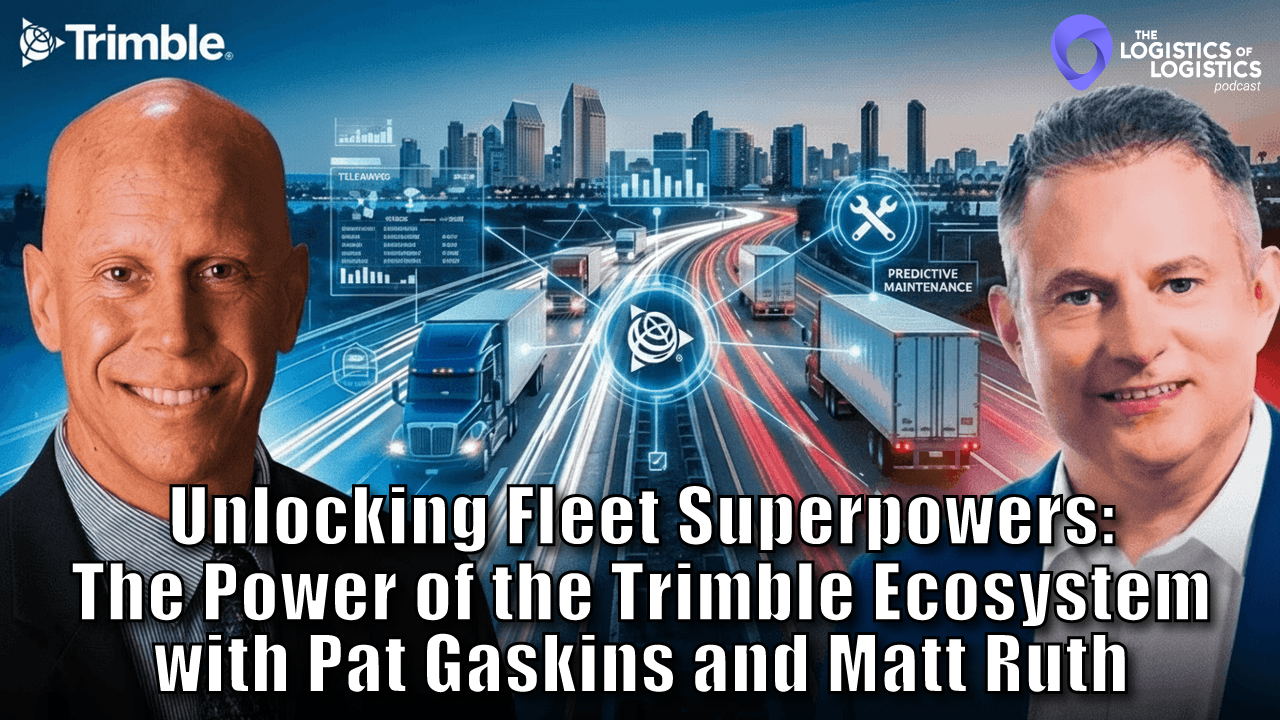
[00:00:00] Hello, friends. Welcome to the Logistics of Logistics. My name is Joe Lynch. Thank you so much for joining us today. Today is a very special day ’cause I am at Trimble Insight at in beautiful San Diego. And even more importantly, I’m interviewing my friends Pat Gaskins and Matt Ruth. And today’s topic is Unlocking Fleet Superpowers: The Power of the Trimble Ecosystem.
Pat, please introduce yourself and your company and where you guys are based. Pat Gaskins. I work with CoreCentric. Been with the [00:00:30] organization for 16 years. Our corporate headquarters is based out of Cherry Hill, New Jersey. We have offices in Europe as well as here in the US outside of just Cherry Hill.
But ultimately, I’ve been with, like I said, been with the company for 16 years, and we specialize in fleet asset intelligent, asset management services, and we’ll go through a little bit more of that as we go through the conversation. Love it. I love it. Matt Ruth, please introduce yourself and your company, [00:01:00] what you guys do and who you serve.
Yes. Matt Ruth. I am the chief partnership and integration officer. I for ISOT. I have been there five years, but I go way back with Trimble. This is a great show. I worked for 20 years connecting systems, connecting TMSs to ELD systems and the, what I call the fragmented ecosystem of supply chain technology because there’s literally hundreds of partners that you have to connect these individual solutions, right?
[00:01:30] To bring the overall solutions to the customer. Yeah. Before we hit the record button, we were talking not just college football, we talked a lot of other things, too. But we were talking about this whole idea of what the expectations now are for trucks, especially fleets. Maybe the small owner operator says, “I don’t need all this fancy stuff.”
Yeah. But anybody who’s dr- has a fleet is saying, “I need everything integrated. I need everything connected.” And, You don’t want a whole bunch of [00:02:00] integrations that are one-offs. And I think, being at the Trimble Insight Conference, you start to see the level of partnerships where they say, “If there’s an app, if there’s a service, if there’s a tool, it is gonna be connected into the Trimble ecosystem.”
And you got… The reason you guys are here today is because your, y- your businesses are integrated into Trimble. So real quick, one more time, what do you guys do? And talk about that Trimble integration. So the main reason that [00:02:30] we’re here at the Trimble conference is that we have developed billing integration with Trimble.
We handle all of the North American billing and receivables for Daimler North America. So one of the largest truck producers in- Yep … US and Canada. We offer that service to both US and Canada. So any repair orders that are generated through that billing instance are auto-populated into the Trimble TMT system.
Okay? It takes all of [00:03:00] that back office paper, the data entry, the key punching and whatnot out… It takes the friction and noise out of that, that, area of the business. So it really frees up organizations and fleets to focus more on other areas of the business rather than just processing invoices that are coming in from various suppliers.
We have about 120 national account programs that we serve in the marketplace. Our suppliers are like Michelin and whatnot. That same billing [00:03:30] integration, you can have invoicing coming through CoreCentric for roadside events, whatever it may be, but it auto integrates with the Trimble system. Yep.
And we all just saw Michael Kornhauser and Rob Painter from Trimble talk about all the new updates, and incredible amount of product updates. And- the whole discussion was h- how do we get faster? How do we get cheaper? How do we get better connected? And you always hear faster, cheaper, [00:04:00] smarter.
And we have to get there. And we’ll talk about AI, and that’s a whole separate thing. But Matt, w- what’s a little deeper dive on what Isaac does? You guys have a hu- huge presence here, as always. Yeah. So we’re a, a fleet telematics company. We focus on ELDs proprietary coaching, which we feel not only, makes drivers happily, happy because we simplify the workflow, makes them more productive, and in turn makes our customers’ bottom line better because of [00:04:30] when they’re more efficient they’re doing better.
How we interact with Trimble we– and on so many levels, you mentioned what Mike was showing with all the different TMSs. If I’m gonna date myself a little bit, I go back and working with TMSs, and there was w- like one TMS, you had one screen. So whether you were a Bulk hauler, a fuel dry bulk hauler, fuel haul, liquid bulk hauler dry van, LTL, intermodal.
You took that square peg and you rammed it through- … that hole and you just used it to [00:05:00] re- really replace filing cabinets in the corner so you could- … digitize your freight. You fast-forward to today, and they mentioned also how work changes as generational technologies come to fruition.
So what did drivers do back in the day? They just had to, They didn’t have to do ELDs. They didn’t have to do… They, they were on paper logs. They were they didn’t have to scan paperwork. They didn’t have to do DVIRs, right? All they… They didn’t have to go into third-party apps and do all this stuff [00:05:30] on the- the tablet, right? All they had to do was drive a truck. So what Isaac does is we simplify that entire process by doing what we call a predictive workflow to always put that next step in front of the driver. We couldn’t do that without the information that’s coming from the Trimble TMS systems, right?
They, they do all the planning. They do the dispatching in the system. Once that route is planned, that comes out to our tablet immediately and we start the from… We take all of the information, the load information from the TMS system, and we let the driver go [00:06:00] about and execute their workflow throughout their day.
We route, we use the Copilot. So we get the information from the TMS. We route them through the PC Miler and Copilot to get them the optimal route. We may even do fuel optimization. We pitch the best fuel stop along the way so they don’t have to think of where they’re going to fuel, right? And then when they get to the shipper, it’ll automatically, based on the GPS position, say, “I’ve arrived.”
He’ll send his loaded call. We’ll scan his paperwork right there, but we’re serving that up to the [00:06:30] driver every step of the way. So we’ve taken a very complex operation of workflows, and we’ve really simplified it for the driver. Yep. And I’m gonna drag you to the shower in, guys. If I get in a truck, God knows I have no business being in there, but there’s a tablet in there, just like a regular tablet we might have at home, and that is the Isaac tablet, and I can have any app I want on that system.
And I was asking you before [00:07:00] we hit the record button, what if you didn’t connect to Trimble? And by the way, before I forget You can use all of your apps which are within… So there, you guys have your own suite of apps, but then you say, “Yeah, we have a whole bunch of other apps that you can use that are not necessarily yours that you support.”
And I know Trimble’s part of that. And but anyway, getting back to the question, if somebody said, “I don’t need that whole [00:07:30] connected thing.” What does it look like when you’re standing alone without the connectivity that w- the, basically the whole discussion of this conference? Without that connectivity, we call it the sw- swivel chair scene, is none of that information’s gonna go out to the driver.
So all of a sudden you exponentially increase your phone calls with dispatch. All that information’s not there, so you gotta get your load information from that. Now, most customers are well beyond that, but all of those what the next frontier, what we’re seeing is all those [00:08:00] specialized apps of all those vendors out there that do specialized solutions, they might, we might wanna call somebody’s app, like if you haul for FedEx, for example, you need to use their workflow app.
We may do what we call an Android intent deep link within our workflow to go out and call that app so the driver doesn’t even have to think about it. We serve that up to them. And so again, they, the predictive workflow, they don’t have to think about it. If, to your question, your original question, without that level of integration, that driver would [00:08:30] have to know every time- Right
in his head to go, “Oh, I need to hunt and peck and go here and open up this app. And by the way, now I gotta, I have the bill of lading and I gotta scan it in this app. And oh, I gotta remember to go to my ELD and update the bill of lading- … and the trailer number.” All of that is happening behind the scenes based on our- Right
workflow predictive workflow driver activity- Yep … system. And this, this industry was used to be filled with clerks, and you could call ’em anything you want, but th- their departments were different, but they were clerks. They were, “Oh, I got a [00:09:00] fax machine, a fax, and I take that fax and I enter it into the TMS.”
And then it’s, or an order system. Every system needed its own clerk to populate it because we weren’t connected. And it’s really awful if you have a truck driver having to e- enter data into that system. We want drivers driving miles. But also it’s not exactly an ideal situation.
It’s one thing if you sit at a computer and you’re doing some data entry. It’s really bad if you have a driver doing it. And by the [00:09:30] way, a lot of drivers, English is their second language, which is fine as long as they’re safe drivers. That little tablet, I don’t want them to have to do that. So e- every once in a while I call what you guys do the tech stack for the driver.
The difference is I don’t want them doing any data entry. I want everything they’re doing pulling from the system. Same question to you Pat. You guys had a service prior to being connected to Trimble. What does that look like without ? [00:10:00] Yeah. So it’s, the relationship that we’ve had with Trimble’s TMT system is bl- long-term.
So that is… What is that system? That’s the fleet management- Yep … or fleet maintenance system, right? Yep. So historically, fleets Isaac’s data is- Yeah … one of the data points that we pull into our business intelligence system. The fuel, the financing cost of fleet assets. So really what we’re presenting to our customers is a little bit more towards [00:10:30] CFO, head of procurement, right?
And fleet maintenance personnel, and that’s the end-to-end fleet solution, which is the acquisition of assets, financing assets. As I mentioned earlier, we have about 120 national account purchasing programs and serve about 2,600 fleets in the US and Canada. All right? And then at the backside, it’s our remarketing services, is getting rid of used trucks.
So our business is really focused on lowering the total cost of [00:11:00] ownership, and one of the key components to that is the utilization of the assets. Okay? So if I have a financing program that is based off of static utilization profile, but I see through the telematics data that doesn’t hold true as my business changes, the fleet’s business changes, then I have to make course corrections on how I finance my fleet, what the asset life cycles are.
So that’s a really integral part [00:11:30] to the overall solution- Yeah … and how to get total cost of ownership down. And do you guys get- And I would add, just to- Yeah, go ahead … to Pat, he rais- raised a good point, is the integration, it’s not always direct, right? Between Isaac and CoreCentric, there is some direct, but we feed TMT the DVIR information that creates the repair orders.
Wait, what is DVIR? Driver vehicle inspection report. Okay. When a driver hooks a trailer, we’ll automatically prompt them, “Hey, you have to do a trailer inspection,” or, “You have to do your tractor inspection.” We’ll feed that over to TMT, [00:12:00] and then therefore, they’ll read that data. So it’s again, a- Yep
Very connected world between our solutions. So let’s just say they do determine, “Hey, there’s something wrong with this truck, and I’m supposed to drive it across the country.” They go through your system? No. If there’s something wrong with the truck, they won’t drive it. No. So- I’m just saying, I’m just saying as far as getting it scheduled or- Oh, optimizing it?
Yeah. This is where you optimize the asset utilization is with Matt’s product, right? So we’ll detect, we’ll flag it whether it’s a major or a minor defect. Oh, okay. If it’s a [00:12:30] major defect, to Pat’s point, that truck cannot be driven. Oh. It needs to be taken to its nearest or a maintenance shop or be towed there- right
depending on how major the defect is. So one of the things I heard not so long ago is somebody said if all three of us owned a truck or 10 trucks, we want those trucks driving 24/7 if we can get ’em. Obviously, they need some scheduled maintenance. Drivers need to rest and all that. But, From what I understand, there’s a lot of trucking companies that still struggle [00:13:00] with yeah, we’re driving Between LA and Atlanta and we had a breakdown, and now we’re on the
now we gotta r- we gotta get our truck towed. And on top of that mechanics are not always in full supply everywhere. So we have a shortage of mechanics from what I understand, of course. And sometimes the parts aren’t available everywhere. And they said, “So you don’t have just ‘Oh, that was a little inconvenient.
We lost a day.’ You might lose three, four, five days, plus that driver. I don’t … he’s not [00:13:30] getting paid for sitting in that hotel waiting.” How does this connected ecosystem we’ve been talking about, how does that help me avoid that? So a, a good question. You can’t necessarily just avoid it.
All right? That’s … a lot of that is done through your pr- preventive maintenance schedules. Yeah. And we’ll work with fleets on identifying, how many of those events are occurring and why. Yeah. Is there any commonality there, okay? So you can do pr- somewhat predictive [00:14:00] maintenance- Right
if you will. We see a failure at this point in time or this mileage, you know- Yeah … parameter. And all of the data that we’re taking out of Trimble’s TMT system, the fleet man- maintenance system, it’s VMRS-coded so you can get down to the component level, is to say, there, you have a problem with this specific specification at this, point in time, right?
So then the fleet won’t send that truck out when it’s in that band, right? If I go back to all of this information that [00:14:30] is being collected by Trimble, okay? We have basically a push and pull. As I mentioned, the billing integration. The pull is all of the data back out, all right? And we pull data from not just the Trimble system, but all of the systems that are integrated with the asset.
Yep. So we have this- But can I add one more thing real quick? Yeah, please do. I’m just gonna … to Pat’s, let’s say they’re more downstream in your breakdown analogy. Yep. We would be more upfront, right? Upstream. We’re at the peak of it, so we have connections with [00:15:00] breakdown suppliers that they just specialize in when there’s an after-hours breakdown, we’re- Oh, excellent
right, so they can hit, “I’ve had a breakdown.” It’ll walk them through the breakdown, pass all the information to them. So that’ll- Get the tow truck, right? Send it to the closest shop, right? And and you had said one other thing. You had said the breakdown and predi- oh, predictive maintenance, right?
Taking des- DTC codes, fault codes where they’re analyzing that information while the truck is driving, and they’re creating predictive [00:15:30] models based on other partners that we have, that are going to determine, “Hey, these 10 trucks, these are at risk of breakdown. You better get them flagged, and you better do this type of repair.”
Because to your point, four or five days off the road because they’re stuck out in- … Montana somewhere is Right? It’s disastrous. Yeah. I’m, … I came from an automotive engineering background, and I remember when I moved into program management, we would s- we had a lot of vehicles, prototypes that we would always load up with [00:16:00] the new parts that we were developing.
And after a while we realized, “God, we’re spending $100 million on prototypes.” So we said, “We can’t do this.” And I remember talking to engineers, and I said, “You have to go and use whatever tools, the CAD systems and the computer engineering, and you predict what’s gonna happen.” And they go, “How am I supposed to do that?”
I was like that’s your job, is to predict that.” I said, “If crashing into a wall and it says it survived and you go, ‘Yeah, I just had to crash it 10 times ’cause we kept adjusting it’, that’s not engineering. That … Anyone can do that.” [00:16:30] And so I feel like we’re getting to a place in our business where we can say, “Hey, w- warning.
You’re getting to a place where a breakdown is much more likely.” And, w- we’ve talked a lot about AI here. I can imagine AI’s gonna get really good at some of these predictions- … pulling from all these different systems. And again, the only way you pull from these systems is they’re all connected.
That’s right. So one of the things that in this conversation and working with everyone in the industry [00:17:00] is this is a very tactical solution with Isaacs, right? Whereas CoreCentric’s solution is more strategic- Yep … in nature. Day-to-day driver, the ease of doing business with the system being able to direct them to shops is amazing, right?
We take all of those instances and say, “Strategically, how am I gonna set my fleet up, for the next five years, all right, to accomplish my overall business [00:17:30] growth objectives and the cost profile that I’m targeting for the next year- Yeah … or five years?” Yep. And guys, I know of a trucking company, and they’re not too far from me.
150 trucks. And I remember they always said, “We always buy this used truck.” And then when you start talking about the mileage it’s a lot more mileage than any of us would have on our car. Yeah. Or feel safe to … By the way, I had the mileage on my old cars when I [00:18:00] was a kid, but so when somebody says, “Yeah, this has got 150,000 miles on it, and I’m gonna get in it and it’s seven years old or four years old or whatever it is, I’m gonna drive it across the country,” it’s daunting from a, a, a layman’s perspective.
But we have an expectation in this business. This is our business. We can’t have a breakdown, and we gotta be able to predict it. So it’s interesting. Another point of reference is the cost of a Class A tractor has soared [00:18:30] through the stratosphere. You’re– we’re talking about day cab tractors costing about $170,000.
So to your point, that smaller fleet is sitting there going, “I don’t have $170,000 to plunk down on ten new trucks.” Okay? So how do I optimize that cash that I just invented, i-invested into these trucks? And the biggest thing is the utilization piece of it, right? How to optimize the utilization, keep it on the road, to your point, run [00:19:00] it twenty-four/seven if possible, and you’re squeezing every last penny out of that investment.
Oops, I’m sorry about that. I have the, I have the, Timer I have the airplane mode on, so I don’t know how that happened. Sorry. Anyway, I wanna talk a little bit about eliminating friction on, for both the driver and the, on the shop floor. ‘Cause that’s what we’re trying to do. We’re trying to avoid the driver sitting around waiting on stuff.
And we’re also, if you’re [00:19:30] the owner of those vehicles, I don’t want you waiting around saying, “Yeah, I’ll make money next week when my truck’s repaired and back on the road.” “This week I’ll just make nothing.” So how do you guys, and I’ll ask you this first and then I’ll ask Pat too so how do you keep that, how do you eliminate that friction?
We touched on it earlier. With Isaac, it’s about that predictive workflow. Ke- we call it keeping the wheels turning, make as less computer work as possible. Make it easy and ma- make it streamlined, right? Because I think, w- you heard Craig Fuller say it today, that the driver [00:20:00] shortage back now, it is real again, right?
Because the crackdown in non-domiciled CDLs CDL mills, cabotage, chameleon carriers has taken so much capacity out of the market that you better make sure that your drivers- … are satisfied, happy, and moving. They’re not making money if the wheels aren’t turning. So that’s how Isaac plays into it.
By making them more productive and streamlining all of their processes, we’re making sure that they are [00:20:30] driving, right? That’s from- Yeah … the Isaac perspective. It, so Craig Fuller from FreightWaves and Sonar famously came out a few years ago and said, “We don’t have a d- driver shortage.”
Remember. “We have a utilization problem.” And that was conventional wisdom is, and I heard somebody say, “We have a driver shortage and we always have and we always will.” And I remember, I was like, “Really?” And that was a CEO of a big company. But by the way, I should say from what I understand, we have a lot of [00:21:00] drivers, the average driver getting five hours in a day, which is ridiculous ’cause that driver gets paid to drive miles.
And if he’s wandering around your facility waiting to get loaded or unloaded or waiting for repairs or to get his systems updated, whatever he’s doing that’s not driving miles, he’s not making any money. But to your point, Craig Fuller now, and again, I trust Craig, is saying, “We lost a lot of these non-dom drivers.
There’s a lot of other issues, and we have a truck driver shortage.” And by the way, I say it all the time, [00:21:30] most of us would struggle to encourage a young person to go become a truck driver, and that is a problem. Gotta make this a better job for … So people go, “Yeah, I wanna get into that industry. There’s a future there.”
But anyway, talk about how you guys take the friction out of it, Pat. So again, utilization you can look at w- we really look at asset utilization as the, the, north star to our whole program is. And again, rely on a lot of the data that we’re pulling out [00:22:00] of, you know, various disparate- Databases, right?
Yep. And that’s another challenge that companies have is you’ll have pockets of information over here, or pockets over here. Oh, yeah. And it, none of it comes together. And you can’t make a decision with it all spread out. So finance and treasury never talks to the fleet maintenance folks, and the fleet maintenance folks don’t talk to procurement, and so on.
So how to get all of those different disciplines in one room, right? And all understand what each other are looking for in the operation of the fleet. [00:22:30] And ultimately, what is the North Star? It’s utilizing the asset in a manner that I’m squeezing every dime out of that investment, okay? To keep trucks on the road, a lot of folks will over fleet, okay?
Meaning that they’ll buy more assets than they actually need just to have spares. And their spares are getting very expensive. Yes. And one of the things Matt and Isaac can point out is, these 10 trucks haven’t moved [00:23:00] in two weeks. You’re shooting yourself in the foot, right?
First off, you’re paying us, you know- … Matt and me for those assets, but you’re not using them, right? And that kind of information from a fleet management per- perspective is exceptionally valuable. Yeah. Every once in a while on my podcast, something will come up that’s kind of- brings it home.
Somebody said to me regarding drivers utilization is [00:23:30] he said, “Joe, if you and I ran a surgery center we had ten doctors working for us, and they were coming in every day to do surgeries, we’d be like These guys are not to go to meetings. They’re, unless if we can send an email, if we can kinda commu- update the processes without them, if they can do 15 surgeries in a day, I want 15 surgeries.
And I’m gonna hire a guard to make sure that nobody talks to them till they get their 15 surgeries in. And you say why are you doing [00:24:00] that?” ‘Cause these surgeons make 500 grand a year, and I need that to happen, right? I need to utilize their time.” But then we say, we come over to the trucking business and say, “Do you utilize the driver’s time that way?”
“No. We don’t even pretend to.” And you go why don’t you?” ‘Cause they don’t make 500 grand a year.” But your truck isn’t worth anything until they sit down and start the engine. Your truck is just overhead until they start driving it. So we have to kinda change our mindset.
By the way, it’s [00:24:30] not just us, it’s also the people we sh- we pick up and deliver to because, n- they’re not being rude, they don’t mean this to happen, but sometimes the driver drives across the country, they get there and say, “Yeah, you don’t mind sitting in the parking lot for an hour or so before we get you unloaded.”
It always feels like I would hate someone who did that to me, but- Sure … we, that’s just, “Oh, that’s just business.” It feels bad. A couple things that you said there to the analogy. One of the things, if you’re a [00:25:00] surgeon or if you’re if you’re managing utilization to the point where y- in the healthcare, you have to do it safely, right?
Yes, of course. Yes. No different with a driver, the safety aspect. So you wanna be as productive as possible, but not cut corners to where you’re- … compromising safety. And that’s something that Craig said today. You should be selling safety, right? With Montgomery v. Caribe today and all of the liability or potential liability that you’re exposed to as a carrier or a broker, right?
So you’re, I’m gonna take your analogy, I’m gonna pull safety back into it. Yes. So you have you’re [00:25:30] right, though, you should think of almost a truck as you’re thinking ab- and driver as almost you’re thinking about your pilot in an airplane, right? And you’re turning these things, and you’re keeping them as productive as possible.
So we focused a lot on the productivity tools that- … Isaac brings to the table and streamlining that. But how do we do it in a safe and efficient manner? The other aspect is driver coaching. What are they doing in the cab? Are you monitoring, with the camera equipment that is offered and the AI capabilities there?
Are they dozing off? Are they on their cell phone, right? There’s [00:26:00] that. Are they hard braking? Are they hard turning? And feeding that information- And you guys can track all that … all that, feeding all that information back may go into a Trimble data warehouse where they marry it with their on-time performance for dispatch data and is re- so another reason why one plus one equals three with with Isaac and Trimble.
And then doing it in a way where, it was said you really have to manage costs in trucking, so doing it in the most fuel efficient manner. So the coaching that tells them, are you over-accelerating? Are you using the cruise control properly? All [00:26:30] of that stuff is being coached to the driver.
Yeah. And with $6 a gallon, o- over $6 a gallon average diesel right now if you can save point… Or if you can add .5 MPG to your truck, which at the, six… Say you go from seven to seven and a half, or six and a half to seven- It’s huge … you’re literally at the end of the day, by the end of the year, I should say, you’re gonna save $7,000 in fuel for that [00:27:00] truck.
And extrapolate that across a fleet of 300 trucks, right? You’re 200- … $2.1 million. So focusing on that driver efficiency, and by the way, fuel efficient driving is also safe driving. So they go together. So I took it a little bit different direction there- no. I lo- I love that
simply because we had talked about the, the productivity side of it all. Yeah. I’ve heard people say this recently and it almost feels like, forbidden language to say I paid extra because they’re safe. I will work with [00:27:30] these people because for that reason. And there’s two people have been on my podcast the last few years.
One was Ruan Trucking, who prides themselves on safe driving. And their VP of safety said, “We are never, ever the cheapest truck.” And he said, “Never. We’re the, we have, do have the safest drivers? Yes. We’re always right there. Do we have the best trained drivers? Yes.” And he said, “People buy from us because of our values.”
I also heard the same thing from Joyce Brenni up in Minnesota. They take really good [00:28:00] care of their drivers. They have a health and wellness, and they said, “Our drivers are really healthy relative to the rest of the industry.” And she goes and our customers value that.” And they go, they buy f- because of our values.
And I feel with the new lawsuits that we’re all potentially… not we. We as the support staff, we don’t get exposed to it, but the trucking companies are, and potentially the brokers. We have gotta kinda change our mindset from I can save 30 bucks and [00:28:30] work with someone I’ve never heard of rather than work the guy I’ve been working with for years.
Yeah. And that $30 savings turns into a $600 million nuclear verdict. Yeah. Yeah, exactly. Yeah. Yeah. So unsafe driving is expensive. Yep. It really is. That’s what it comes down to. So is it really the cheapest, solution for moving my freight? And I go back to what you said with how do we get the younger generation into, looking at driving a [00:29:00] truck as something that’s exciting and that they wanna do.
It’s a good career. Yeah. And it really comes down to the tools that we give, Yes … that new generation, the technology that’s involved in this. We made re- reference to aviation, the pilots with all their suite of, of- Right … avionics and everything, and that’s ultimately where these trucks are going, okay?
It’s not the old school, smoke billowing out of the, … stacks and stuff like that and, sleeping, in no-tell [00:29:30] motel or whatever it may be. But you’re giving them this, s- sort of a, a office environment within the truck that they can become more pr- productive more proud of what they’re doing.
And if you’re proud of what you’re doing, you’re gonna take better care of yourself. Yeah. Okay? Yeah. That’s, by the way, I should mention, just before we got together today, I talked to Jeremy R- Remmer over at Project 61. Project 61, yeah. And Project 61 I mention a lot on my [00:30:00] podcast, but I’ll continue to mention it.
The average truck driver dies at 61 years old, which is- horrible when you’re over 61 like myself. I’m expired. Yeah. But we always hear, “Oh, the, it’s aging. It’s aging.” There, it’s tough to be on the road. And one of the things I learned from Jeremy is the drivers when they’re sleeping in their own trucks sleep less than five hours a night.
And we were just talking about safety. We’ve gotta do better for [00:30:30] the drivers because this is how the industry gets in trouble, where you say, “I’ve got a, I’ve got a guy who didn’t get a good night’s rest.” And that’s not … By the way I’m in a beautiful hotel here. I didn’t sleep as well as if I was at home.
And I’m not in some sketchy parking lot- … in a truck. And it, so it’s penny wise, dollar foolish. And we have to get to a place where we’re doing a better job for these guys. So if you would’ve seen me yesterday, you would’ve seen me sporting my Project 61 shirt. There you go. By the way [00:31:00] they’re here ’cause the Trimble’s a big supporter of Project 61 also.
And by the way, so is Truck Parking. What is that called? Yeah. They have dollar bills all over the place. Truck Parking Club. Truck Parking Club. Yeah. Yeah. And- They always have a interesting booth … and on that note, ATRI’s doing a- another great organization for the trucking industry.
What is it? ATRI. A-T-R-I … no, it’s not, yeah. And they are doing a study right now on the ELD regulations, just to … ‘Cause we always have to be looking to improve that. And obviously you want vendors are gonna make sure they stay on top of the regulatory [00:31:30] framework to make sure that your drivers are always running in compliance.
So I wanna, really curious to see what’s gonna come out of that study that they’re- … that they produced. And you know what I’m hearken back to my automotive experience. We used to run our factories, and we used to go, “Keep it going. Keep it going. Pro- production.” And we had quality issues at some point.
And I think the big three US are n- big two now, they learned right when I started getting into that industry that the Japanese spend a ton of time on preventive maintenance, [00:32:00] higher quality, higher production numbers. Their numbers are better. How can they be better? They’re shutting down for an hour a day to do this, that, or the other thing.
It was all about the preventive maintenance. And I’ll tell you, I, I know there’s a lot of companies out there that are trying to save a buck, trying to do it a little cheaper. Maybe getting a driver is a little less safe, buying an older truck, and maybe pushing a little bit on the met maintenance or repairs, it catches you.
And I, and again, I get people cutting [00:32:30] corners. Here, we’re mostly talking about fleets. There’s no reason for the big fleets, because that leakage is what’s costing you money. A lot of money. And as you said, unsafe driving is really expensive. And th- the government and the legal environment in our country is driving that home.
Yeah. Absolutely. Hey, I’m gonna wrap this bad boy up. Talk about why these open partnerships and this interoperability is absolutely [00:33:00] essential to doing well, surviving and thriving in this market. I’ll let you go first, Matt. Okay. You can’t be everything to all people, right? What we do at Isaac is we stay in our swim lane, anything in cab we own it, but we realize our data has to feed all of these other types of solutions.
So we think the hardest problems in trucking, we say, are solved at the seams, right? And if you create a solution and you’re not thinking of the extensibility of that and how your partners, how [00:33:30] you’re gonna bring your partner network into that, like how we roundabout circle data from the cab to CoreCentric ultimately, even though it goes through the TMT layer, if we’re not thinking about that, on who’s consuming it and what data elements they need, you’re not bringing a full solution that’s gonna solve our customers’ problems.
So we have a open platform that we are constantly thinking about, not just how we’re designing our solution to handle it best, but how that data is gonna be used throughout our partner [00:34:00] network. I love it. How ’bout you, Pat? So one of the things that Matt said earlier was the ease of use for the driver for their system, and making it sorta intuitive.
Love that, ’cause there’s a lot of systems out in the marketplace that are not intuitive. And what ends up happening is you get this confusion in the data, right? If you have a fleet manager or a safety manager, looking at all of these different data points but doesn’t know how to sorta connect them and lace them together, [00:34:30] then your productivity plummets.
And that’s where we try and work with our partners, is to bring all that connectivity together and provide them with ease of use. Yeah. Okay? Where rather than having to dig into the data to discover, we tap ’em on the shoulder and tell ’em where to look. Yeah. I love that. And I was talking to somebody who was creating a pr- parts and service system, redesigning it.
It was old. It was one of the green screen kind of things where it’s hit F8 to go here. [00:35:00] And his instructions to the development team is, “I want it to look like Amazon. I want it to work like Amazon.” And he’s, and he said they, they had parts and service people from all over the country saying, “Hey, heard you’re gonna launch that new parts and service.
When’s the training? I’d like, look forward to going.” And he goes, “There’s no training.” They’re like, “How are we gonna use it?” He goes, “Do you use Amazon?” “Yeah.” And so it gets back to what you guys both said about the intuitive, because I don’t want that truck driver having to go, “I pulled over and [00:35:30] spending 15 minutes entering information.
I want it all pulled.” And that’s where, again, we’ve talked about it throughout this open system that pulls from the other systems, and one plus one is three. Yeah. Yeah. Thank you both so much for taking the time. Thank you. Thank you. And enjoy your time at Trimble. Yeah, absolutely. Appreciate it.
All right. Bye-bye. And thank all of you for listening to my podcast. Your support’s very much appreciated. Until next time, onward and upward. Forgot about the end. Sorry. Yeah. All right, [00:36:00] cut.
Thank you, guys Thank you. Yeah, thank you. Appreciate it. I think that went well. Hopefully that went well. Yeah. Yeah.