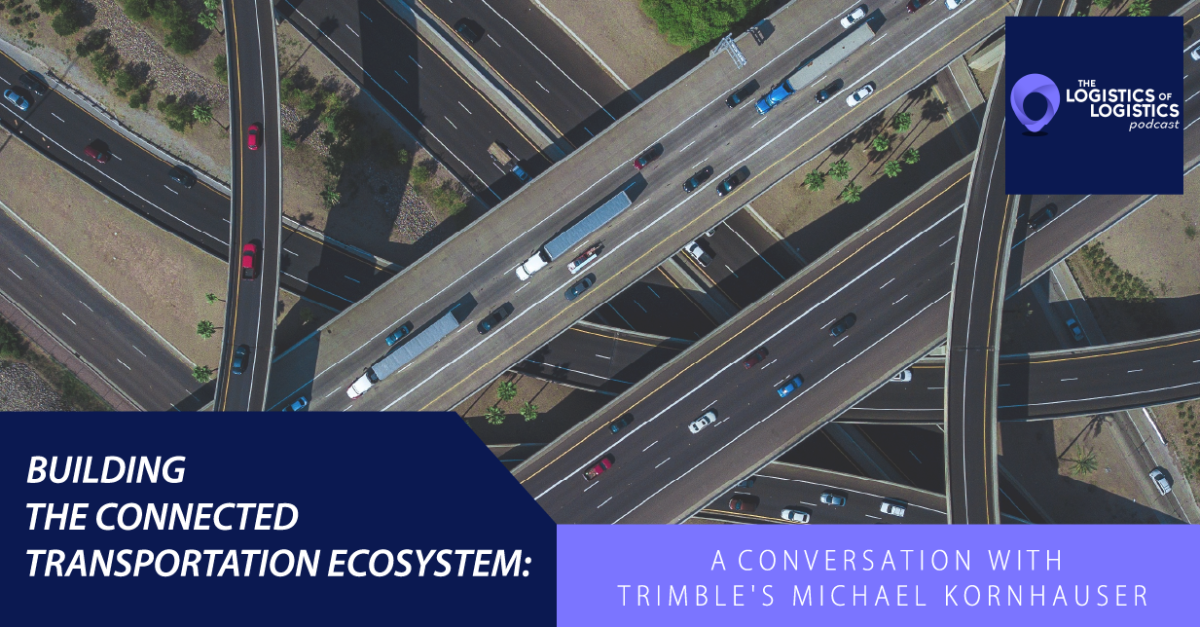
In “Building the Connected Transportation Ecosystem: A Conversation with Trimble’s Michael Kornhauser”, Joe Lynch and Michael Kornhauser, Vice President of Trimble, discuss how integrated data and precision mapping create a more secure, efficient, and connected transportation ecosystem.
About Michael Kornhauser
Michael Kornhauser is sector vice president of Trimble, leading Transportation & Logistics in North America. With more than 20 years in various leadership roles, Michael has proven to be an astute and dynamic leader with deep industry understanding and passion for delivering superior customer value. Kornhauser, along with Dan Popkin, established the European operations and development of the successful CoPilot business and guided the ALK Technologies business integration into Trimble. Under his leadership, Trimble’s mapping solutions have become highly recognized and respected throughout the North American trucking and rail industries. He studied at Trinity College, where he received a research grant from NASA and graduated with a Bachelor of Science degree in computer engineering.
About Trimble Transportation
Trimble Transportation provides fleets with solutions to create a fully integrated supply chain. With an intelligent ecosystem of products and services, Trimble Transportation enables customers to embrace the rapid technological evolution of the industry and connect all aspects of transportation and logistics — trucks, drivers, back office, freight and assets. Trimble Transportation delivers an open, scalable platform to help customers make more informed decisions and maximize performance, visibility and safety.
Key Takeaways: Building the Connected Transportation Ecosystem
- In “Building the Connected Transportation Ecosystem: A Conversation with Trimble’s Michael Kornhauser”, Joe Lynch and Michael Kornhauser, Vice President of Trimble, discuss how integrated data and precision mapping create a more secure, efficient, and connected transportation ecosystem.
- The Power of a Global, Integrated Ecosystem: Trimble is no longer just a collection of individual tools; it is an intelligent ecosystem designed to connect all aspects of the supply chain—trucks, drivers, back offices, and freight. Because many of Trimble’s customers are multinational, the company provides a global footprint that ensures consistency in data and operations, whether a shipment is moving through North America, Europe, or beyond.
- Industry Under Attack: Prioritizing Cybersecurity: Kornhauser emphasizes that the transportation industry is “under attack” from increasingly sophisticated cyber threats. To combat this, Trimble invests over $100 million annually in R&D, with a significant portion dedicated to cybersecurity. By partnering with giants like Microsoft, they ensure that even small carriers using their platform have enterprise-grade protection that they couldn’t afford to build on their own.
- The “Four Revolutions” of Transportation Tech: Michael outlines the technological shifts that have defined the industry:
- GPS: The foundation that allowed for real-time tracking (which Trimble pioneers helped patent).
- TMS (Transportation Management Systems): The transition from paper to digital “ERPs for trucking.”
- ELD Mandate: Moving from selective enforcement to universal, data-driven safety and compliance.
- AI: The current revolution, focusing on automation, predictive agents, and massive efficiency gains.
- Strategic AI Implementation: “Eating Our Own Cooking”: Unlike startups that may take a “move fast and break things” approach, Trimble is highly measured with AI. They are currently using AI internally to write code and improve customer support agents before rolling those features out to their Fortune 500 clients. This ensures that the “always-on” nature of global logistics isn’t disrupted by experimental tech.
- The TMS as the “System of Record”: Despite the many apps and sensors in a modern truck, the Transportation Management System (TMS) remains the heart of the ecosystem. Michael explains that Trimble’s strategy is to keep the TMS as the central hub where “Order-to-Cash” workflows live, while connecting specialized tools (like maintenance or navigation) seamlessly into that single source of truth.
- Precision Mapping for “People Who Drive for Work”: A major differentiator for Trimble is their proprietary mapping (PC Miler and CoPilot). Unlike consumer apps like Waze, Trimble’s mapping is built for heavy-duty trucks, accounting for bridge heights, hazmat restrictions, and even specific entry/exit gates at massive industrial complexes. This “last mile” precision is often the difference between a profitable trip and a costly delay.
- A “Customer-First” Partner Philosophy: Trimble embraces an open platform, hosting hundreds of partners—including some competitors. Michael highlights that the goal is to eliminate the “swivel chair” effect, where a dispatcher has to jump between 10 different monitors. By allowing third-party apps (like fuel cards or specialized sensors) to integrate into the Trimble stack, they provide carriers with the flexibility to build the specific “tech stack” their niche requires.
Learn More About Building the Connected Transportation Ecosystem
Trimble Transportation | Linkedin
Trimble’s Perspective: The Future of Freight is Connected with Rob Painter
The Road Ahead: What Trimble Innovations Mean for Transportation with Jonah McIntire
Smart Routes, Safer Stops: How Mapping Tech is Transforming Trucking with Rishi Mehra