
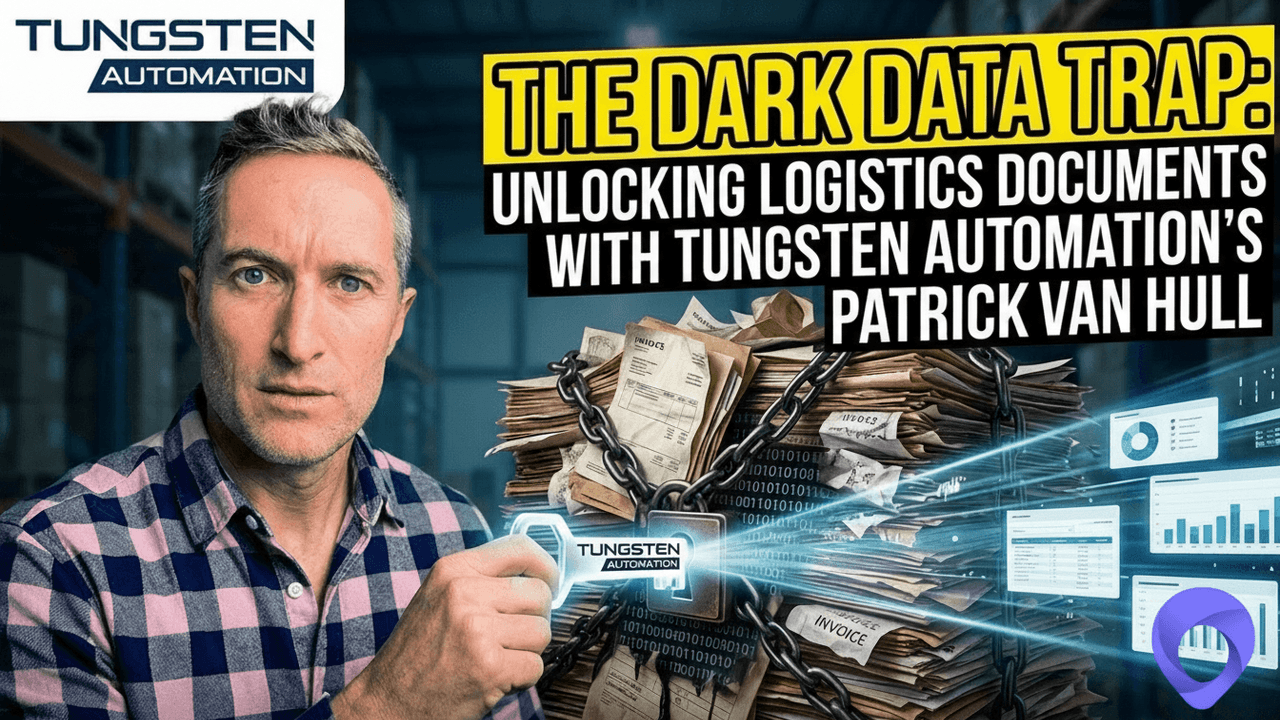
In “The Dark Data Trap: Unlocking Logistics Documents with Tungsten Automation’s Patrick Van Hull” Joe Lynch and Patrick Van Hull, Supply Chain Industry Consultant at Tungsten Automation, discuss how intelligent document processing eliminates manual data traps to drive logistics efficiency and cost savings.
About Patrick Van Hull
Patrick Van Hull, widely recognized as the Supply Chain Storyteller, helps organizations transform complexity into clarity. A multi-time “Top 25 Global Thought Leader and Influencer on Supply Chain” and Supply Chain Pro-to-Know, he focuses on supply chain digitalization and capability development, showing how operational details can drive resilience and performance across the value chain. Patrick’s career spans more than two decades, with leadership and advisory roles at Apple, Dell, Rio Tinto, and CVS Health, Gartner, Deloitte, and SCM World, he became known for bridging practitioner expertise with executive-level insights to turn data and technology into impactful strategies and programs. Most recently, he has focused on helping enterprises use AI-powered intelligence to strengthen resilience and anticipate disruption. He holds degrees from the University of Michigan and Duke University Fuqua School of Business, and lectures on supply chain strategy at the University of Arkansas Walton School of Business.
About Tungsten Automation
Tungsten Automation, formerly Kofax, is the global leader in AI-powered document and workflow automation solutions, boasting a 40-year trusted legacy and a team of 2,200 employees across 40 countries, serving over 25,000 global customers. Our commitment to innovation and customer success has earned us industry recognition, including being named a Leader in the 2025 Gartner® Magic Quadrant™ for Intelligent Document Processing. Tungsten has also been recognized by other key analysts in areas such as Intelligent Automation and Process Orchestration. We are trusted to help businesses achieve unprecedented efficiencies and reduce costs through document and workflow automation, allowing them to scale and future-proof their business.
Key Takeaways: The Dark Data Trap: Unlocking Logistics Documents
- In “The Dark Data Trap: Unlocking Logistics Documents with Tungsten Automation’s Patrick Van Hull” Joe Lynch and Patrick Van Hull, Supply Chain Industry Consultant at Tungsten Automation, discuss how intelligent document processing eliminates manual data traps to drive logistics efficiency and cost savings.
- Tungsten Automation Profile: Formerly Kofax, Tungsten is a global leader in AI-powered Intelligent Document Processing (IDP) and advanced workflow automation. Backed by a 40-year legacy, 2,200 employees, and 25,000+ global customers, the company was named a Leader in the 2025 Gartner® Magic Quadrant™ for IDP. Their cloud-based platform sits cleanly over multiple, fragmented ERP and TMS networks to pull and push data seamlessly.
- Escaping the “Dark Data Trap”: Moving a single international ocean container can require upwards of 30 separate documents. Because traditional TMS and ERP platforms can’t read unstructured data (like dense PDFs, faxes, or Excel spreadsheets), this critical info becomes trapped “dark data.” Tungsten uses IDP to automatically ingest, classify, and extract line-item data from over 40 different logistics document types, turning paper trails into structured, digital assets.
- Slashing AP Errors & Driving Revenue: Manual touchpoints in freight invoicing lead to constant billing discrepancies and human errors. Through automated multi-way matching, reconciliation, and automated exception handling, Tungsten drives “zero-touch” processing for order management and invoices. In one case study, acting as an automated “quality check” against contracted rates helped a major freight shipper capture an incremental $20 million in annual revenue.
- Preventing Customs and Shipment Delays: When data errors or missing documents hit customs or a port, shipments grind to a halt, triggering costly penalties, demurrage fees, and port congestion. Tungsten automates data extraction and email ingestion for customs clearance, validating regulatory documentation and compliance checks before shipments ever hit major bottlenecks.
- Accelerating Carrier and Supplier Onboarding: Traditional onboarding forces procurement teams into a weeks-long “paper chase” of manual risk assessments and compliance reviews. Tungsten uses automated self-service portals paired with automated risk assessments—such as using the platform to instantly verify the legitimacy of bank and credit statements—condensing onboarding timelines from weeks down to a matter of days.
- Bridging the Gap Between AI Hype and Reality: AI cannot solve supply chain issues without clean, unified data. Patrick notes that trying to run raw, messy documents entirely through an unguided Large Language Model (LLM) can cause the AI to run wild, exhausting months’ worth of token allocations in a single week. Tungsten effectively solves this by embedding AI directly into workflows, blending traditional rules-based automation (RPA) for standard patterns with Generative and Agentic AI to manage highly complex exceptions.
- Elevating the Human Experience: Eliminating rudimentary data entry is ultimately a personal win for the workforce. Moving away from “swivel chair activity” and manual data chasing reduces friction and human error. By shifting repetitive tasks to automated workflows, logistics employees are freed up to use human ingenuity, focus on creative problem-solving, and ultimately enjoy more meaningful, higher-value work.
Learn More About The Dark Data Trap: Unlocking Logistics Documents
Tungsten Automation | Linkedin
The Logistics of Logistics Podcast
Joe Lynch: [00:00:00] Hello, friends. Welcome to Logistics of Logistics. My name is Joe Lynch. Thank you so much for joining us today. Today’s topic is The Dark Data Trap: Unlocking Logistics Documents with P- Patrick Van Hall. How’s it going, Patrick?
Patrick Van Hull: It’s going great, Joe. Thank you for having me. It’s a pleasure to be here
Joe Lynch: I’m excited to talk to you. So Patrick please introduce yourself and your company and where you’re calling from today.
Patrick Van Hull: So Joe I’m calling in from Providence, Rhode Island, so on [00:00:30] the East Coast, New England, in the heart of World Cup territory right now.
Joe Lynch: Oh, yeah
Patrick Van Hull: I’m a supply chain industry consultant with Tungsten Automation
Joe Lynch: And what does Tungsten Automation do?
Patrick Van Hull: We are, we’ve been around for over 40 years, and we’re a leader in intelligent document processing and advanced workflow automation. So we take all of those things that underpin all of the movements, all of your documents, all of the bills of ladings and POs and whatever it is, we do that across the board.
And we serve customers across industry. [00:01:00] We have more than 25,000 customers globally, banking, financial services, logistics, manufacturing across the board
Joe Lynch: Yeah, and I like that you’re, obviously we’re talking, gonna talk about logistics stuff today, but I always say the number one question in logistics is where’s my stuff? But the number two, and it’s maybe 1A, is where’s my money? So I love that you guys are also in the financial area, because fintech is super important to the logistics space
Patrick Van Hull: Absolutely. And supply chain [00:01:30] really sits at that intersection of the physical, of the financial, and the information. It’s the three things that have to come together, and they all run through supply chains
Joe Lynch: Yep. So you mentioned some of these documents, but I have technologies. I have a TMS, I have a order management system. I might have a WMS. I might have SAP or another ERP system. What why do I need this? Why do I need Tungsten [00:02:00] Automation?
Patrick Van Hull: Yeah. If you look at what’s happening in supply chains, it’s the same thing that’s happened for generations really, is that there’s still so much manual processing. The TMS does its job, the WMS does its job, but it’s that ability to take all of those documents, the tens and 20s, 30s of documents that it takes to receive an inbound freight shipment internationally, for example, and being able to combine those and extract the information to the reconciliation. All of that often is manual work, and [00:02:30] it’s the type of thing that really consumes a lot of the time of the people that do the jobs. And so we’re at this place now with Tungsten and what we’ve been doing for 40 years, as I said, is this ability to really take all of that and be able to process the information so that we can automate some of that manual work.
We can take some of that pain away, and it’s been effective, like I said, cross-industry to helping companies really streamline their workflows and really advance what the capability is for them
Joe Lynch: Yep. W- I’m an automotive guy originally, and I [00:03:00] spent t- 20-some years in that space. And during the time I was in the business, 20-some years there was fewer and fewer manual functions and fewer clerks. It used to be the land of clerks. It used to be just everywhere you looked was, like, somebody who was basically data entry, but usually they had a title that was much loftier than that.
Oh, by the way, yeah, I met your uncle when I was still in automotive. You’re m- originally a [00:03:30] Michigander like me. And when I left automotive in 2010 and I came to logistics, I was immediately shocked by how much paperwork there was. I remember the company that I came to had a fax machine ’cause some of the customers said, “We would like to fax you this stuff.”
And my team at this logistics company would say, “Yeah, I get these faxed, and I do the data entry.” Others would send us Excel spreadsheets, and we’d do the data entry into our [00:04:00] TMS. And g- back then, it was a lot more e- expensive to integrate, and people just didn’t wanna do it. It was just like, “Oh, this just costs money, so data entry is it is.”
And so we had a lot of clerks.
Patrick Van Hull: Yep. The I was told this story here a f- a few months back of a load or a receiving dock in a f- facility, and someone was telling the story that one of the biggest issues that they had with their documentation was that you’re dealing with paper and pallets [00:04:30] and cardboard and people would get nicks on their hands and, they’d have blood and things like that, is that one of the biggest problems they had with their documentation is that they would scan documents with blood on it in the actual scanner. So that tells you how rudimentary some of these processes are, is they actually had to create a workflow to ensure that your hands were clean and the documents were clean before you put them in a scanner
Joe Lynch: That’s nuts. That’s nuts. This is such an important su- such an important thing, and I gotta also tell you one, and I w- I know we’ll hit on AI as we’re talking about this, but [00:05:00] I use AI a lot, as everybody is starting to use AI a lot, and sometimes I’ll say, “I wanna send an email to Patrick Van Hall about blank and blank,” and I might print a PDF document from an email that I had with you, and maybe another topic, and I’ll just upload it to AI and say…
So I always like the idea that I have these PDFs, but I also think, “Now I got all these PDFs on my desktop that I go…” [00:05:30] And n- once a week I’m going through and going, “Why do I have a thousand d- documents on this desktop all of a sudden?” And it’s not manageable
Patrick Van Hull: No, and it’s– I’m sure they’re all in different formats, and some are paragraphs and bullet points and some are short and some are long. And that’s a, that’s one of the biggest issues is the consistency is you used to be able to look at an, at a form essentially and know what the information was.
Now it’s, that’s a free-for-all
Joe Lynch: Yeah. So we’ll come up back to all that in a [00:06:00] minute. So Patrick please tell us a little bit about you. Where’d you grow up? Where’d you go to school? Some career highlights before you joined the mothership Tungsten Automation, and why you joined. You’ve had options
Patrick Van Hull: Yeah, absolutely. I like you mentioned earlier, I grew up in, in Plymouth, Michigan, so just nearby to Ann Arbor. Ended up at the University of Michigan, so very proud Wolverine. At that point in time, I was offered the opportunity to go work at Dell and I hadn’t even known what supply chain was at that point in time.
But moving to Austin, [00:06:30] Texas at 22 sounded like a good idea after having grown up in the
Midwest
Joe Lynch: a great company that… I think it’s still a great company, but I used to, I bought a few laptops from Dell
Patrick Van Hull: Yeah it really taught me a lot about the just-in-time supply chain. It taught me a lot about the way that they manage the financial side of it. And so that was really my first foray into supply chain, and then really continued that. Started the I like to call it collect and connect, really collecting the experiences and connecting across them.
And as a practitioner, I worked for Rio Tinto Minerals, [00:07:00] so the industrial minerals arm of global mining giant Rio Tinto. Spent a lot of time in the Mojave Desert for that one. I also worked for Apple certainly everybody knows Apple, and then I managed inventory for CVS Health, the retail pharmacy chain. So from that side, I started as a practitioner, and then using that variety of experiences, I moved into more of the industry analyst perspective. I went to go work for a small company called SCM World. We were working with many of the world-leading [00:07:30] supply chain officers and their teams to advance their capabilities. Gartner bought us, so I stayed on as a Gartner analyst for a period of
time, and then was also with Deloitte’s digital supply networks practice. Now that’s all pre-pandemic. Certainly, pandemic did a number on consulting. But since then, I’ve been in the solution side, really looking at the strategy and advisory side of strategic solutions for supply chain.
So I’ve worked for Kinaxis, O9 Solutions, Interos and then the opportunity at Tungsten [00:08:00] was really the idea that supply chains are underpinned by all of these documents. We look at what happens, we see the visualizations, the ships. We talk about straits and canals and hurricanes and all of these disruptive things, but the reality is that so much of the work that happens is that manual work that we talked about below. So it was that foundational element of supply chain success that’s always been really intriguing to me because we get, we can be very eas- easily distracted by the [00:08:30] big flashy things, but it’s that core work, that gritty work that people are doing every day that just doesn’t get appreciated. So that was a big appeal for me.
Joe Lynch: I like it. I like it. Where is Tungsten based?
Patrick Van Hull: We’re based in Denver, Colorado. Previously we were in Irvine, California, but we’re a global company. So we have, for instance, my team is comprised of London, Rhode Island, Denver, and Kentucky. We spend all day every day kind of transversing the world and recently I actually had the chance to go to both Singapore and Sydney as part of our [00:09:00] global summits.
So we’re everywhere
Joe Lynch: So do you work with shippers or do you work more with logistics companies? I always split the world into shippers and logistics providers.
Patrick Van Hull: Yeah, we work with them both really. So I, I would say that we, a couple of examples would be one is like there’s a shipper that we work with, a big global freight company. A- and one of the things that they still do is they do a lot– their billing manually. So they’ll hand enter the billing [00:09:30] codes and the line items, and they’ll actually send the invoices out.
But we work with them as a bit of a quality check to sit on top of that, and we’ll go and automatically review what’s been entered, what the documents are, as well as what the contracted rates are and what the terms are. And so we’ll sit over the top of that. And so we’ve helped that freight company generate an incremental $20 million in annual revenue. On the other side, on the inbound side, certainly we look at, we see all of the things that are happening with tariffs and global [00:10:00] trade and we– the need to, to no longer be able to process an invoice as a straight through single document. Now you have to be able to process it as individual line items based upon origin and destination and size and weight and all of those details.
And so we’ve worked both ends of those, and both of those are real examples that we work with
Joe Lynch: I love it. I love it. So let’s just say, I’m gonna give you an example here for a second Patrick. Let’s just say I, I’m a logistics company and I’m listening today, and I have customers from all [00:10:30] over the world sending me s- sending me shipment information. S- And some of it is in Word documents, some of it is in PDFs, maybe an Excel spreadsheet, customs documents.
That’s, th- they choose to give that to me. I’m the logistics provider. I can’t necessarily say, “Oh, all that, you have to use our TMS. I want you to log into the TMS, and I want you to do this.” And they say, “Nope, you do it. Here you go. Here’s all this information.” Where do you guys sit? How do you help [00:11:00] me fix this problem that my team is opening documents and entering information like it’s 1996?
Patrick Van Hull: Yeah it’s certainly a challenge when the documents are coming in from any direction in any format, any size. A- and so I would say just that initial piece is the capture. So being able to ingest those documents, being able to bring them into our platform. Our kind of bellwether platform is total agility.
So you can bring in all of those documents and you can [00:11:30] train the system based upon what the existing documents are. Here are some examples of bill of, bills of lading and advanced shipment notifications. Or you can use AI to actually identify what those documents are a- and be able to map those.
Joe Lynch: So they’re attached to an email that comes to me. How do you guys ingest it from there?
Patrick Van Hull: We can pull it straight from SharePoint, we can pull it from API, you can upload it. It’s really very flexible and certainly we understand that the processes that exist aren’t necessarily designed for that email to feed [00:12:00] directly in. But if that’s what you wanted, you could certainly bring that email into a digital mail room.
We could extract the file, bring it right into the platform
Joe Lynch: Yeah, and I f- I think about that what do they call it? RPA, robotic process automation. And we talked about that for a while. I don’t necessarily hear people say it as much, but I think that is still being used. And that would recognize that, hey, when that showed up at my, in my email and it had an attachment, that attachment had to be [00:12:30] processed.
Patrick Van Hull: Absolutely. And it’s it’s the repetition of it, right? And so RPA still exists. It’s still something that’s used pretty heavily in many cases. It’s interesting though that we’re moving to that place too, that it’s the combination of capabilities. Whereas before I would’ve said, “We’re gonna use RPA to automate all of our work.”
Okay, but what happens if there’s exceptions in the process? What happens if the RPA isn’t able to recognize that attachment? Those types of things. And so you have [00:13:00] RPA, you have rules-based processing, you have the ability to plug it into a large language model. All of those things it’s starting to come together in that way just because the documents come from different places, they’re in different forms, they have different information.
It may be explicit, it may not. You may not know what’s in the form itself. And so it really is a multi-tiered approach that needs to happen today ’cause it’s not one size fits all
Joe Lynch: So I’m trying to understand where Tungsten, how the, where the technology sits. Is it in my [00:13:30] TMS? Is it is it
Patrick Van Hull: We’re– So we’re cloud-based. We can– We also have some on-prem, but we do, we’re primarily cloud-based and certainly you could bring in the document. We can pull directly from your TMS. It’s a separate solution. It’s a standalone solution. We integrate with all kinds of ERPs and TMS and all of those solutions.
So if you’re a company that runs with multiple ERPs and multiple TMS, we can pull from all of those into our platform, and then certainly we can extract back into those [00:14:00] platforms as well.
Joe Lynch: I like it. I like it. It’s it’s interesting. I had a conversation with a vice president of a big shipper. They spend $100 million a year. This … Just before COVID. And I remember him saying to me How much longer are we going to tolerate emails? And I was like go on. What do you mean?” And he goes, “We are supposed to be using our tr- our Oracle system.
We’re supposed to be using [00:14:30] our TMS that our that our partner provided, our logistics partner, and yet there’s stuff outside of it all the time.” So you have a shipment that you’re shipping for me, Patrick, and you send me a note saying, “Hey, Joe, FYI, I need this, and this,” and the price went up $300.
And I respond by email saying, “Okay, here you go.” And he said, “And it’s all outside the systems.” And I was like, “Yeah.” And I know there’s ways to make that inside [00:15:00] the system, and but he was getting at kind of the whole idea of where’s the record actually live? Is it in the email or is it in the system?
Of course it’s in the system, and I don’t want stuff outside the system. And I want… Maybe I was supposed to go into the TMS and update that or attach it to, but s- it can’t be somewhere else
Patrick Van Hull: Yeah, exactly. And it’s it’s also the case too, is even if you have… I was having this conversation during the breakout session I ran in that Sydney summit, and somebody was talking about the push to have [00:15:30] perfect processes, to design it and go through all of the iterations, make it perfect. But then even if you have that solution where everything’s running in the system, if your inputs aren’t optimized, if your inputs aren’t gonna cooperate with that system, it’s still going to be limited in what its availability is. And so it’s the output of one process becomes the input of the next. So it’s the connectivity that needs to be there as well. The system alone is critical, that infrastructure to allow the data to, [00:16:00] to be extracted and processed. But it’s a flow. It, we think about from a PO to a product receipt, it’s not just… there’s a lot that happens in
Joe Lynch: Yeah. Y- we shortened the title today. Originally, it was The Dark Data Trap: Unlocking Logistics Documents and Workflows. YouTube and the podcasting platforms don’t let us have super long titles, but sometimes when it is very complex and I’m getting a shipper that maybe has [00:16:30] extra documents, it doesn’t fit in my workflow, so you have somebody sitting at a desk taking PDF information and putting it into a other system.
And I think if it was easy, if it was all we say, “Oh, add two fields and we’re all set to our TMS,” we wouldn’t be talking today, but it’s not. We have all sorts of stuff that is good information that would p- later on provide us insights that are still being [00:17:00] manually entered because of, I’ll just say it’s probably ’cause of complexity
Patrick Van Hull: Yeah, it’s– and I think there’s the element too that just you’ve described a situation where people are maxed out in terms of their capacity. So it’s– they have so many documents that they need to process, and they have so much work that’s on their plate, and they often have multiple roles that they’re trying to do. It was a conversation I had with a– I was running a workshop with two different logistics companies earlier this week and the one company actually named this woman [00:17:30] who was doing that work, and they described how her job description is 30% this, 20% that in theory, until they described just how much work she does manually looking for data. And they said, “If we could get her to not have to just look for the data, she becomes effect- more effective and she likes her job better.” That’s the part that was so interesting is that it’s, you can get down to that individual person that’s doing the work. It becomes very personal.[00:18:00]
Joe Lynch: Yeah. Patrick I’ll get back. We, I listed five problems I wanna talk to you about, but I, of course, I have to tell a story. Just before, I think it was during COVID, there’s a consulting company locally here in Michigan that they called me and said, “Hey, can you meet for lunch? We got this problem, and maybe you could help us.
Maybe you could come on and advise or whatever.” It never came to fruition. But they said, “Here’s the problem. A big box store that you would recognize. You’ve been there.” I go, “Okay.” I’m envisioning the big [00:18:30] box store, and he said, “Receives gaming systems.” He goes, “You might have one at your house. I can’t tell you the name.”
I go, “Okay.” And a big logistics company, transportation company is delivering these to the store and not getting a proof of delivery, and it’s caused the gaming system company to not bill millions of dollars per [00:19:00] year. And I was like So I’m thinking big retailer, big electronics company, big transportation company.
And I’m, by the way, I’m pretty sure that’s solved by now from e- either by you or somebody else, but the idea that’s millions of dollars… And r- just later that week, I always said my brother-in-law’s a f- engineer who’s got a MBA, so he’s always worked in finance. I said, “Would you pay if I could prove that I [00:19:30] dropped something off without a proof of delivery?”
He goes, “No. No. N- I’d fire people if they paid you.” I was like, “What if I s- can prove like, ‘Hey I we got pictures of it. It’s here. It’s in the store.'” He goes, “No proof of delivery, no payment.” I’m like, so millions of dollars, and I was thinking, God, that, that is so crazy that you could hire somebody, say, “Hey, we hired a small consulting company.
They have one guy who is full-time chasing proof of [00:20:00] deliveries,” and save millions of dollars a year. And I was like so the idea that this is not happening, if it’s happening to big retailers, b- big gaming system companies, and big transportation companies, you know it’s an issue still.
Patrick Van Hull: Yeah. Yeah, and just look at, I c- I can only imagine the ordering. Certainly a gaming system you’re gonna order in eachs. But I look back to my time in, in, in retail and there were times when you would wanna buy [00:20:30] one, but it comes in a box of 16, and then they end up sending two boxes. So what you ordered doesn’t match what’s shipped, what’s received, what’s warehoused. And so you end up with these discrepancies that just grow over time, and you don’t know where it comes from because we process it dot to dot. So it’s all of those steps, like you said, it gets shipped, it gets loaded on a truck, it gets dropped off. If there’s no proof of delivery, you don’t pay. Everything else went right, but that one last step, [00:21:00] that’s the thing that causes the gap
Joe Lynch: I’m an automotive guy and I, you can say this, the, you can never shut down a plant. So if you’re a supplier and you say that you get an order, get that electronic order and it says, “Send us 1,000 of those parts every week.” And let’s just say one week you can’t get it done. You had a machine break and now you can only come up with 600.
What you tend to do is you send those 600 and then there’s an exception. I owe them 400 more. By [00:21:30] the way, when I was at a logistics company, we managed inbound for some of these. I would always say, “Whatever the overage is, I want the supplier to pay because it’s not my customer’s fault that you only sent 600 of the 1,000 offered.”
And boy, th- there was a lot of people who like, they, for so long, they just were able to use your resources and say, “I just sent it in two, two shipments, one of 600, one of 400.” But our [00:22:00] customers would really struggle, and I’m sure they’ve fixed that. It’s been a few years. But you’re absolutely right. The order says one thing, the received product is another thing, and somewhere along the line, those have to be reconciled.
But if they’re not in the system, if they’re in a, an attachment somewhere, and and or some emails that, that were somehow outside the system, [00:22:30] you lose
Patrick Van Hull: Yeah. And then just imagine when you talk to the salesperson, and then you talk to the logistics clerk, and then you talk to the accounts management person, you’re gonna get three different stories too, because they’re all looking at different information. And so it’s not just a matter of that it doesn’t have a single system, but you also have this giant game of telephone which increases the manual work because somebody then has to go make those three phone calls and then has to go chase down the data. [00:23:00] And when those 400 units go missing, it’s never about, “We know that those 400 are gonna be short. Here’s what our plan is.” It’s always trying to back channel and recreate what happened so you can figure out how to move forward, but you have to fill in the gap of how you got here first
Joe Lynch: Yeah, and so this, just some of the things we’ve just talked about, it’s not difficult for anyone to imagine there’s going to be billing discrepancies between the carriers and the shippers. And [00:23:30] also if there’s a broker in the mix, that’s, you suddenly have, i- if you go and try that example, I only delivered 600 of the 1,000 I owe.
That’s a production issue. Somebody’s… There’s some paperwork that needs to be had for that. But also me as the inbound logistics company, I’m telling the sh- the s- supplier, “You have to pay separately for the tr- for the freight y- that you’re shipping to my customer, ’cause you were supposed to [00:24:00] send it all in one, one LTL shipment or one full truck.”
So all of a sudden I have these billing discrepancies that just… And thousands of those. Not th- if you’re talking about an automotive facility, there’s thousands and thousands of shipments coming in every day or every week, and how do you manage all that? So how does Tungsten fit in, I’ll just say this the accounts payable and the freight audits?
How do you help me with that?
Patrick Van Hull: [00:24:30] Yeah. So I think from the accounts payable side, certainly it’s, reconciliation is a big part of that. And being able to understand what those documents are, what was ordered, and what was the PO, what does the invoice say, what does the bill of lading say? And being able to bring that into a single platform, and being able to reconcile it, not just from the standpoint where you have to have documents one, two, three, and compare them together, but you can bulk load those documents.
You can bring those into the platform, like I said, from SharePoint, from [00:25:00] APIs, and then be able to say, “Here’s what I’m looking for. I need to look for this shipper, this date.” Go pull all of the information, and then reconcile it together. And so the ability to do all of that
Joe Lynch: Patrick, one of my absolute pet peeves when I came from automotive to logistics, this is perhaps my biggest pet peeve of the industry. And I’m not so sure it still goes on to the extent that it did. I say that’s gonna cost $1,800 to deliver it to you, and I d- [00:25:30] and I deliver it, and you get it b- billed for $1,800.
And then A month later, I give you another bill, an extra $400. And you go what’s this for?” By the way, you just pay it typically. I got it. I don’t know what this is for. I might have also said, “You didn’t pay me the 1,800 yet, so I send you a bill for 2,200 because you owe me both.” And now you go, “Do I pay the 2,200 or the 1,800 or the 400?”
That’s a kind of freight audit [00:26:00] 101. But what’s always been upsetting to me is I delivered this. Y- there was an issue, maybe detention, maybe s- maybe m- maybe some- something that you didn’t provide me, and now I charge you an extra $400. I hate that doesn’t come to me on a timely basis. Because y- you might say, “Joe, I don’t know what happened on a Friday afternoon five weeks ago.
Why are you sending this to me?” And I go I told your guy on the [00:26:30] dock. He knew.”
Patrick Van Hull: The guy that wanted to g- get out of work and go enjoy a weekend with his
family
Joe Lynch: yeah. A- and th- there’s always those. And there’s so many of them that they used to go, “I don’t…” I remember, yeah, I remember one or two of those. I don’t… Five? I don’t know. It could’ve been five. That’s always been the way we’ve done business, and I think sometimes that is a a document issue because w- why did it take five weeks to get to me?
Why… and I think they have 60 days or 90 days to, [00:27:00] provide this extra bill. It, you just wouldn’t tolerate it anywhere else. That’s how I feel about it. And by the way, sometimes you’re wrong. It’s you made the mistake. You didn’t w- you didn’t tell me what their true weight was, or you made me wait for detention.
But I keep thinking, “I want an email and detention that day.”
Patrick Van Hull: Yeah, and if, and just things like, you think about all the items that get stuck in a bonded warehouse, and they get hung up for that one document, and then it starts to add up on a [00:27:30] daily basis. You’re getting charged daily and you don’t know why it’s there. You just know that you’re getting a bill day by day. Those are the kinds of things too that are maddening because you’re incurring additional charges, the charges, the byproduct of the process that has failed somewhere before it. That’s the– And that part just becomes a complete mess as companies try to chase down
Joe Lynch: Yeah. And we haven’t said it yet, but this is the challenge of having unstructured data versus structured data. Structured data, am I right to [00:28:00] say that’s the stuff in my systems that I can gain, glean insights from, I can actually use. It’s in my system. It’s what we all agreed we were gonna have, versus the PDFs, the Excels, the s- all the paperwork that
even faxes. All the paperwork outside of that, that I can never really gain the full use of that information ’cause it’s stuck in documents. It’s in the dark data trap, as
Patrick Van Hull: Exactly. And when you look at the example that you’ve just given [00:28:30] too, and then the incremental charges that are going, it comes with line item descriptions that are vague sometimes, many times. And so it– so you end up going, “Did I agree to pay this? Is this in the terms that we negotiated up front?” And so that, that kind of goes to that, the onboarding question too is what does the contract say? Is the contract verifiable? Are we able to go and check against that? And again, when you ask somebody, you or I standing there, we have to know which pile of paper to look [00:29:00] at for which question, and we’re spinning around and it becomes comical because we just end up in a tornado almost of swivel chair activity
Joe Lynch: Yep. Yep. It’s, yeah, so the first thing we talked about was this whole idea of unstructured versus structured. That’s a lot of the manual entry that is just, we all know it’s difficult and every- there’s not anybody who’s looking at it a manager or even the ac- the… A lot of pe- a lot of times it’s the young person who’s, this is their first job and they go, “This is stupid.
Why am I doing manual entry?” [00:29:30] 40 years ago, I would’ve not said that. I would’ve just said, “Thank you, sir. May I have another?” But now the
Patrick Van Hull: afraid to make a mistake
Joe Lynch: now the young people, though, they know inherently, that’s in their blood that this shouldn’t be th- shouldn’t be a separate document for this. So the first is how do we get from this unstructured to structured?
And by the way, I always call it static versus dynamic. If I can have all this great information inside my system, I’m [00:30:00] using using this information to, to develop insights for my customer. If it’s sitting outside of it, it’s I don’t know anything, I don’t know anything about it. It’s stuck in PDFs or a Word document or Excel
Patrick Van Hull: Yeah. It’s a matter– I think part of it too is if you look at even in intelligent document processing, the kind of the initial versions of it, you think about OCR, you think about scanning, you think about those kinds of things. But it was looking for very specific formats, and it’s saying, [00:30:30] “In the upper left corner, look for a date and a purchase order number,” and you think about a traditional memo format. “Look for this information.” That’s great if every single document looks that way. But now it’s saying, what about if it’s on the right side? What about if it’s down below? What if it’s buried in the text? And it’s now a matter of trying to be able to parse that information, ’cause if you didn’t see it in that system before, it would just kick it out and that would become [00:31:00] a manual exception. But what kind of process is it when
everything’s an exception?
Joe Lynch: I used to go to Asia a lot, and I worked with our Asian partners in Thailand and in China, and we would always have these forms that we would develop together. And God, we had these workshops that seemed to take really a long time because you have two different languages, two different cultures, two different companies.
And we would agree to something, and then, I don’t know, it’s just like the [00:31:30] process would run out, and it would just s- all of a sudden you would start getting something wrong coming to us again. And I think about what we got a lot of times is it’s in English ’cause that was the agr- I worked with Beijing Jeep.
English was the official language of Beijing Jeep. But then, not everyone spoke English, so they would have Mandarin or, Chinese underneath it, which is fine. But you can see how it lends itself to a whole bunch of [00:32:00] unprocessed documents
Patrick Van Hull: Yeah. Yeah, and it’s even the case too. I, it– A lot of times when you’re moving quickly, you use a template, you use an old form, you use something that is a, something that’s been done before because you’re just trying to replicate the process. And what happens when the date on the new document doesn’t mesh with the document that you’re using as the basis for it, all of a sudden you have that discrepancy.
And you might not notice. You might just say, “Yes, there’s a date. Great, I’m gonna [00:32:30] enter that date.” But if you’re not specifically looking to make sure that the date says 2026 and it says 2025, that’s an easy mistake to make. But you then have a question of, is this a valid document? Is this fraud? Is there something out?
It creates a whole nother layer
Joe Lynch: Oh, yeah. And even transportation management sy- systems, warehouse management system, they give you fields to fill in [00:33:00] and… But we all have seen this, where you go, “Yeah, this field required, I just put XX in there ’cause I don’t even know what they’re asking.” And then later on somebody says, “Yeah, we can create an automatic report from that transportation management system or where…”
And you look at it and go, “This is not right.” And it’s not the system, it’s the work rules. I don’t know if we even say those. The business rules around it. And I kinda think that you kinda need to get to a place where you go, “There’s a drop-down menu, and you must cl- you must [00:33:30] pick something that makes sense as opposed to…”
Or it auto-fills. We do that with the drivers all the time. Their systems are often auto-filled so that you don’t make them do a lot of data entry.
Patrick Van Hull: And it’s remarkable to think too that a lot of those friction points become the new process. Supply chains, logistics, it’s really good at just plugging through the difficult times. And a lot of times the problem never actually gets resolved, it just, the workaround becomes the process
Joe Lynch: Right? And, one of the [00:34:00] places this always seems to … You can do a lot of things wrong domestically where you’re working with everybody, but as soon as it hits customs and a port, that’s where the documents actually have to, they actually become real at that point because they are not gonna let you ship it to that other country, or we’re not gonna let you receive it into this country if the documents aren’t correct.
And so what does that cause? That causes a whole bunch of stuff to be [00:34:30] sitting with penalties delays obviously, and let’s face it, bad blood. And y- you’re being, gonna be charged for dimension and d- detention demurrage. And and you go, “Why is this happening?” Yeah. Paperwork. And we say paperwork, but that’s the problem.
It sh- probably shouldn’t be paper.
Patrick Van Hull: It, yeah, it, I’m, I mean it, a lot of it’s digitized but the number of documents, if you start to add them up, this was a question I asked in the room again in that Sydney breakout session. I [00:35:00] said, “How many documents do you think it takes to ship one container internationally?” And people were thinking about it, and they’re like, “Four.”
No, it’s much more than that. It’s eight, it’s 10.” And then we just– I just started listing a bill of lading, a declaration form, a advanced shipment notification, a PO and I was like, “It could be 30-plus documents for a single container.” And people in the room just said, “I didn’t even realize that.” And I said, part of that conversation became the fact, [00:35:30] too, is that in that one person’s role, they paid attention to four. In somebody else’s, they paid attention to a different four, and then so on and so on. It’s the old, they told two people, and they told two people, and so on. But it’s– it, it becomes– We don’t even realize the scale of it when you start to go with those examples that you mentioned. And then that doesn’t even mention the fact that a single ocean container isn’t full of the same product and the same pallet and the [00:36:00] same SKU.
It’s mixed loads, and you have to understand where each load came from, and it gets really complicated
Joe Lynch: Oh, yeah. And if you put something wrong on that paperwork and it somehow gets through the country of origin, doesn’t mean it’s coming in here. That happens a lot with people shipping s- magic potions from from some other country, and they said, “Oh, yeah, this is… Yeah, I’ve shipped it. It’s a supplement.”
What the Uni- United [00:36:30] States customs people might not see that as a as a supplement. They’re gonna see that as illegal. Why’d you have this shipped?
Patrick Van Hull: And then it’s, and then it will sit and somebody has to pay for it. And that’s, and that becomes the piece that says, is it, is Walmart gonna be held responsible for that product that gets detained because they mislabeled it on the inbound?
Joe Lynch: Yep. Yeah, so this is, it gets back, so this is all the customs and the shipments that are, they clog up our ports. We had a real challenge with during COVID, and I think we learned some lessons. We had the [00:37:00] changes to the law, which have hopefully successful. But I will s- say this. I have a friend of mine owns a logistics company in the Detroit area, and he does less than truckload e- everything, and he’s got a warehouse, and he does a lot of freight forwarding.
And he was showing me the math on each one of the businesses, and he said, “Freight forwarding, if you do it right on a consistent basis, you don’t really, you’re not competing on price. You’re competing on [00:37:30] competence,” he goes, ” ’cause it’s so hard.” He goes, “Everywhere else in our business, we have, we bump up against competition that, doesn’t allow us to get more than this amount of margin.
Not when we go over here.” Now, as soon as you say freight forwarding, it is so hard that it it commands a premium
Patrick Van Hull: Yeah. And it, there’s– the big part too is whether or not we can see the direct linkage, but you see the Amazon effect of, as consumers, we expect product to be on our [00:38:00] doorstep next day. And those types of pressures, that’s translating into the freight markets. That’s translating into domestic and international trade.
It’s getting to the point where supply chains, logistics companies, w- however you wanna delineate that, they have to be confident in what they can do, and then they need to stand up to what they promised. And so that becomes a critical element of it, is that if we’re throwing darts, making [00:38:30] shipment arrival estimates, and we have no basis for that information, we have no historical context, that might be the last day we’re in business because we just might not– nobody might buy our services anymore
Joe Lynch: Yeah. And right now we have a lot of carrier, a lot of discussion about the carrier onboarding with some recent legal judgments, and also freight fraud, cybersecurity. And I’m of the thought process right now [00:39:00] that cybersecurity is so important to preventing freight fraud.
So when you say cybersecurity and product fis- security, it’s almost the same thing. If somebody can hack into my system, I can take your stuff. And we’ve had so much challenge with onboarding carriers. And the industry, logistics, transportation, we are doing a really good job. There’s all sorts of new technologies, but it’s still a challenge to bring on a new partner.
I wanna make sure that we have done the right work. [00:39:30] But sometimes the s- process, if it’s overly manual, ends up delaying a supplier coming on board or a carrier coming on board, which, and it, and in addition to delaying a carrier or a supplier that I wanna get, start using right away it’s also just a, again, it’s one of those paper chases that you go, “Why am I doing it this way?”
Talk about how Tungsten can help me with those issues
Patrick Van Hull: Yeah, there’s a couple of different elements to it. I think one, the [00:40:00] fraud conversation is really interesting, and the compliance element too is making sure that all of that documentation is completed and all of that is done in a way that’s going to meet whatever that regulation is. But also when you think about the documentation, you think about those PDFs. We talked about discrepancies in the data, but as humans, we can’t– We see a PDF file that comes in, but we don’t necessarily know if something has been annotated and that it’s been changed, and being able to see the layers [00:40:30] of those PDF files, and being able to see the information that exists in that and make sure that there isn’t fraudulent things or at least items that require further investigation. Those types of things are em- embedded in our platform. Just the ability to go and look at the documents and make sure they’re legitimate, that the stamps are real, that they’re something that it’s supposed to be a stamp that’s leaving one location, but the stamp on the document is from something else or it’s a made-up stamp. Those kinds of things are really difficult to discern and you’re right. [00:41:00] The cyber attacks are the– There are always people that are gonna try and stay ahead of those things and be very ingenious in the way that they do it
Joe Lynch: So you can do automated risk assessments and compliance verification with your system?
Patrick Van Hull: Yes, absolutely.
Joe Lynch: How does that work?
Patrick Van Hull: So yes so for example, if we’re looking for those forms and we can go and see a bank statement. You’re onboarding a supplier and you want to be able to see, their credit history, any of those types of things, [00:41:30] and they supply that information. You’re able to then go and say, “Does this look like a Bank of America bank statement?
Is this a verified credit statement? Are we able to go and reconcile this across different sources?” And so it, it isn’t gonna be necessarily a one-size-fits-all, but if there’s specific regulations that says I need to have this set of criteria and it needs to be verifiable, the document scan itself can go and extract that information and populate it
Joe Lynch: [00:42:00] Yeah. I run into this every once in a while when I have one of my customers say, “Give me all this information.” There’s just one doc- one, one number related to my business that ’cause I think we changed the business name a long time ago. And every once in a while, it’ll just spit this out. It’s correct.
I can prove it’s correct, but it always spits it out, and I know that’s automated, and typically they follow up with kind of an exception, like an email “Joe, this got spit out. Please help us with this one.” I think
Patrick Van Hull: And then I’m sure they have just a manual note, something that says, “Hey, ch- we [00:42:30] checked the box. It’s verified. We’re good.” But yes, this– because they wanna be able to go back and audit that after the fact to say, “Yes, we spoke with Joe. This is correct. We’re good to move forward.”
Joe Lynch: There’s a lot of hype around AI, and it’s… By the way, when I say hype, it’s a lot of talk around AI. It is unbelievable. When we’re using it, sometimes we’re seeing this really work. Now, how does that help with the workflow execution that you guys have?
Patrick Van Hull: Yeah. There’s a couple of different elements to it, and I will say [00:43:00] that one of the conversations I had recently was with somebody that says, “I just want AI to do everything.” Which is– sounds great in practice, right? Yeah, we’re gonna have… We can sit back, put our feet up, watch some sports. No.
What– But the problem is that the AI has specific capabilities that we can bring into the conversation, but we also need to be specific about what we’re trying to use it for. There’s a bit of a relational aspect in there. So we have an example of a company a logistics company we worked with, and they tried to [00:43:30] run everything through a large language model. And what happened is that their volume of allocated tokens, what they thought they were going to need for many months, they used in a week because AI just went through and went crazy and said, “We’re gonna go look for everything, and we’re gonna tell you this. And we’re gonna tell you we’re 100% confident because we’re gonna tell you what it is that we looked for and what we found.” So they back into that confidence. That’s the place that gets [00:44:00] really interesting is that, yeah, we turned over all of the work to AI, but we have no way of really… W- If we didn’t do the work on the front end, AI can just run wild. And I think that’s part of the challenge
Joe Lynch: It needs clean, unified data that’s, that you say, “Yeah, the A- AI is not a miracle if you don’t give it what it needs to do the work.”
Patrick Van Hull: Yeah. And I’ll just use one example is we were working with a fleet company, and one of the challenges that they had was that the [00:44:30] VIN number on vehicle registrations, you have 50 states, you have 50 registration forms, and the VIN number appears differently. Sometimes it says VIN, sometimes it says vehicle identification, sometimes it says N-O period. Sometimes it’s on the right, the left. And so one of the things they were struggling with is that to automate that process they just hadn’t found a solution. And so we just– We were able to show them, this was in a demonstration where we took a couple of different [00:45:00] images off of Google Search and just simply typed it into our agent within our Total Agility platform and said, “VIN,” and it was able to extract that. Now, the piece that we told them then was that is, that’s one example of how this works. But if we can tell it to do 70% of this work using a rules-based process where you’re looking for VIN or you’re looking for identification number, you [00:45:30] don’t need AI to do all of that. You need AI to do the ones that go above and beyond the complexity that you know how to solve. And so to bring it back to your question about the workflow is that we can automate the, a lot of that work that is repetitive, even going back to RPA.
You
can take those things that have defined rules and patterns, then we can process exceptions where people can actually do the work that requires [00:46:00] human ingenuity.
It needs the creativity that you might not necessarily find in an AI solution. And that’s more meaningful, valuable work anyway. That’s certainly the work I would rather do than the, pressing the same button all the time.
Joe Lynch: It just speaks to AI is a wonderful tool, and I think we’re just obviously just scratching the surface. But if you don’t give it what it needs to do its job, it won’t get it done. And the one thing a- about getting older, you’ve seen the technologies come along. And I remember from l- early in my career, I worked in automotive engineering.
I w- and I [00:46:30] remember I had a CAD system, and it was still on a mainframe. It was a long time ago. And I remember the bosses would come over and go, “Show them, Joe. Show them how it just automatically designs the part.” I was like, “N- no, it doesn’t.” And they’re like, and they’re like, show them.
Show the customer.” And so you you want to tell the boss, “No, you don’t know what you’re talking about.” But they had never logged into the system, and they didn’t have a sense for what the computer-aided design systems would do for us. They did so much, but you c- it wasn’t [00:47:00] working by itself.
Later on, you saw it, I felt it with Excel spreadsheets, where you’re like, “Oh, it just automat-” You go, “No, somebody has to populate this. Somebody’s adding formulas and adding numbers.” It’s not magic. It’s the…
Patrick Van Hull: No. No
Joe Lynch: and AI’s the same way. It, at least for right now on in June 2026, you need to still give AI guidance and information, otherwise you’re gonna get garbage
Patrick Van Hull: Just think of it from the standpoint too. If you put [00:47:30] a new hire, whether it’s somebody experienced or not, and put them into a role and gave them no onboarding, no context, and you simply told them to go do the job, what’s your confidence level in them being able to do that job well?
Joe Lynch: Yep. Yep
Patrick Van Hull: It’s the same kind of thing, even though it’s a tool or a skill or an agent, whatever we wanna call it. If you don’t set it up for success, then you can’t really expect perfection
Joe Lynch: Yep. Yep. Patrick, I’m gonna summarize what we talked about today, then I wanna get your final [00:48:00] thoughts on the topic. So I’m talking to my friend Patrick Van Hall from Tungsten Automation, and today’s topic is the dark data trap, unlocking logistics documents. And again, when we say un- unlocking logistics documents, we could probably also add, “And workflows,” because that’s what we’re talking about here.
It’s not just the document, it’s the workflow that the document and the people need. So we talked about some problems here. One of the first problems we talked about was manual entry. Still have lots of manual [00:48:30] entry and that’s a problem because it’s a waste of manpower. It’s also not what humans are good at.
We are good at manual entry for a little while, and then we break down. They have AI-powered document processing that’s just gonna be way better, way cheaper in the long run also. We also talked about the issues that people run into with accounts payable and freight audits, and that’s the discrepancies between the carriers and the suppliers and the and the [00:49:00] shippers.
And those are always gonna be there. Somebody has to do that. Much better to get an automated matching and re- reconciliation through Tungsten to be… rather than doing it yourself. And I think one of the challenges I talked about there was I hate the delay in information. I think you could also flag that delay in information real quick from your system and say we’re getting other inputs to the system [00:49:30] one month later.”
You could probably give me the dates on those discrepancies showing up and say, can we somehow get that to a week?” We’re also talking about all the delays in customs and shipping increasing the risk of penalties, port congestion, shipping delays. We’ve all experienced that, and it’s a lot of times it’s just the paperwork.
And, but if you have this compliance and the custom stuff in documents rather than in your system, then you’re gonna find yourself doing the same problem over and over [00:50:00] again. So I also talked about supplier onboarding and carrier onboarding. That can be a lot faster if you leverage automated self-service.
And I, I can say this, I work with my customers, a lot of times now it’s already this automated self-service. Way better. And then the… as I mentioned, sometimes there’s an exception. Usually, that exception is dealt with overnight, and the next day they’ll say, “You’re approved in our system,” even if it kicked out one number that I put [00:50:30] in.
Last but not least, we talked about AI a- and workflow execution. Again, this is all about, AI can do incredible stuff if you give it the information, and Tungsten can help you pull that information from these documents, push, put it into their system, and start with a workflow. Put a big old bow on this one, Patrick.
Final thoughts on the topic
Patrick Van Hull: Yeah I would just say that supply chain’s still fundamentally the baseline foundation of supply chains is a document supply chain. It, [00:51:00] it– we think about the physical, we think about the financial. If the documents stop, the product stops, the money stops. And so that’s the fundamental issue at heart still with supply chains.
And so it, it’s getting to that place where we can advance document intelligence to, to process the information, to make those connections. This isn’t a spot solution. This is a platform. This is a, an entire supply chain of the documentation that we can work toward outputs of one process becoming the inputs of [00:51:30] the next so that we can work smarter and so that we can free up our capacity, so we can do more meaningful work, we can enjoy our jobs more. The foundation of it is that supply chains shape the human experience, whether it’s from the what we deliver or provide, but also the work that we’re creating along the way. So I… That’s the big passion point for me working at Tungsten is this, we sit at that baseline of what makes supply chain possible, and it’s an exciting place to be.
Joe Lynch: Yep. Who’s your ideal customer?
Patrick Van Hull: Really we’re looking anybody, I, I– it depends on [00:52:00] certainly the industry or cross-industry, but if we start to look at functional groups, it, the accounts payra- payable, we look at freight, we look at supplier onboarding, procurement. Ultimately this is gonna roll up into the CFO. It’s gonna… We’re gonna see financial benefits, we’re gonna see cash velocity, we’re gonna see service excellence. I think the CFO is ultimately the one that sees the benefits the most, but anybody within the organization is certainly at play here
Joe Lynch: I like it. I like it. I always say when you’re working in logistics if [00:52:30] all you’re doing is talking to Bob who works on the dock, you’re probably not recognizing the full value you bring ’cause a lot of logistics companies are also doing the auditing, you’re doing the purchasing for us. So if you can get with the purchasing people and the f- financial people and say, “We’re doing the auditing now, so you don’t have to do it.
We have the tools, we have the team.” And if that CFO says, “Hey, I need to go save money,” the first place he looks is at the supply chain, right? So
Patrick Van Hull: And it’s not, a- again it’s, obviously we’re at a place [00:53:00] where companies are trying to cut costs, but they’re also trying to get more from the people that they have. So let’s take the burden some work away from them, not because we’re trying to eliminate them, but we’re, ’cause we’re trying to help them get more from their work to deliver more value with everything they
Joe Lynch: Yep. Patrick, what conference will we see you and the fine folks from Tungsten Automation at this year?
Patrick Van Hull: Certainly the summer is a bit of a slow period there, but I’m looking forward to a couple of sessions at CSCMP Edge in Nashville in early October
Joe Lynch: in Nashville. It’s at the Gaylord, I [00:53:30] think, in Nashville
Patrick Van Hull: Yeah, the Gaylord Opryland, so it’s been a few years since I’ve
Joe Lynch: That is such a cool venue to have a conference at
Patrick Van Hull: Absolutely. It’s big. It’s it’s like a, an adult playground in many ways
Joe Lynch: Yeah, when you get there, you feel like you’re outside walking around in this quaint little town, except you are in a massive facility. I really like it there. Yeah, I’ll be there too.
Patrick Van Hull: Excellent
Joe Lynch: Yep, and what other conference? Any other thing on the… I assume we’ll see you at M- Manifest next [00:54:00] year
Patrick Van Hull: Yeah we’re building our schedule out for next year, so certainly we look at the the big logistics and supply chain events, and we also have our own series of summits that we schedule globally, anywhere from New York to Amsterdam to
Singapore.
Joe Lynch: your summits about?
Patrick Van Hull: We talk from the intelligent document processing, and so we connect with our customers and our partners, but we get close to them and we get down to the level of being on the ground with them ’cause we service customers around the world
Joe Lynch: Is, are those open to the, to anybody?
Patrick Van Hull: Sure, absolutely. We certainly will [00:54:30] look at people that we already know of, but we’re always welcome to having those conversations
Joe Lynch: So what I’ll do is Patrick, I’ll put a link to your LinkedIn profile, link to your website, any of the links you and your go-to-market team give me, I’ll put those in the show notes. And if you give me the link to those summits, I’ll include them. And so you guys w- have worldwide customers?
Patrick Van Hull: We do. Yes. Yes. So whether it’s logistics companies in Australia or major global freight players in the US, we’re having those conversations day in and day out
Joe Lynch: I love it. I [00:55:00] love it. Patrick, thank you so much for taking the time
Patrick Van Hull: Thank you, Joe. It was absolute pleasure. So glad we could connect
Joe Lynch: Yes, me too. You’re most welcome. And thank all of you for listening to my podcast. Your support’s very much appreciated. Until next time, onward and upward.