
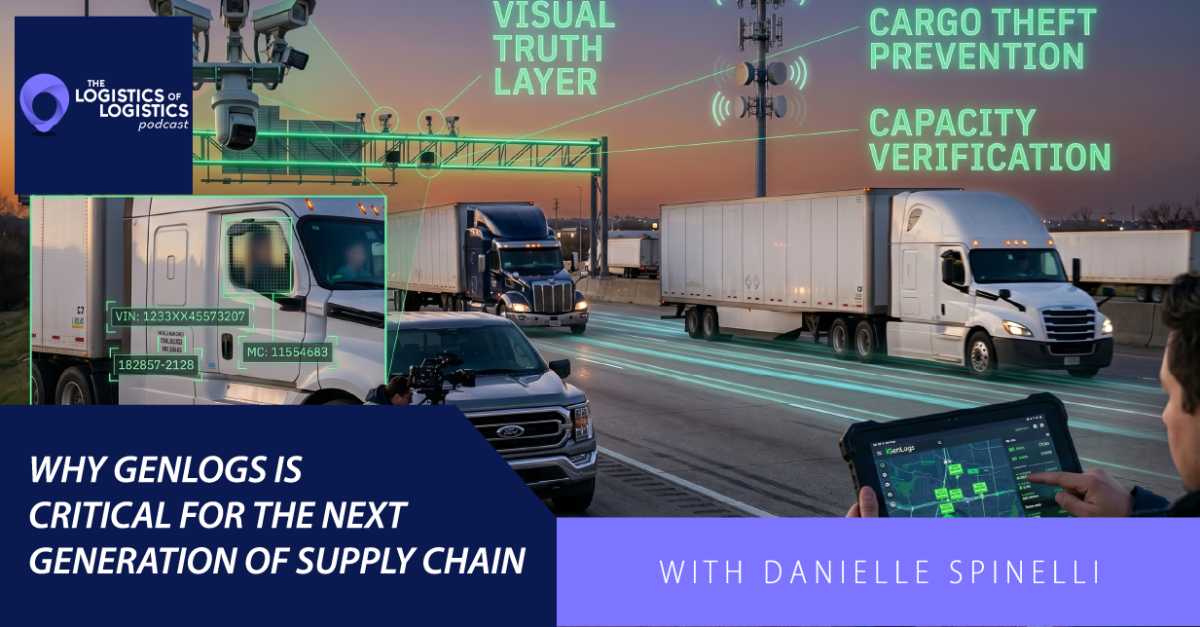
In “Why GenLogs is Critical for the Next Generation of Supply Chain” Joe Lynch and Danielle Spinelli, Director of Partnerships at GenLogs, discuss how visual truck intelligence provides a physical “truth layer” to combat cargo theft and verify carrier capacity.
About Danielle Spinelli
Danielle Spinelli is the Director of Partnerships at Genlogs with over a decade of experience in logistics, carrier vetting, and cargo theft prevention. She also hosts the Tell Me Everything podcast, sharing insights on freight fraud, logistics trends, and supply chain security.
About GenLogs
GenLogs is the Truck Intelligence™ platform that uses AI across a nationwide network of roadside sensors, satellites, and proprietary datasets to track all U.S. commercial vehicle patterns and drive better business outcomes across trucking, logistics, insurance, real estate, finance, and government.
Key Takeaways: Why GenLogs is Critical for the Next Generation of Supply Chain
- In “Why GenLogs is Critical for the Next Generation of Supply Chain” Joe Lynch and Danielle Spinelli, Director of Partnerships at GenLogs, discuss how visual truck intelligence provides a physical “truth layer” to combat cargo theft and verify carrier capacity.
- The Power of a “Physical Footprint”: While the industry has long relied on a digital footprint (ELDs and self-reported data) for carrier vetting, GenLogs introduces a “truth layer” through a physical footprint. By capturing 15 million images daily, they provide visual proof of a carrier’s actual activity versus what is reported on paper.
- Combatting “Chameleon Carriers”: The interview highlights the danger of chameleon carriers—entities that frequently change MC numbers or swap magnetic placards to hide poor safety records or involvement in fraud. GenLogs’ network can track a single truck as it operates under multiple identities, flagging suspicious behavior. *
- The “Ring Camera” for Highways: Danielle describes the GenLogs network as a “Ring for the highways.” With specialized “Trident” cameras deployed across major U.S. interstates, the platform achieves a 98% carrier sighting rate, providing massive visibility into commercial vehicle patterns.
- Advanced Cargo Theft Recovery: Beyond just prevention, the platform is an active tool for recovery. By analyzing historical sightings and specific truck markings (like unique mud flaps or bumper damage), the team has helped recover over 5,000 trailers in just two years.
- Bridging the Law Enforcement Gap: Because local police often lack the jurisdiction or resources to track freight across state lines, GenLogs acts as a critical bridge. They collaborate directly with the FBI and FMCSA to provide the data necessary to prosecute large-scale criminal schemes rather than isolated incidents.
- Beyond Security: Lanes and Capacity: The data serves a dual purpose for brokers and shippers as “Shipper Intelligence.” It allows users to see which carriers are actually running specific lanes—even those who don’t post on load boards—helping brokers expand their business with existing shippers by identifying untapped capacity.
- The Future of Integration: The “next generation” of this tech lies in seamless integration. Danielle’s focus is on connecting this visual data directly into TMS platforms, allowing brokers to see a photo of the truck assigned to their load as a final line of defense before the shipment picks up.
Learn More About Why GenLogs is Critical for the Next Generation of Supply Chain
Tell Me Everything Podcast | YouTube
Unpacking Cargo Theft: Trends and Solutions with Danielle Spinelli
The Logistics of Logistics Podcast
Joe Lynch: [00:00:00] Hello, friends. Welcome to
the Logistics of Logistics Show. My name is Joe Lynch. Thank you so much for Thank you so much for joining us today.
Today’s topic is why GenLogs, is critical for the next generation of supply chain
with my friend Danielle Spinelli. How’s it going, Danielle?
Danielle Spinelli: It’s going good. Thanks so much for having me today.
Joe Lynch: It’s always nice to talk to you, Danielle, even if I screw up the intro. So Danielle, please introduce yourself and your company and where you’re calling from today.
Danielle Spinelli: Yes. So I’m Danielle Spinelli. I’m the director of partnerships here at GenLogs. And at GenLogs, we have cameras all throughout the United States basically taking pictures of trucks and trailers to give you visibility on what’s actually happening on the road to help you with carrier vetting, carrier capacity, and shipper intelligence.
Joe Lynch: Danielle, I know you, you recently joined, and we’ll talk more about where you came from. When I first saw Genlogs, I saw the name a number of times, and then I did see them at a conference last year, and I was this is like a unique animal in our [00:01:00] business and fascinating to me. So you guys have cameras, and I know you won’t– I asked you before we hit record, “How many cameras do you have?”
You said, “That is a secret.” But you have basically cameras everywhere freight moves. And you told me you guys have 15 million images of trucks every day,
Danielle Spinelli: Every day. Yeah, it’s wild.
Joe Lynch: absolutely crazy. But I think most people driving trucks if you asked 10 years ago, “Is anybody taking pictures?” You’d be like, “Uh, probably not.
Why would they?” You guys are capturing every, I’m guessing, the vast majority of trucks moving freight across the country.
Danielle Spinelli: Yeah, I believe we actually just hit ninety-eight percent of carriers we’ve seen out there at least once. So we’re typically seeing almost everybody that’s on the road. And what’s great about that is just those carriers maybe, I know for a while, let’s say with carrier vetting, they’re– people were relying on like inspections to be done in order to say “This is a legitimate company.”
If we’ve learned anything about FMCSA [00:02:00] and DOT inspections and stuff like that, there’s not enough manpower to give everybody an inspection. So this is a way to be able to give some visibility to those, even those type of carriers that maybe haven’t had anything done and kinda prove like, “Hey, these are real drivers on the road.”
So it’s been pretty cool.
Joe Lynch: I know we’ll talk more about your career in a minute, but you are fraud girl, and so I know you are very deep into fraud, um, which we did not talk about so long ago. And I, its first cousin or its sister is cargo theft. Those became enormous issues for us. And it’s not the only thing, not the only problem you guys solve, but if there’s fraud going on, physical pictures tell a story. And you guys are not– It’s just not a picture of, “Hey, that’s a pretty truck. I’m taking a picture of it.” You’re getting, um- the license number, the MC number, the type of vehicle. Then if it’s on the side, you’re getting all the information that we want on that truck. So if somebody was to say, “I can give you this in- this [00:03:00] information,” 10 years ago, most people go, “For what?
What am I doing with it?” Now I think we’re like, “Give it to me. My system wants information. My visibility solution wants more info.”
Danielle Spinelli: Totally. And if you think about this too, like a lot of brokers and carriers and things like that, they’re collecting the information as to who the trucking, who the truck’s gonna show up at the shipper and giving that information to the shipper. But why not also send them a picture of the truck? “Hey, if this, if it’s not this red truck that looks like this and a blue one shows up, give me a ring.”
And before we didn’t have… We would just go off of whatever the driver would tell us. But now we have some more of the actual physical footprint. And even with carrier vetting, as you said, like I’m real, I’m really deep into all this carrier vetting stuff, and I think there’s a big difference between a digital footprint of a carrier and a physical footprint.
You really need both, but to me, the physical footprint of a carrier is really like the truth layer. And what’s really cool is because we’ve been doing this for over three years and we have over three billion images within our network, we’re able to cross, cross-pollinate all these data points in the back end to say “Hey, this [00:04:00] has been this carrier’s footprint throughout the US, and then now they just shifted and now they’re doing something totally different.”
That may indicate a ownership change or something has changed that we’ve noticed on this carrier. So things like that, and even all the topics that everyone’s talking about, like chameleon carriers, we’ve been able to see that on our side, just seeing that network on the backside of this same truck is operating under, 10 different MCs in one week.
Something’s weird here.
Joe Lynch: I’m gonna ask a lot of very basic questions today, Danielle. So first one is, w- what problems do you solve in a nutshell? And then who are you solving those problems for? Who are your customers?
Danielle Spinelli: Yeah, basically the carrier vetting piece any type of like cargo theft that may happen, we e-even give free investigations out. We have a team that does that so trying to make cargo theft recoveries. We’ve been pretty successful with that. Over 5,000 trailers have been recovered within two years, so been trying to help the industry.
Also capacity-wise, so if you’re having a hard time finding a truck that runs A to B, no one’s posted on any load board or whatever, you’re able to see who actually drives these lanes and being able to make [00:05:00] phone calls to those carriers. And then even just as a… I was a broker for a long time, so as a broker, me calling my shipper, maybe I only run these five lanes with them, but I can see, hey, GenLog says that they run actually these 30 lanes.
So I need to call them now and say “Hey, how do I get these other 25 and be able to expand my business?”
Joe Lynch: Yeah. And when somebody’s, like some of it, let’s just say a shipment’s late and it’s very critical and they say, “Hey, don’t wor- don’t worry, Danielle, I’m about 20 minutes away.” And you’re like, “Man, can I ask Genlogs? Can Genlogs tell me, ‘Oh no, you are not 20 minutes away. I see where you’re at, and that is not 20 minutes away.'”
And we have missing trailers. And some of them aren’t stolen, but they’re missing.
Danielle Spinelli: and even safety data, too. Our customer base is we have brokers, we have carriers shippers, and then insurance companies, vetting the type of carriers that, actually would… How do they operate? If I give them a policy, are they gonna, have an accident down the road or more prone to accidents?
And then we’ve been helping government officials all throughout the US in different [00:06:00] departments really honing in on safety. And I know I got two teenage drivers on the road just knowing what we do on our side, it makes me sleep better at night knowing that my kids are out there driving with these massive trucks on the road, but we’re doing a better job to try to keep the roads safe.
Joe Lynch: You got like a side project where you’re like, “I want you to track these two kids too.”
Danielle Spinelli: know, right? We do… Just so that everybody knows, though, we do not take any civilian type of cars. It’s just where they have the things on the side.
Joe Lynch: you use AI to delete
Danielle Spinelli: Yeah, before
Joe Lynch: the drivers except for those two kids of yours.
Danielle Spinelli: Exactly. I wish. That would be great. Yeah, no. But yeah, w- like, very, we’re very sensitive to privacy and things like that, being compliant with everything we can be. But blurring out drivers’ faces, that happens as well. So basically just wanting to have that visibility on who exactly that truck and trailer is.
Almost similar to a Ring camera, right? They collect that information as you drive by a house. But this is the Ring for the highways and interstates.
Joe Lynch: love it. So Danielle, tell us a little bit about you. Where’d you grow up? Where’d you go to school? [00:07:00] Some career highlights before you joined the juggernaut that is Genlogs
Danielle Spinelli: Yeah, so I grew up in Minnesota. I live in Georgia now. Been able to go all over the place with family and stuff like that, travel and kinda grew up that way. But I started in logistics 11 years ago, I believe. And started as a broker, did that for about eight years. Went to MyCarriagePortal.
Kinda like I mentioned earlier, I’m very passionate about cargo theft, and I had to deal with that firsthand with… I shipped
Joe Lynch: That is for people who haven’t already paid attention to that it’s a vetting portal. It’s a vetting tool. And by the way, if you vet your carriers really well, hopefully you don’t have as much f- freight fraud or cargo theft.
Danielle Spinelli: Yeah, and because I had that industry experience and did that firsthand, I was really able, even at GenLog, has been able to take the knowledge that I have and say, “This is how you properly vet a carrier.” ‘Cause we really operate in the gray, in logistics. No-nobody’s really black or white or, yes or no.
A lot of times we’re in that I don’t know type phase. So how do you get past that I don’t know into yes and no’s? And so because I have that [00:08:00] industry experience, I’ve been able to help, MyCarrierPortal back whenever I was working there and then now with GenLog. So it’s been really cool seeing my, my personal career, evolve and just with my…
Who knew that my little brokerage knowledge would lead me to, like you said, be at GenLog?
Joe Lynch: And by the way, probably 10 years ago, Danielle, there probably wasn’t a job for someone who said,
“I’m here to prevent cargo theft and freight fraud.” It was just kind of like, “Well, that’s our broker’s job.” But it, our business, and we talked about this before we hit the record button, our business used to be casual.
I don’t mean unprofessional, but casual in that I talked to my broker or my carrier if I was the shipper, and I had relationships with them. And I’m t- I believe there still is that. But I think as our business got more automated, more digitized, we were all for it and we’re not going back. But one of the things we lost is who’s picking my stuff up, right? And that’s when freight fraud started to become more prevalent because I didn’t know who I was working [00:09:00] with. That’s when cargo theft started becoming more prevalent. Talked to you on this podcast before, and I’ll put a link to some of that episode. Um, when Sammy Hagar and Guy Fieri, I’m sorry, lost that vodka,
tequila, I’m sorry.
Danielle Spinelli: Yeah.
Joe Lynch: was like a million dollars worth of tequila. The guys who were picking it up- didn’t know that they were stealing that tequila. The guys who were loading the truck saying, “Oh, it’s just these guys came and picked up the te- tequila.” I’m not saying that 10 years ago everyone knew everybody, but it was more likely. And so these guys dropped off the tequila at a location that they were told to, and they go, “Another job well done,” having helped somebody steal a million dollars worth of tequila. And if everybody knew everybody like we did the past because we– everything was by phone call or email or text message a little more personal, a little more casual.
Danielle Spinelli: just like you said, that, like that [00:10:00] load for instance, that was a blind shipment that the… Or at least they told the drivers it was a blind shipment. That’s why the delivery was different than the actual address on the paperwork. And so that’s another gray area that we have in logistics that the bad guys have just been able to totally exploit
Joe Lynch: for people who don’t get into that every day, what is a blind shipment?
Danielle Spinelli: Blind ship is basically hiding either the pickup address or delivery address and almost being like a middleman broker, for a product. Instead of having it be shipped from… you saying that you actually make the product, really you’re buying it wholesale from wherever and then routing it over to wherever you need to.
But
Joe Lynch: Yeah, and a lot of distributors would do that kind of thing where they say, “I’m a distributor. I didn’t make that, but I don’t want you going around me, so I’m not giving you the address of the people who shipped it.”
Danielle Spinelli: Exactly. And and but luckily for us, and I think this is important for drivers to know too, is that a lot of times the blind shipment is at that pickup address, not the delivery address. So for, especially with drivers, they really need to be vetting. If you do have a blind shipment, you need to be doing that extra work of vetting, [00:11:00] and even verifying, like, whenever you go pick up a load at the shipper, “Hey, is this is the broker I booked it with.
Is this the broker that it was supposed to be you guys assigned it to?” ‘Cause that’s a way to vet it. But they’ve really been able to exploit that section in itself, and there’s so many other ways that they’ve been doing it. But that is definitely one that we’ve had this big loophole, and we s- we haven’t found a better solution other than a blind shipment, which I’m like, “Why haven’t we fixed this yet?”
But they’re able to do that, and that’s why really we… It’s so important to know on a driver level who you’re working with and who is actually showing up to pick up the load, and then that driver understanding what exactly their job is.
Joe Lynch: So h- approximately how long has GenLog’s been in business?
Danielle Spinelli: Going on three years.
Joe Lynch: So it’s a relatively new company, and again, I’ve told you I’ve not interviewed anyone who does what you guys do. You have not just regular cameras, these are specialized high-tech cameras, and where do you put them?
Danielle Spinelli: Right now we’re basically all throughout the US on major interstates and highways, kinda like main areas that drivers go. So not quite in inner [00:12:00] cities yet. That’s something we, we’re working on, but right now it’s main roadways.
Joe Lynch: So it’s everywhere and getting more every day. But Where, so if I’m… Is it on the side of the road? Is it a, on a, is the camera on a bridge? Where’s these cameras at?
Danielle Spinelli: It’s c- honestly, they’re It depends on where we’re at in the US, but every place that we do have our own, what we call a trident in our cameras is we lease that little section of land of wherever we have it at, and then kinda have it on a pole or wherever, we put it on depending on the area of, with our trident on there.
That way we’re able to get… ‘Cause we’re looking at a couple things. We wanna make sure we have the most visibility on drivers and, let’s say if they’re commonly e- entering or exiting this area, we’re able to see them before they get on or off an exit. And then also making sure we have good signal because we gotta get that data back over to us
Joe Lynch: Oh, so yeah, it needs both, right? Because
Danielle Spinelli: Yeah, which is our biggest challenge.
Right now where we are not the strongest is in the Rockies. Luckily, there’s not a ton of freight that moves in the Rockies, but there is some. And then we’re– [00:13:00] Maine is the
Joe Lynch: have good internet, so you couldn’t, so you could take the pictures, you just couldn’t transmit them. So do you guys have teams traveling around the country putting cameras? Or, and you call them tridents, so these are tridents that wear cameras on top of?
Danielle Spinelli: Yeah, we do. We have technicians that go out there and then even do maintenance on them as well. But we’re deploying more… I don’t know the exact number each week, but they’re– that’s basically all that they do is just deploy more and find those spaces.
Joe Lynch: you get 15 million images a day, so it’s just…
Danielle Spinelli: It’s a big network. They g- they got a big
Joe Lynch: So what do you go through? What do you go through? Just like a million, you, every day?
Danielle Spinelli: I know, right? I know. I have so much fun. L- luckily, because of my presence just with being fraud girl or whatever, people message me on LinkedIn saying, “Hey, I had this load stolen here.” And even I’ve only been there about two, two or so months, and I’ve already made two recoveries just working with my network of people with the information I get from Gen Logs.
So it’s just so cool.
Joe Lynch: So the last
time I talked, I know you were at MyCarrierPortal, which got bought by [00:14:00] Descartes, another great company. And I think you guys did a webinar on freight fraud with the California Highway Patrol. And, I Talked to you about that before you guys did it, and I learned a lot. And it brings it home that w- we can’t count on local police to solve this problem for us.
They’re not, there’s no, they’re not equipped for you. We say, “Hey, it got stolen right here.” They’re like where was it going?” “It was on I-94 heading s- west.” It’s not my jurisdiction I’ll, right now.” And so you can’t call necessarily the state, you can’t necessarily call the feds on this. I think we’re gonna have to solve our problem.
Now, we do want law enforcement at the federal level, I believe, to put the proper punishments in place, the proper statutes in place. So this is considered the crime that it is because I feel like a lot of people, you showed me a picture of a warehouse filled with stolen stuff and you said [00:15:00] these guys went to jail for two years and it had to be millions of dollars worth of stuff.
Danielle Spinelli: Yeah, I think that was $13 million, and it was just over a year actually that they actually served. They were charged eight, but s- got out on one with good behavior and went right back at it.
Joe Lynch: Yeah, and I’ve, I think I probably said this to you before, but I had a friend of mine say, hey, you can buy like a pallet of linens on Facebook Marketplace for this much money. I go, a pallet? First off, why do you need a pallet of linens, dumbass? and then I was like, it’s not like you have us over for dinner all the time, we’re eating pizza at your house. And anyway, he said, you can buy a pallet of linens. And I was thinking that, that came from, that was
theft.
Danielle Spinelli: theft, I
Joe Lynch: That’s theft, So there’s all sorts of marketplaces. I’m sure they’re working on this, but it’s not easy to solve Facebook Marketplace problems. It’s not easy to solve eBay. All of these platforms [00:16:00] allow people to sell stuff on a secondary market.
And I’m guessing they constantly are chasing the same thing we’re doing, which is the bad guys get smarter as the solutions get smarter.
Danielle Spinelli: Yeah. And honestly what’s challenging for law enforcement is that they can… Like for instance, let’s say that they know, like the truck was going from here to here. A lot of times they need even like a subpoena to access the records for the traffic camera. So they have to have a timestamp on “Hey, they drove here.”
How… If they don’t have a tracking on that truck, how would they even really know? Not only that, but they only keep images, I wanna say it’s six months or something. So it’s really hard to see like a full big picture story of a carrier ’cause a lot of times these guys are not– It’s not just one hit that they’re doing.
They’re making multiple cargo thefts, the same network.
Joe Lynch: This is where the world has changed and you educated me on this is that in the past, we had a lot of opportunistic
cargo theft.
which was like Danielle and Joe are walking by and they go, hey, [00:17:00] Danielle, do you think there’s Xboxes in there? Let’s break it open. Oh, no, I don’t need that. Don’t
need all that crap.
Leave it. Now it’s we know there’s Xboxes and we’re going to follow that driver for two hours. And when he stops for lunch, we’re going to break into his truck or they’re doing the same with cargo. With trains, they’re tracking it all the way from the port because it’s valuable enough for them to do
Danielle Spinelli: california Highway
Joe Lynch: And that’s strategic.
Danielle Spinelli: Yeah. They, I… So I did a ride-along with the California Highway Patrol the o- the same ones we did that webinar with where they took me to the rail lines and walked me through, and like every step I took, there was broken seals, there was empty boxes everywhere. It blew my mind.
And so Yeah, so with that being said too, like the ev- every different area that cargo theft is happening, it’s not just over the road, it’s not just rail. It’s, there’s a bunch of different areas that we need to put a stop to things. But a lot of it comes from knowing who exactly you’re working with and helping law enforcement with the tools [00:18:00] of, “Hey, this is the big scheme.”
‘Cause it’s easier for them to kinda pin… the DA will take a case when it’s hey, they’ve done all of this crime versus hey, they stole this, one pallet of whatever. It’s because it’s a non-violent property crime, it’s easier to prosecute them for a longer time if it is a bigger case.
And a lot of times they can tie those same people to drugs or to sex trafficking or to a bunch of other crimes because they’re able to see them on this huge scale ’cause they’re com- they’re connecting so many different crimes. So it’s been interesting.
Joe Lynch: I think I sent you an email with this just before your webinar, and it was a train moving, a moving, train, and a pickup truck’s driving alongside it. And this guy is in the car, and he’s throwing stuff into the back of the pickup truck, and the guy’s catching him. So they knew, hey, this is– this car has this, and we’re gonna steal it.
It’s gotten very blatant, and you, as you mentioned, this is, it’s [00:19:00] strategic as opposed to opportunistic, and the cartels are involved. So if you steal that stuff, especially if you’re in the Southwest, it’s a short drive down to Mexico. And we’re gonna have to fix this problem for ourself. It’s probably too much for law enforcement.
They aren’t used to, uh, freight moving four states like we are, or across the whole country like we are. And I think it’s gonna be the technologies like this one that is gonna help us. Again, cargo theft, freight fraud, cybersecurity, they’re all siblings, and we hate them.
Danielle Spinelli: But I will say the FBI… So I actually went to Philadelphia. Jen- they asked Gen Logs to come. So I went to Philadelphia and met with the FBI team, and they actually are up, up to speed with what’s happening with our industry. I was super impressed with… ‘Cause I was like, “Okay,
I’m ready to educate them on some cargo theft stuff,” like super excited about it, and then they went through everything that they knew. I’m like, “Oh, wait, you actually know everything, so cool. Now all I gotta do is help you learn how to find these guys.” And um, able to help them with Gen Logs information on like, “Hey, this [00:20:00] is how you can use Gen Logs to try to find these guys.”
And they’ve had really good success just with using Gen Logs. So it’s been… it’s really cool being able to help. Like this is such a passion project for me.
Joe Lynch: FBI?
Danielle Spinelli: They… What’s funny is one of them was like, “Hey, I’ve actually seen your podcast.” I’m like, “What?” It was really cool
Joe Lynch: Yeah. I love that you guys are participating with the FBI, and I love that they want to participate with you guys because it is– this might be one of those places where there’s not gonna be one easy solution. There is no magic bullet here. But having the FBI understand the scope and the scale and all the tactics that are out there, because our industry has been maybe overly trusting.
We had all these great relationships over time. It’s “Oh, Bob always picks. He’s been picking up this load for 15 years. I know him. I know everything about him, and he knows me.” And maybe we got a little lax and when the automation came in, it took those [00:21:00] personal relationships away in some regards, not always. Um, and now we gotta get back to it. So Danielle, I wanna walk through, Let’s see. You do, you guys do business with insurance companies, law enforcement, carriers, brokers, and shippers. I wanna talk about the value you guys add for each one of these. And again, I’m talking to my friend Danielle Spinelli.
We’re talking about why Genlogs is critical for the next generation, but you can use it right now. So how do you guys help insurance companies do a better job?
Danielle Spinelli: What’s really cool with being able to see,
you know, ground level truth on, on drivers and carriers is being able to help insurance companies vet who they’re using. There’s some insurance companies out there, and if you’re a broker, I’m sure you can name like five off the top of your head of “Hey, these guys, this insurance company is known for having bad actors on there.”
And a lot of times it’s not really the insurance’s fault that they have these bad actors. It’s that they think that they checked all the boxes with FMCSA, so that means they’re probably
Joe Lynch: don’t want [00:22:00] extra
Danielle Spinelli: They don’t. They d- they definitely don’t. They, and they don’t want that name either, where you’re blocking out a certain insurance type just because of some bad actors.
So they’re definitely using GenLog’s data to be able to predict what the history has been on this carrier, what are, what have they been moving like. Is it where they’ve, shut down an MC, opened up a new one because they had a fatality things like that. The, you’re able to get a full history of a carrier and not just what they report to FMCSA, ’cause that is self-reported.
And we all know that’s touched on the carriers. Why don’t you give us a little education on the chameleon carriers? What is that, and why should we be concerned?
Yeah, so chameleon carriers, and one thing I’ll preface and say is that it’s, what’s difficult, especially right now, and I know we just saw, had a huge, news article about it, is that chameleon carriers, there’s two different ways. There’s day trips that people have leases on. That is legal.
That’s not illegal. So we have that gray area once again, like I was talking about
Joe Lynch: Wait, explain what is a day trip? I don’t know where you’re
Danielle Spinelli: A day trip. So if I’m a, if I’m a owner/operator and [00:23:00] I am needing to l- day lease or lease onto a company so I can haul, I’m stuck in Wyoming, and I’m gonna do a day lease because I’m gonna haul this freight from here to here, they won’t do it underneath my authority. I can do it underneath theirs.
So that, technically, that’s legal. Some people get that confused with it being a chameleon carrier. They’re, they are different. A chameleon carrier is where they will… even tactics like they will show up to a shipper and have one placard on the side of their truck because that’s the one that they can get through vetting platforms with, and they have good safety, and they have all the good things that happen.
As soon as they leave that, that shipping facility, they’ll pull that placard off, throw a new one on there, so that way if they do get in an accident on the road, they’re able to this other entity that they have or m- or DOT, they’re able to, “Hey, if I get in an accident on this one, I’ve already been in three other ones.
I haven’t gotten shut down yet. I might as well just ruin that name.” So they’re basically putting a chameleon face on themselves to protect themselves with… It’s mainly safety, but also cargo
Joe Lynch: Am I right to say that some of these [00:24:00] also, let’s just say three guys own 10 trucking companies. I’m doing the air quotes here. They own 10 trucking companies, and they have eight trucks. And as one MC is burned because they had accidents or tickets or whatever, they just move the guys to the other MC, and then after a while, somebody catches on and go, “I’ll put it in my girlfriend’s name.
I’ll put it in my kid’s name. I’ll put it in my wife’s name.” And they’re basically using the same trucks but multiple MCs, and each time they get in trouble, they just say, “Fine, we’ll just move to the next one.” And how do you even stop that?
Danielle Spinelli: What’s sad is really that’s, that needs to go back to FMCSA and the registration. Being able to vet exactly who this, the driver is, not even just carrier level, ’cause they’re even… Right now, they’re even starting up those same ones. Instead of putting it in your sister’s name or your brother’s name or whatever, you’re putting in your same name and opening up a new entity, and they’re able to do that, which blows my mind.
I’m actually meeting with FMCSA next week in DC to [00:25:00] discuss this. “Hey, why, how come we can’t have this registration point actually be vetted with previous history?” And so that’s what needs to happen on a federal level as far as registration, and then as an industry, h- having something like Genlogs, being able to put the mapping together of hey, these are this truck and trailer and this license plate, this license plate was zip-tied to six other trucks, or this placard, what, they say they only have one truck, but they actually are operating 20.
Like
Joe Lynch: said this while we were prepping today. I mentioned I like SafeLight. They come, and they’re coming to your house. They’ll send you a picture and say, “Hey, Bob Smith’s on his way over,” and you get a picture of Bob Smith. And that might give you a sense like, okay I… You might see his truck in the driveway and you go, “That’s SafeLight.”
But, um, the picture’s nice, and what you guys are kinda doing for the industry is saying We’ll get you pictures of everybody. Can– Now I’m assuming a lot of these you can tell what shipper they just came from or what receiver they just came from. So it starts to tell us, “Hey, [00:26:00] that tr…” Maybe this is, you’ll do this after the fact perhaps, but say XYZ was supposed to pick it up, but this doesn’t look like XYZ. This looks like it got picked up by ABC, and now we can start tracking that truck and find it.
Danielle Spinelli: Which that’s kinda why I got brought on board with being in partnerships is to work on integrating with different systems. Like for instance, they’ll have, there’s some shippers that have like their own camera system and guard shacks and stuff like that. So how do we get it to where those systems talk to each other?
Or a TMS, whenever in the TMS it holds all that driver information, how do we get it where that system’s talking to Genlogs and saying, “Hey, this is the truck that should be showing up. You put in this driver info, this truck and trailer number. Hey, here’s a picture of it. Why don’t you send that to your shipper, have them verify it when you get there”?
And maybe, like I said, the camera’s talking. There’s, it’s been super fun on the data level. Yeah.
Joe Lynch: opportunities are endless on this. You guys have just started, three years, three years and you guys are, in many ways the vanguards in it, but I can see also the company [00:27:00] being,
Much, much bigger, much more influential.
Danielle Spinelli: Yeah, it’s funny, Ryan Joyce, our CEO, he was meeting today. He was saying, we basically spent the past three years building the foundation and people have been like tasting the frosting of the foundation, but now we’re actually building the cake and getting a lot more data in different ways and being able to show that, showcase that in a way where, that’s very unique and no one else has anything like this.
So it’s really cool to be a part of and help the industry in so many different ways.
Joe Lynch: Before I forget, and we’ll t- I’ll make sure I put a link to this in the show notes. You have a podcast called “Tell Me Everything,” where you talk about a lot of this stuff. What is the “Tell Me Everything” podcast?
Not
Danielle Spinelli: talk, tell their story and tell me everything. How did you get here? How did you become successful? Things like that. And then every Friday, which is part of my passion project, is my Fraud Girl Friday episodes where we deep dive into cargo theft.
The month of May I’m doing one with Scott Cornell where we’re doing like a, I call it Fraud Girl University. So it’s like a [00:28:00] crash course. Scott Cornell is with Lojistic. He’s a kinda like a, I call him the king of cargo theft because he knows all things-
Joe Lynch: doing it, but
Danielle Spinelli: Not ’cause he’s doing it, but he’s for running it and knows it.
He’s actually been a investigator for about 30 years now or maybe it’s 25. Maybe I’m dating him. Whoops. But something like that. And so he’s, he came on with me kinda giving a crash course, like if you’re new to the industry, how do you get up to speed on what’s happening? ‘Cause it’s so much, and so much has changed.
So it’s a great way to
Joe Lynch: You said this before when we talked, that, that- If you are in, broker or carrier and you’re involved in a cybersecurity issue or cargo theft or freight fraud, it’s it’s embarrassing. You don’t wanna talk about it. You don’t… Y- you’re just hoping it goes away. You don’t want that es- no one wants to go to the boss and say, “Hey, you know that load we picked up yesterday?” “Yeah, good deal. Good job.” “Yeah, I think it gets, I think it got stolen.” Like, that’s a horrible feeling. So I think in a lot of [00:29:00] ways no one wants to raise their hand and say, “You know how I got my customer’s freight stolen?”
Danielle Spinelli: Exactly. But even if it’s the first thing that happened to you, so part of that course I was just talking about that me and Scott are doing this month, at the last one is if something does happen to you, how do you handle making a report? How do you handle the claim? How do you handle talking to law enforcement?
‘Cause sometimes you get to the point when you’re even making a police report that’s frustrating ’cause you… The police are like, “I’ve never even heard of cargo theft. I don’t even know how to make this report,” and you’re having to figure out how to tell them while you’re flustered. You’re like, “I can’t even do this.”
So it’s our, like, how to com- how to submit a cargo theft report for dummies. So that’s what we got going on this month
Joe Lynch: So the first group of people you work with is insurance companies, and what they’re getting is potentially some better vetting. They know where their, the trucks that they’re insuring are actually going, if they wanna track that kind of thing. Helps them avoid chameleon carriers. And also, w- if something does get [00:30:00] stolen, you guys are helping them find it. I wrote this down. You guys helped find 5,000 missing trailers last year?
Danielle Spinelli: in two years, since 2024. But yeah, since 2024. And then, and now if anything were to ever happen, if you go to genlogs.io and hit Find Assets we have an investigator that actually goes in and does the homework and looks through all of our cameras and tries to find your freight or at least give you some– sometimes…
Joe Lynch: that like a free service and
Danielle Spinelli: free.
Joe Lynch: just as a way to kinda say you should be working with Genlogs?
Danielle Spinelli: it’s also our way of giving back. It’s funny ’cause one of the biggest reasons why I signed on to GenLogs was whenever Ryan approached me and was like, “Hey, I want you on our team.” I’m like, “Listen, this is like passion project. It’s not even just about money. It’s a… I really wanna help the industry.”
And
Joe Lynch: Oh, I know they’re not paying you. That’s that’s
very
Danielle Spinelli: at all.
No. I know. I always check it out for you like that. But I told Ryan, I’m like, “It’s so important to me that we at least give back or we at least give information or, and things like that.” I’m big on knowledge stuff too. But because we do that was part of the biggest reasons I brought- [00:31:00] came on, ’cause we help, and it’s not just about money.
Joe Lynch: Yep. So you guys also work with law enforcement. What are you helping them– What problems are you solving for them?
Danielle Spinelli: So not only just like cargo theft cases, but even let’s say human trafficking over, if somebody gets we, you mentioned the cartels, let’s say they’re bringing over bodies from the border and then they’re going who- wherever in the United States. If they have
Joe Lynch: then they lose you somehow and they’re looking for ’em.
Danielle Spinelli: And they’re looking for ’em, and it’s hard to find these guys on the roads all throughout the US, so we’ve been able to have some really great success stories with law enforcement and help stop, It was more like the drug side that I know of things, but they were able to find a shipment of drugs that was going north.
They were in the Midwest whenever we helped them catch ’em. But being able to find them, ’cause it’s hard. It’s not like a easy, especially if you’re going in these really rural areas. It’s not like a easy way to spot a truck and trailer that’s It’s a big country.
Exactly. So we’ve been able to help them a lot.
And I know they use it in a bunch of different other ways, too, but mainly helping with this cargo theft stuff. And then also, like I mentioned with [00:32:00] FMCSA, like the safety protocols, like they can’t say… They don’t have enough officers out there to be able to do inspections and to find people who are violating hours of service.
But if we’re seeing, this truck repeatedly, doing this many miles, and maybe DOT investigates and they don’t have a team clearly they’re violating their hours of service, which leads to unsafe roads and so forth. Bunch of different
Joe Lynch: So I’m assuming that sometimes when they’re look- the law enforcement’s looking, they don’t have all the information. So if they say it might be a red truck, might be in Georgia, and I think it passed through Atlanta at about noon. Are you guys able to go in and say, “Yeah, we’ll get every red truck on every major expressway, and we’ll tell you where it was at”?
Danielle Spinelli: Yeah, that’s definitely combing through, and hopefully they have a little bit more information. But even if you just have the company name or at least one that they said it was, if you have truck and trailer, if you have license number, VIN number, even if you just have one of those things, we can– we’ll pull up all the images and you gotta filter through.
Joe Lynch: So you guys are– You’re able to pull all the, obviously the VIN and the license plate and [00:33:00] get all those pictures. Are you also cap- capturing the truck type?
Danielle Spinelli: That part we have, but we do not currently have it where you can search it. That’s on our roadmap. So making it where you can do color and type of truck and stuff like that,
Joe Lynch: So you, every day this gets a little more
rich in its because you can’t search images as easily as you can search
Danielle Spinelli: Yeah, like texts.
Joe Lynch: da- data, Yeah, text. Yeah, and I imagine before long with the way AI is working, we’ll get really good at just saying it was a red truck, it was a 53-footer, I think, and I think the last two digits was this on the license plate,
and we’d search by
Danielle Spinelli: And they had this bumper had this marking on it. You know what I mean? Like I think we could really get fur- like further in to finding that same truck
Joe Lynch: Yeah, it had the silhouette of a woman in one of their mud flaps. Can you narrow it down for me?
Danielle Spinelli: Exactly. I, it’s– I’m so excited to be a part of it ’cause, our data team is really cool and really great at like thinking outside the box of “Okay, how can we… All this data that we have, [00:34:00] what can we do with it?” So every time we meet on Mondays, there’s something new and cool I get to see, and it’s just…
Like I’m nerding out over here. It’s so cool
Joe Lynch: It’s very nice that this is, I mentioned earlier that this is not easy for the police on any level to deal with, and I know not only are you guys cooperating with them, but they, I’m sure, are looking and saying, “This is a resource that we can lean on.” So we talked about insurance companies, what you guys do for them.
We talked about law enforcement. Carriers is another group of people you work quite a bit with. What are you doing for the carriers?
Danielle Spinelli: You know something that’s really interesting is I’ve recently heard of a new fraud tactic or cargo theft tactic. They call it, they’re calling it the Trojan Driver, kinda like the Trojan Horse back in the day. There’s always a fun name, I know. But basically it’s where this, like a great carrier, they have, everyone’s kinda hungry to have new drivers on their fleet.
They get a new driver coming in, applying for the, for a job. Meanwhile, without their knowledge, they think everything looks great, they pass background checks, whatever the case may be, but this guy’s actually, [00:35:00] working for a bad guy. They’re waiting on the right load to be hauled on their truck.
They coincidentally park somewhere, leave their truck, and then the freight’s stolen. So it’s being able to use Genlogs for vetting new drivers and saying “Hey, this has been their history,” or, “Hey, this has been their truck and trailer, and they’ve operated under all these different people that may have had fatalities on their safety re- records,”
Joe Lynch: Now, how do you f- how do you know the driver from taking a picture?
Danielle Spinelli: I will say it’s more of the truck and… So it’s mainly owner-operators, so if they have their
Joe Lynch: Okay. Okay. Yeah. So there, and there’s a lot of owner-operators that everyone’s working with,
Danielle Spinelli: most of the time, yeah, usually whenever they’re applying and stuff, it’s owner-operator. So you’re able to vet on a driver level before you bring them on board. And then those a- those big carriers that have, X amount of trailers that just s- one driver quits and leaves a trailer on the side of the road, it’s very hard to find those trailers and where were they exactly in the US ’cause they, knocked off their ELD or whatever the case is.
So we’ve been able to help them a lot, too. So couple different areas for the carriers
Joe Lynch: Danielle, I’m gonna tell a story that I tell probably every six [00:36:00] months, but that’s what I do. When I was at a little 3PL, there was of a Friend of
my cousin. So I had lunch with this guy, and he says, “Oh, I move freight.” “Yeah, I’d love to you guys can bid on that work.” And it was full
truckload. And he said, “Every week we, um, we send out on Monday,” these 20 lanes that they do. And I said, “I don’t like to work like that. I’d prefer to have all your freight.” I explained the rationale. Said, “No.” So I said, “All right, we’ll win ’em over.” I hate working that way. So every week we would get the list, and I remember we won it, and my ops team came into my office and said, “Hey, Joe, we can’t cover that load with our normal carriers.”
I go let’s just figure it out.” And they’re like all right.” So then they come in, they’re like, “We found somebody. We don’t work with them. I don’t know they’re legal and all. It’s just we don’t work with them, and I don’t know anything about ’em.” And I was like, “All right we gotta move the freight.”
So we– It was going from Detroit to Louisiana. And here’s the thing. It was lotto tickets. So the [00:37:00] lotto tickets were being made in Michigan. And, Told me, “If this is more than two days late, we report it to the FBI. It’s the law.” And I was like, “It’s not gonna be two days late.” Well, cut to the chase.
This truck broke down, and the guy called, and then I actually talked to the guy ’cause my guy called me and go, “Hey, your load broke down.” It was over the weekend. I called the guy. He said, “Don’t worry. We’re getting it fixed. We’ll be there Monday morning.” They weren’t. I talked to the FBI on the phone. And my point to that is there are certain things, if they are considered missing, and again there’s rules, and I don’t know what they would apply to, but I’m assuming drugs and probably ammunition and who knows what else. Probably a load over a certain number, cer- a certain price would be considered, if I don’t know, I don’t wanna say higher risk, but basically where you have to report out on it.
And so I can imagine the FBI is very [00:38:00] interested in, “Hey, that’s missing. Where is it?”
Danielle Spinelli: run postal mail, that’s why I even
Joe Lynch: Oh, so that, that is something… Yeah, it’s federal
You can’t steal mail
Danielle Spinelli: Yep. And ’cause each piece of mail is a federal crime against it. Yeah, no, definitely they’re interested in that. And what’s really cool is, as a broker, you’re able to vet these same type of carriers on the same level that a FBI agent is.
You know what I mean? So you’re able to take all that data that they’re doing and take that in for you so that you’re doing all the pre- prevetting and stuff like that, so you’re avoiding all this type of bad things that’s happening. And then even finding carriers, capacity-wise, finding these carriers that we see on the road and showing them, these guys aren’t the ones posting on deck ’cause they’re running the same…
They’re running with Joe Logistics all day, every day, and they don’t ever post out there. You would never know that they even exist. But because we see them on camera, so you’re able to find those good old boys, those good carriers that aren’t just out there on boards.
Joe Lynch: Yeah. And if somebody said to, and [00:39:00] I think this would probably apply for both carriers and brokers and maybe even shippers, is that if somebody said, “I run this lane three days a week, and I’m a GenLogics customer,” I can go, “Oh, I don’t see… That’s, GenLogics doesn’t say you run it three days a week.”
Danielle Spinelli: Even equipment. So because we’re able to see the actual trailers that they’re hauling, I couldn’t even tell you how many times I had whenever I had to do some oddball flat, flatbed loads, and I needed a gooseneck or whatever, I’m like, they’re like, “Yeah, I got that.” And meanwhile they show up with just a regular flatbed, and I’m like, “Oh my God, if only I knew that this is what’s happening.”
And another story I tell too is one time I was desperate for a car- a driver, and I sent one in, and the guy had bungee cord hood. He bungee cord his hood down and duct-taped it. If I would’ve seen them on Gen Logs beforehand, I would have not sent that in, and my shipper would have not been
Joe Lynch: Oh, yeah, you can see equipment.
Danielle Spinelli: Yeah, you can see the equipment, so you can vet
Joe Lynch: Yeah. And before– I’m sure it’s on your roadmap is can we t- can we tell you what year that truck is? Can we tell [00:40:00] you what color that truck is? And all these, all this information I think sometimes you can, if it’s a really old truck, you can kinda tell oh, that’s, that is not what we agreed that they were gonna move my stuff on.
And there are I’m from automotive, and I remember somebody telling me a long time ago, you’re not allowed to move automotive freight on any trailer that’s more than 10 years old. And so a lot of times, trucking companies around here that, that move automotive stuff, they’ll go, “It’s a relatively good trailer.
It’s just 11 years old. You can’t use it for automotive stuff anymore.”
Danielle Spinelli: Same thing with pharmaceuticals
Joe Lynch: Oh, yeah. Makes
Danielle Spinelli: have a reefer for X amount of time old and stuff like that. Yeah, so you’re able to actually pre-vet that and know who’s showing up before having a rejected trailer, and your shipper’s “Why do you keep sending in these bad trailers? I told you our requirements.”
Yeah
Joe Lynch: What do you guys do for shippers? ‘Cause that’s another group of people you guys work with. How are you helping them?
Danielle Spinelli: Mainly for kind of the same thing, carrier capacity and vetting. So they’re able to see exactly, especially high value freight, who exactly that you’re putting on there. So [00:41:00] maybe the broker’s hiring X carrier. Were they able to validate it? And because there’s these lawsuits that are pending, even like with safety, let’s say like the, it…
They’re coming back on the shipper until we get this, lawsuit out there that’s settled with the broker side, see if they’re responsible. Shippers are. So right now shippers are really trying to be careful as to who they’re loading and what their history is so they’re using, gen logs to see as much information as they can to stay as due diligent as they can to avoid any type of major lawsuit.
Joe Lynch: Yep. This is a little off-topic, but I’m always fascinated by this. It’s a lot off-topic, I’m sorry. I s- I saw a, an attorney, a forensic attorney talking on TV, and she said we used to have, you know, there was always talk of serial murders and there was many more serial murders seemingly in the past, and it seems like we don’t have as many.” And she said, um, “DNA has made that a lot more…” She goes, “But also cameras everywhere has made it a lot more difficult. And last but not least, the kind of [00:42:00] electronic im-” I always think it’s a horrible situation with the guys who murdered those kids in I-I-Idaho.
He brought his phone with him.
You’re like, “Oh,
just in they got him.
in case you needed to do a Facebook update?” What is going on? It’s… But that is, when you talk about trucks, we’re not, we don’t have DNA yet. D-Daniel’s on that. We don’t have DNA, but we do have pictures now, and we do have electronics that we can connect. And I don’t know that you guys are doing it or if he’s done the roadmap, but we obviously have a digital a map of where that stuff is at. Soon, I think you’ll be able to say, this is the digital, this is the picture right now
Danielle Spinelli: Yeah, I think digital footprint is what everybody’s been relying on this whole time with carrier vetting, which is why I don’t think we’ve been able to be proactive, just very reactive on, “Hey, a carrier just did this,” that type of thing. Unfortunately even like with ELDs, because they’re self-certified by FMCSA, they’re, they just basically fill out a form and say, “Yep I’m doing everything the right way.”
There are some not [00:43:00] great ELD companies out there that you are able to go in and hack around and, clear your logbook or update your location or whatever. So being able to validate that with some physical proof too. So I’m big on physical footprint and digital footprint. Both need to work together but really understanding who you’re working with
Joe Lynch: Yeah. We’ve had the visibility which we’ve just become very addicted to. But yeah, in the past it was like, “Hey I’m a half hour away.” And then you’re like, “No, I’m looking at the, I’m looking at the dot on the map and you are not a half an hour away.” Now I can see the videos of it also.
Danielle Spinelli: Yeah. And even like tracking through apps, for instance let’s take ELDs out of the mix and we have app tracking, which many drivers still do. Even right now, because they can’t spoof
Joe Lynch: That’s when they download the visibility tool onto their mobile.
Danielle Spinelli: And right now because they are– those tracking companies are doing a really great job at detecting if they’re spoofing that location.
Joe Lynch: Wait, what is spoofing for those people who don’t do that every day?
Danielle Spinelli: It’s basically just manipulating the location and saying you’re here whenever you’re really there just by having apps on your [00:44:00] phone or coding it different. But because these tracking companies can actually detect that something’s been manipulated on the backside, now these bad guys are having to do a in an actual car with the phone because they know it’s getting tracked.
They’re going to the right location while the truck goes this way. So we’ve actually had a use case with one of our customers, one of our broker customers, that was doing a high-value load where the shipment was being tracked this way, but then we were detecting that same carrier going a totally different direction toward California instead of New York.
And we were able to find, find them before they actually stole the load.
Joe Lynch: Yeah, this, this, the nature of our business is it’s spread out across the entire country, and in many cases across Canada and Mexico. By the way, I should ask, are you guys, um, planning on mapping into Mexico and into Canada too?
Danielle Spinelli: We are. I think we’re a little ways away. Right now we’re
Joe Lynch: No, yeah, that makes sense. They’re big countries too.
Danielle Spinelli: I know. Yeah. And but I believe we are, like, going into Mexico, I think, first, and then Canada afterwards. But I [00:45:00] don’t have timeframe or anything like that. But we’re really focused on making sure the network in the US is strong.
Joe Lynch: Yeah, this– Danielle, if we’re talking five years from now, I can’t imagine how much progress we’ll have made
Danielle Spinelli: I know.
Joe Lynch: And I always feel like for a long time we said real-time visibility when we’re using EI-EDI. We’re like, “If that’s– I give you real-time updates.” You’re like, “Give or take an hour or two.”
And, um, and now we really have gotten to visibility that is much better, but it isn’t, until recently, it wasn’t visual visibility. It was digital visibility, a little different. And I think now we’re just getting a clearer and clearer picture of what’s going on with my shipment or with my trucks, with my drivers, and that it– that’s only gonna be good stuff. And there’s still gonna be people for the foreseeable future who are trying to do the wrong thing on this stuff. But you know that you can get perfect. If you think [00:46:00] about, um, airlines, air- planes don’t go down, knock on wood because they’ve, over time, just got better and better and better. Banks don’t get robbed like they once did ’cause we’ve gotten so good, and I think we’re gonna g- and I think it’s companies like Genlogs that are gonna help us get there. Anyway, enough of my blather. I’m gonna summarize what we talked about, then I wanna get your final thoughts on the topic. So I’m talking to my friend Danielle Spinelli, and we’re talking about why Genlogs is critical for the next generation of supply chain starting today. So you guys work with insurance companies, law enforcements, carriers, brokers, shippers, basically everybody. And so you guys have cameras virtually everywhere where freight is moving. If there’s not good signal, you guys might not be there because taking a picture and not being able to transmit it doesn’t do anybody any good. And what you guys are doing is capturing pictures of trucks all over the country. You’re getting the truck’s name, you’re getting the ID– whatever ID [00:47:00] numbers they have, whether it’s DOT or M-M-MC number, and also getting what kind of truck it is. So mo- and every day, if you’re listening to this six months from May 4th, I suspect you guys will have more stuff that you’re capturing. And then this information is now available, and the real, the purpose is, gonna be very simplistic here, stopping the bad guys, whether they’re chameleon chara- ch- chameleon carriers or thieves or people who are running rogue. it’s also finding stolen stuff. Stuff gets stolen. Trucks get stolen. Trailers get stolen. Sometimes it’s just missing like my lotto tickets. But that, that costs everybody. When drugs get stolen– I just heard somebody say this on my podcast. It was Inpios talking about it. They, MercuryGate and Kerber Supply Chain are part of Inpios. Inpios, I’m sorry. They said there, there’s a pharmaceutical company, they got three trucks [00:48:00] and put the drugs on one of them because it’s cheaper to k- make these guys play f- three-card monte with this thing. That’s ridiculous. We’ve gotten to, that’s a that’s a very bad place we’ve gotten to. And those are the drugs that are keeping people alive and keeping people living normal lives. Can’t have it. So it’s finding stolen stuff, it’s finding trailers, it’s finding trucks, it’s finding people. So you guys are helping law enforcement find people who potentially were trafficked into this country, or there’s trafficking w- you know, into this country also. Also, it’s finding the right ride. You guys are helping carriers vet, owner-operators, helping the brokers vet the carriers they’re working with, and same for the shippers. And also just helping those insurance companies because they are trying to do a good job at assessing risk. They want to know what those trucks are at- actually doing, but unfortunately, they’re sitting in a New Y- an office in New York or Chicago or Chattanooga. It is not easy to do their [00:49:00] job without information.
You guys provide the information. Anyway, put a big old bow on this one. Final thoughts on the topic, Danielle.
Danielle Spinelli: Mainly just I’m really big on carrier vetting is a lot more than just technology, right? You need to have a process in place. You need to work on getting out of that gray area, making it be a yes and no, black and white type scenario. I work for a tech company and tech isn’t everything.
Even Genlogs can’t do everything. But I do think having tech there that is, that supports you and grows and is able to evolve with those tactics and stay more on the offensive side, that’s the type of tech really you should be looking for so that your processes are enhanced and you are faster at covering freight.
So whenever… Instead of having to call on every single driver, like you were just saying, which does take time, even though I’m a big old-fashioned fan of that please get on the phone and call your drivers. But if you don’t have time for that, being able to see them on the roads is the next best thing I would say.
So that’s my two cents on everything that I know on cargo theft and carrier vetting. There’s a way to do it, manually and stuff like that, but then there’s also a way to make it where tech enhances you and makes [00:50:00] things faster.
Joe Lynch: Yep. So why should somebody buy GenLogs?
Danielle Spinelli: Oh, Lord, ’cause it’s so cool. No, I’m just … there’s there’s honestly so many different ways. I think what’s interesting is even the ROI piece of it, like, how do I get my money’s worth out of it? Not even just preventing thefts, like the I’m preventing something from happening, but I… We didn’t even get into this part, but our shipper intelligence.
So because we’re seeing where these trucks are coming from a facility A to B, let’s say I’m running, a lane with my shipper. I’m doing five loads w- or five different lanes with them. Genlogs can actually see they’ve actually been shipping these 25 lanes. So whenever you’re calling them and saying, “Hey, how do I get on these other 20 lanes?”
Or you’re cold calling them and saying, “Hey, I have a truck that does this to this,” you’re actually able to get ROI on a product. And that’s… It’s rare nowadays to actually have that insight of in the l- in the logistics field. Think about ZoomInfo or whatever. That’s just, like, all over the place.
It’s not specific to logistics. So that part of it’s just super cool, too. So lots of different areas
Joe Lynch: So you guys are partnering with a whole bunch of companies. That’s your job to [00:51:00] help you guys integrate all of your cool information into systems and take their information. What kind of companies are you looking to partner with?
Danielle Spinelli: Right now our biggest priority is with TMSs. So our broker customers or shipper customers that have TMSs, I want it to where, let’s say maybe you onboard with whatever your onboard platform is and you vet that way, we’ll… That kind of last defense mode of, you put in the truck and trailer number in there and then runs it through Genlogs and says, “Hey, actually we’ve never seen that driver before,” or, “Hey, we haven’t…
We saw them like, six months ago, but then they went dormant. This could be a sold MC,” ’cause we have that intel too. So having that last line of defense in
Joe Lynch: So you wanna have an, so you have an API to a lot of them, will you– and you are looking to do an API to all 25,000 TMSs?
Danielle Spinelli: No it, that’s definitely my biggest priority and the, probably the biggest challenge is doing that first. But then from there, just being able to work with other… Kinda like I mentioned earlier, like having the TMS talk to us, and then we talk to this next part, that all kinda ties together [00:52:00] and gives kinda like a full picture of where are my shipments going on different levels.
So I’m excited to be that connector.
Joe Lynch: Yeah. Danielle when I saw the transportation management system for the first time, probably 2010, ’09, I looked at it, I was like, “This is the coolest thing in the world.” And I remember showing people, and I felt so smart showing them all the cool things it could do. And it just felt like a big step forward, and I think everybody had that sense when they saw a TMS, a really good one that just was intuitive. And since then, there’s been so many, I call them the killer apps, whether it’s a Project 44 or MacroPoint or, um, MyCarrierPortal, now part of Descartes. All of these things or the fraud prevention tools, everything plugs in now and it plugs in easily. And these integrations used to be clunky and hard. Now they’re very simple. And I think virtually all the new transportation management systems were built with the idea that I will be able to connect with [00:53:00] Genlogs. They were building it with the idea. I don’t even know what Genlogs is, but maybe five years ago, but they developed it with the idea that it can connect. And I think even the older systems, which by the way, the older systems tend to have big customers. That’s been around a while. They’ve all created integration layers to make it really easy. So ideally when you say, Danielle, we want to work with you and we use this TMS, you’d be like, boom, we’re there.
Danielle Spinelli: Yeah, exactly. So that’s what I’m working on right now. And even capacity, a lot of cap- TMSs have their own capacity in there, so you can reach out and not go on load boards. Being able to empower that capacity data, maybe your own history data with,
like, oh, also GenLog saw them running that lane recently, so go reach out to them.
So it, it’s really cool to be able to use our data in different ways that is world- real-world life, ’cause I was a broker, I was in carrier sales, I did all these things. I know I would not go to a separate platform and try to find things. It was just easier for me to post something.
So I want it where that workflow is easy for somebody where whenever I was a [00:54:00] carrier rep, I would’ve actually used it.
Joe Lynch: same place. Can we help our industry get down to
Danielle Spinelli: Yeah,
right, exactly. We’ll see if that happens, but
Joe Lynch: it’s going to be a while.
Anyway, I’m going to wrap this bad boy up. Why Genlogs is critical for the next generation of supply chain with my friend Danielle Spinelli. So Danielle, I’ll make sure I put a link to your LinkedIn profile, link to your website.
Any other links you and your go-to-market team give me, I’ll put those in the show notes. I will definitely make sure if you give it to me, put a link to your podcast, which is Tell Me Everything. And on Fridays, you do the fraud girl thing. So you guys, I think if you’re concerned about fraud, Danielle can give you the course starting in May.
So you definitely need to educate yourself because I can’t imagine as a person working in a brokerage or a shipper or even a carrier having to walk in and talk to somebody about, yeah, that new carrier I [00:55:00] got, they stole our stuff. That is an awful feeling. And I think a little bit of prevention, and I think you said it before on my podcast, just don’t be the low-hanging fruit.
Danielle Spinelli: Yeah, make them find someone else that isn’t ch- doing all the checks and stuff ’cause there are still people out there that almost like the bear running after you and you gotta be faster than this guy.
Joe Lynch: Yeah, that’s that old joke where it says, hey, you can’t outrun a bear. I don’t have to outrun the bear. I just have to outrun you.
Danielle Spinelli: Hopefully we get to the point where we’re actually stopping things and everybody’s
Joe Lynch: Yes, hopefully we kill the bear at some point.
Danielle Spinelli: Yeah, exactly. So we’ll get there for sure.
Joe Lynch: Thank you so much for taking the time, Danielle. It’s my pleasure.
Danielle Spinelli: Yes, thank you so much.
Joe Lynch: And thank all of you for listening to my podcast. Your support’s very much appreciated. Until next time, onward and upward