
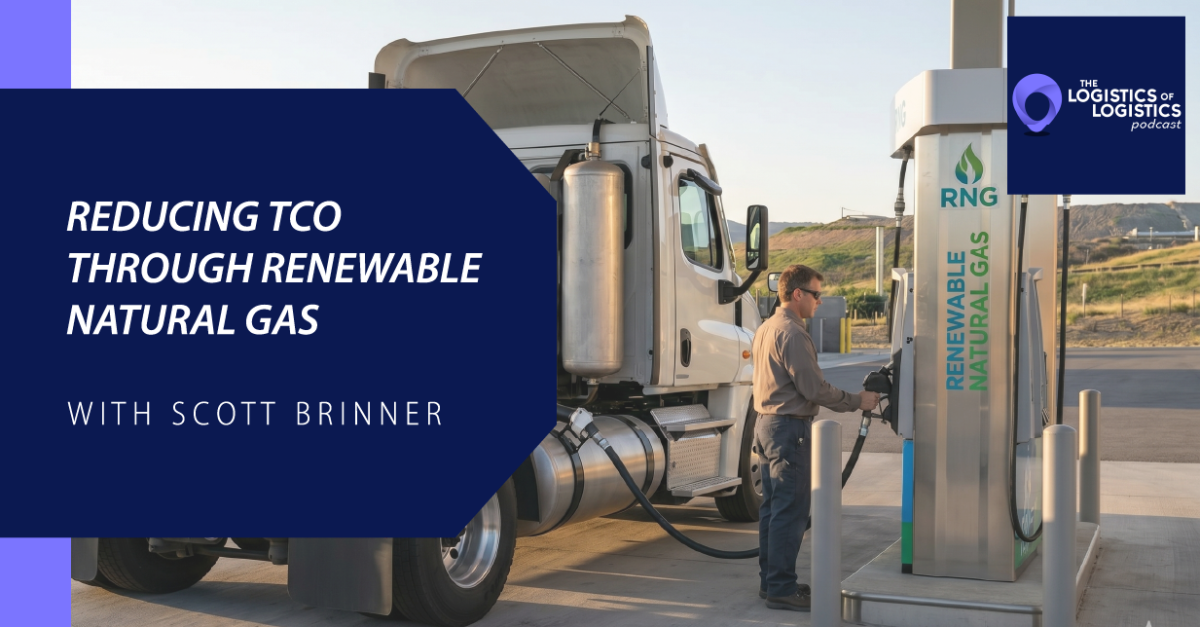
In “Reducing TCO Through Renewable Natural Gas” Joe Lynch and Scott Brinner, Vice President of RNG Solutions at Nopetro Energy, discuss how fleets can cut emissions while boosting their bottom line. Efficiency meets sustainability.
About Scott Brinner
Scott Brinner serves as the executive Vice President of RNG Solutions at Nopetro Energy, where he is responsible for developing and executing the division’s strategy, business development and expansion. His prior experiences include working as a CPA with Ernst & Young, executive vice president, Corporate Development & Strategic Accounts, at OmniTRAX, and as an investment banker with Wells Fargo and Raymond James, where he advised companies in transportation/logistics and waste/environmental services. Scott has an MBA from the University of Chicago and received both a BS, in Accounting and Finance, as well as a Master’s in Accountancy, from Miami University in Oxford, Ohio.
About Nopetro Energy
Founded in 2008, Nopetro Energy is a vertically integrated energy leader focused on the production and distribution of renewable natural gas (RNG) for heavy duty transportation and industrial consumption. The company provides end-to-end energy and transportation management solutions, helping government agencies and companies strengthen fuel independence and create lasting economic value. Nopetro designs, builds, finances and operates both renewable natural gas production plants and fueling stations, allowing fleets to transition to this substantially less expensive, cleaner and domestically produced alternative to diesel. Visit www.nopetroenergy.com to discover how Nopetro is leading the way to a more energy-independent and financially predictable future.
Key Takeaways: Reducing TCO Through Renewable Natural Gas
- In “Reducing TCO Through Renewable Natural Gas” Joe Lynch and Scott Brinner, Vice President of RNG Solutions at Nopetro Energy, discuss how fleets can cut emissions while boosting their bottom line. Efficiency meets sustainability.
- RNG as a Total Cost of Ownership (TCO) Driver: Unlike many “green” technologies that require a financial sacrifice, transitioning to Renewable Natural Gas can actually lower the total cost of ownership. While the trucks may have a higher upfront cost (roughly $70k–$90k more), the significantly lower and more stable fuel prices can lead to a payback period of just 2 to 3 years.
- The “Closed Ecosystem” of RNG: RNG is a vertically integrated solution that captures organic waste from landfills, dairy farms, and wastewater treatment plants. By cleaning these molecules and putting them into the pipeline, Nopetro turns a potential environmental pollutant into a high-performance fuel that can achieve zero or even negative carbon emissions.
- The Game-Changing Cummins X15N Engine: Historically, the trucking industry lacked an engine with the power and torque required for heavy-duty, 80,000+ lb loads. The new 15-liter natural gas engine from Cummins is a “workhorse” that matches diesel performance, range, and horsepower, removing the primary technical barrier for over-the-road fleets.
- Fuel Price Stability vs. Diesel Volatility: Because RNG is domestic and tied to stable natural gas indices rather than global oil markets, it protects fleets from “spikes” caused by international conflict. This allows for predictable budgeting and even the potential for long-term, fixed-price fuel contracts—unheard of in the diesel world.
- Proven Success in Adjacent Sectors: While OTR trucking is in the early stages of adoption, the waste management and transit industries have already proven the model. Nearly 50% of waste refuse trucks and 40% of transit buses in the U.S. now run on natural gas because it is more economical and easier to maintain.
- Infrastructure and “Behind the Fence” Solutions: Fleet owners don’t have to wait for a public station on every corner. Nopetro specializes in building dedicated fueling stations directly at or near truck terminals. This “hub and spoke” approach ensures that dedicated routes have reliable, high-pressure fueling exactly where they need it.
- Sustainability as a Competitive Edge: Large shippers (the Scope 1 and Scope 3 emission-focused companies) are increasingly looking for “greener” partners. Trucking companies using RNG can offer a cleaner solution at the same or lower price than diesel, often securing longer-term contracts (5–7 years) by providing the carbon-neutral results that customers demand.
Learn More About Reducing TCO Through Renewable Natural Gas
The Logistics of Logistics Podcast
Joe Lynch: [00:00:00] Hello, friends. Welcome to the Logistics of Logistics show. My name is Joe Lynch. Thank you so much for joining us today. Today’s topic is reducing TCU through renewable natural gas with my friend, Scott Brenner. How’s it going, Scott?
Scott Brinner: I’m doing great. Thanks for having me on.
Joe Lynch: I’m excited to talk to you. So Scott, please introduce yourself and your company, and where you’re calling from today.
Scott Brinner: I’m in Denver, Colorado, but our company, NOPETRO Energy, is headquartered in Miami, Florida, and I’m the executive vice president of our RNG Solutions division. We’re a vertically integrated company that produces RNG through designing, constructing, building, operating RNG production plants.
That’s renewable natural gas production plants, mostly at landfills. And then we also design, finance, build, own, operate renewable natural gas fueling stations mostly for buses, waste company fleets, and trucking company fleets, whether they’re private in-house fleets [00:01:00] for consumer goods or so forth, or trucking companies.
Joe Lynch: Nice. Nice. So there’s some definitions needed here. First off, your company is called NO Petro, so it’s just spelled just like it sound, like N-O P-E-T-R-O. You got it on your shirt there. NO Petro Energy. And so you guys sell RNG, which is renewable natural gas, which you’ve got trucks running on it.
And the other definition here, I guess mo- some people know what it is, but what is TCO?
Scott Brinner: TCO just stands for total cost of ownership. It’s an often used term, especially in the trucking industry, looking at the cost of owning trucks or owning a fleet of trucks.
Joe Lynch: So the title, Reducing TCO Through Renewable Natural Gas. You’re telling me, and we’ll talk about this for the next hour, that I can run my trucks, I don’t have any, but if anybody’s listening, I can run a truck cheaper using RNG than using [00:02:00] diesel.
Scott Brinner: Absolutely. My background is actually finance, investment banking, capital, stuff like that. So I’ve done a lot of look… i’ve looked very closely at this with a lot of experts in the last few years, and we confidently believe we can help a trucking company or an in-house trucking fleet transition to the use of renewable natural gas trucks and end up with lower cost, higher profit, higher margin.
And then the environmental aspect, the environmental improvement is actually just the kinda cherry on top, the icing on the cake.
Joe Lynch: We all want to be more competitive. We all want to have an advantage over the next guy, at least for a short period of time or a long period of time. And then we all wanna go back to our cons- customers and say, “We’re cleaner and greener.” And on a personal level, I think a lot of people like the idea of saying, “We, my company, we are greener than our [00:03:00] competition.”
And sometimes people get it in their head that somehow whether it’s the Biden administration or the Trump administration or the Clinton, it doesn’t matter. Forget Washington for a minute. The cu- the customers that we all sell to the biggest companies in the world, all have sustainability in their mission statement.
They are all looking for that edge. They are all looking for you, whether you’re a trucking company or a warehousing company, a tech company. What can you do for me that I can go back to my boss and say, “It’s cleaner and greener, and cheaper”? Cheaper is nice, too.
Scott Brinner: Yeah. There’s this, the sustainability, that word, the environmentalism, that, tho-those words were, I’d say, more in the forefront in the, maybe in, in previous
years. But I think the, the idea, the desire, the, the goal is still there with most, most trucking companies, with most, uh, customers of trucking companies.
Now, the hard part is most companies, [00:04:00] uh, You know, the world’s not easy. Profit matters and providing investor return matters. Most companies want the cleaner, uh, but they don’t wanna pay more. And that’s one of the things we think is special about the, the whole idea of using renewable natural gas.
Renewable natural gas is a closed in uh, very cool ecosystem where we’re capturing all this dirty air from landfills and wastewater treatment plants and dairy farms before it gets into our atmosphere and does anything bad to us. We’re cleaning it up. We’re putting it into the natural gas pipelines, and then we’re using it in transportation.
And when the scientists kind of look at the whole, the, the whole ecosystem, it ends up truly being possibly a zero emission, you know, the, like, the cleanest option, in some cases negative.
Joe Lynch: into our tank.
Scott Brinner: A-and we think we can… we’re confident you can do this at an economic [00:05:00] price that is lower than what you’re getting today using diesel, and there’s stability. So there’s so many things that the end customer of the trucking company loves. The environmental aspect is great, but the economic improvement that, and the way you can sell this to your customers if you’re a trucking company is, it’s pretty unique.
We think it can lead to some really nice changes for trucking companies, but it does take some kind of stepping outside the box
Joe Lynch: I think the industry is interested in thinking outside the box in a lot of cases because the economics are difficult in this business. And I think the leaders in this space are getting are making the investments that they previously were unable to. I think we got some of the biggest companies in the space are basically become engineering and innovation companies that are always looking for new solutions like this.
You touched on a little bit the stability of this. Why is this more stable than the rest of our fuel sources?
Scott Brinner: Going back many years but more specifically maybe more
back to the [00:06:00] early 2000s when I’d say that, that game changer of horizontal fracking and our new kind of technologies to the– in the oil and gas industry. The first change was the the access to natural gas
Joe Lynch: shale revolution.
Scott Brinner: of natural… Yeah, the shale revolution and the price of natural gas in this country in, in many countries, but for our country specifically, or North America exactly, is way more stable. It’s way less affected by global politics and global economics and the whole world that oil is affected by. So our natural gas prices have been stable.
They are stable. It’s domestic. We know it’s plentiful. We know it’s gonna be plentiful for a long time. Now you add this production of renewable natural gas, which is from organic waste, not from underground fossil fuels, from the oil. It’s not from the oil and gas industry. And we produce enough renewable natural gas today that it still trades at a [00:07:00] basic price that’s still in line with that.
So it’s very stable priced, and it’s… and that, that provides all kinds of certainty, budgeting, forecasting, all kinds of improvements that can, that that, that can be experienced by the trucking company and their customers when you put this more stable fuel into play, which is also much lower cost.
Joe Lynch: Scott, you’re gonna give us an education on CNG, LNG, RNG, maybe a little bit on propane. Y- but first, before we get into all of that, tell us a little bit about you. Where’d you grow up? Where’d you go to school? Some career highlights before you joined the juggernaut No Petro, and why did you join the juggernaut, the No Petro?
Scott Brinner: Sure. Sure. I grew up… I was born in Atlanta. I grew up in Knoxville, Tennessee the son of a doctor and a nurse. And then I went off to school and s-started as a CPA. And that was ’cause of my grandfather who started that way. And then spent a few years as a [00:08:00] CPA, then went and got my MBA in Chicago decided I wanted to try the world of finance and investment banking.
Ended up living a few different places and doing investment banking for about 13 years, and that’s kinda where I got into trucking and logistics. The first deal I ever
Joe Lynch: That’s a na- that’s a natural to go right from investment banking right into trucking. Yeah, a lot of us the first investment banking, the first investment banking project I was on was a trucking logistics warehousing company. I enjoyed it, and my boss enjoyed me, and he just put me on the rest. And so I ended up being an investment banker at a trucking logistics rail, actually waste companies for 13 years.
Scott Brinner: That’s where I met the founders back in, uh, 2009, ’10, about when the, the founders of No Petro Energy, the two guys came to my office and asked if I could help ’em raise some of their investment money to get the company started. I said, uh, “You know, I’m not real good as an investment banker raising early-stage money, but you guys have an awesome [00:09:00] idea.
It’s so cool.” Uh, we stayed in touch, um, tried to work on a few things. I left investment banking, got more on the kind of company executive growth side of the world. I thought it’d be more fun to help build companies than just help ’em with a transaction here or there as a banker. And then a few years, you know, two years ago, uh, the CEO and co-founder called me and said, “Hey, we’re do- we’re still doing some great stuff here at No Petro.
I think there’s a huge change coming. There’s this great new engine and natural gas coming from Cummins, and the world is gonna take natural gas into the trucking industry. Why don’t you join me and help me grow this company?” So I thought it sounded like a lot of fun. I think, you know, as I said, I came from…
I c- I come from a world where they taught me at University of Chicago a lot about capitalism, free markets, uh, but it’s really cool that I think we can mix all of that.
Economics makes… It’s, it’s practical, it’s good for business, and at the same time, good for the environment. So I [00:10:00] joined full-time about a year and a half ago and having fun
Joe Lynch: Yep. I’ve said this before on my podcast that There’s a lot of companies that kind of wrap themselves up in, “We’re sustainable and we’re green.” But, I’m, and I’m not ripping on Starbucks, but, you buy a $5 cup of coffee that probably cost them 40 cents to make, and then they say how clean and green they are.
That’s a different business than trucking, that, the very nature of it is you’re burning fuel and you have these giant vehicles. And by the way, s- there’s certain businesses like extraction. Anything you take out of the ground, whether it’s coal or gas or anything, all feels “Oh my God, this is so bad for the environment.”
Yet we all wanna live indoors and have heat and air conditioning and I always say I’ve spoiled myself by living indoors and eating every day. But this business, the only way you can go get the sustainability thing is if you can pay for it, and ideally make money on it. And you’re telling [00:11:00] me, so far, that I can– I’m gonna make some investments, but I am going to get a lower cost of total cost of ownership.
The wrong way to say it. My total cost of ownership will be cheaper, and it’ll be more sustainable.
Scott Brinner: Yeah. I think in the past, a lot of the misnomer is to be sustainable and cleaner, you had to be higher cost and your customers had to pay more. We completely believe the opposite is true at this point with th-this new Cummins X15 natural gas engine is just a game changer. It is the first engine that really does everything a diesel engine does. But yeah, as you said, this TCO. Trucking is a hard business. These guys work hard. Operations are hard. Maintenance is hard. Fuel prices, when you’re on diesel and oil, can go up and down like this. It’s the perfect
time.
Joe Lynch: the spike. Yeah, we’re talking on, we’re talking April 28th, and we just had a the the problems in the Middle East with the Straits of Hormuz. Yeah, we saw a big spike in [00:12:00] energy costs. So wait a second. You touched on an engine. So not every engine runs your fuel at this one minute.
What engine does?
Scott Brinner: Yeah. So natural gas engines, to get a really good engine, you’re not gonna probably, in most cases, get a bi-fueled engine or there are kits,
there are ways to change it, some, some trucks to be bi-fuel. But the, to be most efficient, to be lowest cost, to have a, a, a good operation, uh, something you can rely on you really want a natural gas engine in your truck.
Now that. that in the past fifteen, twenty years, there’s been a lot of development. There’s been some ups and downs. Only a few kind of engineering, you know, manufacturing companies are building natural gas engines. Uh, Cummins is really at the forefront. They’re really ahead of everyone when it comes to natural gas engines.
Uh, there was a twelve-liter for a number of years. It had some ups and downs. It’s actually done very well the last, I’d say, five to [00:13:00] seven years. Uh, I think Amazon has over three thousand of the twelve-liter Cummins engine powered trucks. I think UPS has a lot of the trucks that are, um, smaller natural gas engines.
But finally, Cummins has just released about a year and a half ago, the first ever fifteen-liter natural gas engine that then is put into all the trucks you see at, you know… Well, not every brand has it so far, but you can get a Freightliner, you can get a Paccar, a Kenworth, you know, a Peterbilt with this fifteen-liter natural gas engine by Cummins.
It’s the first
Joe Lynch: I get
Scott Brinner: the first. Yeah, the fifteen-liter engine
is– the workhorse of the trucking industry. And what that means is that, that means– That, that’s essentially telling you that’s the power, the range, the horsepower, the torque to do the job that the truckers do with eighty thousand pound trucks, with ninety-three thousand [00:14:00] pound, you know, over the, o-overweight trucks.
Some people doing a hundred thousand, a hundred and ten thousand pounds. You needed the fifteen-liter, you needed five hundred horsepower. You needed, you know, fuel range. This new fifteen-liter Cummins engine, combined with the fuel systems available, put into the Freightliner, put into Kenworth, it now has the exact same power, the same torque, the same range.
And now we’re finally getting to the point where there’s enough people that have driven this, tested it, Cummins tested it. You can go, “I live in Denver. This thing will go over the Rocky Mountains the same way the, the same way the diesel truck does It won’t break down.” You’re getting drivers and maintenance guys saying, “This is great.
I love driving this thing. Wow. What– You know, this has the same power. There’s no loss.” So then you’re saying you gotta pay a little more to buy this truck right now because of the engine and the fuel system, but the fuel savings are so significant.
Joe Lynch: regular engine cost? [00:15:00] I have no idea on these things
Scott Brinner: I talk about it more in the truck. The– So the, we had a customer recently I’ll use and we specced out the comparison. We specced out, what if they bought a diesel? What if they buy this new X-fifteen? The difference in price right now is a little higher than probably the industry would like. It usually ends up, if you’re buying a number of trucks You can probably get the difference in price to be somewhere between seventy thousand and ninety thousand per truck. It sounds like a lot because a lot of the day cabs today are priced at a hundred and fifty to two hundred thousand. So on a percentage basis it’s a nice increase you have to pay for this truck. But the savings on fuel, especially today are just… I was with a customer last week, and they’re paying five fifty to six dollars a gallon for diesel, and I told them if I– Nopetro Energy builds them a fuel station right next to their trucking terminal, when they get to the [00:16:00] point where they transition eighty to ninety trucks over to natural gas, I can charge them about a dollar a gallon.
Joe Lynch: So a little more investment upfront, but the savings you’re gonna pay for it. I’m, Is it right to say probably in the, in a year?
Scott Brinner: It depends on how many miles. What– The rule of thumb is, for me is, if you buy– if your trucks are going a hundred thousand miles a year, then your payback is probably close to two and a half years. If you’re eighty thousand miles a year it’s probably can get probably three years, a little less.
Joe Lynch: And this is only gonna get better though. That that, that’s the nature of these new technologies. It gets it… The cost gets better and better as you get more and more people adopting
Scott Brinner: Yeah. It’s ex- it’s expected to get better. And then the cost, there’s EPA two thousand twenty-seven. There’s a new engine standard that comes out later this year. So starting January two thousand twenty-seven, the industry is expecting the basic price of the diesel to go up ten to twenty thousand dollars.
So that [00:17:00] difference in price is gonna shrink ten to twenty thousand dollars naturally at the start of two thousand twenty-seven, which then you’ve got your payback period is even shorter
Joe Lynch: Yeah. So I’ve always worked I worked a lot in the automotive business for a long time, and any company that I ever worked for, you always have s- one of your customers, like General Motors or Nissan or BMW, they’re always asking, “Hey, do you have anything that you’re doing that s- that we can take back as a something that’s more sustainable than the past.
They’re always looking for that ’cause they all have those missions. They all have goals that they’re trying to reach. So there are– The biggest companies in the world are very interested in sustainability goals. All consumers, for the most part, are willing to… Now when you go to the grocery store we all see the organic, we all see the fair trade, we all see the recycled product.
Tho- there’s a reason those are there, ’cause people are [00:18:00] willing to pay extra for a social cause. Oh, I might have a fair trade coffee. I don’t want anyone to be ripped off selling me coffee from wherever they live, right? We’re willing to pay extra for the stuff that’s cleaner and greener. And I think this is definitely an option ’cause we’re always vilified in this business as being dirty.
Yet everybody loves it when their products arrive at the house or on the shelves, right? I don’t want anything to do with those dirty trucks. Who delivered the food to your grocery store?
Scott Brinner: Yeah. Yeah. The but in our industry I hear you. There’s a lot of examples of people being willing to pay a little more. The trucking industry is hard. It’s tough. The margins aren’t high. It’s been a hard kind of three years that most people in the trucking call it the kind of the longest trucking recession or trucking challenge period the last three or four years.
So paying more for environmentalism is hard, especially when you also go to your customers, and most of the [00:19:00] customers that have sustainability programs aren’t really got– wanting to pay you more to move it with the cleaner truck. But that’s where we think this is so special. We think the renewable natural gas section of environmentalism or sustainability is so great because we do believe you can offer a few things.
We think you can offer either the same price or lower price, and you offer this stability that your customers are not used to. This idea of a fuel surcharge, it can go away with renewable natural gas trucking
Joe Lynch: also, right now we just had fuel prices go up because of the stuff going on in Iran. But there’s also, here in the States, different states decide, hey, we’re going to have a different standard. So in California, they said we have higher standards. So you’re going to have to meet those anyway.
And I was at Long Beach, Port of Long [00:20:00] Beach, Port of LA. They have a real smog problem, a problem that you don’t have in Denver, a problem I don’t have here in Michigan. They have children who are getting sick, asthma at a higher rate, and they believe it’s because of all this smog. So they’ve made the decision.
We don’t want a whole bunch of idling trucks. Usually drayage vehicles tend to be older. So they’re asking us to go electric. And I know somehow, some way, somebody’s going to pay more for the electric. But that’s maybe a good solution there because you can go 50 miles, 100 miles and keep charging your vehicle.
It’s also probably a very good place for RNG. Am I right to say that?
Scott Brinner: Yeah. R-RNG works very well there. If you go
back to the, the, that early day when you’re talking about the shale revolution, there w- there was a little le– you know, there was less RNG, renewable natural gas. There was CNG. Compressed natural gas is about, let’s say, 20% to 25% cleaner, I [00:21:00] think, on average than diesel, but it also, in the terms of your smog, it, it is, it is a drastic improvement.
However, the movement to renewable natural gas and the, the, the infrastructure around the country that’s developed these RNG production plants, when you look at the full cycle, uh, what this renewable natural gas industry is doing, the amount of bad molecules it’s keeping out of our atmosphere is pretty amazing.
I think it’s pretty cool. We think it’s very cool. And if you got this really going and the market share got up and you keep just… We’re all gonna produce, we’re always gonna produce more garbage
It’s mostly gonna go to landfills. There’s always gonna be wastewater treatment plants.
Joe Lynch: and making
Scott Brinner: Yeah.
So now we have created an ecosystem where we can do something very economically efficient and practical with to reduce the environmental footprint, but then use it in these trucks in a way that’s much cleaner. Electric has a space. I’m not com- against electric. [00:22:00] We’re not against electric. There’s a place that electric vehicles and the efficiencies and the operations they can run will work well for short dray. If you get the truck price low enough and you get the right infrastructure, I think there’s still some challenges to make it economic, but there are some places where electric vehicles are gonna work well.
I think it’s gonna be a mixture of solutions. There’s gonna be, yeah
Joe Lynch: I saw a TED Talk on YouTube not so long ago, and it was a guy, and he came, he said, grew up, I think he had like hippie parents, and he says, it was all about the environment. And he said, so I was really behind electric. And he said, I did a lot of research, got involved. And he said And he says I– and he was wearing his T-shirt that said, “The future is eclectic.”
Meaning, as opposed to the future’s… people were wearing shirts that say, “The future is elec-electric.” And he said, “Depending on the use case, we’re gonna have different solutions.” And I think the whole idea of saying we’re all gonna [00:23:00] be electric first off, electric isn’t necessarily just clean.
I’ve heard somebody say that you can create electricity using burning coal or burning wood and then saying, “Do you see my clean vehicle?” It’s not necessarily clean. Again, I’m not against any of these. I think the engines we’ve used for a long time will continue to improve. We’ll find ways to keep taking carbon out.
But this sounds like a great opportunity. I need you to give us a little education here for a second. So I’ve heard the term compressed natural gas. I’ve also heard the term liquid natural gas, LNG, CNG. I’ve heard the propane people talk, and now the latest iteration is RNG. Please give us a little education on what is– what are all those different things and why you think RNG is a really good solution.
Scott Brinner: Sure, I’ll give it a shot. I’m not a scientist or engineer.
Joe Lynch: You’d play one
Scott Brinner: I’m a, you know, but I can do very high level. So liquid natural gas or LNG is really [00:24:00] just CNG or natural gas cooled in, in, into liquid form. It’s high density. It was an idea to put this into liquid form, use tanks and technology, put it on trucks.
You could put, could put it in trucks and tanks and take it to gas stations and still put it in a tank and then fill up the different trucks. Really I’d say what happened in the last 15 years is we realized that compressed natural gas, just natural gas on its own, is in these interstate pipeline systems.
It’s in our local distribution pipelines. And if you just build stations in the right place, in the right way, and you put the right technologies and fuel tanks on the vehicles it’s putting the same natural gas into trucks for transport as you are with LNG. But at the end of the day, it’s a lower cost, more economic way to use natural gas as a fuel.
That’s really why CNG and RNG Have become kind of m-more common than LNG in terms of use on [00:25:00] our roads and trucking and l- and logistics in our– in, in North America. Propane is something that you know, has– and propane has a lot of great uses. It has a high energy content but at the end of the day the idea using propane for our, large needs and transportation it ends up that the CNG or RNG is lower emissions and a more efficient way, more cost-efficient way of distribution and using it in
Joe Lynch: know buses sometimes you’ll see propane and some of those I don’t know if they’re– I don’t know if any of those delivery vehicles are, but I believe some are now propane.
Scott Brinner: There’s, there’s been some that have gotten out there. It hasn’t taken a huge market share. And then I guess lastly, just RNG versus CNG. RNG is renewable natural gas. It’s considered renewable because it comes from organic waste sources such as landfills or livestock manure at dairy farms or wastewater treatment plants. And then it’s actually, once we [00:26:00] clean it up at an RNG production plant, R… it’s CNG. It is clean natural gas. It’s,
Joe Lynch: you’re taking it out of what would have gone into our air. You’re taking it out and saying we’re gonna make it into energy. CNG is still being taken out of the ground which means some sort of drilling, some sort of extraction method. So ideally, the extraction method you guys are using, which is in landfills anyway, you’re not, you’re not– there’s a difference between extraction at a landfill and an extraction in a beautiful mountain.
Scott Brinner: Yeah. So this is, it goes into the same pipeline system once we clean it up, and it mixes with the rest. But the pipelines, if you think of pipeline, it is a closed system. It only has a certain capacity. There are only a certain number of molecules can fit in it. So the more RNG we produce in the country, the more that capacity, it becomes a higher percentage as [00:27:00] renewable sourced, and then we put it into trucks.
Joe Lynch: Now these, this com 15-liter Cummins natural gas engine, it’ll run CNG and RNG?
Scott Brinner: Yeah. It’s really the same thing.
Joe Lynch: That’s the same stuff. I get
Scott Brinner: the same stuff. When we make RNG, we just take the molecules and we put it in the same pipeline system, and it mixes with the natural gas molecules. So we technically can produce renewable natural gas at a landfill in South E- Southeast Florida, and we…
And because of the way they the regulations work We have ownership of that molecule, and if we want to say we dispensed it at a fuel station that we built in the state of Washington, we can do that. So it’s not like you put the station next to the landfill where you produce it. You don’t have to do that.
Joe Lynch: That’s– I think, even though they’re the s- technically the same molecules, as you said, RNG probably is a better deal because of where it’s coming from. What was gonna go into our atmosphere and we were gonna [00:28:00] breathe into our lungs or damage our environment, instead is going into our, in, into our trucks.
And by the way I gotta tell you this. We talked for a long time, so you heard me say this before. For a long time, it seems as if natural gas just got thrown in with fossil fuels and it– I don’t think it should have. I think it was, it’s a really whether it’s CNG or especially RNG, this is a really much cleaner and greener than the diesel that we’ve been using.
For some reason, it seemed as if we just said, “Oh, it’s gotta be wind,” or, “It’s gotta be solar. It’s gotta be electric.” We just seem to– I feel like we abandoned the whole idea of natural gas, which we have in abundance, we have here in the United States. And I don’t know why it just got glommed in with the fossil fuels rather than being considered more of the cleaner and greener energies.
Scott Brinner: Yeah, you’re right. It… With the shale revolution and a lot of the natural gas [00:29:00] molecules we have in our pipeline systems that are going to utility plants and so forth, they are fossil fuels. The renewable natural gas, the production of renewable natural gas did not really take off until, 10 to 15 years ago.
The right structure of the, say, the economy of renewable natural gas the was not set up and perfected. You were dealing with fossil fuels. Now, the fossil fuel part, it’s 20 to 25% cleaner, and there’s some other benefits of being a gas versus in the other forms. And then, there’s definitely been hype about the other options and how fast the other options were gonna be economical.
But this one has worked out very well. I know… we don’t– One thing we ha- a lot of us don’t see, what’s really cool is there were, if, our co-founders saw three industries when they started. There’s the, there’s waste refuse trucks. You think about how many thousands of waste trucks are coming up to houses, the residential waste
Joe Lynch: You mean garbage trucks?
Scott Brinner: You got the garbage trucks, you got
[00:30:00] buses, whether it’s transit buses, airport buses, you know, school buses, and then you have over-the-road trucks Well, back in around 2008 when our founders started NO Petro Energy, I’d say all three of those industries were very, very low market share powered by natural gas.
Today, the waste industry has gotten to the point where, uh, almost 50% of the entire fleet is natural gas. And if you look at any one year, the number of orders is more like 70% to 80%. The largest, you know, WM, the largest waste management company in North America, the most successful, they have, I think, 14,000 natural gas vehicles.
And if you talk to the people who have been a part of that transition the last 20 years, they will tell you they have done everything to test what is the best, what’s the most economical, what is the cleanest, and they will tell you the natural gas trucks are easier to work [00:31:00] on. They’re lower maintenance.
They’re cleaner fuels. They’re lower price fuel. It’s stable fuel. They love natural gas. Then on the transit bus agency, the school buses, the s- the, the same thing. Market share went from less than 5% to over 40%, and I think, uh, over 80% of new transit buses the last few years have been natural gas fueled. Uh, th- these two industries have really taken advantage of all the benefits and the fact that it’s practical and economical and clean.
And, and the trucking industry didn’t have an engine. Now it’s got an engine. We really think now is the best time for renewable natural gas
Joe Lynch: we’ve been the, we’ve been the laggards in over-the-road transportation ’cause we didn’t have an engine, but now we do. So you see that this adoption happened because they had the engines and they said, “Hey, we’ve done the math and it makes sense.” And I think, the people who own buses, I’m assuming those could be some municipalities again, they had probably su- some [00:32:00] sustainability goals.
I know the garbage companies they are always have– They’re taking stuff to landfills that they might have ownership in. They obviously want to say, “We’re doing the right thing when it comes to the environment.” But beyond that, I think they also said it’s total cost of ownership, cheaper.
Scott Brinner: It’s all these industries. Everybody’s trying to produ- produce for investors. You open the stock market, everybody wants investor returns, quarterly profits, but they also want the environmental sustainability. Like we– there’s really no other clean fueling technology that we see out there that truly works as well as this on an environmental and an economic basis.
Joe Lynch: right now if I look at all of compressed natural gas, is RNG a subset of that?
Scott Brinner: RNG is a subset of CNG. But RNG today, we finally in the last couple years gotten to a point where there’s enough RNG produced in the country that you can [00:33:00] Essentially every, or every CNG powered engine vehicle in this country or in North America could be fueled with renewable natural
Joe Lynch: So you have the supply. This isn’t gonna– This isn’t something that you’re gonna at some point go we ran out,” because ’cause we’re s- g- we still have m-m-manure at farms, and we still have garbage that we’re sending to landfills, and for the foreseeable future, you guys have a lot of opportunity.
So
Scott Brinner: think, I think part of the reason I think I’m at this company is our founder and many that have been watching the industry for a long time saw there was a
big change in the last two years, essentially is when the production of RNG is now higher than the demand for vehicles because there’s not enough engines or vehicles on the road and dispensing and going to fuel stations.
Today, there’s more supply than demand. [00:34:00] So that’s, that’s, that’s what my main goal is, to go help others create demand, to go build fuel stations for trucking companies or private fleets, to help tr-trucking companies and private fleets figure out how to make the transition to these new trucks with the X15.
That’s my goal. I wanna help them get these trucks. I wanna help them fuel these trucks. That creates more demand to even out that supply and demand because there is plenty of… There’s, there’s plenty of ceiling left to go on in terms of the supply side, but we need to keep creating the demand and putting more trucks on the road that use
Joe Lynch: these engines, so Cummins makes an engine. Is anyone else g- got a plan to make some of these type of engines?
Scott Brinner: this. The… Unfortunately, the news and everything I know so far is that nobody’s working that hard on a compe- a competitive engine to this new X15.
Joe Lynch: They will if they [00:35:00] start seeing a lot of sales on Yeah. Yeah. Cummins has done a great job. When I talk about the truck the bus engine, the waste engine, those are two smaller engines that Cummins perfected that work great. And then the Cummins had the 12 liter engine that has worked very well for certain cases in trucking Amazon and l-lighter weight loads, and now the 15 liter. And the 15 liter we think really could be a game changer
So I’m, I’ve, I’m, I’ve worked at a trucking company, but I’d never gotten to the back where they’re where the where the work is done on the trucks. There’s a lot of different OEMs, original equipment manufacturers. When I buy a truck, does it come– Do, can I specify the engine?
Scott Brinner: Yeah. So when you go inspect your truck, everybody goes to, their dealers usually or di-direct. It’s, you’re working with Daimler or Paccar most of the time in terms of, especially if you wanna look at a natural gas. Today, you can get the natural gas X15 in natural [00:36:00] gas Cummins engine. You can put it in the Freightliner you buy, that everybody buys. You can put it in a Peterbilt. You can put it in a Kenworth. So when you call your dealer, and you usually order this diesel truck, the only thing that’s gonna look different from the outside… Nothing’s gonna really look that different from the outside other than the fuel tank system that might be on the back of the cab, or you can also get the saddle tanks.
But 90% of the truck is the same truck you’ve always bought. You just now have a natural gas engine put inside.
Joe Lynch: But I can specify what type of engine I get. Now, so let’s just say I do I buy a new truck, and I decided I wanna put this engine in it, and they s- that’s great. And I’m, I’ll just say I’m here in Michigan, and I want to go to Texas. A lot of s- lot of Detroit to Texas stuff going. I really s- El Laredo or El Paso.
Where do I fill up?
Scott Brinner: Yeah. Yeah. That’s one of the other, big fears. It’s not the same type of situation. You’re not gonna just pull right into [00:37:00] every truck stop and find natural gas available there. But I think I, I– even though I wanna build stations all over the country and build many more, I think there’s gonna be demand for a lot more.
I think we can build them, uh, maybe more convenient for operations of trucking companies than just on the side of a road. But today, this, the best example I’ve got is recently we got a call in our office, and it was an Amazon truck driver, and he was opening the– his, there’s an app. He opened the app. It shows every CNG, compressed natural gas, renewable natural gas fuel station in the country. He’s driving down the road. He says, “I’m gonna need to fill up in fifty to a hundred miles. What am I nearby?” He opened his a-a-app up. He saw our station. Said, “Okay, I’ll go fill up there.” He actually gave us a call, asked us about the station. We talked to him for quite a while. It’s pretty possible. I don’t think there’s many places, many chances that you’re gonna get lost, not [00:38:00] be able to fuel. Maybe not as easy as you’re used to, but
Joe Lynch: But I think, there’s some– The larger fleets that are gonna buy some of this are gonna say, “This is going on a dedicated route from here to there five times a week, three times a week,” whatever it is, “and we’re going to know where this fuel station is.” And I think also if let’s just say they’re leaving Chicago or Detroit or Atlanta, they’re gonna say, yeah, there’s tons of fuel stations that they know in the area because the CNG, RNG people are gonna say, “That’s where the trucks are.
That’s where we gotta be.”
Scott Brinner: Yep. Yeah. I think as the truck demand… there’s a lot of investment necessary that we bring a lot of capital, a lot of investment to building a fuel station. They understand that. They bring a lot of a capital investment if they’re gonna transition their fleets over. So as, as we build out the ecosystem of RNG fueling to be more efficient, I think we can build it out to [00:39:00] actually be extremely efficient for the trucking operations.
They’re als- always looking for another way to be operationally efficient, cut costs and we think we can organize a way to build these fuel stations near truck terminals, whether it’s a, like you said, a route that’s going from Atlanta to Nashville or, Nashville to Chicago, making sure that there’s fueling at one end or the other at each end of the hub and spoke system and be very efficient.
Yeah.
Joe Lynch: And I think the nice thing about The way the world works, at least here in the States, is if somebody says, “Hey, I noticed there’s a whole bunch of these fleets over here in the same geographic area are buying these 15 liters Cummins natural gas engines. I’m gonna open a gas station. I’m gonna, I’m gonna be there for them.”
And I think the biggest, fuel stations in this business are gonna say, “Okay, the trucks that we used to fill with diesel, some of them want CNG, [00:40:00] RNG. We’ll be there for them. We’ll up- we’ll upgrade our stations.”
Scott Brinner: Everybody wants to…
Joe Lynch: be right next, might be right next door ’cause it’s a little different than obviously…
Scott Brinner: Yeah. You can’t add natural gas to every fuel station. You need to ne- you need to be near a pipeline.
Joe Lynch: what I mean, next door.
Scott Brinner: You need to be near a pipeline, so you have to fill… and you have… The pipeline has to be, not n- not the, The one that comes into our house is plastic Doesn’t have a lot of pro– high pressure.
It’s not built for the type of use. So you can’t build them everywhere. It takes a lot of capital. There’s, there is this dynamic. It’s not co– every investor that puts capital to build a fuel station is gonna want a return on their investment, right? And when you when the growth and market share of the how many trucks are natural gas fueling, there, there’s this, this…
You’ve got to be very cognizant, very edu– you know, you gotta be bit smart about where you use your capital. So you gotta know somebody who’s gonna drive [00:41:00] into the station and use.
Joe Lynch: I guess my point is if somebody says, “Hey I’m driving,” I’ve made the trip on the I-94 to Milwaukee from Detroit, and there’s a bazillion trucks between Gary and Milwaukee. And I always say the same thing I felt like you’re, feel like you’re the only one not driving a truck.
Obviously, there’s– you’re gonna see people who traditionally have owned gas sta- diesel stations say, “Hey, we’re gonna own, we’re gonna own R- RNG maybe down the street, but we know we’re losing some customers to compressed natural gas, and we’re gonna be there for them.” I’m not wor- I’m not worried about the infrastructure of this because that’s what capitalists do.
That’s what investors do. They look for opportunities, and they take advantage. And again I don’t know that it’s there right now, but this is the kind of thing that our government loves to say, “I’m gonna throw a whole bunch of money behind this because it’s cleaner and greener.” I’m not necessarily always a fan of that, but it’s something that makes sense.
And I do [00:42:00] believe there’s a lot of very large trucking companies that look and say, “God, we have a whole bunch of customers who are asking us, ‘What can you do for us to be cleaner and greener?'” And this is it. And th- and this is cleaner and greener, and also total cost of ownership is much better
Scott Brinner: There’s a lot of trucking company customers with large sustainability goals looking at Scope 1 emissions, Scope 3 emissions. Scope 2 is a little further away from what trucking companies are, but Scope 1 and 3 are very, applicable to the trucking industry, very applicable to the customers of the trucking industry. They all want to hit higher targets. We all work together, we can do this. I think, a trucking company that’s transitioning a fleet is putting a lot of capital into that. They’re putting a lot of time into that. What we think the best option is that’s gonna get the most, the fastest transition is not necessarily going to the customer that wants [00:43:00] cleaner transportation, is don’t a-ask for a higher price.
Ask for a longer contract Tell them we’re gonna invest a lot of money building this fleet, and this fleet needs to pay off. We need a return on investment. In the trucking industry, there’s a lot of one-year type of contracts. There’s very few three to five-year contracts. The natural gas trucks are gonna be so much cleaner. They can offer that at the same price, maybe a lower price, but it’d be great if the customers would give them like a seven or eight-year contract and say, “Look if you’re doing a good job, you got a seven-year deal. If you mess up, you’re gonna get kicked out. But we’ll give you a seven-year contract, and then we could fix fuel price.”
We can literally build them a… And this is unheard of really in the industry of transportation and fuel. If they get a seven-year contract, they come to us, we build them a station, we help them manage fuel purchasing. We could literally fix the price of fuel for this [00:44:00] next seven years. And fixed fuel is something, fixed pricing and stable, stability and forecasting.
It’s unheard of. We’ve had this fuel surcharge thing for twenty-five, thirty years. Fuel surcharge, right? And that, that, that goes up and down. I mean, everybody’s experienced ton recently.
Joe Lynch: Yeah. Yeah. This is not an immediate thing where you say, “Yeah, we’re all of our n- all of our new trucks are this.” But this is a transition that I think makes a lot of sense. And again, this is the stability of it, you just pointed that out, is great, but also its total cost of ownership is cheaper.
I think the right now you gotta spend a little more to buy that truck, but we’ve done that for a while. I remember a friend of mine, I won’t mention his name, but it was a consulting project. I was working the same consulting company, and he said th- this c- scrap company, they had a metal scrap, they owned all their own trucks, and he said they own outright all these trucks, and they’re very excited about the fact that they own [00:45:00] all their trucks.”
And he said, “But they’re old.” And he said, “And I…” He goes, “I did back of the napkin analysis and then I got deeper and deeper into it.” And he says, “Hey the fuel costs are much higher. You’d be better off investing in new trucks because your fuel costs are so high.” And they’re like, “Yeah, but we own these trucks.”
He’s “Yeah, but you’re paying more every year.” And he said they ultimately were like, they were just like, “We own all the trucks. Why would we buy new ones?” He says, “Because your trucking expense is higher every year because your fuel costs.”
Yeah. And he said he just wasn’t gonna commit. They were s- they were a scrapyard, so that was not, their interest wasn’t necessarily on the logistics side of it. But yeah, this makes a ton of sense. And again, I think that we’re seeing this from the biggest companies. I t- I talked to Ryder about this.
My friend Gary Allen he’s looking at innovation constantly. I’ve interviewed him a few times on the podcast. I always see him at a conference. We live [00:46:00] 20 minutes apart. We never see each other. We’re s- we always say we’re gonna get together for lunch, but they’re always looking at stuff like this, is how do we do better for our customers?
That, this talk of innovation and making investments in this kind of stuff wasn’t a thing 20, 30 years ago. Now I think it is. It’s, it, our industry’s growing up. Anyway, enough of my blather. I’m gonna summarize what we’re talking about today to the best of my ability, and then I’m gonna ask for your final thoughts on the topic.
So I’m talking to my friend Scott Brenner. We’re talking about reducing TCO, which is total cost of ownership, through renewable natural gas. And renewable natural gas is different than compressed natural gas. I think it’s a subset of compressed natural gas. But RNG is coming from waste. It’s coming from manure in our farms.
It’s coming from our garbage. This is stuff that was gonna go into the air and be part of the pollution. B- it was part of the problem, now it’s gonna be part of how we run our trucks cleaner and [00:47:00] greener. There has n- always been a limitation of the trucks in our space. Now Cummings has a natural gas truck.
Gotta pay a little extra. You gotta pay 70 to 90 grand upfront more, but you’re gonna save a ton of money every mile that you’re driving that truck. The maintenance is easier. The, you keep ’em on the road longer. Other industries, garbage trucks and buses, 40 and 50% already there. They expect that we are going to continue to move our trucks.
By the way, did Gary I’m sorry, Scott, I didn’t ask you, what percentage are vehicles run on RNG right now? Is it very low? Yeah. So it’s in its infancy, but I don’t think it’ll– I think it’ll grow fast because it makes sense. So we have a big opportunity here, and we did talk a little bit about propane.
Propane has its has its use cases, probably not for what we’re talking about with the big rigs. LNG seems to have gone away. W- CNG is– [00:48:00] CNG and RNG is going to be the leader when it comes to gas. Thank you for giving us a little bit of an education on that. This gives companies the chance to reduce their fuel costs, be more sustainable, and I think this is just a slam dunk.
I kn- I know it’s not gonna be an immediate, like everyone running out and buying these trucks, but I think if it proves out like you’re talking about Scott, I think this is the future. Enough of my blather. Put a big old bow on this one. Final thoughts on the topic, Scott.
Scott Brinner: Yeah. Thanks again for having me. As you can
tell, we’re very passionate, very excited. We think there’s a long way to go here. Uh, it’s not easy. There’s a lot of complexity in it, but once it’s done, the operation actually is pretty easy. Uh, No Petro Energy would love to talk to any trucking company or any trucking fleet owner, whether it’s a private fleet for a grocery chain or a food distributor or a, you know, a, a, a concrete, uh, ready-mix fleet [00:49:00] or a waste fleet or, you know, any of these types of fleets.
We are very, you know, as you can tell, we’re vertically integrated. We produce RNG. We’ve been building RNG production plants, RNG, CNG fuel stations for seventeen years. Uh, we have been mostly in Florida, but we’re, you know, branching out in the hope to be a North American, you know, very diverse all over North America over the next few years.
We’re well-capitalized, and we’d love to help them look at transitioning their fleet. We’ve got some very unique solutions that only a company like us can offer, so we can build, uh, design and build fueling stations behind the fence or just uh, across the street from your trucking terminal or your operation.
And then we also have some interesting ideas to helping the transition to the fleet happen, where we’re gonna take on more of the capital risk of trying out the fleet and help them transition, taking place of like a lessor and even offering service and maintenance. So we’ll do [00:50:00] everything we can. If we can, uh, just get a call and help a company look at this, we’ll help them analyze it on independently.
If it doesn’t work for them, great, but I think we can show many, many companies that this will be great for their, uh, balance sheet and great for their customers, great for their P&L.
Joe Lynch: fuel, you’re providing kind of the transition and helping ’em do the math. And as you said, if the math works or it doesn’t, right? You’re not trying to trick somebody into this and say, “Yeah, now we have a dissatisfied customer to work with.”
Scott Brinner: not at all.
Joe Lynch: I love what you guys are doing.
I’ll make sure I put a link to your LinkedIn profile, link to your website, any of the links you and your go-to-market team give me, I’ll make sure I put those in the show notes. Do you get to any of the logistics and transportation conferences?
Scott Brinner: Oh, yeah. Conferences are gonna start. I haven’t had it too much this year, but starting next week, we’ll be at the ACT Expo in Vegas. Later next week, I’m gonna move from Vegas to Orlando to the National [00:51:00] Private Truck Council Conference. That’ll be a great gathering, and we’ll have a table there. We’ll be probably at the next one or two big ATA events later this year, and we’ll probably be at a few of the kinda state trucking association conferences in Florida and Texas and probably a few more. look for us.
Joe Lynch: fi- if you wanna find you, you can find him at conferences. But again, I’ll make sure I put a link to your LinkedIn profile, link to your website, any of the links you and your go-to-market team give me. If you have something, if you have a case study or, anything like that, we’ll put those in the show notes so people can,
Scott Brinner: yeah. We’ve got a great calculator kinda thing on the website now, where you can kinda put in three or four metrics about your company or your fleet, and it’ll give you an average savings and stuff like that. Oops, the
dog came in. Yeah. Try check that out on the website. It, it’s a first high-level view of the savings.
Joe Lynch: I love what you guys are doing. Thank you so much for taking the time today.
Scott Brinner: [00:52:00] Thank you. Appreciate it.
Joe Lynch: And thank all of you for listening to my show. Your support’s very much appreciated. Until next time, onward and upward.