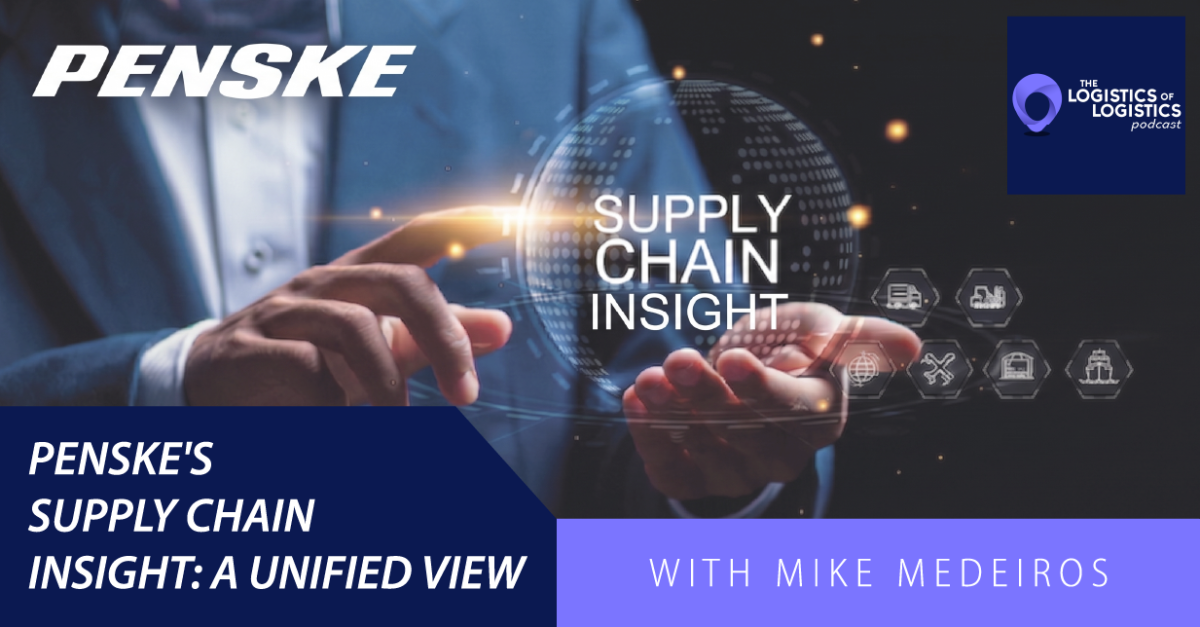
In “Penske’s Supply Chain Insight: A Unified View,” Joe Lynch and Mike Medeiros, Executive Vice President of Operations for Penske Logistics, discuss how their new product, Supply Chain Insight, turns complex data into a proactive tool for supply chain orchestration.
About Mike Medeiros
Mike Medeiros is executive Vice President of Operations for Penske Logistics, where he leads field operations and supports performance across the Penske Transportation Solutions network. He brings extensive leadership experience across transportation and logistics, including dedicated contract carriage and fleet operations. Medeiros has been recognized as a 2026 Pro to Know award recipient by Supply & Demand Chain Executive, honoring leaders driving operational excellence in the supply chain.
About Penske Logistics
Penke Logistics is a Penske Transportation Solutions company headquartered in Reading, Pennsylvania. The company is a leading provider of innovative supply chain and logistics solutions. Penske offers solutions including dedicated transportation, distribution center management, 4PL and lead logistics, transportation management, freight brokerage, and a comprehensive array of technologies to keep the world moving forward.
Key Takeaways: Penske’s Supply Chain Insight: A Unified View
- In “Penske’s Supply Chain Insight: A Unified View,” Joe Lynch and Mike Medeiros, Executive Vice President of Operations for Penske Logistics, discuss how their new product, Supply Chain Insight, turns complex data into a proactive tool for supply chain orchestration.
- Moving from Fragmented Systems to One View: The industry is shifting away from jumping between different TMS, WMS, and ERP systems. Supply Chain Insight provides a “single pane of glass” so you don’t have to toggle between multiple windows to make a decision.
- Proactive vs. Reactive Operations: With the Supply Chain Insight dashboard, both the logistics provider (Penske) and the shipper look at the same real-time info. This transparency lets teams get “upstream” to resolve problems before they happen, rather than just reacting to late shipments.
- Prioritizing Data Quality: The AI and analytics within Supply Chain Insight are only as effective as the data feeding them. The focus is on measuring data quality and ensuring the KPIs you’re tracking are accurate and actionable.
- AI as a Personal Analyst: A standout feature of Supply Chain Insight is the integrated AI assistant. You can query loads or identify performance trends using natural language, essentially giving you a dedicated supply chain analyst at your fingertips.
- Real-Time Asset Coordination: Having total visibility in Supply Chain Insight helps keep freight moving by spotting underutilized assets. For example, finding an empty driver nearby can solve an urgent capacity need and prevent a lost sale.
- Battle-Tested Internally: Before launching Supply Chain Insight to customers, Penske had their own associates use it first. This internal testing ensures that the platform is a stable and reliable system of record from day one.
- Managing Inventory and Carrying Costs: Visibility in Supply Chain Insight extends beyond the road and into the warehouse. Understanding real-time inventory levels helps shippers minimize carrying costs and avoid the risks of seasonal stock mismatches.
Learn More About Penske’s Supply Chain Insight: A Unified View
Supply Chain Visibility Software | Penske Supply Chain Insight – Penske Logistics
The Logistics of Logistics Podcast
Joe Lynch: [00:00:00] Hello, friends. Welcome to the Logistics of Logistics Show. My name is Joe Lynch. Thank you so much for joining us today. Today’s topic is Penske’s Supply Chain Insight, a unified view with my friend Mike Maderas. How’s it going, Mike?
Mike Medeiros: Wonderful, Joe. How are you today?
Joe Lynch: Doing great. I’m excited to talk to you about this. So Mike, please introduce yourself and your company and where you’re calling from today.
Mike Medeiros: Yeah, my name is Mike Mederis. I am the Executive Vice President at Penske Logistics. I have the pleasure of leading all of our operations throughout North America and Brazil, and I am calling from Redding, Pennsylvania where our corporate headquarters is.
Joe Lynch: Yep. We’re gonna focus in on just one part of Penske today. I know there’s a whole bunch of different areas we can talk about Penske. I say it all the time. I’m in the Detroit metro area where every automotive facility has Penske trucks. I don’t know if they’re your logistics trucks or the leasing trucks, but they’re, every facility has Penske.
So you guys are everywhere. But we’re gonna talk today specifically [00:01:00] about a new product. Talk about that.
Mike Medeiros: Yeah, so we’re on a journey with this supply chain insight platform and really trying to redefine the way we provide visibility to our customers and in, in a really a single source view. And it’s been an exciting road so far and we still get a long way to go but couldn’t be more happy with the team and where we’re at.
Joe Lynch: Yep. And there seems to be a kind of a recognition, I think, by the whole industry that we have all these cool systems now. A TMS, I might have a WMS, I have my ERP all the visibility platforms, and now I have this for the ocean, and they all seem to be out there. The problem is I have my information in all these disparate systems, and I’m trying to make good decisions, and you go yeah and Mike you’re a boss.
You could say to V- Joe, you, I gave you everything you need to make a decision.” I’m like, “Yeah, all I gotta do is log into these 15 systems to pull everything out, put everything into a spreadsheet.” And you’re [00:02:00] like, “Wait, did you go back to 1998? No spreadsheets. Make a decision.” So what you guys have created, something a little better than that.
What is that?
Mike Medeiros: And I think l- let me start with with our company. So we really plug into the supply chain for our customers really at various different stages, really from inbound to distribution, outbound, reverse logistics. And through all those stages, we have great tech. We have tier one technology but what we lacked was this unified view. And as we see more and more of our customers leveraging multiple services we provide, whether it’s dedicated in conjunction with some brokerage or some warehousing we found ourselves in that same position that you were, Joe, 15 windows open on any given day, toggling back and forth and really trying to connect the pieces on where’s my stuff, what’s going on, where do I need to be looking?
And supply chain insight really brings a unified platform, single site view to our customers and our associates on the front line supporting those customers.
Joe Lynch: Yep. So have you guys already launched this or are you [00:03:00] going to an event to launch this? What’s the story on this?
Mike Medeiros: Yeah we are in the process of fully launching for the full market launch May 4th and 5th at the Gartner Supply Chain Symposium. We have over 70 customers on the platform today. Those customers have been really integral in building out. So every four weeks, we do what we call a sprint to where we’re actively enhancing the system based on the feedback directly from our customers.
And that’s been in process since day one. Really excited about, how that shapes the future roadmap and where we’re going with this.
Joe Lynch: I think that’s, seems to be the new way to develop product is you bring in some of your trusted trusted customers and say what’s wrong? What can we do to fix it? And will you help us with feedback that you’re not developing it, you’re just providing ongoing feedback so we don’t go off and on a tangent and provide you something you didn’t ask for.
[00:04:00] Yep. And if I could add this one of the things I’ve noticed with AI coming, and this was the same with visibility. There’s a lot of, startups, and by the way, tho- those are startups are absolutely crucial. Those startups eventually get bought up by Penske’s and and other big players in the industry.
They tend to be very bombastic and, they’re VC back, so they gotta grow really rapidly. And they can say things because they don’t have the largest companies in the world depending on their s- on their services yet. Maybe they will, but they don’t right now. So they can say, “Hey, fire your logistics team, because we got this AI bot that’s gonna do it.
You guys, given who you work with you can’t be you can’t be an unstable platform. You can’t be taking wild risks. They just, your customers wouldn’t tolerate it, and of course you guys wouldn’t do it.
Mike Medeiros: [00:05:00] Yeah we absolutely need to keep, security execution in the forefront with everything we do. We’ve we work with some very large shippers and we wanna make sure that we’re protecting their supply chain as if it were our own. And, I’ll tell you, w- where we, with the services we provide, when you look at the landscape that we work across, it’s not uncommon to have our Penske associates embedded with our customers.
And I travel quite a bit and go out and visit our operators and operations. And, the shining moment for me is when I walk into a customer operation and I have a hard time disseminating which associates are Penske associates and which associates are customers. That to me is, it tells me still that a lot of
There’s still that personal touch and technology certainly is advancing us and helping, but people working shoulder to shoulder together really are making the difference.
Joe Lynch: Yep. Yep. Before we move on, who are your customers who are your customers and then who, who is this supply chain insight targeted at?
Mike Medeiros: Yeah, it’s directly targeted at our customers, so we do deal [00:06:00] with some of the largest shippers in the industry all different shapes and sizes. And like I said, we plug in, whether it’s on our transportation side through our dedicated services, we have a shared dedicated network. We also offer a brokerage offering to help with flex capacity. On the warehousing side, we support with flexible space, cross-stock support, as well as, full dedicated warehouse management with our technology en- embedded inside those four walls. And then beyond that, we do what I would call supply chain orchestration through our 3PL and 4PL models.
Really focus on network design and where can we lean out and optimize the network on behalf of the customers. In that space, we have, gosh, over six billion dollars in freight under management that we’re responsible for on behalf of our customers. What I would say is we deal with really the whole array when you’re looking from a shipper standpoint.
We, we have, single site, small regional shippers as, as well as, worldwide giant shippers that
We’re working with every day. [00:07:00] Yeah, absolutely. So it’s really where our customers need us. And and we really tailor those solutions to meet the specific needs of the customer.
You think about transportation, warehousing and, that supply chain management or orchestration, it can go a bunch of different directions and not every customer needs the same thing. And I think that’s probably one of the unique things about Penske is we really focus on identifying where our customers need us, how can we leverage our experience, our expertise, the operational execution with our team in the field and really help accelerate their performance.
Joe Lynch: I love it. I love it. So Mike, tell us a little bit about you. Where’d you grow up? Where’d you go to school? Some career highlights before you joined the mothership Penske.
Mike Medeiros: Okay. I grew up in New England. I I spent the first 18 years of my life in in Plymouth, Massachusetts. And from there I was ready to leave. And I I applied to two colleges, one in Florida and one in North Carolina, Elon University where I ended up going. I studied business at Elon, graduated from there in 2000, and you’ll you’re probably not gonna [00:08:00] believe this, Joe, but I have been working for Penske since the day I graduated.
So
I was coming out of school, I’m looking for a job, and I had interviewed with several companies up in the Boston Metro area. And I saw an ad, I think at that time it might have been on Monster. And I said, “This looks interesting.” And I’ll tell you what I went. I met with the the leadership team there and it was a culture fit from day one. I’ve been afforded the opportunity to hold multiple different roles. So I started my career as a management trainee on the rental counter in Boston, Massachusetts. From there, I’ve probably moved eight or nine different times with the company, spent my first 15 years on the truck rental and leasing side of our business, and then transitioned over to a l- our logistics business 11 years ago.
So it’s been a 26-year journey that has gone by very quickly, and I can tell you I wouldn’t trade it for the world.
Joe Lynch: Just from the little I know of you, you’re obviously very ambitious to be the executive vice president. The [00:09:00] fact that they had opportunities to keep you there. And now I gotta be honest, I was at a logistics company and I had some young guys that I had to say, “Hey, at some point, this is gonna be too small for you’re gonna have to move on.
And that was a ba- a bad feeling. Now, by the way, I can still talk to those guys all these years later Penske’s had those opportunities because I think they’ve grown with what I’ll call the new expectations for a logistics partner, for a transportation partner. 20, 30 years ago, it was like, “Oh, we got trucks, you need stuff moved.”
Now it’s, “Bring me not only the assets or but also I need you to bring me technology.” And I think today we’re gonna say, “I need the assets I need the technology, and I need the data.” I think our supply chains run on data as much as they do on trucks.
Mike Medeiros: Absolutely.
Joe Lynch: Yeah, so they, they must have had big opportunities Penske’s grown pretty quick.
How many people do they have when you join? Do you remember?
Mike Medeiros: I, gosh, I can’t recall. [00:10:00] I know in just in our logistics business, we have over 20,000 associates. You put that in perspective, it’s significant. I think when you roll in the truck leasing and rental side, it’s double that. It’s a, it’s been a great place to be. And with the growth has come that opportunity I would tell anyone out there looking for somewhere to land.
It’s just been a fantastic place to be. I think the culture and the people here are really what set us apart. So couldn’t be more happy with where I ended up in the last 26 years.
Joe Lynch: Yep. So I wanna talk to you about a few … Again, these are big shifts in our space. So first thing is why visibility and point systems fall short. So we talked the other day about this a little bit. We have more visibility than ever before, but we also have it all in these different systems, and you call them point systems.
Please explain.
Mike Medeiros: Yeah, i- regardless of the TMS, the WMS, where your data is housed, and like I mentioned to you, I think, this really started as a internal concern. Like we, we said, “How do we connect the pieces as our customers are asking us for more [00:11:00] end-to-end visibility of all the services and products we provide them, how do we connect those pieces?”
And, I think visibility, we identify pretty quick. It breaks down in between these systems. It doesn’t matter how good the system is, it doesn’t matter tier one, the best in class, how do you connect those systems? And really, that was where the precipice of supply chain insight. And, through that journey we’ve identified a whole lot more, but it was really, how do we get that unified view for our customers of their entire supply chain and aggregate that data in a way that’s gonna allow them to make data-driven decisions?
Joe Lynch: So you guys created supply chain insight to pull information from these disparate systems so I can have all my information in one place, whether it was from my WMS or TMS or visibility solution, and God, there’s so many visibility solutions now, this becoming just probably one of the latest. But we have the nature of it.
You have to connect with all of them. Now, is this a separate platform that I log into or is this connected to my ERP? How do I access this information
Mike Medeiros: This is [00:12:00] a … Y- you would log into this platform with the vision being this is the only platform you log into. And what I would say is I think it, it delivers the ultimate level of transparency because it’s the same platform our frontline leaders in the field are using to support the customer’s business.
So they are literally looking through the same pane of glass as our customers which to me is the ultimate level of transparency. I, and, we don’t wanna get a text or a phone call of where’s this or where’s that and why is it late? This whole product is designed to get us further upstream, provide that clarity and be that single pane to, to which the customer and our field leaders can work together on, preventing those disruptions before they even occur.
Joe Lynch: When you look in s- some people, still, a lot of people in our business, they’ll have three monitors. They’ll have the one in front of them, one to the left, one to the right, and they’re there, and they’re looking to make sure that, that trucking company that I just contracted with, that they’re, are compliant, that they’re o- they’re [00:13:00] good in our system.
I’m also looking over here into fraud. I’m also here looking at the network and, on time performance and all that. And the challenge is that guy or gal who’s sitting in that seat is the weak link and all of that. And the fact that they have to have three monitors we’re not meant to work that way.
I should be able to look at one monitor and do my job, ideally. And maybe we’re not all the way there, but I think the supply chain insight is one of those tools that’s gonna bring us all the way there. And the problem is y- that person, if they’re sitting there say, “Oh, I pulled this information, and I just texted Mike something,” and Mike sent me an email responding to it.
The, th- that’s not the, that’s not putting all the information where it needs to be. It all needs to feed up to one system, a supply chain insight that we’re all looking at. I can’t have somebody on the other side of the world, the other side of the country with information that all of us don’t have.
It just, it, that’s not the way it works.
Mike Medeiros: [00:14:00] Yeah. No, you’re 100% right. And I think that connectivity, that single pane, that, that’s really what starts getting us to that proactive state. And o- one other thing I’ll bring up, Joe, is while we’re talking about it, our customers have the ability based on, like you were talking, different people in organizations do different things.
They have different responsibilities. This system is configurable to the user level, to where they can log in and look at just the routes or the loads or the warehouse inventory they wanna see that they’re responsible for. They can save views, they can establish their own metrics based on what their, what is in their responsibility.
I think it’s unique in that regard where it really can be tailored to meet the needs of whoever the user is within the partner that we’re supporting.
Joe Lynch: I love it. I love it. And the next piece of all this, and this is another point that I had written down is data quality. So we still have data quality problems, and we’re pulling information in. How do you guys, when you get it, are you, what are you doing? Do you clean it up or is that [00:15:00] kind of expected before it gets pulled into the supply chain insight?
Mike Medeiros: Yeah, so I mentioned some of the things we’ve learned along this journey, and I will just say with good data, I’ve said that probably more than more than a few times over the last 12 months. But yeah, I think when you think of data one thing we identified early on this journey was we need to really understand what are those critical data elements that are driving accuracy in metrics and visibility. And they’re different by the service or the product or the system that we’re pulling them from, but we went through every single service that we provide and how it was feeding our supply chain insight platform and said, “What are those three, four, five critical data elements in each one of these services that if they’re not right, we’re not gonna have what we want, and the customer’s not gonna have that clear picture of their supply chain.” And we said, “Okay, we identified those. We figured out what those were. How do we take it to the next level? We’ve created dashboards and metrics [00:16:00] around our data. We’re physically measuring the quality of our data as it comes from the core system into our supply chain insight platform, and we’re managing the behaviors, we’re addressing the anomalies. W- we are at a position where we can, based on the data we’ve collected so far, we can automatically behind the scenes through AI close those gaps. We, we are probably you know, if I go back to where we started to where we’re at today it’s light years with regards to data, and it’s really changed the culture in our field from our field leaders and our customers too.
They’re really understanding how powerful this product can be when you have good data, with good data. It guarantees the metrics are right, it’s gonna make sh- make those KPIs so much more impactful, really drive those desired performance outcomes that we’re all looking
Yeah,
from all of our operations throughout North America and South America, Yep.
Joe Lynch: So when I think of [00:17:00] s- something being the formatting issues, little things like, okay, we say it’s 1:00 PM here, and somebody says, “Oh, you mean 13:00?” I need it all formatted the right way. I can’t be working with apples and oranges when I’m looking at my information.
Somebody’s gotta clean that. And so that, that’s, that speaks to the quality of the data, but somebody also might have to, I don’t know, clean it up or make it appropriate for us.
Mike Medeiros: Yeah. And when you’re pulling it into that single platform, you’re gonna get better visibility internally to where those gaps are. And I think just by the sheer volume of data that we’re pulling in, we’re gonna be able to identify those gaps early and often, really find out what the root cause is.
And is there a systematic way we can fix this without any human intervention going forward? That’s all things that we’re looking at on a daily basis.
Joe Lynch: Yeah. And, we’re not gonna get super deep into it today, I don’t think, but we all wanna use AI. I can’t feed AI a whole bunch of dirty data and say, “Oh [00:18:00] how’s that AI model?” It’s okay, but I’m giving it incomplete data, I’m giving it inaccurate data. Hopefully it can figure it out.
No it’s not gonna figure out something that it’s, it would, it’s garbage in, garbage out just like our old systems.
Mike Medeiros: Yep, it really is. One, one thing that we’ve been so laser focused on this data being right as it enters this platform is because the use cases for AI are robust. And w- we’re piloting right now an integrated AI assistant that really will … It has the ability today to query loads, orders, any exceptions.
You can ask it performance questions really without needing any dashboards or an analyst with you. The best part of this is it’s really designed to evolve into being really a personal supply chain analyst for our customers, and they can ask it anything. They can ask it to pop up a dashboard for them, show me the metric trends over this period of time. I think that’s really where we’re going with this, and we’re not too far off. And [00:19:00] when you look at what it’s already performing for us today we are, we’re not that far away from really having this as a personal supply chain analyst for our customers in the very near future.
Joe Lynch: Are you guys piloting internally?
Mike Medeiros: Yes, we started with our internal users. I think the one thing with any of this technology is, that adoption is crucial. If you miss out of the gate, people just don’t go back. They don’t trust it. And we wanna make sure that with anything we enhance or integrate into this platform, it’s been tested, it’s been tried, it’s true and it’s not gonna have the adverse effect.
We want people in here every day making this their system of record. This is where they go to do their job. We’re not gonna get that if we stumble out of the gate with things like this. So we’re really focused on making sure it’s right.
Joe Lynch: I’ve talked to a number of large technology companies in this space that have said, “Yeah, we have AI. We’re piloting internally.” And all of them are that, on, on that same place, recognizing that [00:20:00] the scale of your customers is such that you just can’t take chances. But also I heard somebody say it this way, and I really love this, they said it’d be dishonest.
If we weren’t using it internally and getting value, and then saying, “Hey it, we’re eating our own cooking rather than say, Hey, Mike, have a taste. Tell me if it’s, how’s this, how is this? And you go, say it’s horrible. Oh, all I guess I could have tasted it here internally. So you’re eating your own cooking for a while, and then when it does get launched, it’ll be solid.
And I’ll contrast that a little bit with, there’s a ton of AI startups and I’m not against any of this that’s no hate here, it’s just they don’t have massive teams to tr- try it out internally. You guys have 20,000 associates who can try this out prior to you rolling it out to your customer. So when it’s a solid solution is when you guys roll out.
Mike Medeiros: I think it’s, … I’ll tell you a little side story here, AI has really just become prevalent over the last year or so. You hear it so much more today than you did, [00:21:00] and, I, we talked to our IT team and they’re like, “We’ve been doing this AI, we’ve been doing this for, over a decade.”
And you go back and we’ve had, predictive analytic models built by our team, our data scientist team, and we were predicting driver turnover, warehouse worker turnover, we’re we’ve had these in place for a long time. And this is just the next iteration. It’s how can we take some of the lessons learned over those predictive models and push those into, through our experience, push those into the capabilities of this AI assistant or this supply chain analyst that we’re building out and really make it impactful for the end user.
Joe Lynch: Yeah. It’s amazing. And, anyone who uses a mobile phone goes through this where you’re talking to your buddy about a ballgame or whatever, and then the next ad you sees for tickets or what you’re like what’s going on here?” And I keep thinking it’s just a matter of time before we get to the place where you say I got a message from Penske about blank because the systems know that I’m in trouble, or the systems know that there’s an opportunity to save money.
We’re getting [00:22:00] better and better at this every single day.” So there’s a big shift here and we talked about a little bit already, but it’s the need for the sh- one operational view. I know you guys created this really with your customers in mind. What is the, what is, what were they saying and then what is the value that they’re getting, for the 70 companies that are already using it?
Mike Medeiros: Yeah it what we heard was you guys provide great service down and in. So down and in dedicated contract carriage you’re excellent there. Warehousing, you do a great job for us. Supply chain management but where we share your support and those services across our business we can’t see everything that we need to see to be as successful as we can.
That, that was what we heard. And, I’ll give you an example because it’s recent and it’s on my mind. We were doing business for a large scale grocer out on the West Coast and our operator happens to sit at the the distribution center with his counterpart and the counterpart came in hair on fire.
It’s going into Thanksgiving holiday and he says, “I got [00:23:00] a load of turkeys, two loads of turkeys, full trailer loads sitting at a cold dock. I can’t get coveraged. I can’t find capacity to get these to the DC. The trucks are sitting at the dock waiting to go. And my fr- my frontline leader pulled up supply chain insight, identified a dedicated driver coming back empty with a refrigerated trailer, rerouted them right to the cold dock, picked up the turkeys, brought them in to the distribution center.
I think they sat on that distribution center for about two seconds before they went out on those route trucks and wound up on Thanksgiving day tables across the communities that we serve out there. That to me told me we’re on the right track with this. When you saw how quickly they were able to make that happen, they pulled it together with a quick conversation, a couple clicks of the mouse, and all of a sudden we’re rerouting a driver and we’re solving a real problem in real time before it created a disruption.
Joe Lynch: And I gotta say this, I think, a lot of the conversations I’ve been having lately are, [00:24:00] “Oh, there’s disruption because of the conflict in the Middle East. There’s problems with, this port or that port, the war in Europe.” We seem to talk about those just like it’s daily. And, since COVID, we all thought after COVID, it’ll just go back to normal.
It’s never gone back to normal. It feels like the disruptions are constant. And I’ll throw this out there. I think a few things happen. First off, we have visibility tools that tell us that didn’t arrive on time at the port. It used to be, I used to receive stuff from the port. I used to ship stuff to China back and forth into Thailand.
I remember the, I remember my supply guy, an automotive company saying Joe, don’t bother me. Come back next week, late next week.” That would be it. Come back late next week. We don’t manage supply chains that way anymore. And it used to be, hey, that goes from Shanghai to Long Beach, it’s picked [00:25:00] up.
We never changed for years, and now if Long Beach is slow or expensive or slow down, we’re gonna move it because the customers that we have, whether they’re the end customers, we’re all very impatient, but also the retailers and the, the Amazons of the world, they’re like faster, and they have scorecards and we have visibility into this.
So I think the bar has really risen for logistics and transportation. We expect more.
Mike Medeiros: Yeah. I think the consumer drives the behavior and it’s, it is. It’s more faster, but don’t sacrifice the quality. And w- we, I routinely will tell the team, our primary focus is safe, on time, professional, in full. If we break it down and simplify it, that’s where we wanna be.
We wanna be safe, on time, efficient, and in full. And it’s not going away. We gotta continue to lean into those opportunities to use technology to make us m- make us better. And this is one of those moments where, you know, that, [00:26:00] that single pane of glass I think is really the
I’ll, I’m gonna go back to it again. It’s the ultimate level of transparency, for me, gone are the days where you go to a customer meeting and you, they say, “Show me your KPIs,” and someone’s been up for a week or two weeks pulling them together and putting them into a PowerPoint and going to Kinko’s and binding them and, those days are gone.
The business reviews of today are us opening a computer, plugging into a screen and having conversation with our customer on what are the trends telling us? What are the metrics showing us? Where do we need to double down? Where do we need to focus?
Joe Lynch: Yeah, Mike, I’m, I’ve always been a big believer in KPIs, and I always say only the best metrics grow up to be KPIs, and give me four or five good KPIs to manage. And then I always say that’s when the conversations begin. Because you say what is this telling me? ” I had a boss years ago. I worked in engineering.
I remember I sent him spreadsheet which he, he wrote back, “What am I supposed to go through this and determine what’s [00:27:00] going on? ” He goes, “I wanted you to do. That’s what you’re getting paid to do. ” And so he said, “Next time you send this, you can send me the Excel, but I want in the body of the email, what are the findings?”
And I think those are the kind of conversations we wanna have with our customers and our associates. With a company as big as Penske, a lot of times it’s probably internal. We’re gonna have these good internal conversations, but I can’t have them if I have a little bit of data and I have to guess the rest of it.
Mike Medeiros: Yeah, no I, and what I’ve seen, what I’ve seen the product do is it’s generating those conversations exactly what you’re talking about, a lot from our frontline leaders. They’re looking, where do I have lean opportunities? Where can I make sure this doesn’t happen again? And they’re proactively working with the customers on, “Hey if you can do this, we can make sure that we don’t experience what we experienced last time.”
And those are the conversations that are more prevalent today than probably ever
Joe Lynch: Yeah, I think also, we all want to move our execution teams from a place of harried ex- execution, dealing [00:28:00] with exceptions all day. And I wanna move them to a place where you say, “Hey, Mike, if we move this on, you called us on Monday rather than on Wednesday, we could save you 10%.” And by the way I think we’re carrying a little more inventory than we need.
We, we could save you some money on carrying costs over here. That’s where I want my team kind of being in that consultative place. And let’s face it, our business is growing out of this, but we’ve been a business of exceptions where, people call and say, “Hey, you guys were late.” And I always say, “I’ve always been a scorecard guy.
Yes, we were late that one time and we’re working to make sure we don’t do it again, but did you see the other 200 shipments where we’re on time and in full?” That is where we’re trying to get to, but I can’t get there without the, without this good data.
Mike Medeiros: Yeah. Yeah. Yeah I think you, you’ve definitely been around Joe. I’ve had that conversation a few times. What about the other ones where we weren’t late, but it’s yeah it, I [00:29:00] think taking that historical late data and looking at it over a longer period of time that’s really where we can start seeing those trends and identifying, is it seasonality?
Is it, a certain road? Is it a highway? Is it a touchpoint somewhere within the supply chain? And what do we gotta do? We gotta figure it out. And I’ve just seen such a relentless focus from our team in all the departments, whether it’s IT, engineering, how do we solve for this to really make a better day tomorrow?
And that’s been, it’s been the mainstay here. So it’s exciting. It’s really exciting.
Joe Lynch: Not so long ago, I spoke to John Larkin. He’s a industry legend and money guy, and I was asking him, the biggest trucking companies are just a few percent of the market.
And he said, “Yeah, but Joe, they’re m- wildly more efficient. They buy better. They utilize better.” They have the network density, they have all the stuff that is going to allow them to grow. And so sometimes people look and go, “Oh, those guys have a lot of trucks. Those guys have few [00:30:00] trucks.” A- a little fleet versus a big fleet.
The big fleets are oftentimes much, much more efficient because they can be. They’re gonna have the funding, they’re gonna have the the density and the customers that allow you to grow in a way that makes sense. Meanwhile that’s not to discount any of that. We absolutely positively need all those independents out there too, to fill the gaps.
But the bigger companies they do it better. That’s why they’re bigger.
Mike Medeiros: Yeah. A- and we’re fortunate, right? We certainly have Penske Truck Leasing as a extremely strong partner. And I think if I look today, we probably have more than 20 emerging technology maintenance, new ma- maintenance technologies that we’re piloting on out in the field with real use cases and pulling that data in and really understanding what’s the impact to MPG, what’s the impact to efficiency?
How does the driver feel about it? And being able to do that in real time with real applications with a partner like Truck Leasing, [00:31:00] Penske Truck Leasing is, you can’t find that everywhere. And I think it’s a it’s really helped make us stronger, make us better, but more importantly it, we use fleet is an advantage for Penske Logistics.
We, tr- I think there’s 900 or more brick and mortar truck leasing facilities where we have access to get maintenance anytime of the day. They’re twenty four seven over the road coverage is best in class. They’re fix- today they’re fixing trucks over the air without the driver ever coming into the shop, which, you look at the level of service that we’re afforded and what it translates to our customers is it’s uptime.
It’s uptime and it’s on time and that’s really where the rubber meets the road when you’re talking about our dedicated or truckload
Joe Lynch: Yep. So one more time, what is the benefit that your customers, and again, you’re just starting to roll this out, 70 customers so far, soon to be, I’m su- I’m assuming thousands will be using this b- before too long. What are the benefits they’re getting? What are the … Is this saving them money, making the money?
What are they doing with all this information?
Mike Medeiros: I would l- I would like to [00:32:00] think it’s saving them money. And I, you use that turkey example as an example that would’ve translated to lost sales in some mode. Maybe they would’ve got it there. It wouldn’t have got there as quickly as it did. That certainly would’ve had an impact on the stores and the sales there.
I think where they’re using it is to take and aggregate the data over a period of time today. This is a lot of the conversations we’re having and say, “Is this telling us something that we didn’t see before?” And those are the, those are more of the conversations we’re having. And, it, it has great visibility.
You can see where’s my stuff and with good data, you can see exactly what’s in that truck. We have customers that, their data is of a extremely high quality and we can see down to every part that we’re delivering and how many are in there and where do they, where are they going and what time are they gonna be there? And the customer can go in and set up proactive notifications and say, “I wanna know if this load is gonna be late by 10 minutes because it’s that crucial to my customer, my end user.” So [00:33:00] I think that’s really where we’re seeing a lot of usage is, those proactive notifications a lot of customization around what are the metrics I need to be on top of every day and really focusing the hunt for our customers. Instead of having to weed through countless dashboards and metrics and pivot tables and spreadsheets, now they can go to one place and set up a, an environment that is gonna give them exactly
what they wanna see.
Joe Lynch: The other day when we’re prepping for this call, I I mentioned that when I was in automotive, I did some lean facilitation and we would always kind of … Lean looks at order to cache and we would use the term end to end or order to cache. Most manufacturers use that kind of talk.
And we’ve created all these siloed systems, which by the way, every single one of them was a miracle. The first time I saw a TMS, I couldn’t believe it. I remember presenting it y- years later to a c- just some [00:34:00] spreadsheets. I said, “You guys aren’t using a TMS, this was a large shipper that should have been.”
I think their brokerage was, and when I showed them these screens that just s- screenshots, they’re like, “Oh my God, this is unbelievable.” Those were miracles. Warehouse management was always spreadsheets or paper. So we’ve had all these unbelievable technology breakthroughs, but like all breakthroughs, they lead to the next dissatisfaction.
And that dissatisfaction is these point systems that aren’t necessarily all connected in a way that lets us see everything. And when somebody says, “I want order to cash and I want flow,” that’s what the big companies asked us to do. And we go, “You want flow? We got a whole bunch of point systems for you.
And now this gives me a sense for flow. I, this gives me a sense for end to end, and I’m assuming it’s just gonna continue to grow and pull in more and more pieces of the supply chain as opposed to [00:35:00] just over the road transportation, which our industry tends to be very inward looking on that stuff.
Mike Medeiros: Yeah, we’re already, the platform already l- is being leveraged inside our warehouse operations to look at inventories, to understand, how quickly product’s moving, where do I have potential shortages or outages? We’re losing it with our supply chain management team and the third party carrier partners that we support and just having that aggregated visibility has been game changing because you, you hit the nail on the head, Joe, you go back and you could have the best transportation management system.
It could be the best and you could build all the greatest add-ons around it, but that’s where it ended. If you brokered a load for that customer, you lost that visibility. If that customer asked you to move that, some product and store it in one of your warehouses, you had to go to another system to see that product. And really what this does is it takes that away where there’s more toggling,
Joe Lynch: Yeah, Mike, I think there’s also another piece to this, which is [00:36:00] we tend to look at transportation and logistics and say, “Oh, I can save you 50 or $100 on a truck.” And if you’re being more strategic, you’re like, “We’re gonna, we’re gonna improve your business and save you 5% over the course of a year.” There’s, we’re gonna streamline the process.
What we don’t always talk about is inventory and the cost of carrying inventory. And we learned during COVID how nasty inventory can become when it’s late, when you bought too much, you expected those sweaters to arrive in November and they arrived in January, now you can’t sell them all by the end of the year.
And we all want to be lean. The, when you have stuff on shelves, s- bad things happen. You don’t want sweater, like we’re talking right now, April 24th, we do not want a whole bunch of sweaters from wintertime on my shelves anymore. I need to get the shorts in here. And the same I’m an automotive guy.
When we would, anytime we had inventory, we had so many product changes that parts were obsolete. And these [00:37:00] ve- very expensive parts would go obsolete because we’re carrying inventory. So not only do we need to have visibility into my transportation, but also into my inventory carrying costs, which are sometimes gonna be higher than transportation costs.
Mike Medeiros: And I, and again I think it’s that data and working with our customers to make sure that we’re supporting them the same way we went on that journey on how do we drive and ensure with good data, quality data at every opportunity, specifically around these critical data elements that you absolutely need them to be right, to get those metrics that you can really dig into and identify where there’s opportunity.
And I that, that’s gonna be the changer. I think people are already recognizing that, you need good data to move faster, and the demand is there. We have to move faster. Being ahead of that curve from a data standpoint really challenging our customers in a professional way to, to say, “You gotta get this right for us to be able to deliver X, Y, and Z.”
And [00:38:00] th- those are where we’re spending a lot of our time and it’s exciting because I, after being doing this for a long time you, you’re always so used to reacting when something goes wrong, like we talked about earlier, and it’s, how do I get out of the hamster wheel?
I, when something goes wrong it’s inevitable. That’s not the only thing that’s going wrong that day in this world. Y- getting to where our people feel like they have a mechanism and a method to get further upstream, to head those problems off before they happen and really work shoulder to shoulder with our customers that’s the exciting part, because that’s where the, that’s where we wanna be doing.
We wanna be innovating, we wanna be optimizing, we wanna be looking at how do we tweak this solution to make it even better and more resilient and more agile for our customers so the next time there is one of these events we’re prepared for it, we’re prepared, and it that’s, those are the exciting conversations.
Joe Lynch: Yeah, Mike, I think everybody expects more from their vendors than ever before. In the past if you were a trucking company, you did not [00:39:00] have the same level of supply chain expertise as the supply chain that you served. I think that’s changing. And by the way, you’ve also implemented technology outs- that you might’ve bought from someone else.
In the past, it was like, “Hey, could you help us implement this? ” “Hey, we sent it to you. What else do you want? “We’ll send a consultant over. Now the, now if you guys, you’re probably doing it internally, but if you guys were to buy an outside technology, the expectation is they’ll send experts and it’ll be a painless process.
I think the biggest companies in the world expect that now from their transportation logistics partners. They expect that proactive, proactivity that you just talked about. They don’t expect to say,” Hey, we won the business. Now what? ” [00:40:00] Yep. Mike one last time who is the customer for supply chain insights?
Let’s just say somebody’s listening right now, they go, ” Oh, I leased some trucks from them, and I’ve done some work with them. “Who, is this for anybody who’s working with Penske?
Mike Medeiros: it’s for all of our logistics customers. So when you think about our logistics customers, their dedicated contract carriage customers, our share dedicated customers, our brokerage customers, our truckload customers, our warehousing customers our supply chain management customers, all those customers [00:41:00] have access to supply chain insight.
Any new customer we bring on today immediately, granted the access supply chain insight in that single pane of glass. Really any, anyone we support from a customer standpoint on the logistics side they have the supply chain insights for them.
Joe Lynch: Does it take training? Does it take long to implement?
Mike Medeiros: It doesn’t thankfully, because there’s, like I said there’s other, core systems driving it. We use a system for our transportation that feeds the supply chain insight. We use a system inside the four walls that we manage that feeds supply chain insights. So really supply chain insight is just the aggregator.
It aggregates that data. It displays it in a view and a method that is easy to use for the user and allows them a lot more opportunity to customize and specialize what they’re doing and what they’re seeing on a day-to-day or month-to-month basis.
Joe Lynch: Yeah. I think there’s a new paradigm when it comes to systems like this of a friend of mine was im- implementing a new parts and service for, a [00:42:00] parts and service solution for all of their distributors around the world. And I remember he said to the developers,” I want it to be like Amazon, and I want you to copy what Amazon does.
“And so then all these distributors were calling him and saying,” Hey, I’m gonna come for the training. “And he’s ” There’s no training. ” And I was like, ” That’s smart. “Like the a- the whole idea, you use Lyft or Uber if somebody said,” Hey Mike, all you gotta do is go online and take a, like a 30 minute class so you can learn to use Uber, be like, no, the, it’s a, the reason we like it is because it’s intuitive, I know right away, I call it consumer grade tech.
Consumer grade tech doesn’t make me take training or hit control F8.
Mike Medeiros: Yeah. Oh, yeah, absolutely. And that’s exactly what we’re doing. And when there is that moment in time where the user has an issue, our customer success team is right there they have the ability to remote login and actually walk that individual through, like I said, [00:43:00] this is how you do what you wanna do.
And I think that, that builds that comfort, that builds that adoption and really makes them move closer to that, super user that we’re wanting them to be. We want them to have everything they need at the, at their fingertips at any given moment in
time.
Joe Lynch: Mike, I’m gonna lose you in a few minutes, so I’m gonna wrap this bad boy up and then I might your final thoughts on the topic. So I’m talking to my friend, Mike Maderas. We’re talking about Penske Supply Chain Insight, a unified view. So we talked about Penske Logistics Fen- Penske Transportation.
And this brand new tool that you guys are most brand new solution, it’s probably bigger than a tool, brand new solution that gives me that single pane of glass that lets me see if it’s not right now, end to end, it’s pretty close and it’s getting better every single day. We’re adding, they’re adding new fields, and this is gonna give me that unified view so I don’t have to pull up my warehouse management system and my ERP and my order management system and my TMS.
I don’t have to go over to the [00:44:00] visibility solutions. All the information’s pulled into one place so I can see it and I’m, and they’re normalizing it, making it so I can look at it with the right insights. And because one of the problems you always run into with all these kind of things is incomplete data inaccurate data, half the data that, that’s not good enough.
So these guys are pulling this, all this information and this stuff gets better every day. And again, we’re gonna need this kind of data eventually to pull for our AI. So we talked about a few things. We talked about why visibility and point systems fall short. The biggest supply chains in the world trusted us, the logistics world, the transportation world, warehouse world to create flow.
And what we gave them back was a whole bunch of point systems. And this is finally our industry saying, no, we can give you the view that you need. We can give you the flow that you expect for your supply chain. By the way, they’re not doing it internally either. They’re doing the best they can. And the reality is we all want good data and the data quality has [00:45:00] become a constraint.
And you’ve just talked about you guys are actually measuring the quality of data and trying to get to the place where you’re measuring saying, “This is what this data needs to be. ” It can’t just be like, “Hey, we pulled in that information and maybe it’s right, maybe it’s wrong.” We can’t have that if we’re gonna feed it into AI.
You can’t have it if it’s gonna, it’s gonna determine how I make decisions. We also talked about the need for one operational view. I don’t wanna talk to you and have you say, “Oh yeah, everything’s going good.” And then I’m look- because you’re looking at one, one view of the data and I’m looking at another view of the data, we need to have that shared view, the shared vision of what, what’s going on in the business.
We also talked about how you guys built this. You guys took 70 customers that you’re already working with and said what do you need?” And then also you rolled it out internally to let your team use it, which is a pretty big team, probably bigger than most of your customers. But that’s important because I think this is the way technology’s being developed today.[00:46:00]
It’s not, we’ll go off into a back room, create a whole bunch of technology that we think you need and then roll it out to you and you go, “Nah, that’s not what I needed.” You know what your customers need because you’ve been working on it and you guys are also using it. You’re eating your own cooking.
Anyway, very cool solution. Put a big old bow on this one, Mike. Final thoughts on the topic.
Mike Medeiros: I’ll do my best, Joe, and thank you. What I will say is Penske Logistics is committed to accelerating supply chain performance on behalf of our customers. That, that’s our focus day in and day out. What we’ve built with the supply chain insight platform, it’s really to given the ability to run your supply chain through a single pane of glass and that transparency between our frontline operators and our customers looking at data in the same fashion, the same manner, in the same moment, you just really eliminate the noise.
You eliminate that lag, that second guessing that has historically slowed everything down, and supply chain insight, i- it enables us to move differently, and it makes us [00:47:00] faster leads to fewer disruptions, and ultimately accelerates that performance on behalf of our
Joe Lynch: I love it. I love it. I’ll make sure I put a link to your LinkedIn profile, link to your website, any of the links you and your go- to market team give me, I’ll put those in the show notes. So I know you’re going on the road to talk about supply chain insight. Talk about some of the places you guys will be
Mike Medeiros: Yeah, so we’ll be
Here at Gartner Supply Chain Symposium and in, in Orlando first week of May, And then later this year, we’re gonna be at CSCMP, as well as the Next Gen Supply Chain Conference, both I think in Nashville this year in October. So looking forward to those events coming up.
Joe Lynch: I’m assuming there’s gonna be lots of press releases and all sorts of other o- other appearances maybe on other shows. I’ll make sure I put a link to all of those in the show notes. And Mike, thank you so much for taking the time today.
Mike Medeiros: Thanks, Joe. Really enjoyed it.
Joe Lynch: Yep. And thank all of you for listening to my podcast, your sports.
Very much appreciate it. Until next time, onward and upward.
Your Content Goes Here