
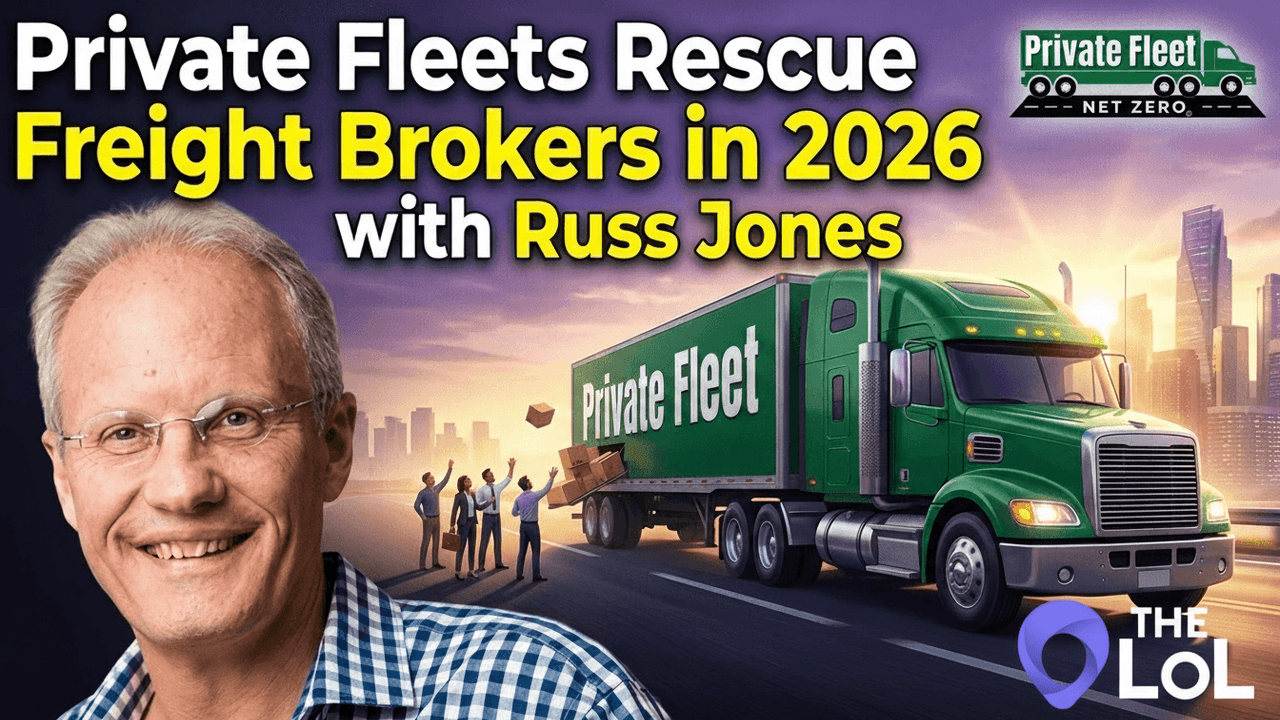
In “Private Fleets Rescue Freight Brokers in 2026”, Joe Lynch and Russell Jones, CEO & Co-founder of Private Fleet Net Zero, discuss how unlocking empty private backhauls provides brokers with discounted, high-quality capacity to combat fraud and skyrocketing liability.
About Russ Jones
Russell Jones co-founded Private Fleet Net Zero to help the 45% of trucks that are in Private Fleets with usually empty backhauls find loads from $50B+ of 3PL freight spend, leveraging his leadership of Cargo Chief, which enables 1,200+ 3PL buyers with $8B+ of spend to buy transportation capacity more profitably. Previously, Mr. Jones co-founded and led two cloud-based physical security firms. He was also the founding CEO of Clearvox Communications, which pioneered the market for cellular phone headsets, which he sold to Plantronics. Beforehand at Adaptec, Mr. Jones doubled a $50M channel products business to $100M. Mr. Jones has been awarded 10 patents, and holds a BSBA with highest honors from Boston University and an MBA from the Harvard Business School.
About Private Fleet Net Zero
Private Fleet Net Zero, PFNZ, is uniquely aggregating 10,000s of trucks with 1,000s of lanes of underutilized, underpriced, theft-free and superior private and dedicated fleet trucking capacity and matching via multi patent-pending technologies and artificial intelligence to $10Bs of freight spend registered on our cloud-based platform, while generating a compelling client ROI. Our network is quickly and efficiently growing both fleets and 3PLs on PFNZ, which is on a path to save 30M+ tree equivalents.
Key Takeaways: Private Fleets Rescue Freight Brokers in 2026
- In “Private Fleets Rescue Freight Brokers in 2026”, Joe Lynch and Russell Jones, CEO & Co-founder of Private Fleet Net Zero, discuss how unlocking empty private backhauls provides brokers with discounted, high-quality capacity to combat fraud and skyrocketing liability.
- Massive Fleet Scale: Private Fleet Net Zero (PFNZ) has rapidly aggregated 80,000 trucks and 40,000 lanes of coverage, using patent-pending AI to match this massive pool of underutilized capacity with tens of billions of dollars in registered freight spend.
- The $150B Backhaul Waste: Private fleets (where the cargo owner owns the asset, like Walmart or Sherwin-Williams) make up 45% of all trucks on the highway, yet they run empty 80% of the time on their backhauls, leaving a $150 billion pool of premium capacity sitting idle.
- Pure Profit for Fleets: Because the primary “front haul” already covers the driver’s salary, equipment, insurance, and core fuel costs, any backhaul revenue captured through PFNZ represents a 95% pure profit margin for the fleet owner.
- Quadrupled Broker Margins: Brokers can secure this premium capacity at a 25% discount to the market rate. In a tight market where a typical gross profit might only be $150 on an $1,150 load, cutting carrier costs from $1,000 to $750 can effectively triple or quadruple a broker’s net margins.
- Eliminating Fraud and Liability: Shifting to private fleets bypasses the modern plague of cargo theft, cyber fraud, and “chameleon carriers” who hide bad histories under new DOT numbers. Furthermore, because private fleets have newer equipment and a third less accidents, they shield brokers from catastrophic multi-million dollar “nuclear verdicts” tied to carrier safety under the recent Montgomery ruling.
- Combating the 2026 Capacity Crunch: Massive federal enforcement of English language proficiency rules is projected to strip 25% of for-hire drivers (400,000 to 600,000 drivers) off the road. PFNZ rescues brokers by giving them an automated “outsourced recruiting team” to tap into stable private capacity that was previously heavily monopolized by the top 10 mega-brokerages.
- Seamless Integration & Sustainability: PFNZ connects to a broker’s TMS within weeks via APIs, reports, or an AI bot to automatically map buying patterns. By eliminating empty miles, the platform is on track to save over 45 million tree equivalents in CO2, giving public companies and shippers a verifiable decarbonization story for SEC and board reporting.
Learn More About Private Fleets Rescue Freight Brokers in 2026
Private Fleet Net Zero | Linkedin
Private Fleet Net Zero: The Deadhead is Dead with Russ Jones
The Broken Safety System Threatening Shippers and Brokers with Chris Burroughs
What is Blue Ocean Strategy | About Blue Ocean Strategy
The Logistics of Logistics Podcast
Joe Lynch: [00:00:00] Hello, friends. Welcome to the Logistics of Logistics. My name is Joe Lynch. Thank you so much for joining us today. Today’s topic is private fleets rescue brokers in 2026 with my friend Russ Jones. How’s it going, Russ?
Russ Jones: Joe, things are doing great. Thank you for having me on your show. It’s a great time to talk to you about what’s happening with private fleets today
Joe Lynch: I love it. I love it. So Russ, please introduce yourself and your company and where you’re calling from today
Russ Jones: Sure. So [00:00:30] I’m Russ Jones. I’m the co-founder and CEO of Private Fleet Net Zero. I’m here in Northern California. And at a very high level, think of us as match.com for private fleet backhaul capacity, enabling savvy brokers to buy truckload capacity for– with superior service at a twenty-five percent discount to market
Joe Lynch: So when you say private fleets, that is not a common carrier, right? What is a private fleet?
Russ Jones: That’s a great, that’s a great [00:01:00] question ’cause some people think it means a public or private type company. What it really means is when the owner of the cargo owns the truck and employs the driver. Think of Sherwin-Williams or US Foods or Walmart. Those are entities that own their own fleet of trucks, employ their drivers to haul their own cargo.
What’s amazing, Joe, is that this represents 45% of the trucks on the highway, and then get this, they’re empty 80% of the time [00:01:30] on their backhauls. This is, we’re talking about $150 billion worth of truckload capacity that’s waiting to be taken advantage of
Joe Lynch: Yeah, and so these companies, they buy those trucks because they are very interested in the front haul. Not that everybody isn’t, but if you’re delivering to a grocery store, if you’re delivering to a big box store, at some point these big brands … First off, I think they like the idea of seeing their trucks with the, their name on the side.
It gives them more control. It’s [00:02:00] not necessarily a cost savings. Sometimes it might be, but I don’t even think that’s the pitch that those guys are, them having their own fleet, I don’t think they think of it that way. They say, “We’re big enough that our, and our brand is important enough to us that we are going to do this right.”
Russ Jones: It ensures that they can make the deliveries that they’ve committed to their customers and to their DCs. So the Sherwin-Williams truck leaves, Pittsburgh, the factory, and goes to Chicago. They know that truck’s gonna arrive and deliver, [00:02:30] Sherwin-Williams product to the D- DC in Chicago.
And then it return… say they do that on Wednesday, it returns back from Chicago to Pittsburgh every Thursday literally empty 80% of the time
Joe Lynch: Yeah, so how is your company, Private Fleet Net Zero, taking advantage of, I shouldn’t say taking advantage, working with these private fleets and brokers? What’s your role?
Russ Jones: So what we do and Joe, is what we do is we run around to all the private fleets, and we’ve now amassed eighty thousand trucks, forty [00:03:00] thousand lanes of coverage. And we get from them their empty backhaul lanes. They are all set up to haul someone else’s cargo, and they they’re interested in doing so.
They have metrics around empty miles. They ha- they want to get the revenue. What’s really interesting is in our example for Sherwin-Williams, their truck’s full in Pittsburgh and goes to the DC and Chicago. On the return trip, they’ve already paid for the driver, they’ve paid for the truck, they’ve [00:03:30] paid the maintenance, they’ve paid for the insurance and most of the fuel.
So if they get any revenue on the backhaul trip, it’s ninety-five percent pure margin. This is an incredible opportunity for the private fleet, and it’s a great opportunity for savvy brokers to be able to buy at a twenty-five percent discount to market. Everybody wins, and the ecology wins as well, right?
Now you’re filling up, and now we’re making it so we don’t have to have a second truck go from Chicago to Pittsburgh and have [00:04:00] another truck, like a Sherwin-Williams truck, return empty. Now you’re filling a truck, so there’s fewer empty trucks running around
Joe Lynch: Yep. And we’ll come back to this, but I wanna ask one question of you ’cause I already know the answer to this. Are some brokers already taking advantage of this opportunity?
Russ Jones: They are, and they’re f- they’re really frustrated in twenty-twenty-six with all of the theft, the chameleon carriers, the ruling from the Supreme Court the English language proficiency issues that’s happening in the [00:04:30] for-hire fleet world. And so they’re using Private Fleet Net Zero to secure superior truckload service at a substantial discount, game-changing discount for most brokers, tripling, quadrupling their margins and they’re thrilled about it
Joe Lynch: Yeah, and by the way, Russ, I happen to know this ’cause you told me this. The biggest brokerages are already doing this. They can hire big teams. They got a dozen guys who are just going out and getting capacity at these things and, [00:05:00] yeah, capacity from these private fleets. And you don’t most companies d- don’t have those kind of resources.
But it’s also, I know of a few of those big companies that say, “Why would we go get that when Russ and his team have already built it?”
Russ Jones: That, that’s a great way of thinking of it. You can think of Private Fleet Net Zero as an outsource private fleet recruiting team for your brokerage. That’s a great way of thinking of it. The most, the largest brokers, we’re talking about people that buy five billion dollars or more of [00:05:30] truckload capacity, usually have a team of people focused on exclusively c- recruiting private fleets, and they buy a substantial portion of their cargo or their s- their trucking service from private fleets because it has great service advantages as well as a cost advantage, which enables them to beat other 3PLs.
We’re making that available to now all 3PLs, leveling the playing field
Joe Lynch: Yeah. And before we hit the record button, we were playing around with titles, and the first title we came up with, it was the cost of bad carriers: [00:06:00] fraud, theft, and liability with Russ Jones. Right now, the, as you mentioned, the Montgomery ruling, additional liability, freight fraud is still an issue, th- and cargo theft obviously still an issue.
And these carriers, private fleets, they have they have their own trucks. They have drivers who usually have a lot more tenure. They’re safer. They have better equipment ’cause they have their name on the side, and they’re [00:06:30] not gonna steal your freight. That is not the business they’re in. You’re not going to infiltrate a Fortune 500 company to steal like we have in much of our industry right now
Russ Jones: Yeah, it’s very different. Think about Sherwin-Williams or US Foods. Think about all the s- the maintenance, manuals, procedures, newer trucks, better paid drivers. Compare that to four-truck Fred on some giant load board who you’ve met [00:07:00] once, never heard of, never will use again, and who can barely keep tires on his truck.
And private fleets are in a third less accidents. Their trucks are newer. The drivers, they’re– They also have proper insurance. Sherwin-Williams doesn’t want to, have anything happen, so they have plenty of insurance. They’re not a chameleon carrier. It’s very clear who Sherwin-Williams is.
And so a lot of the bugaboo issues that are plaguing freight brokers can be resolved by them [00:07:30] shifting to work with private fleets or dedicated fleets. If you think about Kimberly-Clark, they might say, “Hey, I need a hundred trucks. I don’t want to own the truck. I don’t want to employ the driver, but I want to tell the truck where to go.”
So they go to a large fleet, maybe like Sherwin-Williams– excuse me Schneider, a for-hire carrier, and say, “I need a hundred trucks.” And so those trucks are busy on their head hauls, but dedicated fleets are also empty a bunch on their back hauls. And we focus in on that, and we have dozens of [00:08:00] private fleets and dedicated fleets on our platform that, as a group, represent eighty thousand trucks of coverage.
When we engage with a new client that’s looking to buy truckload capacity, we’ll probably fill three-quarters to eighty percent of their buying lanes that they care about with coverage from our fleets at this point.
Joe Lynch: I love it. I love it. We’ll come back and talk more about this in a minute. But first, Russ, tell us a little bit about you. Where’d you grow up? Where’d you go to school? Some career highlights before you started Private Fleet [00:08:30] Net Zero, and why did you start Private Fleet Net Zero? What hole did you see in the market?
Russ Jones: I’m very much of a wispy wig Wisconsin guy. Grew up in a small town in Wisconsin. Went to Boston for school and grad school and then came to Silicon Valley. I love
Joe Lynch: I were you, I would always say I went to Harvard when I was in Boston, but
Russ Jones: I did,
Joe Lynch: That’s
Russ Jones: did go to the Harvard Business School. I, I don’t and we call it dropping the H-bomb. I also have…
Joe Lynch: I love it. By the way, my, my [00:09:00] ex-father-in-law went to Harvard, and I used to wear hi- he went to medical school there, and I remember I used to put his ring on, and I was like, “God, what I couldn’t do with a Harvard Medical School ring on my finger.” Anyway, I digress. Go ahead. A little more about you.
Russ Jones: I do have 10 patents, so I love technology. I have an engineering aptitude. So I came to Silicon Valley. The first company I came to work for wa- the stock, it was called Adaptec. The stock went from seven to 70. That allowed me to buy a nice house in Palo Alto, which is very expensive, [00:09:30] and start with my first startup, which was called ClearVox Communications.
This was a company that pioneered the market for headsets for mobile phones. We became the category leader, shipping millions of units. We had tens of thousands of retail locations. I sold that company to Plantronics, which was public at the time. I then did a social give back and start up a company called Sentinel Vision that pioneered the market for vision-based security systems for the people who live in apartments.
Think of ring.com a little bit too early. I then remember all the emo- all the tr- [00:10:00] all the issues I had with transportation and trucking when I had my headset business, and I started up Cargo Chief as a tech-enabled freight brokerage
Joe Lynch: Which, which is still doing
Russ Jones: it is. It’s doing really well. It’s interesting. So Cargo Chief grew very quickly, and we introduced all these cool new technologies that people go, “Oh my gosh, I’ve never seen anything like this.”
And then in twenty seventeen, other brokers started saying, “Hey, Russ, can I license your multi-patented award-winning tech?” When I heard that for the sixth time, it reminded me of a distant relative that came to the [00:10:30] California Gold Rush, not to be a gold miner, but to sell pickaxes and shovels to gold miners.
And I said, “Oh my gosh, if I took a hundred brokers and bring together all their data, enable them to buy truckload capacity more effectively, more efficiently, that’d be great for them and their fleets.” We pivoted Cargo Chief, and today Cargo Chief helps something like twelve hundred buyers, eight billion dollars of freight spend, buy for-hire trucking capacity far more effectively than a random load board.
And then in, in [00:11:00] Cargo Chief days, we did a pilot with Amazon’s private fleet, and the pilot was successful. I started doing some research, and when I saw that private fleets are forty-five percent of trucks on the highway, I fell out of my chair. I go to start going to the private fleet conference and oh my gosh, I had a couple dozen conversations.
They’re like empty eighty percent of the time. I go, “This is an incredible opportunity, probably the best opportunity in my career.” So I left and started up Private Fleet Net Zero, and very quickly, within a year of [00:11:30] recruiting, we’ve recruited, eighty thousand trucks, forty thousand lanes, tens of billions of dollars of freight spend in the very hardest year for our recruiting.
And we now have a team of recruiters. We have incredible functionality on our platform that no one’s ever seen. And so now, when we s- do a new demo, it is super rare that someone goes, “Oh, I don’t care about this,” or, “This isn’t important.” They love it, and they’re excited, and they want to take next steps.
Joe Lynch: I love it. I love it. I think for people who haven’t been exposed to it, they don’t [00:12:00] realize that you just said it’s 45%, so it’s basically half of the market is private. And sometimes those private fleets are managed by a Ruan Transportation or, what, you said Schneider. There’s a whole bunch of the largest trucking companies will often…
Sometimes those companies will say, “We’ve been running it on our own for 20 years. Would you take it over?” And the reason they do that is ’cause they realize, “I’m in the food business, and I’m running a trucking company on the side.” [00:12:30] And what you realize very quickly is they’re buying better.
Whether they went through a big established trucking company like a Ruan or a Schneider, those companies buy much better. They get a better deal than if you and I decided to buy a few trucks today, we’re not gonna get the best deal. They buy better. They maintain better. They have teams. It’s, those trucks are always in better shape.
And their drivers, I’ve interviewed, I interviewed a driver from Ruan, and other, [00:13:00] others, but I remember that. Those guys have with them for 30 years. That’s a whole career
Russ Jones: It’s a way and think of Rouen as a specialty. They have thousands of trucks. They’ve been doing this for decades. They’re
Joe Lynch: And they will say, a- and if you ever hear them, they’ll say, “This is what Ruan says.” And I’m, again, they also, they manage a whole bunch of people’s transportation with, with dedi- dedicated trucks that have the name on the side. And Ruan will say, “We’re not the cheapest. You’re never gonna find us being the cheapest.
What you will [00:13:30] find us at is the safest drivers in the world.” And they s- they, that’s what their claim to fame is. And it’s, is when you s- when you say private fleet, what you can’t afford as a private fleet, I don’t care what your fleet name is, you can’t afford horrible accidents. Now, they happen.
Accidents happen because they’re accidents, right? But the biggest companies say, “That hurts our brand potentially catastrophically. We can’t afford [00:14:00] drama.” Look, as you mentioned Four Truck Fred, if somebody that he’s, has as an employee steals cargo does something else horrible, like accidents or whatever it doesn’t hurt the Four Truck Fred brand that much.
Or if it didn’t matter anyway. It’s, these are two different worlds
Russ Jones: Or he’s a chameleon carrier. He just puts a sl- he puts a s- different sticker on the side of his truck at midnight, and now he’s, four truck Pete and going down the [00:14:30] highway
Joe Lynch: Yeah. But by the way, tell us what is a chameleon chameleon carrier
Russ Jones: This is a big deal. It e- it even rise to the level of a 60 Minutes did a story on chameleon carriers. So basically, for Truck Fred, he starts off and he’s cutting corners, not really repairing his ca- his trucks as much. He has a number of violations with
Joe Lynch: it’s, it, by the way, it’s a tough business, so a lot of guys who are maybe questionable anyway decided, “All right, I’ll take a few sh- shortcuts here because who’s gonna know?”
Russ Jones: [00:15:00] It’s true, and it’s low barrier to entry. You get in a fight with your wife, you go, “Great, now I’m gonna start up Russ’ Trucks.” You storm out of the house, get a loan for 100 grand, and now you bought a used truck, and you’re Russ’ Trucks, and you’re in business. Chameleon carrier is the instance where the carrier has a number of violations from inspections and has a, an accident or two, and then what they do at midnight is they just simply apply for a new trucking license.
They put the new DOT number on the side of the t- of the tractor, give it a different name. We’ll go from Four Truck Fred to [00:15:30] Four Truck Pete, and they’re in business, and everyone– no one knows about the real history of this carrier, and they think that the new carrier is okay to use
Joe Lynch: And sometimes you’ll see I watched a YouTube video about this. By the way, check out our YouTube channel. When I watched somebody else’s channel, I forgot who, I would give them credit. But they talked about just two or three guys who owned 12 different trucking companies. And to your point, they just [00:16:00] say, “Oh, we got in an accident with XYZ carrier m- go pick up with ABC carrier.”
And then when they bring that back and a driver from XYZ drives it anyway. And it gets the shippers in trouble. It’s the … Y- you’ve run into … you’ve basically taken your brand and given it to guys who are half bandit.
Russ Jones: Yeah, I think it, there was a report that came out something like one apartment in Southern California had 126 or 128 trucking companies, headquartered there. That’s [00:16:30] crazy
Joe Lynch: Y- yeah, I just talked to Chris Burrows, and by the way, I’ll put a link to that episode in the show notes, along with I’ll put a link to Private Fleet Net Zero and all the information you give me, your go-to-market team gives me. I’ll put those in the show notes. But I interviewed Chris recently from TIA, and one of the things that’s happening now is they realized, some of the thieves they realized that I can’t start a new authority because a lot of brokers and shippers say, “We don’t wanna work with anyone who hasn’t been in business for two years.”[00:17:00]
So they go find a trucking company, buy it. It might have 50 trucks, might have been around for f- 10 years, have a crystal clean reputation. They might do 1,000 loads. Everything looks good, and then they steal 50 loads and disappear. And I, by the way, I bet they bought that other trucking company with a loan that the owner carried, and they’re not getting paid either.
It is … And these are people who are very [00:17:30] sophisticated. This isn’t one-off truck theft. This is not a Smokey and the Bandit thing. This is b- I, from what I understand, a lot of these are companies outside the companies, cartels and criminal syndicates outside the US. And
Russ Jones: Look what happened to Guy Fieri. A million and a half dollars worth of tequila stolen, right? It hit 60 Minutes and well, a lot of the news things, and they had, top drawer team
Joe Lynch: Yeah, that was Sammy Hagar and Guy Fieri. They have a tequila [00:18:00] company, and they didn’t necessarily want one, but they are celebrities, so they had to have one. And the trucking company that picked that up, I think they thought they were doing the right thing, and I think they delivered it to a warehouse, and somebody got into their system and said “Deliver it to this warehouse.”
They delivered it and said, “Job well done,” only to realize later that they participated in the theft un- unwittingly. But that’s another thing. When you talk about [00:18:30] cybersecurity, freight fraud, cargo theft, they’re all first cousins. If somebody can hack into your systems, they can steal your freight. And if you’re talking about these larger companies, the private fleet, that own private fleets, it’s gonna be much harder to get into their systems just because the bigger these c- not to say big companies are immune from cybersecurity issues.
They aren’t. But they’re the ones who also have a billion-dollar budget for IT
Russ Jones: Yeah, and I also think w- we talk with each [00:19:00] one of our fleets. We do a monthly sync with each one of our fleets, so we’re intimate with all of our all of our fleets. This is a very different situation than what’s on a giant load board where there are hundreds of thousands of no-name or tiny e- entities represent themselves as carriers.
Joe Lynch: Yep. Russ, talk for a minute about this Montgomery ruling and why that puts the wind at the back for you guys over there at Private Fleet NetZero.
Russ Jones: I appreciate that. There’s a lot of things that are helping us out. It’s a perfect storm for [00:19:30] us. So the Supreme Court has basically said that freight brokers, when they select a carrier, if that carrier has an accident, the victims in that accident or the families of that, of those victims, if those victims are killed, could u- s- come and pull the broker into a nuclear verdict where it’s tens of millions of dollars.
It would literally wipe the company out. Most brokerages don’t have extra cash just laying around like that. And so it, it puts greater pressure on the broker to [00:20:00] avoid doing business with Four Truck Fred, who’s, he’s never heard of, will never do business with again, and be more inclined to do business with a private fleet that has, one, lots of insurance, has newer trucks, is not asking their drivers to drive 20 hours in a day, but, and follows the law.
That’s going to give the broker more peace of mind. And that’s a big deal for the broker and the broker’s clients.
Joe Lynch: Yeah, and I gotta think right now there’s a lot of large shippers who are looking at their [00:20:30] brokers and saying, and probably also looking at the carriers if they work directly with carriers, and saying, “Hey, prove to me that I should continue working with you.” There’s, I n- I, they can read too. They know there’s cargo theft.
They know there’s freight fraud. They know all these issues. They also know that the potential for liability just went up for brokers, meaning their insurance are gonna go up. Prove to me I should work with you. And I think they’re gonna s- part of that’s gonna be sh- what capacity can you get? And [00:21:00] by the way, right now is when a time when freight brokers always grow during the times when capacity gets tight Capacity has not been tight for a long time, Ross.
I feel like since COVID, and it was a long drought for a lot of those brokers and carriers, and it was very good time for the shippers. But now those shippers are gonna start looking and saying, “I guess I’ll call that broker back, but I’m gonna call him and I’m gonna expect [00:21:30] that he has good answers on why should I work with you direct rather than go directly to the carrier?”
Russ Jones: And this is why our episode, Joe, today is called Rescue, because now the broker finally has survived for three and a half years since COVID. Now the broker’s getting calls from shippers looking for capacity, and they go to get the capacity, and the capacity that they were using is being dried up because of English language proficiency enforcement by the administration.
The administration is [00:22:00] pushing all these states, basically holding back funding if they don’t comply, saying you have to clean up your act. You can’t have these drivers who can’t speak English, can’t read English, be driving 18 hours a day. So a lot of these smaller fleets are losing drivers to English language proficiency.
And people are, the reports I’ve seen, are saying they’re going to lose 25% of the for-hire [00:22:30] fleets, or 25% of the for-hire fleet drivers are going to be taken off the road. We’re talking about 400 to 600,000 drivers. This is a huge deal.
Joe Lynch: Yeah, and there was a, in addition to the… So by the way, we should also mention there are drivers from Canada who are allowed to drive here. That’s part of our deal. And drivers from Mexico who are dri- able to drive here. That’s, that always has been a thing. So if they pick it up in Mexico and drop it off in New York, that’s fine.
What we’re talking about is the [00:23:00] non-domiciled. And they got to be a big number, and there was truck driving schools, and I’ve heard people say this, that popped up, and they would have a microphone in somebody’s ear, and they’d be translating what the instructor said for that guy who was driving because they didn’t understand English.
That w- and by the way I only speak English, so I always say I can appreciate somebody wanting to be here, but if you’re gonna drive a truck here, you should understand the language, and you [00:23:30] should have the paperwork that allows you to be a legal driver. Because I can tell you, in court, the first thing they say is, “This is a driver who wasn’t supposed to drive, be in this country.”
You talk about that liability, it’s a liability for the carrier, the broker. And by the way, I don’t even know if it can ever come back on a shipper, but usually lawyers are looking for the deepest pockets, which the Montgomery ruling, by the way, was on C.H. Robinson. Probably not a [00:24:00] coincidence the, one of the largest, if the largest logistics
Russ Jones: But I think if you’re the broker, you’re ABC brokerage, and your shipper client gets pulled into a lawsuit, they’re never gonna do business with you again. That’d be a horrible situation
Joe Lynch: Yeah. Yeah. I I also say this, Russ, this is progress, and I don’t think any of us wanna go back. 10 years ago even, if you got a carrier to move your freight, you were probably talking. So if you’re a b- broker, you’re talking to the carrier, talking to the dispatcher. You’re also talking to the [00:24:30] shipper.
A lot of stuff has become automated, which has saved money, which is fantastic, but I no longer c- call Russ and say, “Hey, Russ, you guys got a truck for me?” And then, “Hey, did you see that game last night? How’s the wife and kids?” None of that happens right now. I- and it’s a little bit of a shame because the guy you were working with for a decade was not the one who was defrauding you.
It was the guy that you found yesterday on a load board or through a friend of a [00:25:00] friend or however you might have found him
Russ Jones: Yeah, I think that’s part of from a, from an industry-wide point of view, the digital freight matching generates incredible efficiencies for both the fleets and the buyers, which is great for everything. Helps Mrs. Smith buy, tomatoes at a lower price. But now it opens the door to fraudsters.
That’s exactly right
Joe Lynch: And by the way I I know you started Car- Cargo Chief. When you started Cargo Chief, those guys, I think one of the pr- [00:25:30] premise of that company is you wanna work with good carriers over and over again, and it doesn’t tend to happen. You go, “Oh, I really like working with Russ. Don’t worry, Russ, we’re gonna get you a lot more work.”
And then the next day a system picks somebody $5 cheaper, and you’re like, “I would’ve gone with Russ anyway. I don’t care about the five bucks.” That’s one of the reasons we need capacity management, and capacity management is everything in a market like this. And what [00:26:00] you’ve done I’m not just saying this to be nice, you’ve opened up a whole new pasture of capacity that’s just ripe for the taking.
And it’s better capacity than the general market
Russ Jones: One of our advisors is the former president to the Transportation Intermediaries Association, or TIA. His name is Doug Clark, and he sees what Private Fleet Net Zero is doing as like a blue ocean strategy. It’s this incredible field of great capacity. Not only are we using private [00:26:30] fleet backhauls, we’re using dedicated fleet backhauls, we’re also using
Joe Lynch: Wait, what’s the difference? Tell us the difference just in case someone doesn’t know
Russ Jones: And so a dedicated fleet is the example where we go back to Kimberly-Clark who says, “I need a hundred trucks.”
So Schneider provides them a hundred trucks, provides them a hundred drivers. Schneider maintains the trucks, pays the drivers, but Kimberly-Clark tells those trucks where to go. And so that’s a dedicated fleet. Those fleets also behave similarly to a private fleet regarding their [00:27:00] backhauls. The third thing that we’re doing that we’re unaware of anyone else doing as well is we’re taking van loads and offering them to container-based fleets if the buyer allows that.
So you think about one of our fleets on our platform is a Drayman in Chicago. He has four hundred trucks leaving the port of Chicago going to Indianapolis full, and they return back empty ninety percent of the time. Savvy brokers know that a truckload of water, a truckload of beer would easily [00:27:30] fit inside a container truck.
And when that happens the broker’s gonna triple their margin. It’s great for everybody
Joe Lynch: Yeah. And, we haven’t hit the environmental angle very hard here, but the only way you can talk about environmental benefit in this business is if you can also save money. And it just so happens when trucks are full, it’s better for everybody. It’s better for the driver, it’s better for the carrier, it’s better for the shipper, it’s better for the planet.
That’s… [00:28:00] And we have a whole bunch of trucks that are still moving empty. We’re b- way better than we were 10 years ago or 20 years ago, but there’s still a lot of empty trucks. And I will go one step further, there’s a whole bunch of half empty trucks too. The better we can use the capacity that we have.
Also, what you’re talking about is if you get really good at this, over time, the whole industry keeps getting better and better. There’s fewer trucks on the road, which is overall a good thing for traffic, for all of us who have to get [00:28:30] on the expressway and go somewhere
Russ Jones: Yeah, I think that’s totally right. Think about we’re on a path to save millions of tons of CO2, or to put into layman’s speak f- over forty-five million trees. And when we talk to big private fleets, they’re like, “Oh my gosh, our CEO has to talk to the SEC every 90 days.” And the SEC always asks what are you doing about decarbonization?”
Now, when they’re active with Private Fleet Net Zero, they have something they can talk to the SEC [00:29:00] about. That also works for the shippers. Many of the brokers say, yeah, they’re not willing to spend an extra twenty percent to have a greener solution, but they get pressured and asked about it. So it’s a nice-to-have and helps them get more business.
So for brokers that have a w- wide swath of c- of clients that, some of those clients care about green initiatives and decarbonization, Private Fleet Net Zero is a great answer
Joe Lynch: Yep. Re– The– If you look at the top shippers, every single one of them is [00:29:30] a Fortune 500 company. And they all have a mission for cleaner and greener. They all say s- we value sustainability. They… And, th- there’s a lot of people who seem to believe that, oh yeah Trump’s in now, and he doesn’t wanna value this.
It doesn’t matter. These the guys who run Walmart or Ford Motor Company are way smarter than anyone in Washington, DC. They listen to their customers, and their customers say, “I want cleaner and greener.” Everybody wants to be able to say, “We can do this.” [00:30:00] The problem we have as an industry is we’re a low-margin space, so it has to be paid for.
I can’t go to the boss and say, “Yeah, this is great boss. I we’re running with a lot less environmental impact, and we only lost 10% over last quarter.” He’s “Oh, hey, thank you very much. Pick up your last check.”
Russ Jones: It’s funny you mention that. So out of the top 100 Fortune 100 companies, the vast majority of them have a sustainability officer, and we’re starting to get interest from those [00:30:30] sustainability officers, helping them generate extremely high margin backhaul revenue and have s- a great green story to tell at the next board meeting
Joe Lynch: Yeah. And I always say I use Starbucks as a bad example, and I apologize, Starbucks, ’cause I don’t mean you personally. But it’s companies like that say, “Hey we’re doing the good things for the environment,” whatever those might be, and you sell me a $7 coffee that costs you 30 cents or 60 cents.
And so yeah, they can [00:31:00] take a few cents of that and say, “Yeah, we’re not in a space like that. We’re in a space that is is tight and competitive. But we s- we also are a big part of the greenhouse gases and what, all the carbon. So the world is looking at us, and they’re saying, ‘Get better.’ And if we don’t get better on our own, the feds are gonna show up and say, ‘Hey, remember when we used to talk about you having electric trucks?’
We’re talking that way again.”
Russ Jones: J- Joe put a number on that. Forbes reported that the the big trucks [00:31:30] generate a quarter of our nation’s greenhouse gases and over half the deadly fine pollution particulates. This is a
Joe Lynch: Oh, yeah. And where you live out you live in Northern California, but I just talked to Noel Hacegaba out there at, now he’s the CEO at Port of Long Beach, and they have more asthma in LA, and they believe a lot of it’s because of the smog and the truck traffic. And obviously they have a lot of car traffic too
Russ Jones: You don’t need a [00:32:00] federal study to see that the air is bad in LA.
Joe Lynch: Yeah. Yeah. It’s always nice when I’m there. Anyway, so we talked about the Montgomery. When we talked about freight fraud, cargo theft, it’s just so much less likely in a dedicated fleet or a private fleet. Here’s another thing that’s happening here, though. When you say liability, insurance costs are going up for carriers, and I’m not positive of this, I’m just thinking out loud.
I wouldn’t be surprised if it’s going up [00:32:30] less for private fleets than it is for the average trucking company
Russ Jones: I was, where I thought you were gonna go, Joe, is think about a typical brokerage, and now you’re the insurance company. Are you– The, now there’s this new ruling where ABC Brokerage could be pulled into a $20 million, $40 million lawsuit. Oh my gosh, I need to bump up my rates ’cause I’m gonna have a
Joe Lynch: Oh, they’re all going up.
Russ Jones: And so that’s gonna hit all those guys. And so how to defend against that for brokers is say, “Here’s what we’re doing to, about that. We’re working with private fleets. We’re working with [00:33:00] dedicated fleets. These are named companies. We’re avoiding doing business with Four Truck Fred on the da- on the, on a giant load board.”
Joe Lynch: Yeah. Yeah, they’re gonna, they’re gonna start looking really closely. And again, I think, at least initially, I think you’re gonna see a lot of brokers their rates are gonna go up. And we’re already seeing a a big consolidation. So maybe you wanna be part of that consolidation and say, “Yeah, please buy up my company.”
But if you don’t you’re still in business. By the way, I’m grabbing my [00:33:30] report here. So this I’ll see if I can’t put a link to this. There’s a report from Armstrong Associates, and it says the three biggest brokerages, which I think is CH Robinson, TQ and maybe it’s JB Hunt. Hang on just a second.
Forgot who the third one is. Yeah, J.B. Hunt. They control 24% of the market, freight brokerage market. And then you look at the large guys, they [00:34:00] are 23.5. So basically the top 10 brokers control 50% of the freight brokerage market. And I think we’re gonna continue to see consolidation. And this, what we’re talking about can drive consolidation.
But I think also if you wanna be competitive over the next couple years and make your s- position yourself as a company that can be bought or at least stick around you’re gonna have to get, think outside the box. It’s not gonna be, [00:34:30] “Yeah, we do it, we doing it exactly the way we did five years ago.” And th- this n- this is not just this.
There’s the tech stack’s gotten more expensive. There’s a lot of things that are pushing hard on the brokers, and they have to find better ways. And I won’t mention names. I was talking to a top 100 freight brokerage, and I said you guys, with all the technology and what you’re doing with this, what you’re doing with that, I bet you, your margins are fatter than gr- gross margin.”
He goes, [00:35:00] “Our gross margins,” I think he said 12%. And I was like, “Ugh, that’s a lot different than when I was doing
Russ Jones: You think about a typical brokerage, they sell a load, say they sell a load for eleven hundred and fifty dollars, and they’re expecting to pay the for-hire fleet a thousand dollars. So that gives you a hundred and fifty dollars of gross margin to pay your team’s salaries, your team’s commissions, the utilities all the IT costs, all these costs that a [00:35:30] brokerage have, the rent and everything.
The brokerage might only make twenty or thirty dollars on that transaction. So when we come in, we help them buy that lane, not paying a thousand dollars, but paying seven hundred and fifty. That’s huge for the brokerage.
Joe Lynch: Oh, it’s a difference, this is a difference maker. And I gotta tell you they’re right now you need difference makers because again, this business is getting very tough. Not that it wasn’t always tough, but it used to be, “Oh, I’m gonna [00:36:00] open a, I’m gonna open a brokerage. I can work from home.
Nobody cares about my tech, nobody cares about my security.” And we didn’t have cargo theft and all these issues at the scale we have them at now. And I think I’ll tell a quick story, to the best of my ability to tell a quick story. I helped a very large shipper select a 3PL. They spend $100 million a year.
And it came down to some very large companies the usual suspects we’ll call them. [00:36:30] And, The guys I worked with, we had a we had a criteria. It was like 10 things. And I kinda knew what those were, but as we, a number of us worked on it, a few consultants, a few internal, we really honed this. And when I was done, I was like, “Yeah, this is perfect.”
So technology was definitely part of the decision, but it wasn’t the number one thing, and security wasn’t even in that technology disc- and this was just before COVID. So prior to COVID, a whole bunch of [00:37:00] industry veterans got together and came up with, “Here’s what you need to do,” and we had plenty of time to do it.
I’m sure there was something about IT security, but it certainly wasn’t front and center. It was, it was hopefully it’s part of their presentation. And now I feel like now you have to be able to show it. And I’ll go one step further. We probably would’ve asked for something on sustainability.
This is a big company that val- that company, in [00:37:30] their selling their products, they are a leader in their space on environmental. So we would have done that this go around. That was just before COVID, not that long ago. And I talked to one of the guys recently, we’re friends, and we’re talking about football, and then I bre- brought that up to him.
He goes, “Oh yeah, it would’ve been at the top of the list now
Russ Jones: Absolutely. Absolutely. And I think savvy brokers, a- savvy business people see that their environment’s changing, and they lead change in their [00:38:00] organization so they can be responsive for their clients, they can be responsive for their team and take advantage of change. Change is an opportunity.
And so for all these brokers here, the new things are changing. Being a broker today is very different than it was
Joe Lynch: that’s what they teach you at Harvard Business School
Russ Jones: You know? And
Joe Lynch: Change is opportunity.
Russ Jones: Yeah. And and so this is a great opportunity for a broker. You have incredible demand, and now with [00:38:30] Private Fleet Net Zero, we can help you meet that demand and have greater margins.
It’s wonderful for them
Joe Lynch: Russ, I’m gonna summarize what we talked about today, then I wanna get your final thoughts on the topic. Oh, but wait, before we get to that, I wanna ask a more basic question. If somebody’s listening and they said, “Yeah, Russ, this sounds good. I like this. Let’s do it,” what does that look like? How, what’s the implementation?
Don’t talk about the sales process, but talk about what the implementation looks like
Russ Jones: So it’s a very easy thing. We have five different ways that we can integrate [00:39:00] with a broker to receive their load data. We can write to their API, they can write to our API. We can work off reports. We can work off of an email. We also have a-an AI bot that can log into their system to pull down the loads.
And once we get their loads, we start learning their buying patterns. Most brokers don’t know their true buying patterns, and we help them figure that out. And then we start matching them to pro– private fleets and dedicated fleets and help facilitating the [00:39:30] call. Then they onboard those new fleets because they’re new carriers from the broker’s point of view, and then they’re off to the races and enjoying these incredible benefits.
Joe Lynch: So is this days, weeks, months?
Russ Jones: It can be as quick as a month. It usually will be a couple months would be typical
Joe Lynch: Now, do you, when you, let’s say you engage with a new broker and they say do you ask and say, “Give us your last month or your last quarter and let us tell you what you would have paid working with us?”
Russ Jones: Savvy brokers will give us their load [00:40:00] history. If they don’t want to, we don’t need it. It helps us do a better job. The more the broker tells us about their past buying, the better job we can do matching and finding the great private fleets that are saying, “Hey, you match in these 16 lanes. You’re matching, probably 1,000 loads a year.
You guys should be talking with Ashley Furniture, US Foods, Sherwin-Williams,” whoever it is
Joe Lynch: Yeah. It’s an interesting thing. Sometimes when you ask a shipper or a broker, “Can I get your last quarter?” They’re like, “Oh, no, I’m gonna hold that close to my [00:40:30] chest, and then you’ll give me your lowest price.” But what it does f- to me, I’ve always said this, is I just have a lot less information to deal with
Russ Jones: I don’t have to, I don’t need, we don’t need their price. They can hold back that. I just need to know where are they buying? Are they buying Bismarck to Provo or LA to Phoenix? Where are they buying?
Joe Lynch: It’s a lot easier to sell it internally if you say, “Hey, we just looked at the last month. It was just 500 shipments, but we would’ve saved this much money. Let’s roll.” As opposed [00:41:00] to saying, “Oh, we just took a flyer on this guy and …” By the way, this also is higher quality carriers. That’s just, that’s the, that’s what it keeps coming back
Russ Jones: It’s a higher quality level of service. So at, a- as a former broker, every time you sign up a new shipper, you know eventually you’re gonna lose them. Something’s gonna happen, you’re gonna lose that shipper. By you working with private fleets, you’re gonna postpone that day that you did something horrible in service and lost that great client[00:41:30]
Joe Lynch: It’s like having a girlfriend, Russ. Anyway I’m gonna summarize what we talked about today. I’m talking to my friend Russ Jones. He’s the founder of Private Fleet Net Zero, and today’s topic is private fleets rescue brokers in 2026. And we were gonna call this the cost of bad carriers: fraud, theft, and liability with Russ Jones ’cause that’s what we’re talking about today.
So we’ve had a whole bunch of changes in our business, making [00:42:00] it very difficult. So we’ve had the, after s- after, what, f- four years, the longest freight recession in history. Good for the shippers, not so good for the carriers, not so good for the brokers. We’ve seen a ton of consolidation in the space, and I think we could see more.
There’s this Montgomery ruling that puts more liability on brokers. And if you’re gonna have that more liability, you’re going to be, have to be able to prove to your customers, to your shareholders, [00:42:30] to the shippers, that we have less liability than the next guy. There’s no such thing as no liability here.
There, you can have… they call them accidents for a reason. No one planned on having it. But we also, in the last couple years, have had just tremendous amount of freight fraud, cargo theft, cybersecurity. And you know what we’re learning is cybersecurity is freight security, and that’s another big investment.
Everyone has to invest in that. AI [00:43:00] is helping the bad guys just as much as helping the good guys, but an investment to stop the bad guys, an investment to keep improving so you can keep up with the industry. Just one more challenge. Lots of liability. Your cost of insurance is gonna go up. And keep in mind, you still have to compete against the carriers.
Most freight goes directly from shippers to carriers. If you’re a freight broker and that differential be- gets too fat, they’re gonna go directly to carriers. And there is a better [00:43:30] way, and we talked about the better way. It’s Private Fleet Net Zero. It is access to 45% of the market that is private.
These are either dedicated, run by the biggest trucking companies in our space, who buy better, who take better care of their equipment, who usually, not always, usually take better care of their drivers. I’ve talked to those drivers. They’re with the same company for 25, 30 years because they have good [00:44:00] lanes good income, security.
Usually there’s a benevolent ownership in those, and that capacity often drives home empty. They’re very concerned about the front haul. They don’t necessarily care about the back haul, in the past. Now they’re starting to care about the back haul because they have to report on sustainability.
And I don’t think it hurts the bottom line to say, “Yeah we got got a little bit of money for driving this stuff back.” But that is never going to be their top [00:44:30] priority. Their top priority is getting their trucks back so it’s ready for the next front haul. And you guys are taking advantage of that.
You’re a matchmaker, but it’s a matchmaker. You ever see those matchmakers who say “elite matchmaking”? This is elite matchmaking
Russ Jones: What we see is a triple win, right? So we’re helping the fleets get, for free, revenue that’s super margin-rich. That’s wonderful. When we when we approach a fleet, we represent tens of billions of dollars of freight [00:45:00] spend. Sherwin-Williams is not gonna wait six hours for someone else’s freight.
They’re not gonna drive hundreds of miles away for someone else’s freight.
Joe Lynch: They’re picky
Russ Jones: They’re picky, so they need a precise match of, the type of truck, the right time of day, the right hour of the day, the right type of f- freight, the right buyer. And our platform brings them… Our platform has more freight spend on it registered than there is in any single buyer.
So our ability to find that precise match that works for Sherwin-Williams is unparalleled. And so we help [00:45:30] those those fleets get revenue for free that’s h- super margin-rich. And then for the buyers, we introduce them to high-quality capacity that has newer trucks, better-paid drivers, lots of maintenance manuals, procedures, lots of insurance, third less accidents.
And we do all that while generating a 10X ROI for the customer. So our buyers, our freight brokers, are thrilled with the service and how it works. And then we’re also helping the ecology, so there’s less decarbonization for everybody. [00:46:00] Millions of tons of CO2, tens of millions of dollars, tens of millions of trees saved
Joe Lynch: I love it. I love it. Russ, I’ll make sure I put a link to your LinkedIn profile, link to your website, any of the links you and your go-to-market team give me, I’ll put those in the show notes. What conferences will we see you and the fine folks from Private Fleet Net Zero at in the next six months?
Russ Jones: Thank you very much. So I love conferences. Later this month, I’m gonna go to the OTM conference to see if I can get some of their fleet stats.
Joe Lynch: Where is that [00:46:30] at?
Russ Jones: It’s in Minneapolis
Joe Lynch: Okay, so that’s Oracle Tr- Transportation
Russ Jones: That’s the Oracle one that will have the, that have– and they those big companies have big fleets, so I’m gonna be looking for fleets
Joe Lynch: Oh yeah, Oracle’s the top TMS
Russ Jones: that. Then I’ll be at the McLeod Show. That’s I think in Nashville. I’ll be at ATA. I’m going to probably go to Trimble and around
Joe Lynch: Oh, I’ll see you there. I know I’m going to that one for sure. That’s out in San Diego, not too far from
Russ Jones: Yeah, not too far. Then around the corner, [00:47:00] probably hit TCA for sure TIA and T- and then I feel like I’m missing one. Manifest, I’ll probably be at Manifest as well. Easy coming from Northern California to Vegas for a couple days. That’s a piece of cake
Joe Lynch: Exactly. Exactly. Anyway it was a pleasure talking to you and I love what you guys are doing. I think this is, as you mentioned, a blue ocean strategy. For those of you who are not familiar with the book, there’s a book called Blue Ocean Strategy, and it’s about getting out of that red ocean, which is very contentious, [00:47:30] where all the blood is in the water.
You wanna go over to the blue ocean where there’s more opportunity
Russ Jones: That sounds great, Joe. Thank you so much
Joe Lynch: Yep. And thank all of you for listening to my podcast. Your support’s very much appreciated. Until next time, on- onward and upward