
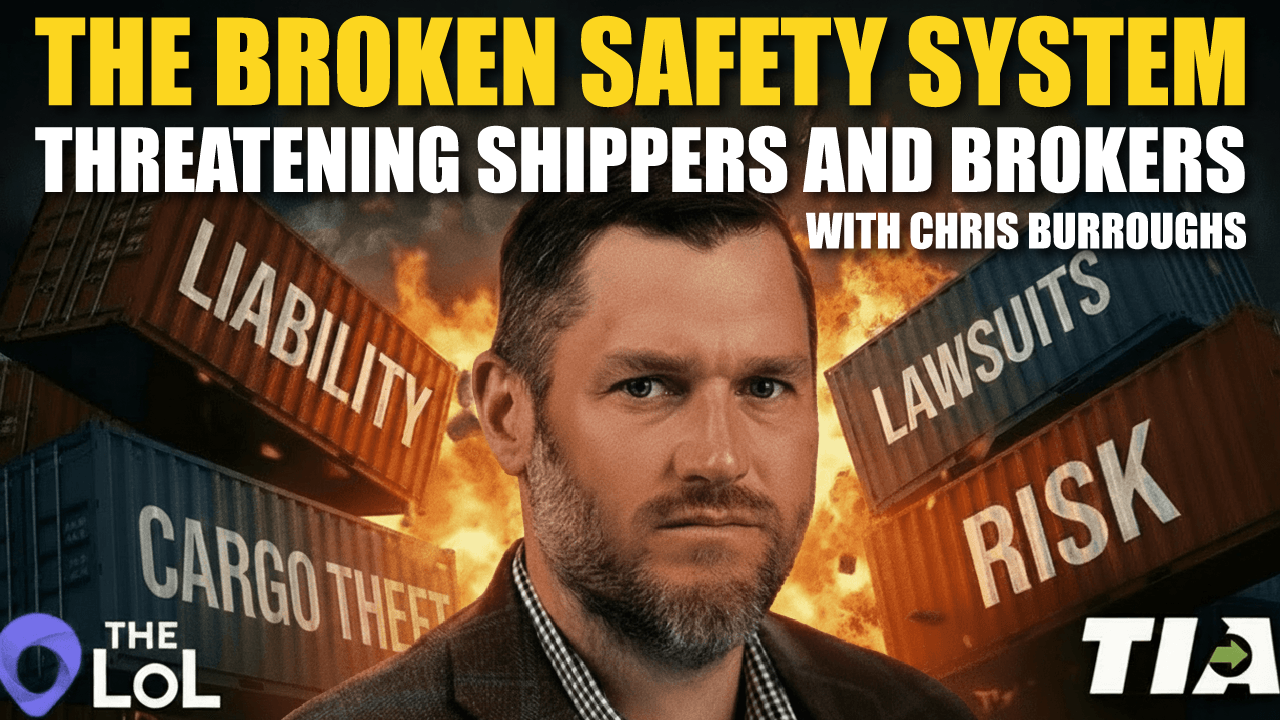
In “The Broken Safety System Threatening Shippers and Brokers,” Joe Lynch and Chris Burroughs, President and CEO of the Transportation Intermediaries Association (TIA), discuss the fallout from a landmark Supreme Court ruling and rising freight fraud are reshaping the logistics liability landscape.
About Chris Burroughs
Chris Burroughs is the President and CEO of the Transportation Intermediaries Association (TIA), a position he assumed in November 2024. With over 14 years at TIA, he previously served as Vice President of Government Affairs, overseeing legislative and regulatory efforts before Congress and federal agencies. Before joining TIA, Burroughs gained valuable experience on Capitol Hill, working for the House Transportation & Infrastructure Committee and the House Natural Resources Committee. He also served as Director of Government Affairs at the Twenty-First Century Group, advocating for clients in transportation, telecommunications, health care, and defense. Burroughs holds a Bachelor of Science degree in Political Science from Shepherd University in Shepherdstown, West Virginia.
About TIA
The Transportation Intermediaries Association (TIA) is the professional organization of the $343 billion third-party logistics industry. TIA is the only organization exclusively representing transportation intermediaries of all disciplines doing business in domestic and international commerce. TIA is the voice of transportation intermediaries to shippers, carriers, government officials, and international organizations. Learn more about TIA at www.tianet.org
Key Takeaways: The Broken Safety System Threatening Shippers and Brokers
- In “The Broken Safety System Threatening Shippers and Brokers,” Joe Lynch and Chris Burroughs, President and CEO of the Transportation Intermediaries Association (TIA), discuss ow the fallout from a landmark Supreme Court ruling and rising freight fraud are reshaping the logistics liability landscape.
- The Montgomery Decision Resets the Liability Landscape: The Supreme Court’s recent 9-0 ruling in the Montgomery case (involving C.H. Robinson) eliminated the long-standing F4A federal preemption defense for brokers regarding carrier safety selection. While 31 states had already rejected this defense prior to the ruling, the decision officially shifts safety and negligent selection liability standards back to a patchwork of differing state regulations.
- TIA Petitions the FMCSA for a National Carrier Selection Standard: In response to the confusion caused by the Montgomery decision, the Transportation Intermediaries Association (TIA) filed a petition for rulemaking with the Federal Motor Carrier Safety Administration (FMCSA). TIA is pushing for a clear, national federal standard to dictate exactly what checks a shipper or broker must perform when vetting and selecting a trucking company, eliminating state-by-state confusion.
- The Core Elements of TIA’s Proposed Vetting Standard: TIA outlines three baseline data points that the federal government should mandate for a secure carrier selection process: operating authority (ensuring full compliance with the FMCSA), valid insurance (confirming active, legitimate coverage to combat marketplace fraud), and safety status (verifying the carrier has not been placed out of service for safety violations or paperwork compliance issues).
- A Broken Data System Leaves 94% of Carriers Unrated: A major hurdle in carrier vetting is that 94% of trucking companies remain “unrated” by the federal government. Because the FMCSA relies on strenuous, physical audits and suffers from limited inspector resources (drastically worsened during the pandemic), they only audit carriers that trigger red flags. TIA strongly advocates shifting from this outdated physical audit system to an absolute, data-driven safety rating algorithm.
- TIA Demands the Release of the “High-Risk Carrier List”: The FMCSA maintains an internal database of approximately 3,000 to 4,000 trucking companies categorized as “high-risk,” based on their Safety Measurement System data. As a key part of their petition, TIA is demanding that the government publicize this list so brokers and shippers have the transparency needed to actively avoid dangerous carriers.
- The Sophistication and Rise of Strategic Freight Fraud: Freight fraud and cargo theft have evolved past opportunistic crimes into highly organized, international cyber syndicates. Strategic theft has skyrocketed by 1,500% since 2020. Bad actors are shifting tactics—moving away from registering new fraudulent entities to buying up clean, legitimate, 2-year-old authorities on online marketplaces, executing massive “heists,” and then vanishing.
- Industry Consolidation and the Value of Trusted Associations: The compounding costs of increased insurance premiums, tighter vetting processes, and necessary technology stacks are expected to drive significant market consolidation, forcing smaller players out. Because of this complex environment, shippers are increasingly looking to work with brokers tied to professional organizations like TIA, which enforces a strict code of ethics, offers ongoing education, and acts as the exclusive advocacy voice for the $343 billion 3PL industry on Capitol Hill.
Learn More About The Broken Safety System Threatening Shippers and Brokers
TIA Technovations with Tom Curee
Trucking Through Trouble with TIA & Anne Reinke
TIA Unpacks Freight: Tariffs, Trust, and the Fight Against Fraud with Chris Burroughs
FMCSA Petitions for Rulemaking (Open Petitions)
The Logistics of Logistics Podcast
Joe Lynch: [00:00:00] Hello, friends. Welcome to the Logistics of Logistics. My name is Joe Lynch. Thank you so much for joining us today. Today’s topic is the broken safety system threatening shippers and brokers with my friend Chris Burrows. How’s it going, Chris?
Chris Burroughs: Joe, good to see you, sir
Joe Lynch: Good to see you again. So Chris very important topic today. So please introduce yourself and your company and where you’re calling from today
Chris Burroughs: I’m Chris Burrows, president and CEO of the [00:00:30] Transportation Intermediaries Association, or as commonly known as TIA calling from the beautiful Commonwealth of Virginia here
Joe Lynch: Very nice. Very nice. So what does TIA do?
Chris Burroughs: So TI, we’re the trade organization, trade association for the third-party logistics for the freight brokerage industry. So we do all the great things that trade associations do for their members. Tip of that spear is really advocacy and government affairs. We’re the voice of the industry on Capitol Hill with members [00:01:00] of Congress, with the federal agencies, with the administration.
In addition to that we have a w- a wide variety of educational courses. We hold conferences throughout the years for our members so also for learning and networking opportunities. So the full gamut of the trade association but like I said, advocacy is really what we’re what we’re known for and is as true of many trade associations.
Joe Lynch: Yep. We need you now because we had this big ruling, the Montgomery decision, [00:01:30] and you guys are right standing in the breach. So talk about the legal ruling that is the Montgomery decision that everyone is scurrying about trying to figure out what’s next.
Chris Burroughs: Yeah. So there was a Supreme Court decision recently it was called the M- Montgomery case dealing with CH Robinson as the broker. Carbine Transport was the carrier in the case. So before the Supreme Court it was actually Montgomery v. Carbine Transport but CH Robinson for all intents and purposes was the party [00:02:00] there more or less defending themselves.
So v- involved a truck crash a few years back where somebody was severely injured. Like I said, Robinson was the broker of record and, went through district courts. There was a split in the district decisions really centered around the defense of what’s called the FORA.
It’s a 1994 piece of legislation that became law. It’s the Federal Aviation Administration Reauthorization Act. And really talks about states [00:02:30] stepping in and pre-emp- or the federal government preempting state decisions. So rate, you probably hear rates, routes and services. States cannot set standards on those provisions in terms of trucking and transportation.
And like you said, it’s been a defense that a lot of TIA members, a lot of brokers, shippers have used throughout courts. There was a multiple different split decisions throughout the country, so it obviously rose to the level of the Supreme Court saying, “Hey, we should take a look at this and see if this is a viable [00:03:00] defense in terms of safety.
Are brokers excluded or are they part of this federal preemption under FORA in terms of their care and being negligent in the selection of a trucking company?” Or… Go ahead.
Joe Lynch: Yeah, we’ll get more into that in a minute ’cause this affects everybody who is a broker, who’s f- if you’re a carrier, and certainly I think also shippers. The real threat though is to the brokers and the carriers. Am I right to say that?
Chris Burroughs: Absolutely. So yeah, forwarding ahead, the decision obviously was 9-0 in favor of the Montgomery, Sean [00:03:30] Montgomery side that really eliminated this defense. So it’s really gonna change the landscape the liability landscape and the carrier selection landscape amongst shippers brokers and carriers
Joe Lynch: Yep. So let’s talk a little bit more about TIA, and we’ll get back to that. So first off, I could not work at TIA, Transportation Intermediaries Association, ’cause I cannot consistently say intermediaries. That would be a very hard problem for me to get over. But [00:04:00] your mission is this advocacy. So right now you guys have a petition that is going to, what, Congress to help out with- to to get some clarity for us in the brokerage world and in the carrier world?
Chris Burroughs: The petition actually goes to the FMCSA, the
Joe Lynch: Oh, okay. Okay
Chris Burroughs: Administration. Yep. But to go back to your intermediary part, I always love to tell this story. So we’d obviously love to say TIA when we’re on the Hill talking with members of Congress, with agency staff. But [00:04:30] there’s actually four or five different TIAs.
There’s like telecommunication, there’s tire, there’s toy, there’s the tortilla industry, which is, way cooler than what we do probably. I love tortillas. So yeah I’m with you on that, Transportation Intermediaries Association. And when you’re talking with a 20-year-old on Capitol Hill or a member of Congress, by the time you get that out, they’re kinda checked out.
So TIA is what we like to say, but there is competing TIAs out there. But yeah, so we, we’ve recently filed a petition for rulemaking to the FMCSA to really get clarity. It’s all about getting [00:05:00] clarity in the carrier selection process. And it’s asking them to promulgate a federal standard. What certain checks should a shipper, broker look at when selecting that trucking company?
And this is actually it’s based on a piece of legislation that we have been pushing for years both from a clarity per- perspective and also a safety perspective. And we’ve been pushing that on the legislative side for a number of years. And we wanna have conversations with the agency moving forward to get this out, to get the clarity [00:05:30] and reduce a lot of the confusion.
Because of the decision and we’ll go into this a little bit later, but because of the decision, there’s so much confusion out there now because it puts it back into the states in terms of a patchwork of what the liability standards should be or what that selection standards should be, which is gonna be different based on what locality and state you’re in.
Joe Lynch: Yes. Yes. And it’s, we’ve always had this system where the brokers pick a carrier and you say, “Did you vet them?” We’ve been talking about vetting a lot more in the last [00:06:00] five, seven years than we ever have in the past. We’ve …Cargo theft, cybersecurity, places where you guys are taking a leadership role also, but that’s for another day. We’ve talked a lot about vetting, and y- but I can vet. I can say, “Hey, I just picked the very best carrier in our system. They haven’t had an accident in 20 years.” And they have an accident. A- am I on the hook? Am I on the and if you’re CH Robinson or so [00:06:30] many other big companies you wonder if, are they just being added to the lawsuit ’cause the trucking company ha- is, a million dollars in revenue, and they have a trillion dollars in revenue
Chris Burroughs: Yeah, and it’s been, th-this isn’t a new, y- there, there’s a lot of buzz on social media and the press about, now brokers can be sued and held liable. The reality is this is not new. The first negligent selection case was a g- a case known as the Schram case also involving C.H.
Robinson. To your point, when you’re the 800-pound gorilla in the room, you’re gonna be, [00:07:00] you’re gonna be a target for folks to go after with your pockets. But that case was back in 2004. So nothing new to the industry.
Joe Lynch: I didn’t realize that
Chris Burroughs: Yeah and actually this year, TIA has been releasing for 20 years our carrier selection framework.
So it’s not best practices, it’s ki- it’s a, here’s things that you could potentially look at or incorporate into your carrier selection process. Again, this is not a standard. We’re not we’re not in the standard-making business, but it’s a framework to potentially use within your business on things.
So it this issue has been top of [00:07:30] mind of our folks for a number of years because of some of these decisions and cases that have been coming out for, 20-plus years at this point
Joe Lynch: Yep. So I think there’s a lot of people who just think when they hear TIA they go, “Oh, I love TIA. I go to conferences,” and they host them, and they’re always great. There’s a lot more to it. We’ll come back to all that in a minute. Chris, tell us a little bit about you. Where’d you grow up? Where’d you go to school? Some career highlights before you took the top job at TIA
Chris Burroughs: I grew up I grew up in northern [00:08:00] Virginia, so not far from Washington, DC. And I went to school at Shepherd University a small division two school out in Shepherdstown, West Virginia. We like to call it the Harvard on the Potomac. So it was g- this very small liberal arts school
Joe Lynch: Those are sometimes the best schools ’cause you get the attention
Chris Burroughs: Absolutely. Absolutely. And my, my background really has been in government affairs and politics. So my dad was a longtime congressional staffer, 40-plus years working on the House side of [00:08:30] Congress. Something obviously stuck with me as he would take me in the summers.
As out here in Washington, DC, and a lot of places, there’s HOV lanes, and he needed an additional rider to get on those HOV lanes, so I was called… They called them slugs. I was basically his
Joe Lynch: what is HOV stamp? I don’t even know… We don’t have that in
Michi-
Chris Burroughs: high occupancy vehicle
Joe Lynch: okay, so you
have to have two people in it. California has that too, right?
Chris Burroughs: Yeah, so two, two or more people, get you into the city quicker.
So as we were commuting in during the summers, he would put me in the back of a congressional hearing room usually with a quarter, and I would just [00:09:00] play with it. And apparently something stuck in, ’cause I was really always into politics, always into government relations. So after graduating college I started working for the Transportation and Infrastructure Committee on the House of Representatives side.
And obviously loved the issues of transportation. Did that for a few years, working directly for Congress. Went to a small boutique lobbying firm after that. Had about 10 or 12 clients, a variety of different sectors, including TIA was one of our clients. So I got to know our previous CEO, Bob [00:09:30] Altman Bob Altman first.
And yeah, 15 years ago Bob offered me a job to come in-house as a manager of government affairs and help help with that department under under my boss at the time, Nancy. And, here we are 15 years later. I’m- I’ve assumed the role two years ago of president and CEO of TIA following Anne Reinke who was a great mentor for me over the past four years that she was at TIA.
So yeah, I- it’s a great organization. Love the members. These are salt of the earth folks in the logistics [00:10:00] industry. But my background’s, pretty much exclusively been government relations and politics, which obviously fits extremely well with what we do as a trade
Joe Lynch: yeah, I was gonna say not just the pol- politics, but also on the transportation side, which is important. And by the way, my last episode, which published yesterday was with IANA. With- they’ve done… They have a brand-new they have a brand-new index that we talked about. But anyway, let’s get into today’s topic.
So give us this background on this Montgomery decision. Talk to me as if I know nothing, [00:10:30] because I know just a little more than that.
Chris Burroughs: So like I said earlier, it was an accident involving in- involving a young man who was severely injured. Robinson was the broker of record. The, there was a split decisions at the court level in terms of this F4A preemption defense. Are brokers ex-
Joe Lynch: What does F4A stand for?
Chris Burroughs: Yeah, it’s the Federal Aviation Authorization Act.
It’s from 1994. It’s a law that Congress passed that talks about, preempting state [00:11:00] regs when it deals with rates, routes, and services
Joe Lynch: It exempts it, so now they’re saying take that exemption away?
Chris Burroughs: Potentially, yeah. And to be fair, so y- we- we’re all aware that the Montgomery decision went nine-oh in favor of the petitioner or the, the plaintiff side. But to be fair, 31… Because there were such a split decisions in the districts, 31 states had already said, basically, this wasn’t a viable defense.
So this isn’t totally resetting the marketplace in terms of the liability standard. But it will, it’ll it will change the [00:11:30] landscape moving forward for a variety of reasons. So decision comes out. Obviously, I think there’s gonna be… And we’re still in that reactionary period and I think we’re gonna be for a while.
Because it really takes all the potential of brokers being preempted from state regulations dealing with safety and puts it back within those states. So now we’re gonna have a patchwork which is what F4A tried not to do, but we’re gonna have a patchwork of decisions that are gonna be coming out from states on different liability [00:12:00] thresholds.
And what that means is, in the state of Illinois, you could, a broker could be held liable for what’s called negligent selection based on X, Y, and Z. In the state of Texas, it could be A, B, C. In the state of Virginia, it could be D, E, F. We just don’t know what those standards will be, and we’re probably not gonna know for a while because, until some of these decisions come out.
So because of this confusion, because of all these conflicting information that exists out there, and a very limited data source from the FMCSA [00:12:30] 94% of trucking companies are still unrated. Meaning they haven’t had that compliance audit from the federal government yet to give them a rating
Joe Lynch: So am I right to say it this way Chris, that even though this is not looked at as a positive ruling for our industry that it probably forces us to do the things that you’re trying to do right now? Elevates it
Chris Burroughs: I think the, this has been talked about a lot in the media is a lot of the companies that are really putting [00:13:00] stringent carrier selection processes in place are gonna continue to do that. And, some of the folks that may be fly by night or hiring unscrupulous carriers, hopefully, that the, this would stop that.
That’s a positive of it. But there are gonna be impacts to this for sure. And then two of those impacts are gonna be obviously increased insurance cost. I think some of the insurance cost has really already been baked in ’cause like I said, these decisions began in, in really 2004 with that Schramm decision with CH Robinson.
So they’re not new. So some of the cost has really already been put in, [00:13:30] but there’s gonna be a reaction by the insurance companies to increase per, increase, cost of insurance. We don’t know what that
Joe Lynch: Is that cost for the brokers or cost for the carriers or?
Chris Burroughs: Plus, pr-probably across the board. Now the personal injury for carriers is $750,000. That’s federally mandated. That hasn’t changed in a number of years and probably should go up at some point. But that’ll be cost to, to cost a broker some insurance mostly. And secondly is you’re gonna see…
And I don’t use this term, I’ve talked about this a lot, but I don’t use this term negatively, is you’re [00:14:00] gonna see an overreaction on the vetting process. Because you’re really gonna have to drill down into what your selection process is, and there’s going to be a segment of trucking companies that are gonna be excluded.
That’s just a reality of it. You’re gonna tighten the screws down. There’s gonna be a segment of trucking companies that are excluded. And some of those folks may be the conditional carriers which are authorized by the FMCSA. The, some of those folks may be the unrated carriers that don’t have a lot of data.
And that could be problematic to some of [00:14:30] those small folks because an unrated carrier, by all intents and purposes, and we’ve said this for years, they’re unrated, May- maybe I should, maybe we should back up a little bit in terms of to get a safety rating from the FMCSA, it’s still done by a physical audit.
So meaning the FMCSA has to physically go out and audit the company. It’s a strenuous two to three-day process typically. And from that they get a safety rating. As you can imagine with limited resources, they’re not doing a lot of these a year. I think I just saw an article recently that the number of safety ratings or audits that were coming out [00:15:00] has drastically decreased.
We saw a massive decrease during the pandemic, obviously, because we were all social distancing. Prior to COVID, we’d asked the agency, and I think they said they do about 10,000 audits a year. There’s 800,000, 500,000 roughly somewhere in between there, for higher trucking companies.
But they have 340 inspectors. They can’t do these audits for 800 or 5,000, whatever the number is in terms of active trucking companies. So it’s a problem. So with that large number of carriers that are unrated, [00:15:30] and again what I was saying before, they’re unrated because they really haven’t done anything to trigger that compliance audit.
So they haven’t had crashes. They haven’t had a lot of violations. There’s data on them, but there’s not enough data for the agency to be like, “We really gotta go touch this guy.” So those are the carriers that are gonna be excluded, which is can be problematic for them. But that’s gonna be the reactionary step taken by industry
Joe Lynch: Yeah. Chris, you might re– it’s a little off topic, but there, I think it’s relevant. Under President Obama, we had the Food Safety Modernization Act [00:16:00] signed, which was the first upgrade of the FDA in 70 years. And it really was saying, rather than a f- a focus on inspection, we’re gonna have more of a focus on process, which is just catching up to modern manufacturing. And as part of that, they also said we have to get our hands around, arms around all of the food that comes to our country from other countries. That, and the whole goal of Food Safety Modernization Act is to prevent people from getting [00:16:30] contaminated food and from people tampering with our food. Anyway they don’t have enough auditors, so they had a whole process for let’s create third-party auditors, especially in other countries, because we don’t have the FDA worldwide, although we do have a bigger footprint than you would think. And I almost think the same thing needs to happen here.
If you’re going to… I would rather than not grow the FMCSA. I’d ra- I’d prefer [00:17:00] third-party auditors just because of the efficiency that the private sector has
Chris Burroughs: Yeah, and I actually remember that, I remember that FDA rule very well. I sat in, actually in the first meeting that was held on that over at College Park, Maryland at the FDA headquarters. So yeah, and that was a massive change to the industry. I, I remember asking the FDA official-
Joe Lynch: And by the way, it impacts our industry because in the past trucking companies, we had sanitary rules for sanitary movement of freight, but, or food. And I always remember when I did a lot of training and consulting in that, [00:17:30] and I remember some of the webinars I did with trucking company.
People were like, “Joe, we don’t answer to the FDA. We answer to the FMCSA. We answer to this guy, that guy. We don’t answer to the FDA.” I was like I’m not the law. I’m just telling you what they, what the new rule is.”
Chris Burroughs: Yeah, that, that changed under the sanitary transport because, now there is a segment of transportation under FDA, yeah. And that, that all began in a, because of an instance. I think it was a tank truck load of liquid eggs that the properly wasn’t a clean out, and then they put powdered milk for ice cream or [00:18:00] powdered ice cream in there, and everybody got sick.
And there was a couple instances like that led to the federal government stepping in and saying, “Hey, we, FDA, we need you to have some oversight of transportation for sanitary conditions to our food.” And, like I said we put a lot of education out. We worked with them. We advocated with the agencies.
There was a lot of buzz around that and it worked out in the end. It’s been a very positive movement for the industry
Joe Lynch: I still don’t like the clean out standard. I know we’re going down into the weeds, but you have to clean out your truck if, if I just [00:18:30] move chickens I probably shouldn’t be moving fruit in the next load. A chicken and poultry after they’re dead. And I always felt like they left the, they didn’t want to be too prescriptive about the clean out.
But I always said don’t focus on the clean out. There should be some sort of test, right? Maybe a swab. You swab four places to make sure that it’s clean.” But that’s that’s me. A- anyway, let’s get back to our thing here. There’s not enough people at FMCSA to do all these [00:19:00] reviews, so we have 94% of carriers that’ll never, that are not rated, and they haven’t been rated because there was no neas- no reason there, there was nothing flagged because of their driving record, right?
Chris Burroughs: Absolutely. And I would say you, you brought up earlier about third-party inspectors. Something TIs really support on this front to change it from a physical auto system to one of data. And actually President
Joe Lynch: Oh, I like that
Chris Burroughs: Yeah, President Obama tried to do this towards the end of his second term and it, [00:19:30] it got stalled for a couple of reasons.
One was timing and then when President Trump came in, he rolled it back. Two was also there was some strong opposition from some of the, from the trucking side and some of the bus side. But what President Obama said was, “Hey, we have data,” or his administration said, he said, “We have data on all these trucking companies already.
Let’s build an algorithm that’s fair to industry, that’s not the compliance safety accountability program, but there is problems because th- that’s a relative system.” Care- and CSA and SMS, the Safety Measurement System, carriers are put [00:20:00] into pools based on their size. And if let’s say there’s a carrier that has a bunch of clean inspections they would go down, which is good in CSA.
The higher the score the worse. And then a carrier who may not have done anything wrong but may not have those positive inspections is gonna go up. So in a relative system, that’s problematic. But he said, “Let’s use the data, let’s build an absolute system and let’s give carriers a safety rating,” of which he proposed two, safe or unsafe.
You can move, get rid of the conditional that you’re bad but you’re not bad enough, and let’s give [00:20:30] carriers their safety rating based on data
Joe Lynch: No, I like that. And by the way, you can also say, “Yeah you did you did this audit on your own. We trust you, but keep in mind there are random audits that we’re gonna keep you honest.” And that way you make it clear to everybody that just because we didn’t audit you doesn’t mean I don’t think most carriers are like this, that you don’t have to follow the rules ’cause we’ve never been audited and we’re all set. Y- yeah, the, it, this is a challenge. And I think the challenge you’re getting to here [00:21:00] is we’re gonna have an overreaction because of this ruling. Some carriers who don’t deserve to lose business are gonna lose business. And the, if there is an accident, there was never a standard
Chris Burroughs: Yep, and that’s a p- perfect segue into wh- why we filed the petition. We need the federal government to kinda prescribe that standard for us. What are the things what are the minimum standards or what’s the standard that our brokers and shippers should [00:21:30] look at? We think it’s authority.
We think the insurance, that they have valid insurance on file, and three, they haven’t been placed out of service at the carrier level. Now, there’s a couple different ways to, a carrier can be placed out of service
Joe Lynch: say that one more time. You said there’s three things that they should be judged on. authority,
Yeah. Yep
Chris Burroughs: Valid insurance. There’s a lot, different topic, but there’s a lot of fraud in the insurance and marketplace as well. And they, and the carrier has been placed out of [00:22:00] service. And like I said, most people look at that and say that means they’re unsatisfactory.”
That’s one trigger. Not doing your biannual updates. If you have the Trump administration 2.0 made if you have a non-English speaking driver, the ELP violation as a driver, that was a trigger for an out of service at the c- at the carrier level, but they could also trickle up to the…
i’m sorry, at the driver level, which also could trickle up to the carrier level. So there’s a variety of different ways a carrier can be placed out of service. So those are three things, and we’re open to discussing with the agency and other segments of [00:22:30] industry on what other checks should be in place.
But we need a f- national federal standard from the FMCSA to give industry the clarity they need, because we’re not gonna know in many instances that a carrier is unsafe until an accident happens
Joe Lynch: So you said n say that one more time. National, federal, what?
Chris Burroughs: The Federal Motor Carrier Safety selection standard is what we have been pushing for
Joe Lynch: A- and so at that point, if I’m a broker and there is an accident and then somebody says, “You guys are [00:23:00] liable,” I can say, “Hey, look, I followed this national federal selection standard. I did what I was supposed to do.” The very best carrier in the world can have an accident, and they can be negligent. It, it- th- they’re probably not doing it on a regular basis, but if s- if you’re driving millions of miles over time, there’s gonna be accidents. And, this also, we run into this with autonomous vehicles. There are accidents and deaths every day [00:23:30] in trucking. Unfortunate. But millions and millions of miles, obviously we need it.
It’s the backbone of our economy. But if one of those accidents killed somebody today and it was an autonomous vehicle, it’d be front page news for a week, and there’d be, and there’d be rumblings in Washington about banning autonomous vehicles. And
Chris Burroughs: I just wanna be clear the s- the standard wouldn’t be, people probably hear that and they go, “Oh, this is brokers looking to [00:24:00] skate liability.” It’s not. It’s, it is, this is, sure, it’s a defense that we could point towards, just like we point towards the F4A defense.
But again, 31 states already said, prior to the McGovern decision, 31 states already said the F- F4A is not a valid defense. So this is a, this is more clarity to a massive confusing system because, quite frankly the FMCSA has dropped the ball on data over the years for the past 20 years plus, in terms of what constitutes a safe carrier.[00:24:30]
And, I say, I don’t, say that lightly, and I wanna give a massive shout-out to this administration and this FMCSA because we’ve met with Administrator Derek Barrs numerous times since he’s been, since he’s assumed the role as administrator and he’s the real deal.
This is a guy that wants to get things done, and he is passionate about safety. And, he knows that the agency has kinda sat idly behind for many years, and he wants to fix that. He truly does. And you’ve seen that with Secretary of Transportation Duffy as well, and he’s taking a [00:25:00] lot of action.
They’ve taken a number of steps to address a lot of these problems and safety concerns over the years. So th- this agency, this administration, is taking the right steps but it’s a lot. There’s been a lot of neglect over the years that they’ve gotta dig out of
Joe Lynch: Yeah. It’s And I know there’s some people like me who would listen to a podcast like this and go, “Oh, God, just what we need more overreach by the government into our business and into our lives.” And I think all we’re talking about here Chris, is we’re not saying hire [00:25:30] thousands of people and a- add a whole bunch of bureaucracy.
I think what we’re saying is let’s have some standards, let’s have some guardrails that guide the industry so we don’t bump into kind of, as you’ve talked about it, this patchwork of state regulations where y- what I … we don’t drive through … I’m just making this up. We don’t drive through Idaho anymore because of this, right? Or we know we close that terminal because of the liability in that region versus this region. And the thing that we have [00:26:00] going for us here is this massive country is the laws are consistent across across the states. So a- as I drive from New York to LA, I don’t have to say, “Oh, yeah, the speed…”
The speed limits have always changed, but they’re usually set by the federal level on the expressways. I don’t have to worry about a million different laws that are crazy in one state or another
Chris Burroughs: Sure. Absolutely. Yeah, you nailed it right on the head
Joe Lynch: Just give us some guardrails, fellas
Chris Burroughs: [00:26:30] Yeah. As a trade association, that’s been our line for a while, is that, we don’t, we’re not in the business of burdensome regulation to get in the fa- to get in the way of our members doing their job. But there is some regulation that is good and is needed. You do need some federal government intervention on certain things
Joe Lynch: By the way, we had, during COVID we had problems at the port, and then we had… I forgot. I’m gonna drop the ball on this, but we had a federal ruling a rule change at the port. Because you think okay, why do I need the [00:27:00] government there?” The reason we want the government is there because the ports are an economic center, and if there’s a whole bunch of lawlessness is probably the wrong way to say it, but if there’s a whole bunch of maybe unnecessary fees that are happening, the government just says, “Hey, you’re gonna prevent this country from doing business with the rest of the world because of this port.
Let’s just get it right.” And, your petition, this is rulemaking. They’re asking, “We wanna hear from TIA. We wanna hear from the [00:27:30] industry so we can put the guardrails up that make sense
Chris Burroughs: Yep. It’s really just let’s have a discussion, let’s figure it out, and let’s put something together that improves safety and provides clarity to the folks out there in the industry, transportation industry
Joe Lynch: So what’s the next step? You’ve s- you’ve submitted a petition. What is, what, give me some of the bullet points from that
Chris Burroughs: Yeah w- we were in the, actually this week, meeting with with Administrator Barr and his team at FMCSA about the petition. And, it will move to what you just described. It’ll [00:28:00] move to hopefully quickly, although nothing in the federal government moves at too fast a pace but hopefully relatively quickly into a period where there can be discussions with the agency and the public, either through a comment period or one-off conversations.
But we wanna start working with the agency to develop what the standard would look like. And then that would have to go out to a public comment period as do all rulemakings, so that the general public and everyone has a chance to provide their perspective on what this should look like. And [00:28:30] then the agency gathers up all of those different comments they read them, they take them into consideration, and then they would develop a final rule
Joe Lynch: Yeah, and it, I followed the FMCSA, I’m sorry, I followed the Food Safety Modernization Act as they put in the the rulemaking. And not very many people commented. That was … And so this is your opportunity if you’re a trucking company or if you’re a broker or you’re a citizen, this is the time.
They’re gonna ask, “We want [00:29:00] your two cents.” And I think this is, again, another place where TIA steps into the breach and says, “Guys, we as the trucking community and the brokerage community and the shippers, we all need to come and give them our two cents.” You can’t complain later and say, “God, I can’t believe how stupid this is,” if you didn’t participate in the comment section
Chris Burroughs: Yeah, absolutely. And it’s a, like I said, it’s a chance for brokers to comment on the confusion and the clarity they need. And what we talked about, those carriers that are [00:29:30] gonna get segmented out, this is their chance to comment too, because, this is their livelihood. This is their business.
Shippers as well and really everyone within the industry should at least have their voice heard no matter what your opinion on it is. And that’s why the system’s in place. That’s why the processes are there. Take advantage of it
Joe Lynch: So Chris, give me the dream scenario here. If Chris Burrows said I am going to spend the weekend with FMCSA and we’re gonna hack this out, what does it look like when you’re [00:30:00] done? Give me three or four bullet points on what that looks like
Chris Burroughs: Our pro– based on our proposal that we sent to them like I said it’s really the three things that we outline: the authority, the insurance, and really the safety status that we have. And, if in my dream world, we would start that, we would use that as our starting point, there may be some other data points that are added.
But that would be the standard that the agency promulgates. And then the second part of our petition deals with the high-risk carrier list. We’re asking for that to be publicized to be put out.
Joe Lynch: [00:30:30] That’s your list, right?
Chris Burroughs: No that’s the FMCSA’s list
Joe Lynch: Okay. All right. Don’t you guys have a list?
Chris Burroughs: No, we don’t have a list as an association, no. The FMCSA has for years had a high carrier list.
Joe Lynch: High risk
Chris Burroughs: Yeah, it’s based on some data points it, within that, like I talked about earlier, that compliance, safety, accountability, safety measurement system database that they internally use for kind of investigative action, for audits, for warning letters, et cetera.
So they have a list of, [00:31:00] I don’t know how big it is. I think last I read years ago was like 4,000, 3 or 4,000 trucking companies that they consider high risk. We’re asking for that to be promulgated out to public
Joe Lynch: Yeah, don’t hide it. We need the, we need it in our hands
Chris Burroughs: hide it. We need to know Exactly. So
Joe Lynch: Y- yeah, so those three a- areas you hit on, operating authority what within operating authority? What do you wanna see in there?
Chris Burroughs: That they’re, that they’ve gone through the steps and are compliant with FMCSA to have authority
Joe Lynch: So then, so the next [00:31:30] one, valid insurance. And then the last one you said is about out of service versus
Chris Burroughs: That they haven’t been placed out of service for either a safety rating of unsatisfactory or not doing paperwork, basically compliance. They’re compliant in their safety status
Joe Lynch: Yeah. This, I’m telling you, as I, I was taking notes here and I’m, e- even as I look at my notes, I’m like, “God, do I fully understand this?” And I know you fully understand this, and I think this is where somebody listening who says, “Oh, yeah, I know of TIA,” [00:32:00] this is why you need to get involved with TIA. Because I can tell you right now, if I was a shipper a- and I was looking, I would say, “I wanna work with, I wanna work with a broker who is part of TIA, who is active in this community, who I think understands what’s going on.” I think this, what we talked before we hit record, this could lead to its consolidation, and the consolidation’s gonna happen because shippers get a little panicky and they say, “I wanna work with the [00:32:30] big guy.” And some of the little carriers, little brokers might say, “Eh, it’s always new rules. I’m not worried about it. We’ll do what we’re supposed to do.” This is confusing. This is a challenge. I think this is why you need to get involved with TIA ’cause it’s not just all those cool parties they put on.
They educate and advocate
Chris Burroughs: Yeah. There’s a lot of people in the industry that have thought we’ve been kinda going, before the McGovern decision, we’re kinda going through a market restructure already in terms of built on technology. It’s more expensive [00:33:00] to open, for instance, to op- probably open a brokerage now than it is in 2015, and a lot of that is the technology stack and the technology spend that’s gonna come into play in terms of running a business.
And I think as we talked about with insurance costs is increasing, the technology costs that are there, you’re gonna see consolidation and you’re gonna see some of the smaller players exit the marketplace. You m- you brought up, earlier, like what is the pool of the carrier lo- or broker base look like?
I think for f- most recently, the agency has said there’s about [00:33:30] 25,000 licensed property brokers. I’m curious on what… we’ve always kinda questioned that number, and I think we’re gonna get an answer soon. ‘Cause, the agency recently launched MODIS which hasn’t gone as smoothly as anybody has wanted the new registration system within the FMCSA.
But, a- and to having that conversation with the FMCSA just on the carrier side of things, I think they said one third of the trucking companies that they sent letters to came back undeliverable. So how many of those brokers, in 25,000, I think the [00:34:00] number’s probably closer to 10.
That’s just a guess.
Joe Lynch: E- yeah, our buddy Kevin Hill tracks some of this stuff, and I’m sure he’s, I’m sure he’s looking at it w- in, in interest to this stuff. But he told me this not so long ago. I wrote it on my wall. The top 1,000 brokers have 80% of the volume, and let’s just give or take. Things change. That’s the top 1,000.
So the other 24,000 are sharing 20% of the volume, which st- by the way, there’s still some good sized brokers [00:34:30] below that 1,000. And I will say sometimes you’ll find a broker connected to a large carrier, and they might not be a top 1,000 broker, but they’re a top 1,000 carrier. The top 100 brokers have two-thirds of the market, and which is 66%. The top 20 have half of the market. So th- we already have seen we’re, industries are already getting a little top-heavy. If you’re a ma and pa carrier, I’m sorry, ma and pa shipper, and you say, “I don’t know, [00:35:00] the, I’ve been working with these guys. I only do two shipments a week, and they take good care of me,” I don’t care how big they are. Obviously, if you’re a very large Fortune 500 company, you’re gonna have to go through a vetting process that’s very different. Yeah if you don’t mind, I’d like to switch gears for just a minute with you ’cause I don’t talk to you all the time. You guys are also taking the lead on some other big issues in the industry.
So we’ve had, and I think they’re all first cousins, cybersecurity issues in our space cargo theft [00:35:30] issues, and freight fraud. So I don’t know the best way to talk about those, but I’m sure you do, Chris. So what are you guys doing on that for our industry?
Chris Burroughs: Yeah. This has been a massive problem for many years. And kinda going back to that FMCSA negligence, if you will. I found some comments that, that our former CEO, Bob Voltman, wrote back in 2008
Joe Lynch: Oh, wow.
Chris Burroughs: chameleon carriers and fraud. Yeah to, to the FMCSA.
So but yeah we saw, like everyone, [00:36:00] we saw the massive explosion of cargo theft and freight fraud really exploding during the pandemic. And it has hit our members extremely hard, just as it has everybody else. This is one issue that every part of the segment, every part of the
Joe Lynch: It undermines the trust
Chris Burroughs: Absolutely. It’s a massive trust problem. So we’ve in addition to many other trade organizations, trade associations have stepped up and tried to work on pieces of legislation that will help us re- reset the table a little bit in terms of cargo theft and address some of the problems that exist, some of the gaps that are [00:36:30] there and create greater coordination between federal agencies and the public and industry.
In addition to setting up a direct partnership and a hotline for our members to provide their data that we provide directly to the FBI. There’s a field office in Philadelphia and there’s multiple ones throughout the country that are looking at this, that are addressing cargo theft.
Since 2020, I think strategic theft, which is like that cyber side of things, has increased like 1500%.
Joe Lynch: Yeah that’s grown faster [00:37:00] than the… So we’ve always had opportunistic.
Chris Burroughs: Sure
Joe Lynch: Now we all of a sudden have, this sophisticated strategic stuff going on
Chris Burroughs: Yeah. And this is not your mom-and-pop, theft that’s going on. This is very well-organized criminal activity, mostly headquartered and centered overseas that, that’s kinda spearheading this. And it’s a huge problem. And, we’ve been talking about it for years. When I joined TIA 15 years ago, the first piece of legislation we passed and we worked on was the Fighting Fraud and [00:37:30] Transportation Act.
So it, it’s been a problem for a while. It’s un- it’s unfortunate, like the safety aspect, that it’s taken a lot of high-profile accidents and instances to really elevate it to get the attention that it’s deserved. And then, the Guy Fieri’s tequila brand was one that 60 Minutes talked about.
Millions of dollars of tequila was stolen. And we’re like, it’s Guy Fieri and Sammy Hagar.” And they’re like, “Ooh, tell us more about that.” That, that stuff is good for audience. Or the lobster heist that happened right before the Christmas [00:38:00] holiday that we were involved, one of our members and we got a lot of media on that.
It’s unfortunate that it takes kind of those high profiles ’cause it’s affecting everybody every day
Joe Lynch: Yeah, and I, by the way, I just was on Danielle Spinelli’s podcast yesterday, the Fraud Girl. And so she’s been working on it, and I’ve listened to her podcast every once in a while, and she’s been on mine. When you talk about this issue, if somebody has a [00:38:30] theft of their cargo, you don’t even know where to look right now.
There’s th- there was, there’s still “Should I call the local police?” And they’re gonna go, “Oh, it was picked up here, and where is it now?” “I don’t know. It was in four states away.” We’ll call them.” And I don’t know if I’m right to say this, but I want your two cents. I’m a– my belief is we’re gonna have to fix this ourselves with technology and being a little more vigilant about who’s picking up my freight, and I don’t know that we [00:39:00] can count on the government.
I’m sure there’s something they can do. What is your two cents on what they should be doing on those issues?
Chris Burroughs: Yeah. First and foremost, I agree with you. This is everyone’s role. Industry has a role, public has a role, federal government has a role. We all need to work together in unison to address this problem. So I agree with you first and foremost on that. There, there are some things that the FMCSA, for instance could be doing more.
And there’s things that, DHS and other agencies could be doing to help mitigate this. And I think going through this registration system, the new registration system, and some [00:39:30] of the stuff they implemented a year ago is helping. So for instance, a year ago, the FMCSA implemented IDEMIA which does all the TSA security checkpoints.
So when you walk up to go in the gate, you get that little picture of yourself. They check you and a background check on who you are to make sure you’re not, a fraudulent criminal or a terrorist, or whatever the case may be. They’re not doing that for entrants. So they’ve…
IDEMIA is doing all the background checks on folks coming into the marketplace. We don’t have the numbers, but I’d imagine it’s probably, from what I’ve heard, probably, 20% to 30% of folks that are [00:40:00] applying to become trucking companies or becoming brokers or forwarders are, have been turned away.
So closing down the front end so they don’t get authorities will help. Putting teeth into their enforcement will help. If there is, if there’s a penalty or a, if the bank’s wide open and the vault’s wide open and there’s no security, what’s stopping everybody from going in there and getting everything?
And that’s really what has happened with the, with coming into getting authority. We had a member who talked about this at our flying with the FMCSA a couple of years ago with cargo theft, and he said he caught one of these [00:40:30] guys on the line, and they said, “You’re a fraudulent company.
We’re gonna, we’re gonna block you. We know what you’re doing. You’re trying to steal cargo.” And the guy was, he was cocky about it. He was like, “We’ve got 100 other authorities. Get this one shut down, we’re just gonna reincarnate another one, and we’re gonna do it all over again.”
Joe Lynch: I was googling sorry, I was on AI and I asked about all the f- fraud vectors, all the cargo theft vectors, and one of them that popped up was the bad [00:41:00] guys buying an existing company that had a very good record, and then moving 1,000 loads as a legitimate carrier, and then one day they steal 50 loads and disappear.
And they probably owe the old carrier, they probably owed the carrier they bought it from. They probably bought it with a loan that they’re not gonna pay
Chris Burroughs: Yeah. Yeah. And that this was, industry started reacting to all the theft, and they stopped using… they may not have [00:41:30] stopped using, but they were more cautious about using new entrants. So then they changed their tactic and they started to go out and buying, like you said, buying, authorities that have been in place for two-plus years.
We saw some of the stuff on like Amazon Marketplace, or there was one even on eBay. Has to be in business two years, good standing with, shippers, blah, blah, blah, paying cash, strong offer. And it- it’s So yeah, they’re d- they’re shifting their tactics. So you know, why we talk about it and we highlight it, we try to be very cautious about not giving our playbook out to the [00:42:00] public because we know these folks are listening.
And they’re looking what we’re doing, and they’re adapting, and they’re changing their strategies. And they’re smart. These people are smart
Joe Lynch: Yeah, I d– probably three, four years ago, I talked to Anne Reinke, who was sitting in your seat at that time. And before we hit record, she said, “What would you do to prevent freight fraud, cargo theft on your freight?” And I said, “First off, I would go get all the technologies that are out there. I’d figure out which of the technology I can start using.”
I go, [00:42:30] “But starting day one, I would talk to the carriers who move my freight like we used to.” And I said, “It doesn’t guarantee anything.” I go, “But generally speaking, you’re not being defrauded by someone you’ve been working with for 10 years.” We automated a lot of our business, and no one wants to go back.
That made sense. It — for the most part, that is a wonderful thing for our business. It’s just there’s a few bad actors, and that’s why we’re talking about the bad actors. We’re not talking about the 99%.
Chris Burroughs: Yeah and I think that comes full circle to what we [00:43:00] were talking about in the beginning with the safety ratings and what we’re trying to do is relationships matter. You’ve gotta talk. We gotta start talking to each other, brokers and carriers that we know that we’re utilizing where we can safe carriers, and also that we’re using legitimate carriers.
So I couldn’t agree more with you and, you were spot on
Joe Lynch: So building those relationships, it might make sense to do it at a conference. Do you know of any conferences that we could meet at?
Chris Burroughs: Obviously, o- one thing we heavily promote is building those relationships. We’ve had the, we’ve had the pleasure over the [00:43:30] last two years of having Lewie Pugh, who is the executive vice president of the Owner/Operators Independent Drivers Association at our conference to have these discussions.
What keeps you all up at night a- as carriers? And we’ve also, we’ve had a shipper who’s been on our panel as well and what keeps you guys up as shippers? And we do have a broker on there as well. But we wanna build those relationships. I’ve talked about this before on, on other platforms I’ve been on, wh- when I started at TIA, a lot of people were talking about, “Hey our customers are our shippers, and that that’s our business, that’s our bread and butter.”
And it, it not frustrated me, [00:44:00] but at the time I was like why are we not looking at carriers as ship- as customers as well?” ‘Cause they really are. And we’ve gotta look at carriers as our customers, and we’ve gotta take care of those folks because at the end of the day, they’re moving our custom- the customer, the shipper freight and they’re…
We need each other. We’ve had some board members, and I agree talking with Lewie over at OOIDA and, ATA and other traders or trade trucking groups we’re peanut butter and jelly. We need each other. We make that perfect sandwich
Joe Lynch: When is your next conference?
Chris Burroughs: So we have a a DC policy forum as we [00:44:30] call it, our fly-in that’s in September.
But our big… And we have a tech conference in October, but our big conference is in April. So we had it a couple months ago, our Capital Ideas Conference, which is our largest gathering in the industry. So we’re looking forward to our conference next year, our large conference next year in 2027 in Orlando in addition to our fly-in, our DC advocacy day and a half in September of this year, and our technolo- our Technovations Conference in October of this year as well
Joe Lynch: So you have education and stuff that people can update [00:45:00] themselves on all the stuff we’ve talked about?
Chris Burroughs: Yeah, we have a ton of education for our members that is part of the membership package and some certifications as well. So we like to keep our members up to date on everything that’s going on, and those things are updated constantly with the Montgomery decision brought into it and everything else that’s impacting the landscape of the industry.
Absolutely. Education, advocacy, education, networking, the top three things we do
Joe Lynch: By the way, if you are a shipper and you’re wondering, “Should I continue working with this broker? Con- should I [00:45:30] consi- continue working with these people who have been moving my freight?” If you see that they’re a T- TIA member, if you see that they are part of SmartWay and that they’re involved with the industry, that usually indicates that they’re going to the conferences, they are participating in the certifications, the education, and they’re staying up to date. Because this is, again this business you t- you took over at a crazy time, didn’t you, Chris? Chris, right in the middle of the greatest freight recession ever. But then all this [00:46:00] freight fraud, cybersecurity issues, and now this. Your hair’s gonna go gray like mine, Chris.
Chris Burroughs: Yeah, the b-beard’s going gray already, so I gotta shave it up a little bit. But but yeah, no, you’re ab-absolutely right. And that’s, we’ve been pushing the brand for a number of years of TIA and we’re passionate about what we do and what our, who our members are that they are the best of the best.
And, we do have a code of ethics at TIA too. And if a member doesn’t, adhere to those best business practices action is taken against them. We, and, like anybody, reputation is [00:46:30] everything. So the TIA brand means everything to us and that’s why members join to be part of that family that network of folks in the industry that are doing it the right way
Joe Lynch: Yep. Chris, normally I would say, “Let me summarize, then I want your final thoughts,” but this is confusing, and I don’t know that I’d summarize it properly. So please summarize this and then tell us why we should join TIA
Chris Burroughs: Yeah, so there, there’s obviously, I think you, I think you summarized it perfect a few seconds ago. There’s a lot going on in the industry from fraud, from technology [00:47:00] to liability landscape. What does that look like? And, you want a trusted voice guiding you through all that, and that’s where TIA comes in.
We’re that trusted voice on Capitol Hill and a variety of places helping-
Joe Lynch: Yep. And this is exactly why we need advocacy. Right now, you there’s a reason you are based in Washington, DC and not out in Chicago or Phoenix. We need your voice in DC helping us get the guardrails we’re looking for, to get the clarity. You’ve said it a few times. [00:47:30] Clarity. Make this make sense for us. Help us. Anyway enough of my blather. I’ll make sure I put a link to your LinkedIn profile, link to your website. Any other links you and your go-to-market team give me, I’ll make sure I put those in the show notes. Put a big old bow on this one. Final thoughts on the topic today, Chris
Chris Burroughs: I think, like I said, there’s a lot going on in the industry. We’re, TIA is a trusted voice to kinda help you navigate that if you’re in the logistics freight brokerage space. Learn more about us at tianet.org. We’re here to help you navigate everything that’s going on.
[00:48:00] And like I said, advocacy, education, networking is what we do. And we’re happy to help in any way we can. And appreciate appreciate, Joe, being invited and always good to see you, sir
Joe Lynch: Yes. Thank you so much. Again, I’ll make sure I put a link to your LinkedIn profile, link to your website. Any of the links you and your go-to-market team give me, I’ll put in the show notes. So if someone wants to join TIA or reach out to Chris on LinkedIn we’ll have all those links in the show notes. And Chris, w- I know you have you had a post on LinkedIn. That’s how we started this [00:48:30] conversation. Can you give me some links to that Montgomery decision and the petition that you guys have? That’d be excellent. Thank you so much.
Chris Burroughs: Thank you
Joe Lynch: Yes, and thank all you for listening to my podcast. Your support’s very much appreciated.
Until next time, on- onward and upward