
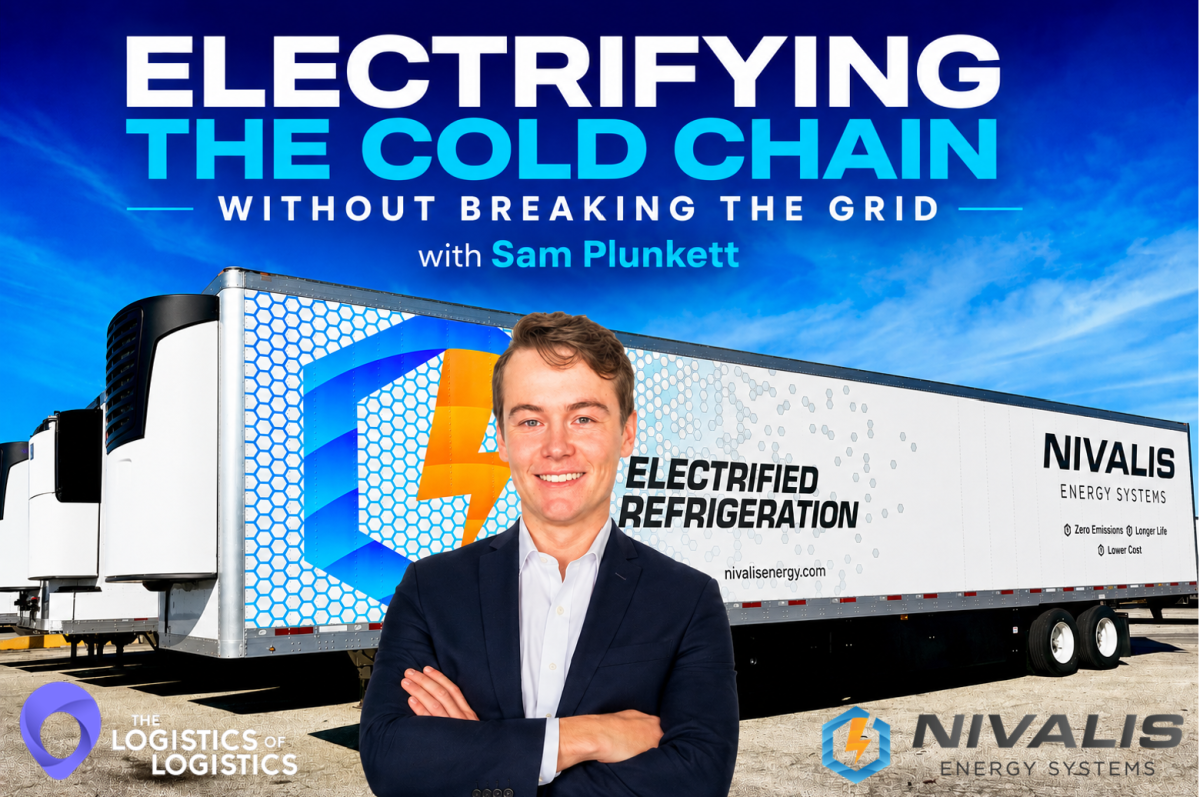
In “Electrifying the Cold Chain Without Breaking the Grid” Joe Lynch and Sam Plunkett, CEO of Nivalis Energy Systems, discuss how self-powered, electrified trailers can drastically cut fleet costs and emissions without overwhelming the power grid.
About Sam Plunkett
Sam Plunkett is CEO of Nivalis Energy Systems, where he is leading the transition away from diesel-powered refrigeration in commercial transport. Under his leadership, Nivalis is developing and deploying electrified refrigerated trailer solutions that help fleets reduce operating costs, lower emissions, and improve the efficiency of cold-chain logistics operations across North America and Europe. Prior to joining Nivalis, Sam led Battery Technology at Beam Global and built a career spanning materials science, electrochemistry, electrical engineering and product development. He holds a PhD in Chemical Engineering from Argonne National Laboratory in conjunction with the University of Illinois Chicago, where his strong publication record and patented innovations focused on battery thermal safety and advanced Lithium battery chemistry. Today, Sam brings this expertise in electrification, energy storage and commercial transport to Nivalis, helping bring innovative technologies from concept to real-world fleet deployment.
About Nivalis Energy Systems
Nivalis Energy Systems develops electrified refrigerated transport solutions designed to help fleets transition away from diesel-powered Transport Refrigeration Units (TRUs). Supporting refrigerated logistics operations across North America and Europe, the company’s platforms are designed to lower operating costs, reduce maintenance requirements, and improve operational efficiency across cold-chain transport operations. Designed for both retrofit and new-trailer applications, Nivalis solutions support a wide range of trailer sizes, operational requirements, and the system is TRU agnostic. The company’s technology roadmap includes next-generation multi-energy systems combining battery, solar and regenerative technologies to improve the long-haul viability of electrified refrigerated transport.
Key Takeaways: Electrifying the Cold Chain Without Breaking the Grid
- In “Electrifying the Cold Chain Without Breaking the Grid” Joe Lynch and Sam Plunkett, CEO of Nivalis Energy Systems, discuss how self-powered, electrified trailers can drastically cut fleet costs and emissions without overwhelming the power grid.
- Proven Bottom-Line Savings: Nivalis’s electrified solutions have been on the road for over two years, demonstrating average operational savings of $12,000 per trailer, per year by dramatically reducing diesel consumption and mechanical maintenance costs.
- Strategic European Acquisition: The recent acquisition of SolarEdge eMobility brings 25 years of automotive-grade electrification engineering and manufacturing scale, accelerating Nivalis’s integration of solar and regenerative braking technologies.
- Independence from the Power Grid: Upcoming next-generation platforms will utilize solar panels and e-axles to harvest braking energy. This allows trailers to generate their own power, drastically reducing or entirely eliminating the need for expensive and time-consuming depot grid charging upgrades.
- Seamless, Agnostic Integration: Designed to be TRU (Transport Refrigeration Unit) agnostic, the technology easily retrofits onto existing Carrier or Thermo King systems. It requires zero operational changes from drivers, automatically powering up or down alongside the existing refrigeration unit.
- Trailers as Mobile Microgrids: Nivalis is building toward a future where returning trailers with latent battery capacity can push energy back into a distribution hub’s grid during peak pricing hours, using AI to optimize energy usage across the entire facility.
- Powering Advanced Security and Compliance: The robust onboard battery provides a reliable, redundant power source for critical auxiliary systems—like advanced telematics, door-breach sensors, cameras, and pallet-level temperature tracking—without draining the tractor’s alternator or relying on idling diesel engines.
- Expanding into Dry Vans: A new European pilot program applies Nivalis’s solar and e-axle technology to standard, non-refrigerated dry vans. The harvested energy is used to slightly propel the trailer on the highway, reducing the tractor’s workload and tracking toward a savings of 2,000 gallons of diesel fuel per year.
Learn More About: Electrifying the Cold Chain Without Breaking the Grid
Nivalis Energy Systems | Linkedin
Nivalis Energy Sustems EU | LinkedIn
The Logistics of Logistics Podcast
Joe Lynch: [00:00:00] Hello, friends. Welcome to the Logistics of Logistics. My name is Joe Lynch. Thank you so much for joining us today. Today’s top is, today’s topic is electrifying the cold chain without breaking the grid with my friend Sam Plunkett. How’s it going, Sam?
Sam Plunkett: Doing well, Joe. Thanks for having me
Joe Lynch: I’m excited to talk to you. This is something brand new to me what you guys are up to, so I’m gonna ask a lot of dumb questions.
So Sam, please introduce yourself and your company and where you’re calling from today.
Sam Plunkett: Absolutely. [00:00:30] Sam Plunkett, I’m calling from Philadelphia in the United States. I am the CEO of Nivalis Energy Systems. Nivalis Energy Systems is a company that is electrifying the cold chain space of logistics. So we make a electrified system that mounts to trailers to take the existing carrier and Thermo King refrigeration systems that are mounted on the front of heavy duty trailer to keep the inside of those trailers at certain [00:01:00] temperatures for perishable goods. And instead of having those engines run on the diesel engines and consuming diesel fuel that they do today we allow them to run 100% of the time off battery electric power to help improve the operating costs and maintenance costs for fleets.
Joe Lynch: I like it. I like it. And then I can also say that this has got a sustainability angle, right?
Sam Plunkett: Absolutely. We see very much that fleets will scale and adopt this technology based on the operational benefits and [00:01:30] economic driving force and they are the driving force, but obviously the benefit is definitely a sustainability opportunity as well.
Joe Lynch: Yep. I like it. I say this often, Sam, that in the trucking business, it is, there’s not a lot of extra money, so there’s not, y- nobody can d- drive their truck and say, “Yeah, we’re sustainable, but we are very expensive and no one will work with us.” Ef- I sometimes use the example with coffee. You go buy a Starbucks coffee for [00:02:00] $6 and they say, “Oh, and we’re green.”
You’re like, “Yeah, ’cause you sell a 40 cent cup of coffee for six bucks.” So you can afford the nicety the luxury of s- of doing sustainable things. With trucking, you have to pay for it first. You have to have, we all have to get both is what we ultimately need. We need to make money, and we also need to do the right thing for the environment.
Sam Plunkett: Yeah, you’re absolutely right. We strongly believe that sustainability will be achieved if there is an operational benefit and a driving force. It’s not the other way around.
Joe Lynch: I like it. [00:02:30] I like it. Real basic again what problem do you solve and who do you solve it for?
Sam Plunkett: Yeah, so we solve the problem of expensive operating costs for diesel refrigeration systems for fleets. So those fleets that move perishable goods they spend a lot on diesel, and they spend a lot on the maintenance of their refrigeration systems because of the diesel engines that are used to power them. And by eliminating the diesel engines and the diesel fuel we reduce their operating costs both in terms of fuel and [00:03:00] maintenance
Joe Lynch: I like it. So there’s a diesel engine that moves the tractor that pulls the trailer. Then there’s a separate diesel engine that just keeps the cold air flowing into the trailer
Sam Plunkett: Exactly right
Joe Lynch: I didn’t know that. I didn’t know how … I just assumed. I’m I’m not a, I’m not from the trucking background, but I always just assumed somehow that was coming, being powered by the engine.
There’s a whole separate system that goes on those [00:03:30] cold chain trailers.
Sam Plunkett: Yeah, and the amount of diesel fuel consumed in these is obviously not as high as the tractor but it’s significantly higher than what most people think. These fleets run these systems often over 20 hours a day and there’s quite a high demand for energy. And so therefore, there’s a large opportunity to reduce operation costs of these systems for fleets.
You– if you take some of the largest fleets in the US that are distribution fleets, so their whole business orientates around moving [00:04:00] perishable goods, you’re talking about 30-plus percent of their market value can be improved by electrifying their refrigeration systems. So significant economic driving force.
Joe Lynch: So everybody’s heard about electric here in the United States anyway, and one of the issues we have here is w- our grid’s a little outdated. So if somebody said right now all tr- all cars and all trucks just work on– as if we had the solution on the trucking business, we [00:04:30] don’t. But I can’t tax the grid in many places anymore.
I– there’s a story that maybe it’s a, maybe it’s a myth, but I’ve heard people say it to me multiple times, is that some electric trucks in Peoria were charging overnight, and it used an enormous amount of energy, and the city reached out and said, “Hey, what are you doing? We don’t have that much energy to give.”
Your solution doesn’t use energy from the grid. [00:05:00] Please explain.
Sam Plunkett: Yeah. I think you’re absolutely spot on, and obviously the demand for electricity is exponentially accelerating with the increase and expansion of data centers, right? So the benefit of electrifying the TRUs, which
Joe Lynch: What is a TIU?
Sam Plunkett: The TRU is the acronym for Transport Refrigeration Unit, so that’s the refrigeration system on the front of the trailer. So the opportunity with TRU electrification that is more prominent than the [00:05:30] potential adoption rates or opportunity for tractors is that we can be very independent from the grid. Today in the US we’ve had a product on the road for over two years, and that product is a battery-only product, and we launched that product for simplicity to start to educate these fleets and obviously to lower our initial deployment costs for these fleets as we continue to develop technology. And m- recently, particularly with the recent acquisition that we’ve done in Europe we are now deploying new technology into the [00:06:00] US early next year, and that new technology will add on to our system a solar capability as well as e-axle capability to harvest braking energy that would otherwise be lost from the trailer. And so with the addition of those two technologies, we can actually significantly reduce, and we’ve even demonstrated in certain route types, we can completely eliminate the need for grid charging, which means that, number one, fleets can scale very quickly the electric TRU adoption [00:06:30] and not have this huge need to go and install their infrastructure upgrades which is obviously a long lag time and very expensive and simply in some places it can’t be done because of the lack of energy from the grid. And so we see this as a means to not just e-enable rapid adoption but also enable improved autonomy from fleet operations, right? You often, or fleets often look at electrification as very expensive in terms of cost and also operational complexity and time.
Joe Lynch: Oh, [00:07:00] yeah
Sam Plunkett: But through the, through TRU electrifications with the technology that we’ve deployed and are about to deploy, we see not just an economic benefit, but also operational streamlining of their…
’cause they can, they don’t have to plug it in or they- their plug-in times are very limited and therefore refueling is reduced, right? Not increased.
Joe Lynch: I like it. So you guys are basically using the t- to, to put all that energy into that battery, it’s either gonna be solar or it’s going to be from braking?
Sam Plunkett: Exactly. [00:07:30] Yeah, there’s an there’s a product that we have had on the roads in Europe, obviously through that European acquisition that we’ve recently completed. And that product has been running around multiple countries in Europe for almost two years now with both solar capability, e-axle capability in the battery. And the power generation from those from an e-axle source and the solar source has been in, in a lot of routes, been able to completely provide enough power to run the trailer, and in other routes it can reduce the energy need to, a few [00:08:00] tens of kilowatt hours a day, which is a fraction of that, right?
An order of magnitude less than the need for other electrification products like heavy duty trucks.
Joe Lynch: Yeah. That’s excellent. That’s excellent. So we’ll come back and talk more about this in a minute, but first, Samuel, tell us a little bit about you. Where’d you grow up? Where’d you go to school? Some career highlights before you joined Na- Novalis
Sam Plunkett: Absolutely. Originally from the East Coast of Australia grew up there and went to s- school there. And then I came to the United [00:08:30] States for grad school for my PhD, which I completed at Argonne National Laboratories and in conjunction with the University of Illinois Chicago. So my background is in chemical engineering and my PhD focuses on advanced materials for lithium-based energy storage. So after I graduated moved into the industry and have spent my career mainly on the energy storage development side, so both in terms of the chemistry and also the battery systems themselves. Typically focused in [00:09:00] the startup environment and done a few different ventures now. Pr- prior to Novalis we exited from AllCell Technologies to Bean Global, where I served as the director of battery technology and supported that transition for a period of time before I, I joined Novalis.
Joe Lynch: Very nice. Very nice. So when and why did you join Novalis?
Sam Plunkett: Yeah, so I think two, two key reasons. The first one was I very much saw that the battery industry and the energy [00:09:30] storage industry was consolidating and the opportunity for niche or smaller companies to be able to find areas where they could be valuable beyond the larger organizations was getting smaller and smaller. And I saw a shift in terms of opportunity for people such as myself to be from the energy storage side, more on the s- full system side, right? So taking those energy storage devices and putting the power electronics, the intelligence, and the other complexity around them for [00:10:00] specific applications. And so that was a key driver.
And then secondly the founder of Novalus Energy Systems, Dennis Townsend also remains the chairman of the board and the significant stakeholder within the company. Him and I have had a strong relationship now for many years, and he’s been a key mentor of mine. And there was definitely a strong gravitational pull to come and work with him again.
Joe Lynch: I like it. I like it. So you mentioned you were at Argonne. Is that Ar- is it Argonne Na- National Labs?
Sam Plunkett: National Labs outside of Chicago, that’s correct
Joe Lynch: So that’s [00:10:30] a f- that’s a that’s very prestigious. Congratulations. But they work with a lot of Department of Energy and also defense stuff. Please explain what that is for people who are wondering.
Sam Plunkett: Yeah, so the United States has multiple national laboratories and y- you hit it, they’re funded typically by the Department of Energy or the Department of Defense Argonne National Labs is specifically funded by the Department of Energy. They obviously have lots of industry partnerships and do a lot of industry projects as [00:11:00] well. But the vast majority of funding comes from the DOE, Department of Energy. And, it is a fabulous place to, research and get a PhD or other higher education and obviously do research beyond that because of the huge amount of multidisciplinary research that goes on the expertise there and the capabilities there to really explore the frontier, whether it’s energy storage or other
aspects.
Joe Lynch: So are a lot of the universities associated with, are they doing joint projects with the universities?
Sam Plunkett: Very much. Yeah. So [00:11:30] obviously mine was a joint project with the University of Illinois Chicago they have a huge amount of university partnerships and, constantly doing different projects and new projects and building new relationships on a daily basis. Moving forward very much.
Joe Lynch: Yeah, I was looking at some of the projects they do the other day. It’s very comprehensive. So but anyway, let’s get back to today’s topic. This is electrification, but you guys aren’t… It’s not just about sustainability. So s- and I know everybody listening to my podcast is in logistics, [00:12:00] supply chain, and they’re gonna say, can it help me with my operations?
Can it reduce my costs?” And I think we’re seeing also, we’re seeing innovation in this space that we haven’t seen in perhaps ever with the recognition that we have to somehow get leaner and greener. And meaning we gotta reduce our costs, and at the same time, we somehow get get cleaner because the expectations of the brands we serve and the consumers that they serve expect [00:12:30] it.
Please elaborate
Sam Plunkett: Yeah. So I think we’ve touched on it a few times but the key for us is you need to be able to, save these fleets money in the business that they’re doing today in order to create adoption of your technology, right? That is first and foremost. And with our product here in the US being on the road now for more than two years, we have clearly demonstrated a huge economic benefit of our product. With all of the deployments that we’ve done and additional field [00:13:00] trials that we’ve done over these two-year period, we’ve shown on average throughout the US, there is a $12,000 per trailer per year operational savings in terms of reduction of fuel and maintenance. So being able to deliver the the product at a price that is a delta above diesel but there is a upfront cost addition, but we are deploying a product whereby that upfront cost addition is much less than the net present value of those yearly savings over the lifetime of the product.
So [00:13:30] therefore, you get a total cost of ownership benefit of electrification. The second key aspect is there are operational complexity with electrification that people obviously see as a barrier to adopting. And one of the huge benefits of our system and I think TRU electrification generally, is that the additional operational need is quite minimal.
The way that we have reverse engineered our product is to pair with existing TRUs and to run [00:14:00] the electric TRU in a very similar fashion as they would typ-typically running our diesel– their diesel TRU. Simply put, they turn the TRU on, our system turns on with it. They turn the TRU off, our system turns off with it.
And really o- the only additional operational need today is the charging of the trailer, right? Which is somewhat comparable to refueling with diesel, although it does take longer and you do need that charging infrastructure But like I said, with that technology that’s coming down the pipeline and gonna be available next year, [00:14:30] is with the solar capability and the regenerative capability from the axle, that need for charging reduces significantly.
And so now you have an asset that saves money, is extremely streamlined in terms of operation, even better in terms of operational streamlining than the diesel. And I think that as we see this being adopted into a fleet, we actually see a lot of opportunity to benefit fleets more than just operational savings from the diesel fuel and maintenance of the TIU, [00:15:00] right?
We’re looking at things such as these electric trailers now effectively being a mobile microgrid. If there’s latent capacity coming back from a route that now you’re sitting outside of your building and you’re in, peak electricity price time, you can actually take that energy from the trailer, push that back in the grid, and lower the electricity cost for the whole, fleet domicile location.
There’s a lot of artificial intelligence that we’re looking into that we can layer on top of these systems in order to optimize the generation from these different [00:15:30] aspects optimize what we do on the trailer throughout the route so that you can then optimize the electricity cost for the building.
It’s… We have to do this step by step crawl, walk, run, but at– we see, the electrification of the TIU aspect is the first step of the value that, that these technologies can bring.
Joe Lynch: No, I love it. I love it. And right now we’re talking on June 17th, and so the World Cup is going on, and we’re seeing the reactions here in the United States of all the world visiting, which has been fantastic to see the, to see [00:16:00] our country through other people’s eyes. And one of the big feedbacks we’re getting is, “Man, it’s hot.”
It’s really un- It’s hot a lot of places especially down south. And I think of our s- if I’m in Michigan, you don’t always think of it, yeah, that’s great for solar. But we do get enough sun. It being a peninsula, we get a little less sun than the places around us. But g- many of the routes that trucks are moving are very sunny and [00:16:30] very warm.
And I think I think Texas is probably the best place right now, Arizona for solar, but it’s working a lot of places. Y- years ago I was talking to Walmart on here. Walmart’s got solar panels on tons of their buildings, and I think there’s some they said perhaps doesn’t make sense. But with a truck, the nature of it, it can go wherever it needs to be.
And you could say, “Hey, these, we’re gonna, if we’re gonna deploy them here, th- here ’cause we have routes, but also it just happens to be a very [00:17:00] sunny place.”
Sam Plunkett: Yeah, absolutely. The another benefit of the TIU application is that obviously the driving force of the energy demand is the delta in temperature of what you want it to be at
inside- Yes
the trailer and what it is outside, right? And as it gets hotter outside the energy need goes higher and higher. But the… typically, that correlates very nicely to there being more and more solar energy available as well, right? It’s hotter outside, there’s more sun. And the energy demand matches the [00:17:30] generation from the input of solar
Joe Lynch: Yeah. We should also mention cold chain’s been around for a long time, but the bar continues to rise in cold chain. You can’t have an old system that’s leaking, there’s too much condensation. You have to be able to stay within a temperature range. The Food Safety Modernization Act mandates if you’re moving food, that you be able to prove that this stayed within temperature range.
And obviously, nobody [00:18:00] wants to move food and have it go bad. But it’s one of those things, if you’re a grocery chain, it’s very damaging to say, “Oh yeah, if you ate this type of lettuce, please if you bought this type of lettuce, please throw it out.” It’s like the last thing they wanna do. And it happens.
It… We move a lot of food. But that, the stuff, this refrigerator continues to grow. Pet food is being moved in cold chain. Lots of pharma is being moved in cold chain. I think [00:18:30] we’re gonna see more cold chain rather than less cold chain going forward
Sam Plunkett: Yeah, I think that’s absolutely right. I was at a distribution market recently just yesterday actually and we were talking about kind of the infrastructure development since it was installed in the ’60s whereby you would have trucks that weren’t refrigerated, come to the warehouse and be loaded in an open dock and then if they were staying for more than a day, they would get refrigerated.
But typically, you would just come in unrefrigerated, you would, unpack, repack [00:19:00] unrefrigerated and go back out. Whereas now you see that the trucks are electrified, the trailers are electrified, sorry the, the warehouse dock is electrified, not just the like long-term storage and then it distributes on, short-term routes fully refrigerated as well. And that has created an enormous energy demand increase for that market. And we’re obviously talking to them about opportunities with our product to, to negate that bottleneck, and I think we’re gonna continue to see this. Now you’re [00:19:30] transitioning from, no refrigeration to, more and more has to be refrigerated.
But also now the monitoring, like you said, isn’t just you need to prove that kind of that order was within a certain temperature, but now they’re starting to look at temperature management on a individual, box or pallet level, right? So
the-
Joe Lynch: I think the Food Safety Modernization Act really requires that you do it at the product level. I don’t know that we have that technology quite yet. We can tell you what the temperature of the [00:20:00] truck is, and maybe I could put a sensor on a pallet, but you’re not gonna put a sensor on every single product within that pallet
Sam Plunkett: There’s definitely some technologies out there that they’re looking at deploying those things are, RFD chips and et cetera. And I think the, the simple conclusion is that the we are raising the bar and raising that bar is also raising the energy demand, and so we need to get more efficiency to combat that.
And I think that electrifying the refrigeration is, the clear step in order to move in the direction of better and better [00:20:30] efficiency.
Joe Lynch: S- Sam, when, a few years back probably five, seven years back now I think about it, I was talking to somebody, not on the podcast, off the podcast and he said that there was a large food company and they had some of their own trucks, and they were delivering to grocery stores. And then they couldn’t make a delivery.
It was a, it was… I don’t know if it was frozen or just chilled. Anyway, they couldn’t deliver it on a Friday. They brought it back to the terminal, [00:21:00] and somebody said, “Make sure you run that over the weekend. Keep that cold over the weekend.” And everyone went home for the weekend, whatever they did. As people came back Sunday night and they said, “Oh, this is thawing out.
This went out of temperature range.” And at that point, there was no sensor saying, “Warning, this is going out of range.” So these guys, they got $70,000 worth of food in there, and you’re there in the warehouse, you go, “Hey, do you wanna [00:21:30] tell the boss that you didn’t keep it running, or should I tell him?”
So they just turned it back on. They chilled it again. And you like to think there was no problem with that. But that has been the way business has been done in the past. I don’t think we wanna tolerate that anymore. But also we want to have sensors that tell us before we have a problem.
And we have that technology now, but it all needs to be charged. So if your trailer isn’t [00:22:00] charged over that weekend doesn’t matter whether you knew it was going out of range or not, you can’t do anything
Sam Plunkett: Absolutely. Yeah, and we’re getting lots of customers that are reaching out to us about powering auxiliary systems on the trailers, right? So it’s not just the refrigeration unit, it’s also lift gates and the pallet chargers, and even like internal sensors and cameras and things of that nature as well that typically have been powered off alternators from the truck.
But now that you have a much larger, efficient [00:22:30] energy source on the trailer, there’s more redundancy that we can build in there to make sure that sensing and charging and other energy needs is– has both an efficient but also redundancy built into making sure that power is available for those devices.
Joe Lynch: Oh, yeah. Yeah, you think about we we want we wanna know where that truck’s at, so the visibility tools are very important. But we also have had a big problem as of late with cargo theft. And [00:23:00] certain things like drugs that move on cold chain are very valuable to thieves also. So those sensors that tell us that the door is being breached very important to us now.
And, as I say it often, Sam, is 20 years ago someone said, “Just get me a truck that moves my stuff from point A to point B.” Now it’s increasingly, “Give me technology that shows me you’re doing it the right way, streamline the process.” But we’re also asking for data, and all of those [00:23:30] things require energy.
And if you can fuel that not from diesel that’s a big step in the right direction
Sam Plunkett: Yeah, absolutely. There’s almost a mandate now, right? It’s a must-have to have telematics and monitoring of your tractor, of your trailer, and even of y- certain yard devices in order to make sure that, the food safety requirements are met, both in terms of temperature and time. And also, as you mentioned, where the trailer is and, protection against theft and things of that [00:24:00] nature. But what we’re really exci- And obviously the Nivalis system has, our own telematics but we see a lot of benefit in taking data, providing it to the existing platforms that fleets use, right?
And a fleet wants to look at kinda one dashboard or one platform and look at all their different vehicles and all the different data inputs that they need to see from those vehicles and we’re kinda partnering with those entities and those organizations rather than saying, “Hey, you also need to look at the Nivalis dashboard as well.” Although we do have both [00:24:30] capabilities, but the Nivalis one is more focused around, our engineering and continual optimization improvement. But where we’re we’re starting to look towards is the next step, which is, predictive capabilities in order to not just know what’s happening, but look into the future and say, “This will happen, therefore I can do X, Y, Z, which will improve my energy efficiency use.”
And that’s what we’re starting to get really excited about, especially when we start to talk about solar generation and [00:25:00] regenerative braking and pairing the trailer with the building load when it returns and things of that nature. So I think there’s a move in terms of the data need in order to do that and the telematics that we’re gonna start collecting in order to improve the energy utilization more and more.
Joe Lynch: Yep. So you mentioned that you’re currently working with some customers already, and please explain what does that look like? Beyond the sales call. So they say they, they finally call your sales guy back and say, “Yes, this is what we need.” [00:25:30] Walk me through that process and act as if I have the knowledge of a 13-year-old.
Sam Plunkett: So the obviously mounting a battery system, an electric system under a trailer is quite new to these fleets, right? They have some prior experience with electric yard tractors that have been out in the market now for a long time. There’s some great products out there. They have lesser experience, but still some experience with electric tractors.
And so electrification, it often isn’t new to these fleets. Sometimes it is but the [00:26:00] concept is not foreign. And so typically that kind of early education experience is focused around, the details of what does this electric product look like in terms of operations specific to your fleet?
So we typically start with a one trailer demonstration period where they can, put the trailer into their fleet and they can understand, where does the charging need to be, what are the routes that it can go on, what are the routes with the current product, the gen two product today that, doesn’t have the long haul capability and just has the short haul capability, what routes can and [00:26:30] cannot it go on? And what are the charging times and loading times that we may need to optimize around this specific electric product? So there is a learning curve with the current generation of product, the battery only product today that we simply, you know, really without doing a demonstration or going through a quite detailed d- data analytics process to understand their operations and how we adapt them to the electric product. That’s really the first step. And so once we pass that and, there’s an alignment on, hey, yes, [00:27:00] there’s an operational alignment here, there is also a economic benefit here, then we move into, okay, what does the site plan look like, right? So where does the charging go? What’s the charging site it need to be? And all of those decisions are based on, the demonstration or the data analysis that we’ve done. So that’s typically the process, right? Demonstration, operational understanding, use that to do the site solution around the charging and otherwise, and then we move to the deployment phase, which is, quite streamlined if, the prior work is being done [00:27:30] effectively.
Joe Lynch: So when they’re using this right now, this is a charger. How much does that weigh?
Sam Plunkett: So the charger’s obviously stationary. It can weigh quite dramatically between if it’s a smaller charger, typically we use down to about 30 kilowatt chargers.
Joe Lynch: I shouldn’t have said charger. I meant the battery. How much does the battery weigh on that trailer?
Sam Plunkett: Yeah, so our system today has an installed weight of three thousand pounds. If you take the diesel engine and the full tank of fuel and remove that the– that, that’s about a thousand pounds. [00:28:00] And so if you look at a diesel trailer versus a fully electric trailer, there’s about a two thousand pound weight delta or weight increase. Obviously the new technology that we’re looking at deploying next year it’s going to reduce that delta down to about a
Joe Lynch: Yeah, that’s gonna, that’s gonna c- that’s gonna get thinner and thinner as battery technology im- improves. So right now I’m charging it, so I have to have charging locations. I’d no doubt have some at my terminal, and s- so that’s it- is there another place I can charge that’s not a [00:28:30] unique charging system, is it?
Sam Plunkett: No, it’s not you. We use standard CCS1 charging and we’re de- deploying with the next generation AC charging as well. The vast majority of our customers today have actually been able to deploy 100% of their charging for these trailers at the dock which is very streamlined. You have a charger at the dock, and you charge the trailer while it’s loading before you deploy.
So extremely streamlined. There are some customers that have, for example, automated warehouses where that loading time is extremely [00:29:00] fast, like matter of minutes. And therefore they’ll place charging in other locations throughout the depot in order to streamline their operations whilst making sure that the trailers can leave for their routes fully charged. And as I mentioned before, those deployments now are not insignificant because of the battery-only product that we have on the market. But as we move to the next generation the, those, that infrastructure in, install becomes, significantly less
Joe Lynch: Yeah. And also, so when, right now it’s, [00:29:30] you’re charging at a s- at a charging station, but soon you’re gonna have this what do you call it? The regener- regenerative braking. Please explain that for people who aren’t familiar. That’s what the hybrid technologies uses sometimes, right?
Sam Plunkett: Simply the trailers have brakes on them in their axles, and that braking takes, the energy of propulsion and reduces the propulsion and expels heat from those brakes. And so instead of, braking and losing that energy to [00:30:00] heat, we are putting that energy through a motor that we place on the axle that’s our own motor design, and that generate…
That electrical energy is now stored in the battery pack, and then we can now use that electrical. So we’re taking waste energy from braking and using that, recuperating that through an e-axle to the battery pack
Joe Lynch: And then you also have solar, right? That’s also on the roadmap. And solar would be fantastic in so many parts of the country. I don’t know please ex- I’m not a solar expert. [00:30:30] Sometimes I hear people say, “What good is solar do? It’s cloudy where I live.” Does solar work in ev- every climate?
Sam Plunkett: Yeah, it’s more effective obviously in hotter climates. But like I said
before- I think, Yes
the good news is the hotter it is, the more energy you need, and therefore it, it matches quite well with the solar capability. But for example, I was just doing a site analysis in New York, downtown New York, and the solar production on the trailer there for a standard trailer can account for over [00:31:00] 20% of the energy need for that refrigeration system on a daily basis on average.
Quite a significant reduction then in other forms of energy input you need for that system.
Joe Lynch: The thing is about this business is it’s a business of nickels and dimes. It, th- this is … If you say it only saves us 3 or 4%,” 3 or 4% is enormous in this business. And right now hopefully and we’re talking on 6/17, June [00:31:30] 17th, supposedly we have a deal with Iran and the Strait of Hormuz will open.
But we’ve had very high diesel prices lately, and diesel’s also a lot dirtier than regular fuel, right?
Sam Plunkett: Absolutely. The and even more so off-road diesel, which is often used in these TRUs can be more again, right? The volatility of diesel prices, because of the geo- geopolitical situation has definitely strongly incentivized customers both here and in Europe. We’re seeing, strong demand for our product and [00:32:00] electrification is general to not just because of pricing, but also for independency from petrochemical dependence.
Joe Lynch: Oh, yeah. And I think being w- I don’t think we’re gonna move completely off of fossil fuels, but we’re gonna get better and better at this other stuff, and we’re gonna have opportunities where we don’t have to use it, and that’s gonna be a wonderful thing. And I think also before we hit the record button, we talked about the idea of trailers just getting smarter [00:32:30] and smarter.
I think as much as I’d love to think the government is going to jump in and help us with cargo theft, it is one of those things that is so dispersed across the country that it’s not easy. I think technology, which needs power, is going to be what ultimately brings a fix for us. Am I right to say that?
Sam Plunkett: Absolutely. I think that there’s a lot of technological solutions that are rapidly being deployed to curb [00:33:00] the theft in the logistics industry, and I think we’ll see a lot of deployments of those technologies because of the cost that these fleets are burdened with.
Joe Lynch: Yep. I just talked to Danielle S- over at Freight Fra- the Fraud Girl, I guess she goes by, and Danielle Spinelli, and she’s been talking with California Highway Patrol, and they did a webinar together not so long ago. Doing, Descartes was part of that. And [00:33:30] the freight fraud has gotten … I’m sorry, f- cargo theft, freight fraud too probably, has gotten very sophisticated.
Used to be somewhat opportunistic theft. Now it’s sophisticated, meaning they planned it. They saw that right from the port, and they’re gonna track that because they know it has some electronics or some drugs or whatever. And we have to keep getting better and better, and I think the idea of making that trailer smarter is a great idea.
But the first thing, right as soon as you say, “Make it smarter,” so the next [00:34:00] question is, how do we power it? And I think you have an answer
Sam Plunkett: Yeah, absolutely. I think a key point there is as they become more intelligent as well, there’s op- obviously more opportunity for, hackers and people that aren’t trying to do the right thing to gain access in terms of valuable information. So not only is it the solution, but if it’s not done right, it can also be a potential access point and opportunity for these people.
And when we look at deploying our systems, we look at doing the right thing and the right engineering approach in terms of [00:34:30] guidelines and requirements for cybersecurity and over-the-air update safety and things of that nature too. So w- yes, it is absolutely a solution, but we need to make sure it’s done right.
Joe Lynch: Yep. So who’s your ideal customer right now?
Sam Plunkett: Yeah. In the US our ideal customer are distribution fleets focused in the cold chain space. So whether it’s distributors of food to restaurants, distributors of food to gas stations whether there’s grocery chains out there that are going from, their warehouses to their grocery [00:35:00] stores.
Anyone that is using trailers to move perishable goods our product works also for other non-food perishable items like pharmaceuticals as well. If you run a fleet that is moving tra- refrigerated trailers that is our customer base. And with our current product we’re focused on fleets that do a nightly return, right?
So if you have a tr- if you have trailers that leave from location A, go on their route, and within the same day return to location A our product will be a [00:35:30] huge benefit both in terms of savings and operational benefit for you
Joe Lynch: I’m a- I’m assuming if you worked with a company that had a terminal, say, in Chicago and one in Detroit, that would also work as long as they had charging stations at each
Sam Plunkett: Absolutely. We’ve done a deployment actually in Illinois downtown Chicago, actually, and we found that there’s a niche benefit there for them. They, because of the cold, actually, in the wintertime, they run their engines in these refrigeration systems twenty four/seven around the clock because they’re concerned if they [00:36:00] turn them off, they won’t be able to cold crank them again the next day. And so being able to electrify allowed them, Obviously, we demonstrated that we can, turn on our system in the dead of winter in Chicago with the… which was quite a technology advantage of our product. And now they can run their systems much more efficiently in the winter ’cause they don’t have to run them around the clock on, on diesel.
A great operational and economic benefit for that customer.
Joe Lynch: I like it. I like it. Let’s see. What did I miss anything here? Oh, so we talked a little bit about this [00:36:30] acquisition you guys just made. What was the purpose of this acquisition? What was the company, and what did they bring to your to your company?
Sam Plunkett: So s- we acquired SolarEdge eMobility, which was a division of SolarEdge. SolarEdge is a large organization focused on power electronics for the photovoltaic or the solar industry. And they were refocusing on their core business and therefore we had an opportunity to purchase their eMobility division. That division has a [00:37:00] 25-year history of electrification, deploying full electric drivetrains to various applications. That includes motorcycles and even includes a project where they deployed over 3,000 per year full electric drivetrains to the automotive industry for passenger vehicle. And the benefits and the reason that we’re excited about closing the application is, m- mainly three, three parts. The first one is, the excellent team there and the technology that they’ve delivered now [00:37:30] for, the trailer industry, which has been, obtained through 25 years of experience through, electrification, even in the automotive space. Secondly, th- they have huge manufacturing expertise and capabilities. As I mentioned, they deployed over 3,000 full Tier 1 certified electric drivetrains per year. And so we can convert that capability very quickly into several thousand TIU electric systems per year. And lastly, we see huge opportunity in terms of market presence and obviously sales in [00:38:00] Europe because that Europe is very focused on electrification because of the benefits in that region for electrifying. Obviously, there is- Yeah, I love it … a lot of interest recently now with the geopolitical situation in the Middle East and elsewhere, having them v- they’re very focused on independence from petrochemical industry
Joe Lynch: Yeah. I think everybody has the same thought process, which is, yeah, we have to f- we have to figure out what’s next. I don’t know that it’s gonna be 100% of the solution. It doesn’t have to be. It just has [00:38:30] to we’re not gonna, we’re not gonna get there in all one big bite. But I think the…
for a minute we were saying, “Oh, we’re all gonna be driving electric vehicles,” so we realized we don’t have the grid quite yet. And as we build the data centers, we’re starting to realize we gotta make our grids better. And I joke about it here. I live in Michigan. We have storms every year that knock out our power, and I always think, “What, you didn’t expect we’re gonna have a storm?
We have a storm every damn year that knocks out power.” Those updates are [00:39:00] at billions and billions of dollars of investment. So the idea that I can work and work without those at some point, be separate from the grid, that’s a beautiful thing.
Sam Plunkett: Yeah, absolutely. I think, what separates Nivalis as a company in my opinion, is that we have deep energy storage, deep power electronics, but also deep electrification expertise, right? We have a vast understanding of all the different applications out there that [00:39:30] are on the spectrum, right?
As you’re right, it’s not gonna all happen in one bite. It’s gonna happen as, this application. You look at forklifts, right? They’ve been electrified for a long time and, they’re starting to transition from lead acid-based technology to lithium ion. But they’re an application that’s been electrified and had the economic and operational benefits for a long time.
And then you look down the spectrum and there’s, things that are challenging with technology today that will become electrified in the future, but we shouldn’t do… focus on the electrification today. And through those expertise, we’ve realized that obviously fleet electrification [00:40:00] is a huge opportunity because, they have a lot of products and they run them twenty-four/seven, which is the fundamental benefit of electrifying, right?
You pay more, but the more you run it, the savings get higher and higher. And so through those understanding, we’ve, really focused in on TIU electrification because the technology of today can provide an economic benefit and an operational benefit for displacing, the incumbent diesel technology. But you’re absolutely right. We need to look at it as [00:40:30] application specific and even customer specific. Once we deploy the technology, is it right for them? Is it right for the application? And not just look at it as we need to electrify everything at a hundred percent duty.
Joe Lynch: Yeah, and if you look at a lot of the applications we’ve seen, so we use CNG or for garbage trucks. You’ll see it with school buses. I think a lot of those Amazon trucks are running on natural gas, which is great. Most of those applications don’t come to the [00:41:00] trucking the big trucks. So we’ve been waiting, we’ve been waiting for someone to bring us some s- some things that we can check the box on sustainability
Sam Plunkett: Yeah, absolutely. We’re excited to be part of electrifying the fleets. I think there’s a huge opportunity there, and we’re excited to be part of it
Joe Lynch: So I’m gonna wrap this bad boy up, and I want your final thoughts on the topic, Sam. So I’m talking to my friend Sam Plunkett. We’re talking about electrifying the cold chain without breaking the grid. And again you guys [00:41:30] are devel- developed battery that’s right now charging, but soon we will have solar panels on top of the my, on top of my trailer, and also regenerative braking.
So you’re using re- completely off the grid at that point. And I don’t think that’s gonna have to happen overnight, but it’s a just a beautiful thing to be able to say I run a lot of my functions on my soon-to-be very smart trailer. It has to be. They … I think that’s the thing we’re seeing everywhere.
Trailers are getting smarter and smarter, and they [00:42:00] need to with all the challenges we have, not just from a sustainability, but just from a safety perspective, from a visibility perspective, from a cargo theft perspective. And as you mentioned also, gotta be really s- careful with the the hackers who are out there, the freight fraud, and the cybersecurity challenges.
That’s another podcast. But you guys are going in with a battery and saving people money every year on not [00:42:30] running the truck, but running the trailer. I didn’t realize that every trailer, cold chain trailer, has its own engine, in effect, that keeps it cold. And that’s runs on a lot of diesel.
You can cut that diesel price way down if you start using what they got over here at Novalis. It’s gonna s- it’s gonna lower your total cost of ownership, which if you can do that, y- you’re gonna be a winner in this space. We, we didn’t really get into this Sam, but please t- tell us a little bit about [00:43:00] what you had ideas on what you guys will be doing with d- dry vans soon.
Sam Plunkett: Yeah. So we’ve just launched a demonstration pilot in Europe with TIP, which is a very large leasing entity in Europe along with BPW, which is a key axle manufacturer in Europe and a customer, Sommer. They’re a a distribution fleet. And this trailer does not have a refrigeration system on the front of the trailer.
It is a dry van de- deploying or delivering non-perishable goods. [00:43:30] And we’ve taken our system as I mentioned, it’s, with the solar on the roof and the e-axle on the trailer, the battery system mounted underneath that has been, operating and being deployed across Europe for the past two years to power the reefer. And now instead of powering the reefer, it’s actually slightly propelling the trailer on the highway. And it’s a very lightweight, very low cost system design that we’ve reverse engineered around what’s the available energy and how can I use that available energy [00:44:00] in terms of the solar and the otherwise waste braking energy to propel the trailer in order to reduce diesel consumption for the tractor pulling the trailer in a way that provides a significant total cost of ownership benefit to the customer. And we’ve only been on the road now for a week, so it’s early days, but what we’re finding is that our hypothesis of the capability to save fleets almost 2,000 gallons of fuel per year is actually realized. And there’s a [00:44:30] obviously significant total cost of ownership benefit of that. And obviously, that’s to help reduce diesel fuels for tractors, but also part of that pilot has also got a power sharing capability. So now we can share power that we’ve generated back and forth with the electric tractors, right? And so now you talk about, whether it’s range extension or operational streamlining with electric tractors as well.
And so we see that… Go ahead.
Joe Lynch: I was gonna say, I love where this is going because one of the [00:45:00] challenges we’ve always had is with trucks idling, where they’re waiting and they gotta stay warm and, or m- maybe they just wanna run their r- their electronics in their car. And you can see w- getting to a place where you say, “If I can start to generate energy through solar and through this regenerative braking where I can turn off my tractor potentially.”
I know you didn’t say that. I don’t wanna overpromise for you, Sam, but you can see so many opportunities as soon as you’re creating your own power
Sam Plunkett: Yeah, I think simply put the [00:45:30] trajectory of Nivalis is such that we want to be able to generate and harvest power and provide that power to uses that we provide a total cost of ownership a financial benefit or, and an operational benefit to fleets, right? Whether that’s powering refrigeration systems, which is obviously the focus and really the lowest hanging fruit in terms of reducing diesel fuel maintenance. But we see a lot of other opportunities to improve, i- improve fleet efficiency as the company and the technology develops.[00:46:00]
Joe Lynch: I like it. I like it. So I started to summarize this. This is gonna save people money. This is gonna, this is going to… I think the electronics is, what we’ve learned, I think mostly from any sort of electrification is it doesn’t have as many moving parts as the mechanical stuff, the f- the fuel stuff that we’ve always used.
I think I think we’ve covered it all. Put a big old bow on this one, Sam. Final thoughts on the topic
Sam Plunkett: Yeah. So Nivalis is a product on the road now focused on nightly return [00:46:30] distribution fleets for over two years, and we’ve proven that those fleets on average can save two thousand dollars a year on fuel and maintenance. And we’re actively in production and deploying those across North America. We have just completed an acquisition with advanced technology with products on the road in Europe for two years that brings solar and e-axle capability that will allow us to not just meet short haul and long haul, but will also improve those yearly savings. I think another very exciting [00:47:00] aspect of this technology is it will significantly reduce dependency on the grid by generating its own power from the sun braking energy that now we’re harvesting. And we’re excited to deploy that technology next year and continue to expand our footprint and adoption across North America and Europe. And we see a lot of exciting opportunities that go beyond just reducing diesel and maintenance costs for refrigerated trailers, but we also see benefits in terms of non-refrigeration fuel and maintenance savings [00:47:30] as we mentioned, by propelling the trailer or providing energy that we harvest to their, their dump site, like their distribution warehouse.
So a lot of opportunity today, a lot of opportunity on the horizon
Joe Lynch: I love it. I love it. So what conferences will we see you and the fine folks from Novalis at this coming year?
Sam Plunkett: Yes, we’ll see us at ACT in Vegas. We will be there around May time next year at the ACT conference
Joe Lynch: And what does, ACT is American Clean Transportation? Is that
Sam Plunkett: Advanced clean transportation, that’s [00:48:00] correct?
Joe Lynch: Advanced
Sam Plunkett: Yep, we’re going to be presenting our product at IAA in Hanover in Germany in September. I, along with a lot of the team folks will be there. And then also early next year we’re looking at although not confirmed we will most likely be attending the Manifest Expo in Vegas as well, which I think is
in January or February
Joe Lynch: Yeah, it’s usually late January or early February. I call it the Super Bowl of logistics and supply chain. Sam, I’ll make sure I put a link to your LinkedIn profile, link to your [00:48:30] website. Any of the links you and your go-to-market team give me, I’ll put those in the show notes.
And I love what you guys are doing. It’s very interesting future we have here with the trucking business
Sam Plunkett: Yeah, Joe, very much appreciate your time. Look forward to following up
Joe Lynch: Yep. Thank you. And thank all of you for listening to my podcast. Your support’s very much appreciated. Until next time, onward and upwards