
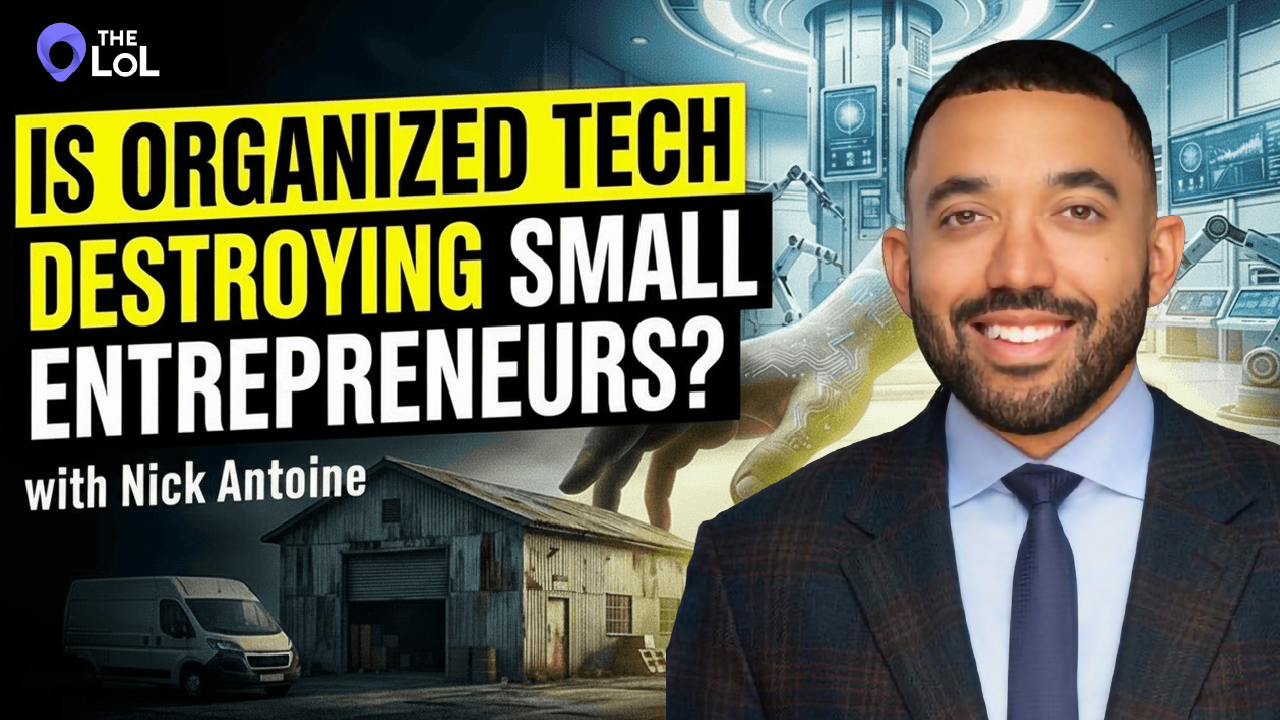
In “Is Organized Tech Destroying the Small Logistics Entrepreneur” Joe Lynch and Nicholas Antoine, Co-Founder, Co-CEO, and Managing Partner of Red Arts Capital, discuss how mid-market logistics companies can leverage emerging automation and strategic “moats” to successfully survive and compete against tech-heavy enterprise giants.
About Nick Antoine
Nicholas Antoine is the Co-Founder, Co-CEO, and Managing Partner of Red Arts Capital, a private equity firm he co-founded in 2015 – at age 26 – to invest exclusively in supply chain and logistics businesses. A Princeton graduate, Nick began his career as an equity research analyst at Princeton Global Asset Management before joining Ariel Investments in Chicago, where he served as Chief of Staff to the Chairman and CEO of the $17 billion asset manager. At Red Arts, he leads fundraising, research, and investment thesis development, building one of the few Black-founded and -led PE firms in the country and one of the top-performing, ranked #7 on Bloomberg’s 2025 Best-Performing U.S. Buyout Funds. Nick is a member of YPO and a board trustee of The Studio Museum in Harlem and WTTW (PBS Chicago).
About Red Arts Capital
Red Arts Capital is a Chicago-based private equity firm focused exclusively on partnering with North American supply chain and logistics businesses. Founded in 2015 by Nick Antoine and Chad Strader, Red Arts is a 100% Black-owned firm investing across the “supply chain economy” – freight, transportation, warehousing, contract packaging, and related middle-market companies with strong growth potential. In 2023, the firm closed its latest fund oversubscribed at $270M, above its $225M target, backed by institutional LPs including Prudential Financial, the University of Chicago’s Office of Investments, and funds managed by Neuberger Berman. Red Arts pairs a sector-focused thesis with a belief that diversity drives performance – women represent roughly half the firm.
Key Takeaways: Is Organized Tech Destroying the Small Logistics Entrepreneur
- In “Is Organized Tech Destroying the Small Logistics Entrepreneur” Joe Lynch and Nicholas Antoine, Co-Founder, Co-CEO, and Managing Partner of Red Arts Capital, discuss how mid-market logistics companies can leverage emerging automation and strategic “moats” to successfully survive and compete against tech-heavy enterprise giants.
- Firm Profile & Focus: Founded in 2015, Red Arts Capital is a 100% Black-owned, Chicago-based private equity firm that focuses exclusively on North American supply chain, logistics, and middle-market infrastructure businesses.
- Target Investment Profile: Unlike venture capital firms that hunt for speculative “hockey stick” growth, Red Arts invests $50M to $100M+ into established, profitable middle-market companies (typically family-owned with $100M to $500M in revenue) to provide liquidity and operational scaling.
- Strong Institutional Backing: Validating their sector-focused thesis, the firm closed its 2023 fund oversubscribed at $270M (surpassing its $225M target) backed by premier LPs like Prudential Financial and the University of Chicago.
- The Concept of “Organized Tech”: Nick defines “organized technology” as a modern third form of power alongside organized people and organized capital. Large enterprise players use their scale and massive resources to deploy tech—and partner with startups for free trials—giving them a distinct, systemic advantage.
- An Opportunity, Not a Death Sentence: Organized tech is not inherently destroying small logistics entrepreneurs; rather, the risk lies in a lack of adaptability. Because AI and automated tools are becoming rapidly commoditized and affordable, small business survival depends on an entrepreneurial willingness to experiment.
- Building Defensive “Moats”: To avoid competing strictly on commoditized pricing, successful logistics companies must build defensible moats. This includes high-touch customer service, strong cultural values that lower driver turnover, or geographic asset density (like uniquely zoned cross-dock terminals) that competitors cannot easily replicate.
- Outsized Returns from Small Tech Investments: Technology adoption doesn’t require a massive overhaul to significantly impact the bottom line. In one LTL case study, Red Arts introduced a simple automated software tool to capture missed, manual accessorial charges, plugging a major revenue leak and yielding massive profit returns.
Learn More About Is Organized Tech Destroying the Small Logistics Entrepreneur
Investing in Supply Chain Solutions with Nick Antoine of Red Arts Capital | Impact Podcast
Black Professionals in PE & Finance spotlight | McGuireWoods
Fund close coverage | $270M, Business Wire
Organized Technology: A New Power Defining The American Dream | Forbes
The Logistics of Logistics Podcast
Joe Lynch: [00:00:00] Hello, friends. Welcome to Logistics of Logistics show. My name is Joe Lynch. Thank you so much for joining us today. Today’s topic is organized tech destroying the small logistics entrepreneur, with my friend Nick Antoine. How’s it going, Nick?
Nick Antoine: Hi, Joe. Great to see you. Thanks so much for having me
Joe Lynch: Yes, it’s great to have you. So Nick, please introduce yourself and your company and where you’re calling from today
Nick Antoine: Sure. So I’m calling from sweet home Chicago and my name’s Nick Antoine, and I run [00:00:30] Red Arts Capital a private equity firm based in Chicago
Joe Lynch: So what do you guys invest in?
Nick Antoine: So we invest in supply chain and logistics related businesses and par- particularly middle market companies. So companies less than a billion of revenue is where we focus our time
Joe Lynch: Yeah, and what’s the minimum size of those companies?
Nick Antoine: So we’ll look at companies as small as 50, 100 million of revenue. And again, we’ll look at businesses much larger than that. But two-thirds of the country is is middle [00:01:00] market or smaller businesses, and so that’s where we spend our time
Joe Lynch: I like it. I like it. So Red Arts Capital, where’d you come up with that name?
Nick Antoine: So my business partner and I came up with that name over 10 years ago, and we, I love art his favorite color is red, and that’s how we got, that’s how we got it going
Joe Lynch: I like it. I like it. So you guys have been around 10 years?
Nick Antoine: Yeah, almost 11 now
Joe Lynch: Nicely done. Nicely done. So for people who don’t do private equity every day, give us the quick history [00:01:30] lesson or the quick, the basics of private equity
Nick Antoine: Sure. Private equity is basically a term used to describe investors who invest in companies that are not publicly traded. You have the stock market, you have big companies like in logistics, like CH Robinson or XPO or Knight Swift. Those are publicly traded companies. But you also have lots of privately owned or privately held companies like Echo Global Logistics is a good example, which used to be public. And [00:02:00] basically private equity, I’m simplifying this quite a bit, but we basically raise capital from institutions and we in- we ra- invest that capital on behalf of those institutions. And the institutions that I’m referring to are organizations like university endowments and the capital that’s raised from them that we invest, the profits are used to invest in universities and, help grow, departments and things like that.
We also invest on behalf of pension plans. And those pension plans have [00:02:30] folks who are, thinking about their retirement. So we provide a service to those types of institutions, foundations as well. And that’s the type of investors we have versus in the public market, it’s individuals’ money oftentimes, usually in a pool of capital
Joe Lynch: Yep. So Nick, if I’m a business owner and I’m trying to grow my business, of course I can go go to the bank and borrow money. Good luck. Not saying you can’t do it, it’s just not easy. I can also just keep reinvesting my profits [00:03:00] or I can go potentially and come to a company like yours and say, “Wanna buy a piece of my company to help us grow?”
I’m assuming that’s one of the things you guys do?
Nick Antoine: That’s right. And, typically, the private equity industry has evolved over the past several decades. And as a formal industry today private equity is seen as not just a liquidity solution, meaning a family member, that owns a company and, their kids don’t want the business and they wanna sell and retire. It’s not just [00:03:30] liquidity, it’s also helping these businesses grow. And so we come in and provide that liquidity solution for families or entrepreneurs that own small businesses or middle-market companies. So they get the liquidity, but we also then focus on helping that business grow and being a great steward for that business, the people in that company. We’re looking to hire more people and grow the businesses so we can get them to the next level. I think private equity historically had a reputation many decades ago [00:04:00] of slashing and burning and cutting headcount, but that’s not what we do
Joe Lynch: Nick, if there’s one thing I’ve noticed, and it’s not just in our business, I think it’s everywhere when it– we, we see private equity or venture capital or family offices for that matter, is the investors what are now… part of the reason I would work with Red Arts Capital is because of where they invest and how they invest.
So they, they can bring you in and you say, “Look, I [00:04:30] understand what’s happening in this market ’cause we already invest in this market, and we can make introductions.” Not only bringing some, some well needed capital, but also bringing expertise, also bringing introductions that are invaluable a lot of times
Nick Antoine: Yeah, that’s right. We– I started the firm with my business partner 10 years ago. And this is all we focus on are these types of businesses. Warehousing companies, logistics businesses, tr- trucking, we’ve invested all across the trucking landscape [00:05:00] distributors infrastructure services. And so we like to think that we’re always learning, but w- this is our area of expertise. And so when we make an investment, we oftentimes bring other folks who have run businesses or maybe are retired. We’ll bring consultants. We will think about org, org structure. We’ll help hire. We are like a partner and l- literally, but also conceptually a partner to help that business grow in whatever way it’s needed.
And so oftentimes when we come to the table the family, and we’re usually investing [00:05:30] in family-owned businesses, are saying, “Hey, we’ve been a $100 million business for, and we’d like to get to the next level, but, we’re having a hard time doing that.” And so we’ll sit down and say, “Hey, based on what we’ve seen how the business operates today, we can be helpful in these areas. Not to mention, we can also provide liquidity to you and your family. Is that something that you’d be interested in?” And if they say yes, then we work towards making an investment in their business
Joe Lynch: I like it. I like it. So we’ll talk more about that in a minute. But first, Nick, tell [00:06:00] us a little bit about you. Where’d you grow up? Where’d you go to school? Some career highlights before you started the mothership, Red Arts Capital.
Nick Antoine: Sure. So I was born in New York, grew up in New York, New Jersey. I went to Princeton University for my undergraduate degree. I actually just had my 15th reunion go Tigers. And I moved to Chicago almost 15 years ago to work at a firm called Ariel Investments, which is a very large, I think they have $15 billion under management or something like that investment firm.
They invest in public markets and private [00:06:30] equity. And I worked on their investment team, and then I went to work for the founder and the CEO at the time, John Rogers, in a chief of staff capacity. And I got to learn not just about investing, but I also got to learn how to run an asset management business. And so I got to learn about fundraising and firm operations. And after I did that for a while, I decided to leave and start my own firm with my own b- my business partner, and that was about 10 years ago. So that’s a little bit about me.
Joe Lynch: So how did you end up investing in this segment? The [00:07:00] warehousing, the logistics, the trucking. Not that it’s not valid, but I think 10 years ago it was probably not the most glamorous place a, a young man could start a firm to support.
Nick Antoine: Yeah. It’s funny. I learned a lot from, uh, from working with John, who is a legendary investor and just a wonderful person. And he’s a disciple of Warren Buffett and as am I and as and of him. Actually, I have a book on my desk, “The Intelligent Investor,” which I crack [00:07:30] open from time to time, which was written by the great Ben Graham a very famous investor from almost 100 years
Joe Lynch: Yeah, and that’s what Buffett kind of always– it’s not his en- entire philosophy, but a big part of his philosophy
Nick Antoine: That’s right. And a big part of it is understanding kind of making sure you have a circle of competence, as Buffett talks about, having an area of expertise. And Ariel also, thought about that. My, my old boss John constantly talked about the importance of focus, and his…
And not just in investing. His whole life [00:08:00] was, organized around being really focused with his time. And so that really rubbed off on me. And so when we started, I knew we should be focused in some area, and then we was looking about where can we build an expertise that’s differentiated, we have less competition we’re not up against 100 other private equity firms saying, “We all invest in software.” We wanted to find an area where we could carve a reputation and be unique. And as we looked across the marketplace, we saw that there was a big, investment [00:08:30] firm focused on supply chain logistics. But in the middle market, we hadn’t seen a lot of institutional investors, and so we decided there, and that was luck is such a big part of life, then COVID hits, and then everyone realizes how important supply chains are. So we, we had good timing too.
Joe Lynch: Nick, I gotta tell you just my own story. I’m an automotive guy originally. I spent most of my career in engineering and product development in automotive, which is very cool. I launched cars all over the world, China, [00:09:00] Thailand, US, Europe. And when I came to this space, which by the way, that I came in 2010 when a company I hoped to buy someday didn’t get paid by Chrysler in the bankruptcy.
And I found myself in this space, and I thought, “I’ll be here for 18 months or two years.” I went to a little company turnaround, and I thought, “I’ll do this and I’ll leave.” And I started to look around, and I was like, “This is a very entrepreneurial place, much more so than automotive.” This [00:09:30] was before Musk started Tesla.
And I thought, “Automotive’s very mature.” Now, at one time a hundred years prior, you might’ve looked at automotive and said, “There’s a hundred different automakers. What kind of market is this?” At some point, the market became the market we know today, where there’s big players and some niche players.
Now you look at logistics and go, “Who’s the leader in warehousing?” I don’t know. There’s a lot of [00:10:00] them, right? There’s no one lead there. And who’s the leader in trucking? I think the biggest trucking company has what? 2% of the market
Nick Antoine: Yeah, it’s a massive space in the United States. And I think that, people it’s easy to not appreciate how much we rely on the efficiencies of the supply chain that exists today, but we also live in a massive country geographically. And then so there’s a lot of road to cover, a lot of rail lines to [00:10:30] cover. It’s just a huge space. And it’s the infrastructure essentially that allows for the quality of life that we have today. And it’s just a, it’s just a really exciting time, particularly right now with some of the technology changes in my opinion, to be
Joe Lynch: And I also, we’ll talk a little bit about this in a minute, but I think there’s a consolidation happening. And when you say our industry I tend to say our industry. Warehousing’s very different than over-the-road transportation, whether it’s LTL or trucking or expedite. It’s very different from the brokerage [00:11:00] space.
They’re all connected. Very different from all the technologies that support our businesses. And then there’s so many specialized services. But I think we can all kinda see this, is there starting to be some consolidation within some of the tech companies, within some of the the bigger players buying smaller players exiting or coming into the business.
Now that the rates are up a little bit in trucking and brokerage, who knows? We gonna see new players? Perhaps. I wouldn’t be [00:11:30] surprised.
Nick Antoine: Yeah, I think, there there’s been a long history of consolidation in particularly in logistics. But I, I do again, I do think we’re at the beginning of some changes. One of the big ways in my experience and what I’ve seen that differentiates logistics businesses from each other is, has been geography or owning capacity.
When I’m, what I mean by capacity is owning equipment or owning something that’s tangible that is very expensive. So like for instance railroads, 120 years ago there [00:12:00] were hundreds of class one railroads, and now there’s only a handful, right? So there’s been consolidation, but it’s very difficult to build across, across national rail line. And so they have competitive advantage that makes them really interesting. But at its core, railroads have been around for almost 200 years, right? And I think there’s a lot going on and technology and geography are differentiating businesses these days. Not to mention the kind of the infrastructure and the capital intensity of those, some of those indus- industries.[00:12:30]
Joe Lynch: Yep. So today’s topic is organized tech destroying the small logistics entrepreneur? So I know what small logistics entrepreneur means. What do you mean organized tech? And by the way, is this is an article you wrote, right?
Nick Antoine: Yeah. So I I published an op-ed in Forbes a couple months ago, I think. But this is a topic that I’ve been thinking about quite a bit and for, actually for years. I’m a big reader. I love to read. And there was a book called Superintelligence [00:13:00] I read about 10 years ago about the rise of AI, and I remember it was a Friday, and I read the whole night. I just couldn’t go to sleep. It was such a fascinating book. And so it’s been really interesting watching the developments of technology, and particularly automation in recent years. Not just agentic AI, but also robotic process automation as well. Um, and so in taking a step back, y- the idea is two-thirds of the United States is small business.
Not just middle market. And there are [00:13:30] companies that are much smaller than 50 million of revenue as well. But that’s where most of the jobs are, most of the revenue and i- is in these smaller businesses. It’s easy to think about companies like Google or today SpaceX or Nvidia or things like that, but our country is powered by the millions of people that work in transportation and logistics and other s- smaller businesses that power our economy. And technology is shifting so quickly. There’s a lot of data [00:14:00] out there that’s showing, increases in compute power and things like that every year. It’s very hard to contemplate how quickly that will change. It’s like going from, a blue screen IBM computer that, my mom was a computer programmer in, in the ’80s to having an iPhone in 70 years.
It’s just an incredible change, and I don’t think that people fully appreciate that. And the big companies have the resources and oftentimes the experience to invest in these [00:14:30] areas in an organized way, where I think smaller businesses, and because we invest in them, I get to see that, don’t necessarily have the resources to do that or the know-how.
And so the article was, is really about encouraging small businesses and owners and families to think about creatively and entrepreneurially, but how do, how can they use these tools? So that was the idea behind the article.
Joe Lynch: Yeah. And it’s interesting because before we hit the record button, we were talking about this is I talk to a lot of bigger companies. I talk to [00:15:00] smaller companies too, but what I’ve noticed with the bigger companies, they’ve a lot of money to invest relative to their smaller c- competition.
They’re spending a lot of money on AI. And now I’ve worked at very large companies in the past. Sometimes they make investments that don’t work. That’s the nature of the scale they have is they don’t– The it’s a little less valuable. You don’t have the founder’s, you don’t have the founder’s hand there.
But I see the big companies making big investments in AI and starting to show [00:15:30] real progress. Not so long ago, I think just a couple months ago, I think CH Robinson said, “Every day we get all these requests for quotes for a lane. We used to answer 60% of them.” Now they said, “We are answering 100% of them with AI.”
Now, it’s also people behind AI, but that’s a big deal. And now granted, they’re CH Robinson, so they have a whole bunch of deals that they were– not deals. Opportunities that they just, they walked [00:16:00] past because they didn’t have enough time. Most small businesses say, “I would never. Anybody who sends me an email, I quote.”
But we’re seeing those announcements and I was talking to my friends over at Trimble. They’re using AI in a big way. I just talked to Descartes. Descartes’ using AI in a big way. And what all those firms will say is, “We’re using in- internally first, and then we’ll start pushing it out to our customers.”
So in some ways, you could [00:16:30] say, “I don’t see it. I don’t see. What is Descartes doing? What is T- Trimble doing?” And both of them said the same thing to me, which was, “It’d be inappropriate to ask our customers to use it before we’re using it fully internally.” And so I think in a lot of ways, some people could fool themselves in saying AI’s not moving as fast as I thought it was.”
It’s moving. You just don’t– the bigger players are waiting to, to the right time, and I think we’re already [00:17:00] starting to see them push that out to their customer base.
Nick Antoine: Yeah I completely agree. And, part of my job is doing research and trying to understand how systems work, how industries work, mapping out the different constituent components that go into making an industry or a business work, right? And the kind of the economic driver of that, uh, of that business. And, My perspective is I’ll tell a quick story. My, my father was loved the game Monopoly, and he, in Monopoly he talked [00:17:30] about you, you wanna know the rules of the game. And the purpose of the game was during the Depression was also, political comment around, around society and capitalism. But the rules were, such that there was a winner, and you win eventually by bankrupting everybody else.
And there were different places on the map, on the board, that you could play where there was statistically a higher chance of winning. And m- the point about that anecdote is that’s how business works, right?
Compounded interest of [00:18:00] your capital, it allocating the capital in the right places makes a big difference over time. Just so happens that this technology’s moving quickly, so you may not see it right away, but over time, you start to see the big improvements. And I think there’s a big debate right now about whether or not you all the capital, that’s being built into data centers and all this is gonna yield return. The there’s some obvious things that are going on that I think that people are not accounting for. So for instance, take which, is a [00:18:30] self-driving car. Now it’s not exactly, pure play logistics, but I think it’s one that people can consider. Bond Capital put out this was a, and a research firm, put out a very long, it’s like a 300-page memo that I read, um, a couple years ago, or maybe about a year ago, that showed that Waymo went from 0% market share to almost 30% market share in the San Francisco market in a year and a half with only a couple hundred cars.
And on the road in San Francisco during the day, [00:19:00] there’s about 5,000 to 6,000 cars on the road, s- taxis, Ubers, Lyfts, et cetera. And they captured 30% market share nearly with only a couple hundred cars. Now, that was a couple years ago. Waymo’s rolling these cars out in Chicago, I see them, I know they’re in Miami, Atlanta, Phoenix. Their constraint is really building out the cars and actually implementing it, road by road. But the data shows pretty clearly that within the next 10 years we’re gonna see [00:19:30] massive market share of self-driving cars in every tier one city in the United States. Now, people can debate the timing of that, but I’m not sure anyone’s really debating whether n- anymore whether or not that’s going to happen, right?
And that’s my point, is because the There may be over capital spending in technology and you don’t know which tech tool isn’t, is gonna work and which one’s gonna be the winner and the loser. Doesn’t mean it’s not gonna transform how we live our lives. And the big companies have [00:20:00] the resources to make mistakes, and so they can invest and I’ve seen this with public companies and big companies that I talk to and their tech teams. Not only are they investing in these technologies, they’re also getting some of them for free. ‘Cause the big– startups are saying “We we wanna have a partnership with you, so we’ll offer you our tool for free.” And then they get to try it out and take what they like and not, and create partnerships. That’s what scale allows. And so if [00:20:30] over time that system allows for organized technology to benefit the bigger businesses, what about the middle market? What about the smaller companies? And that’s where we focus, that’s where we invest. And I, we– I talk to entrepreneurs literally every day, almost every week, I was to say every day. But just yesterday I was talking with an ent- an entrepreneur, an extraordinary entrepreneur in the Southeast, started basically with nothing and, is extremely wealthy and built this large business. Um, there’s lots of [00:21:00] stories like that. It’s the American dream, and I just think that the American dream needs to also incorporate how do we s- make sure that the rules and the system allows us to continue to play. And that’s my goal is to help these businesses continue to grow and continue to play
Joe Lynch: Yeah, I you mentioned that Waymo story. I thought about this I got my hair cut the other day. And first off, I’ll say a few years ago, I interviewed Tom Walker over at DroneUp, and he was delivering stuff via [00:21:30] drone, and he was doing it for Amazon. I think they got bought by Amazon now.
I’d have to double-check. But anyway, I remember saying to Tom, I go, I just don’t envision I go for a walk and I live by a lake. I walk around the lake. I don’t wanna see a whole bunch of drones flying by. I don’t wanna see a flock of drones.” I go, “I live in Michigan. I just feel like out in the we’re gonna shoot those down, man.
This is…” And he said, “No, we ne- we’ve never had anything shot down.” And he says, and he explained, how many shipments it [00:22:00] would be into my subdivision. Anyway, he kinda convinced me, and I was like, “Oh, this is cool.” And they had hundreds of thousands of shipments by that point. And I remember telling some friends this, and they’re like I don’t see it.
I don’t know.” I go it’s already happening.” But, w- I didn’t see it. Then I was at the barbershop the other day, and a guy says, “A drone came by, flew over my neighborhood. It was delivering something.” And I thought… And you go what do I care about drones?” If you’re a delivery company right now, and you’re [00:22:30] delivering to– You say, “Oh, we work with Amazon or Walmart,” or whoever you’re working with, and you’ve got 20 trucks, and by the way, you’ve built a nice little business.
You don’t see the risk in one drone flying by one day. But as there starts to be deployed on a a higher volume, you’re all suddenly at risk. And do you have the money to make that switch? Most likely not.
Nick Antoine: And I think that small businesses do, right? The t- one of the things about AI [00:23:00] that I’m noticing is that i- it is, particularly like in logistics it is becoming commod- commoditized. It’s not that expensive relatively speaking to have access to some of these tools. Again, there are startups that are trying to figure out how they build a relat- the right relationship, so they’re giving great trials. But it’s also mental, It j- my ar- my argument to this, Arpad, was just can we help people think about let’s experiment entrepreneurially about these things? For [00:23:30] instance there’s a number, and you and I have talked about this already, before, before the call. There are a number of tech companies that are, startups that have extraordinary tools.
I’ve seen these demos and, they’re doing appointment-based, um, deliveries for, for freight where it’s completely automated. It’s a robot that sounds, an AI tool that sounds like a human being calling a driver, a human, a real human being, asking their delivery time, putting into their ERP system, booking it. This has hap- [00:24:00] and this is, this was like a year ago. And that’s a small company. Now, obviously CH Robinson or Echo, my, my friend Doug Wagner, who we, we’ve talked about before, is great guy, very entrepreneurial and technology savvy. Those companies do stuff like that too, but small businesses can do it as well. And so I think part of it though is just being aware that, hey, it’s not something to be afraid of, but we can be part of this too. We can be part of this next chapter of the American dream, which is this powerful tool that’s being deployed across our [00:24:30] country, and we’re just not seeing it yet. So I that’s 100%, I’m aligned with you on that
Joe Lynch: This might be a place where the private equity… So they, when they’re making investment, they become your, not just your figurative partner, they’re your literal partner now. And that’s where, they’re bringing hopefully some capital and and maybe the encouragement to say, “Hey, other companies like you are using these technologies.
Let’s [00:25:00] improve our investment by using these technologies.” And again, you mentioned the entrepreneur from the Southeast. A lot of these, a lot of s- entrepreneurs in our business just keep consuming m- the new ideas and incorporating them. But sometimes people get, you say, “I’m 55 years old.
I don’t know what I’m… I want to grow. I know I need the n- the next generation of tech, but I’m running out of energy.” And that’s where maybe a partner comes in and says, “You got a great business, and here’s what’s the next frontier for you, and we’re here for you.”
Nick Antoine: [00:25:30] Yeah. And that’s basically our pitch, right? And, not everyone is gonna want that kind of partnership. But we oftentimes like the owners to retain some ownership in the business, even if they’re selling the majority part of their business to our firm. And then we also early on, I think it’s really important to lay out expectations, right? So here’s what we think, can be done, and here’s how we think we can help this business grow. And then you- the goal is to live up to those expectations [00:26:00] versus not talking about it and then later making changes that they didn’t expect.
That’s not, from a cultural perspective, that’s not how we like to do business. I think at the end of the day, the culture piece of it is so important ’cause w- we talk about technology, but it’s still being run by people, and people have to decide to opt into this. And so the cultural alignment is really important.
Values around not just can we use technology, but transparency and communication, all those things are really important. And a [00:26:30] partnership is like a marriage. And you’re gonna– we’re gonna be partners for many years in helping this business grow and, helping the employees adopt tools and grow and hiring more people, all those things come back to culture.
So that’s another important piece of all this as well for us, is we’re investing in an organization of people. And it just so happens that we invest in, in that in those types of organizations in logistics and supply chain,
uh, related issues
Joe Lynch: It has to be a good f- it has to be a good fit. You guys are gonna be partners with these guys. Now, [00:27:00] so back to it, today’s topic: Is organized tech destroying small logistics entrepreneurs? So first off, one more time, what is the organized tech as you see it? And then is it actually killing them, or do they have a, an opportunity to be successful because of it?
Nick Antoine: Organized tech is a, is a play on… There, there has been some, um, kind of economic theorists who think that there’s kind of two forms of power historically. There’s [00:27:30] organized people, and then there’s organized capital. And I presented this idea that there’s organized technology as a third form of power in society. And I don’t think that it’s destroying small business. I think it’s an opportunity, a very attractive, exciting, powerful opportunity. But I do think that if small businesses do not experiment in these areas, I do think that there’s risk that the big players who have the resources, who made those investments, who are willing to be flexible and try things out, I do think that they [00:28:00] will become incumbents many times, many instances where it becomes harder and harder to compete against them. And so that’s the idea, is not that, that they’re being destroyed, but this is the time to start thinking about that earnest, in earnest. And so that’s my perspective. Now, maybe that changes in a couple years
Joe Lynch: Yes, you said organized people. Is it organized companies?
Nick Antoine: Yeah, so organized organized people, organized capital, and organized technology
Joe Lynch: Okay. I like it. I like it. By the [00:28:30] way, you mentioned this competition. One of the things I noticed this, if you’ve ever listened to freight brokers or carriers, they’ll always say, “We’re a, we’re a commodity market. The lane rate is this much from Chicago to Atlanta.” That’s just etched in stone.
There’s two companies, and I’m gonna remember one of ’em. Oh, Brenny Joyce Brenny up in Minnesota, and then she has a trucking company, and then [00:29:00] Ruan Trucking out of Des Moines. Both of them said on my podcast, “We win business because our our values align with the people we work with. So they work with us because they like the way we think.
They know we’re like them.” And they aren’t competing on price. So Ruan would always say, “We’re not the cheapest for any lane. Are we the safest? We think so. Do we train our drivers better? Do we retain our drivers better? [00:29:30] Yes, we do all those things. We have great trucks. We have great relationships that go 90 years back.
So yes, this is the way we work, and we’re not interested in competing in this commodity red ocean, so to speak.” And Joyce said of Brenny Trucking they move higher value stuff. They move monuments and stuff stuff carved from marble, but they also move oversized stuff. And she said, “Our drivers, we take really good care of them.
They’re in [00:30:00] fantastic health relative to the rest of the trucking world. And people love that about us, and they work for us. They work with us because of those reasons.” So I think we’ve, we almost default to, “This is just the economics of my business,” and it’s not necessarily true.
Nick Antoine: Yeah, I, so that again, that’s back to the type of work that I do with my team when we’re, where we’re doing research on industries, right? Which is what are the economic [00:30:30] drivers of that business, right? So when I hear this story about Ruan and saying we’re not just taking anything, trucking is commoditized
Joe Lynch: Of course. Yeah
Nick Antoine: Company A with an international and company B with an international, what differentiates them if they both can drive from point A to point B? Um, but within that what I hear is they’re saying that there’s a service component and a relationship component tied to that service that’s different from others. So service is where you might be able to compete. They’re available, they’re [00:31:00] responsive, they’re on time, they don’t damage freight. That’s very important. And then the other part of the business what I heard in that story was how they treat their employees, right? So they take care of their drivers, they’re healthy. They are also proud to be owners and, or, employees of the businesses. That’s important too because in truckload for instance, turnover is a big risk for stability and abil- and your ability to get, match, the freight that you’re hauling with [00:31:30] the miles per, the cost per mile of that truck. You’re constantly turning over drivers, you can’t get that quality of service. So they’re– what I hear translated into economic terms is w- the way in which we operate based upon our values and our culture means that we have better service and that differentiates us. And the, and then the way to look at that economically is to look at the returns on their assets, the returns on the invested capital that they have in their business and say, “Is this return [00:32:00] compared to my peers better?” So it’s, there’s a kind of a forensic part of that analysis that we like to do. Um, and then part of that is also how we think about businesses and one of the types of industries we like or I like, I’m liking more and more are capital intensive businesses where there is CapEx, but it’s very difficult for an- just any old body to buy, a specialized piece of equipment
Joe Lynch: Give us an example of that
Nick Antoine: A really easy example of that [00:32:30] would be rail, right?
So we don’t invest in rail today, though we invest rail adjacent. We have, we do some transloading in one of our businesses. But the rail space, rail, tr- trains have been around for almost 200 years. S- so there’s not differentiation between, th- this, this train or this kind of rail car and that rail car necessarily. But it’s very expensive
Joe Lynch: It’s a, you got a moat.
Nick Antoine: Yes. Yeah, just as Buffett talks about or Ben Graham talks about is, a [00:33:00] differentiable competitive advantage that’s sustained over time because of the burdens of of the cash that’s needed to build that out. So there’s geography that can be an impact, right?
If you have… You mentioned the other one, the other company that invests in a region where they’re moving something very heavy. Heavy stuff is very expensive to move over far distances by truck. If you have market share in an area and you have the right equipment that is designed to handle moving very heavy freight, [00:33:30] it’s hard for new competitors to come in ’cause there’s only so much heavy freight in that region.
So that’s the type of thinking that we think about. We’ve had great success. We made investments in less than truckload many years ago, which is now part… We sold to Knight Swift AAA Cooper. We had great success
Joe Lynch: I didn’t know that. Oh, congratulations
Nick Antoine: yeah and implementing that idea. Um, and so we look for areas where we can differentiate ourselves as investors in businesses that have some kind of sustained competitive stability [00:34:00] and advantage.
And that’s why I come back to technology, because technology is changing and it’s creating some advantages that may be sustained, and it’s also an interesting exercise of what’s gonna stay the same if technology is changing so many of these industries or has the potential over time to do that?
Joe Lynch: Yeah. Yeah, I like it. I like it. You mentioned just one of your investments. Could we go through– You don’t have to mention the name of the company unless you want to, but take us through some of your case studies, ideally some of your success stories.[00:34:30]
Nick Antoine: Sure. I mentioned we, we invested in less than truckload space for many years. So a number of carriers in the Midwest that were, um, had built these kind of competitive m-moats in regions that were hard to replicate. And many of the East Coast carriers would prefer to have marketing partnerships like that when they owned LTL would partner with our companies in Nebraska or South Dakota, North Dakota. And those businesses [00:35:00] had, um, again, going back to our analysis, they’d had built out this competitive advantage because of regulation. Before 1980, as we know, from 1935 to 1980, trucking was regulated for a variety of reasons. And so you couldn’t, any- not any old body could get into the space. Um, and so over that 50-year period, essentially, you had companies that built, really deep entrenched relationships with very capital-intensive network of trailers, trucks, cross-dock terminals in regions [00:35:30] where it was just too hard to compete.
We’d rather partner together. So that was the thesis there. So we had great success making investments in
Joe Lynch: Yeah. And it’s, it takes, I think there’s 25 LTL companies, maybe it’s 20 now, that have 90% of the market. And I’ve talked I think I was talking to Ben Gordon about this down over there at Cambridge, and I remember him saying, he said, “Joe, it’s incredibly hard to build the density that you need to be a profitable LTL carrier.”[00:36:00]
And he said “And same with small parcel.” Now we’re seeing small parcel ex- explode in the last decade, but getting that density has been really hard. And once, but once you’re part of the club, so to speak, and you say, “Yep, we got it. We- we’re in the right region,” or some are super regional now and some are even national, but that’s really hard.
I think there’s only probably two or three national LTL carriers. Am I right to say that?
Nick Antoine: Yeah there’s I think Transport Topics has a list of the LTL [00:36:30] carriers. But the big ones like Old Dominion have, massive market share in LTL. It’s not quite like rail, but you do have infrastructure-like components to LTL in which, they have massive cross-dock facilities in areas that have now been zoned where you can’t rebuild or, someone couldn’t buy property and then build competing cross-dock facility in that area. So it, it’s a one-of-one property, and then with that, they have network effects in that region ’cause they can get– they can provide service in a shorter, [00:37:00] faster, more efficient time period to that region than anyone else can. Um, that’s the kind of the idea behind it
Joe Lynch: So when you guys made this investment in AAA Cooper and then eventually– So did you buy the whole thing and then sell it?
Nick Antoine: No just to clarify, we sold our businesses to AAA Cooper
Joe Lynch: Oh, okay. Got it. Okay. But I got it. So what did you guys do with your, with the company you bought to i’m assuming there was some investment on your part and then you’ve sold it to AAA
Nick Antoine: Yeah. So some of the things that [00:37:30] we did in that investment for instance we did bring in technology to help with something called accessorial charges where they had been done manually, right? So an LTL shipment comes to to the dock and it’s put on the truck, and the driver gets to the destination.
It’s not another dock, it’s actually a ranch, and they have to take it out, and they have to deliver it, or they have to do some kind of install. You have to charge them for that extra service that wasn’t originally [00:38:00] booked, and that’s called an accessorial. And the idea behind it is if it’s manually done, sometimes the drivers miss it or it’s not booked properly.
But with technology tools, you can automate some of that process. And that was an extraordinary investment. And it w- wasn’t a m- a, a big investment from us, but the return on that in terms of profits were massive, right? So there’s things like that
Joe Lynch: And then they, that, that business is notoriously difficult, the, with the accessorials. And none of us here [00:38:30] invented the LTL pricing with the… and it is notoriously difficult, but they’ve improved it quite a bit over time. And I gotta tell you the upgrades in technology are significant. So I always remember visiting USF Holland, no longer around, but they were showing me the s- they had these electronic guns that were measuring density.
And they said, “Yeah, each one of those guns makes us, in the hand of a, an operator, makes us a million bucks a year.” [00:39:00] Because ba- basically people are saying, “Hey, this is class 50 s- f- class 50,” when it was really class 80, and they were missing that for many years
Nick Antoine: Yeah. That’s exactly right. And so there, there’s– that was a, all these pieces you learn as you go as an entrepreneur as well you piece them together and then it comes up with these realizations. And so that was a, an aha moment for me the power that technology can have in terms of making a business more profitable.
And then when they’re more profitable, you have those, the [00:39:30] resources to then reinvest in the business. And that going back to the technology idea is, if you can increase your margins, by using some of these tools, and not cutting heads, but redeploying that, so instead of, for every hour I have X return, now for every hour I have Y return because I don’t have to spend my time doing some of this, this paperwork, what have you, it gives the team more ability to sell or to generate revenue, is very powerful. [00:40:00] Um, another investment that we had that came out of LTL is a business called Flex Logistics, which is a warehousing business that we invested in we still are investors in almost five years ago. And that’s a business that focuses on middle market, again, sm-smaller businesses, but middle market. We, though we do have some large cap customers today. But middle market companies that need access to inventory, storage in major metro areas like Chicago near the Port of [00:40:30] Elizabeth, New Jersey, Los Angeles, Dallas. And that, in that business we, we believe that by being able to provide a comprehensive geographic service across the United States, not just in one region, we can provide the same quality of service, as you mentioned with Ruan, to middle market customers that don’t need a million square feet in each location, but they may only need fifty thousand square feet. But they need all the value add services that come with that, the packaging, the kitting, the assembly, logistics, [00:41:00] drayage, brokerage, anything that comes along with that tied to managing that inventory in tho-those regions. So that’s been a really experience. We have a great CEO who’s running that business, Stefan Freeman, who worked at Coca-Cola and Dr Pepper Snapple in warehousing and logistics. And he has built an extraordinary company by acquiring, other businesses from, from families, and they’ve all come together and the business is now called Flex Logistics. So that’s been a great one for us as
Joe Lynch: I, I li-, I like it. It’s interesting [00:41:30] prior to Amazon and the same-day, next-day that we all live with now, if you’re going to have a warehousing company, you might say, “We’re just gonna have one, and it’ll be somewhere near Chicago or Indiana, somewhere where you can reach two-thirds of the population of the US in one day.”
Now we look and say, “I need multiple nodes around the country.” But what’s also so different about warehousing is if you walk in a warehouse today, they’re clean, they’re lit [00:42:00] they’re high-tech facilities. They weren’t high-tech a generation ago. So we more or less, just in the last 20 years or so, upgraded the whole industry, and the ones that didn’t upgrade, didn’t invest in the technology, I think they’re probably struggling to compete.
And I think there’s also, there’s s- so– this is the nature of capitalism, all these businesses popped up to say, “Hey, you’ve got empty f- you got empty space in your warehouse? Let me fill it.” [00:42:30] And not making enough money? Let me help you out. You need more funding? There’s just business after business that I talk to about warehousing that is helping make it a much better business than it ever was before.
And let’s face it, we as consumers are, We’re demanding. I want same-day, next-day in some cases, not all cases. But also the s- the retail environment, and the wareh- the auto makers and all the m- industrial companies, we no longer [00:43:00] want to waste money on ex- excess inventory, and our warehouses become the the nerve center for making sure I don’t have extra money invested in inventory.
In the past, it was like, “Oh, we got extra inventory? Ship it to the store and put 50% off on it.” Not anymore. Not anymore.
Nick Antoine: Yeah, I, so– and it’s funny too, a-again, talking about technology the principles of logistics really have been the same for [00:43:30] a very long time. So agai-examples like Amazon’s like the Kiva robots that they bought, 15 years ago, what have you, that moves inventory, in a, in their warehouse to the picker, who then puts it into a box or assembles it in some way and puts it in the box for fulfillment for e-commerce. That idea is based upon management, warehouse management theory. I have warehouse management books, from 30 years ago that talked about how you s- put inventory that you’re holding on your racks in warehouses based upon how far you need to walk, [00:44:00] right? Because it’s all about the labor hours and the time that’s spent and how that, how you think about the cost. So a lot of this is just making the business more efficient on principles that already exist. So Amazon, they invested early in areas that made them more efficient. And I think what Amazon’s supply chain– ’cause I think, see, if Amazon is like a logistics business as well as like a consumer tech business and a data business now. But the logistics business, they– it’s like a loss leader that allows them to [00:44:30] then, uh, provide the quality of service to the customer of same day, next day, by offering really attractive rates for massive volume. Um, so they figured that out. And so that’s basically, again, we have rolled out technology to help us think about how to s- you know, how to measure and how to store things properly more efficiently. So there are ERP systems that allow that to be more efficient versus Excel spreadsheets or [00:45:00] things like that. So there’s basic off the, off-the-shelf stuff that you can do as well before you even get to robots or automation. But I will say that’s coming too.
Joe Lynch: Yeah. Before I forget Nick, I’ll make sure I put a link to your LinkedIn profile, link to your website link to that article that you wrote for Forbes, if you send it to me. And any other links you want to go to market team send me. I’ll put those in the show notes so people can reach out and talk to you.
So what kind of investments interest you right now? What areas are you [00:45:30] really looking hard at?
Nick Antoine: Yeah. So we focus on the same space. I really like infrastructure-like assets that you know… Let me take a step back. What makes us interested in investing are areas where are stable. So the sectors are stable, the end markets are stable. And we like food-related logistics, we like healthcare-related logistics, we like infrastructure services like waste. No mo- no matter what’s going on in the world or the economy, we know that those industries, there’s gonna be [00:46:00] demand for that regardless if it’s COVID or not, or, there’s a war, God forbid, or not. We know that those areas are gonna be required. So then there’s logistics that serve those spaces that we like. I also do like areas where capital intensity or geography can differentiate that business and make it more competitive. Because to your point, a lot of logistics is commoditized. There’s no difference between company A and company B delivering the same thing. If company A has spent a [00:46:30] bunch of money and no one else can really catch up to them, and there’s only so much volume in that space and they have the market share, that’s essentially a differentiable positions.
We like infrastructure, or I like infrastructure-type stuff that can be enabled by technology, right? Those are the types of businesses that I like. I think that’s, if you look at other successful investors in the space, either public or private, I think that they’ve moved that way. Of course, there are folks who invest in just technology, and of course we’ll look at those kinds of companies.
[00:47:00] But for us, we’re looking at businesses that we know are gonna be around for a long time because they have something that’s differentiable
Joe Lynch: Nick, I probably should have asked you this upfront but I know some number of people will say, “Oh, okay Nick is a venture capitalist,” ’cause I’ve heard that term. But Nick is not a venture capitalist, he’s a private equity guy. Please talk about the differences between what you guys are looking for and what the venture capitalists are looking for
Nick Antoine: Sure. I think we like to categorize to make it easier to understand. So venture [00:47:30] is, I would think of as businesses that are starting, from scratch. They’re going from zero to one. And I think of private equity as more investors who are helping established going concerns grow. That, that would be how I would simpl- I would, again, really simplify it. I think at the end of the day, there, there’s very famous investor who passed away recently the late great Sam Zell, who said, he’s a professional op-
Joe Lynch: He’s a Michigan grad.
Nick Antoine: Yeah. There you go. He’s a professional opportunist, right?
It’s, that’s [00:48:00] the, that’s what he is as an investor. And I think that good investing is tied to that idea of you have to be thinking about opport- opportunities when they present themselves because the world changes. It doesn’t stay the same. But you’re trying to think about how do I get stability within that environment that may be changing
Joe Lynch: Yep. And I the way I’ve always thought about the private equity guys is they’re more likely to say, “Hey, we’re gonna buy your grandpa’s firm because n- no one knows, the next [00:48:30] generation isn’t interested,” or there may be the family wants a liquidity event, whatever, or we need a partner that’s gonna help us grow.
And I don’t know that you guys do, but sometimes you’ll see private equity invest in companies that need help, turnarounds even. You usually, with a venture capital, they’re just saying, “We want hockey stick growth.” And I think of that also in a new market where you say, “This market is brand new, and we’re going to become the leader, and we can’t do it bootstrap, so [00:49:00] we need to spend big money to become that market leader.”
And maybe that market is a mirage, maybe it’s not. You don’t know yet. And venture capitalists are willing to make those investments, where private equity is gonna say, there’s no return. I don’t even know how to look at this,” right?
Nick Antoine: That’s right. And so for instance I think a venture investors is making lots of investments not knowing which one is going to necessarily hit because it’s so much unknown about that idea, um, where they [00:49:30] may make, particularly early, early stage $500,000 investment or a million dollar investment.
But we’re making, 50, 60, $100 million investments in one business. And so that that’s the difference, right? So we have to have a lot of conviction that investment is going to do well before we make that investment. So it’s just a different, it’s a different exercise, but the idea, the principle is that you’re still trying to find a way to make an investment.
The dollar that you invest is gonna return, two or more dollars, basically.
Joe Lynch: And it’s interesting you mentioned Warren Buffett. [00:50:00] I think about some of the things he said about investing. For– Anytime there’s a company that’s growing, their stock price is going up, like Amazon, people would say, “I– Did you invest in Amazon?” He goes, “They aren’t making any money. I don’t know how to invest in a company not making money.”
He says, “Other people do. I just don’t, I don’t invest outside of my knowledge.” And s- and then I think at some point people were asking about the same with Apple, and at some point I think he became an investor in Apple and Amazon after they were making money and he felt like their stock price was [00:50:30] undervalued relative to the value.
So he was in ear- he wasn’t early. At some point he came in when he felt like, “Okay, now I understand this investment.” And you said it right up front, y-you can’t be everything to everyone. You guys have your niche, and it’s a fairly large niche which is our business. But Warren’s the same way. He says I only invest in businesses I understand.”
Nick Antoine: Yeah. And there was, when I worked at Ariel from with John, he was friends with a very famous legendary value investor, Bill [00:51:00] Miller at Legg Mason. And Bill would say “We believe invest in what you know, but we also believe that we can learn new things.” I’m paraphrasing. And and I think that’s the same case for Warren, and obviously he had, other folks who were also investing with him and his team these days. But my understanding, again I’m not following the details, but my understanding is he sees Apple as a consumer business now, and they have basically a monopoly on phones. So I, I think that, again, to your point, the m- the dynamics [00:51:30] change, he understands it better because he learned as an investor. There’s some great reading, in his annual letters, I think it’s like 1982 or ’83, I can’t remember exactly what year, where he talks about what makes a great investment, what makes a okay investment. And he’s borrowed heavily from others that he, he’s read. But he summarizes, that you’re looking for something where there is a constraint on supply, and that business provides that [00:52:00] constraint or has an ability to have that constraint for a long period of time. And so that’s what makes them differentiable and gives them a moat, a competitive position. And so I think that’s the idea behind Apple. It’s the same thing with SpaceX, which candidly is, based upon it’s a logistics business. They’re f- they’re putting stuff into space, but it’s enormously expensive and complex to do that, and they fig- figured out a way to do it even cheaper than anyone else can. There’s no competition, right? So they have this infrastructure in place that’s [00:52:30] powered by technology that’ll now… now they’re in the internet business, but that’s the idea, I think, behind
Joe Lynch: I don’t think NASA’s pushing is going to do any more. I think, I’m– I’d have to double-check this, but more or less saying, “We’re gonna let the private sector do rockets, so we’ll we’ll pay them.” And so I think it’s suddenly a business that was traditionally the government now becoming outsourced.
And I see the same thing with Anduril. They’re doing business completely different than [00:53:00] the incumbents, and I think it’s a very attractive model for defense.
Nick Antoine: lots of great places to invest, and I think, again, supply chains and logistics are gonna be the forefront for a lot of these great opportunities. And and so I’m excited to be a part of it of it all, and and it’s been a really run
Joe Lynch: Well, Nick, we’ve covered a lot of ground here, and I will try and summarize it shortly here, and then I wanna get your final thoughts on the topic. So I’m talking to my friend Nick Antoine, and today’s topic is organized tech [00:53:30] destroying the small logistics entrepreneur? And I think Nick’s answer is not necessarily.
You have opportunities you do not have. If you’re a small company, don’t look at all the hype and say, “We’re doomed.” There is opportunity in chaos, and we have a little bit of chaos going on. We had a lot of chaos over the last four years since COVID. God, it doesn’t seem like it’s been four years since COVID, but so you mentioned to start that two-thirds of the business out in the, in our country is [00:54:00] small business.
So we really have a kind of an obsession with the bigger companies that we all follow on Wall Street. But the ma and pa businesses of the world are what powers the country. You talked about this idea of organized tech. So some political pundits in the past have said there’s organized people and there’s organized capital.
You see another column, which is organized tech, and it can feel like it is going to [00:54:30] kill the entrepreneur. There is a lot of technology, but I think every time there’s a new technology company that says, “Hey, we’re gonna, we’re gonna make brokerage digital,” and everyone goes, “Oh, that’s it. That those guys are gonna take over the market.”
There’s always a competitive response where somebody says, “We created technology to let you compete against that digital freight brokerage.” We’ve seen that in the last decade. Every time something pops up where you say, “Oh my God, that those [00:55:00] guys have tech dollars and they can’t be beaten,” somehow there’s a competitive response.
And I think in a lot of cases, that competitive response is gonna be partnering with companies like Ri- Red Arts Capital. You guys are investing in the middle market, less than 100 million in sales. Is that right? 100 million?
Nick Antoine: Yeah, we’ll look at businesses between 100 and 500 million of revenue when we
Joe Lynch: Okay. All right. Good, good to know. And you invest in logistics, [00:55:30] transportation, warehousing. We talked about LTL, we talked about warehousing. Anything that supports the supply chain, you guys invest in. Enough of my blather. Put a big old bow on this one. Final thoughts on the topic, Nick Antoine
Nick Antoine: Sure. I think that I think that in- infrastructure like investments in logistics and transportation where you have differentiable assets that, enable you to compete in a world that’s changing from technology is a really [00:56:00] exciting place to s- spend some time. And and I think also industries where you– we know that there’s gonna be need for food, there’s gonna be need for healthcare, need for defense.
Think that those areas are really interesting, exciting and we’re looking forward to seeing how things go. But it’s been, again, as I said, it’s been a good run and looking forward to the next decade.
Joe Lynch: Yep. And again, I’ll put a link to your LinkedIn profile, link to your website, link to that article if you send it to me, and any other links you and your go-to-market team give me. What [00:56:30] conferences will we see you and the fine folks from Red Arts Capital at? Do you get to any of the logistics conferences?
Nick Antoine: We do. We do. I think partner I write Manifest earlier this year, so I don’t know off the top of my head, but we try to hit ’em all
Joe Lynch: All right. All right, sounds good. Nick, thank you so much for taking the time today.
Nick Antoine: Thanks very much
Joe Lynch: And thank all of you for listening to my show. Your support’s very much appreciated. Until next time, onward and upward