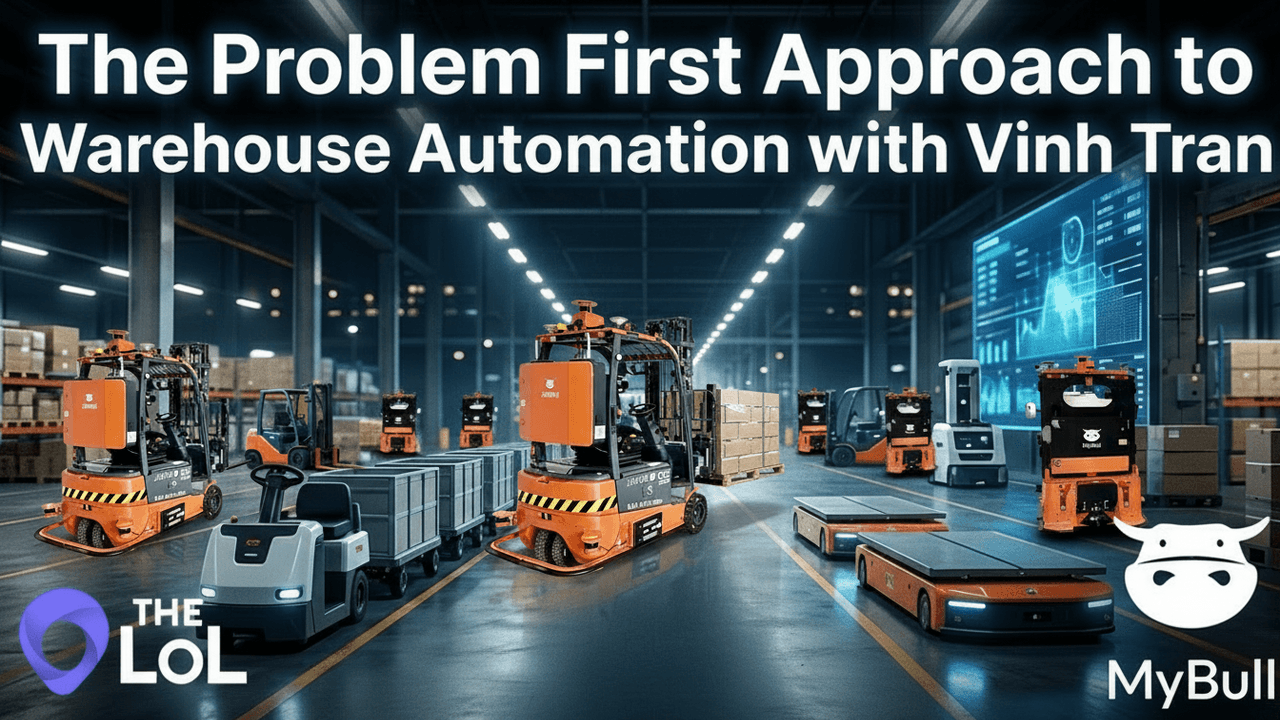
In “The Problem First Approach to Warehouse Automation”, Joe Lynch and Vinh Tran, Managing Director of MyBull Intelligent Machinery USA, discuss how prioritizing a facility’s specific operational challenges over standard tech products leads to successful automation.
About Vinh Tran
Vinh Tran is the Managing Director of MyBull Intelligent Machinery USA, where he spearheads the company’s North and South American strategy, commercialization, and customer deployment of Autonomous Mobile Robots (AMRs) for manufacturing, warehousing, and logistics. As the company’s first U.S. employee, he built the domestic organization from the ground up, establishing its engineering, sales, after-sales support, and strategic partnerships. With over 30 years of leadership experience, including executive roles at Sensata Technologies and Continental, Tran has a proven track record in autonomous mobility, ADAS, and global business expansion across North America and Asia. Today, he focuses on accelerating industrial automation by delivering practical AMR solutions that enhance safety, productivity, and operational efficiency across the automotive, logistics, and heavy equipment sectors. Tran holds a B.S. in Mechanical Engineering from the University of Michigan, as well as an M.S. in Mechanical Engineering and an MBA from Wayne State University.
About MyBull
MyBull is a global innovator in autonomous robotics and intelligent logistics systems, dedicated to redefining efficiency in warehousing, manufacturing, and supply chain operations. With a focus on AI, machine learning, and modular design, MyBull empowers enterprises worldwide to achieve sustainable, future-ready automation. For more information, please visit mybull.com.
Key Takeaways: The Problem First Approach to Warehouse Automation
- In “The Problem First Approach to Warehouse Automation”, Joe Lynch and Vinh Tran, Managing Director of MyBull Intelligent Machinery USA, discuss how prioritizing a facility’s specific operational challenges over standard tech products leads to successful automation.
- The “Product-First” Trap: Companies often fail in automation by forcing a specific product (like a forklift or tractor) into a facility without understanding the workflow first. MyBull advocates for a “problem-first” approach, focusing on the client’s biggest operational bottlenecks before selecting the equipment.
- The Brains Behind the Robots: While MyBull utilizes partner chassis for its physical hardware, its core innovation is the Position Navigation System (PNS) kit. This standardized “brain” utilizes LiDAR, 3D SLAM mapping, and sensorics to make forklifts, tuggers, and flatbeds fully autonomous.
- Bridging the Indoor-to-Outdoor Gap: While indoor autonomous solutions are highly developed, the outdoor yard remains an operational blind spot. MyBull specializes in rugged, weatherproof AMRs built with large tires and enclosed compartments that seamlessly transition from warehouse Wi-Fi to outdoor cellular networks.
- A “Farmer” Mindset Over a “Hunter” Mindset: Drawing from his experience living in Japan, Tran emphasizes a gradual, nurturing approach to automation (akin to Kaizen). Rather than chasing instant revenue, true success comes from a slow, deliberate integration between human operators and machine processes.
- Labor Displacement, Not Replacement: Automation shouldn’t be viewed purely as a headcount reduction tool. Instead, it eliminates mundane, hazardous, or extreme-weather tasks—such as driving a tugger in freezing snow—allowing human workers to upskill into higher-value roles like fleet management.
- Exposing Process Bottlenecks: Introducing automation acts as a forcing function that immediately exposes a facility’s “lack of control” or fractured workflow visibility. Once a repeatable, structured robot is introduced, operational inefficiencies and shifting bottlenecks become clearly visible.
- Delivering Outcomes, Not Just Technology: The ultimate goal of warehouse automation is not just owning high-tech machinery, but delivering tangible operational outcomes and maximizing throughput (the number of products successfully moving out the back door).
Learn More About The Problem First Approach to Warehouse Automation
The Logistics of Logistics Podcast
Joe Lynch: [00:00:00] Hello, friends. Welcome to the Logistics of Logistics. My name is Joe Lynch. Thank you so much for joining us today. Today’s topic is the problem first approach to warehouse automation with my friend Yen Tran. How’s it going, Yen?
Vinh Tran: I’m doing great. How you doing, Joe?
Joe Lynch: Doing great. So Jan, please introduce yourself and your company and where you’re calling from today
Vinh Tran: My name is Gian Tran. I’m the managing director for MyBull Intelligent [00:00:30] Machinery, and we’re calling from Farmington Hills, Michigan
Joe Lynch: Yeah, you’re about 20 minutes from me. I’m out in Howell, so not too far away. And we’re both Michigan Wolverines. Hallelujah. Go Blue.
Vinh Tran: Go blue
Joe Lynch: apologize to the Spartans, the Buckeyes, and everyone else who doesn’t like that. I inter- I gotta tell you, I interview a ton of Buckeyes. Very seldom do I interview a Wolverine.
Anyway, Vinh your name is spelled V-I-N-H, and last name Tran, but the V [00:01:00] is silent, so it’s Yen. I’ll … I hope I’m pronouncing it close to but what I’ll do is I’ll make sure I put a link to your LinkedIn profile, a link to your website, any other links you and your go-to-market team give me.
We’ll put those in the show notes. So please introduce yourself and your company and what you guys do
Vinh Tran: Yeah. So let me just start, Joe. Thanks again, and I’m really happy to be here, Joe. So it’s a great honor to be able to seriously speak to you, fellow Wolverine. Let me go real quick, a little bit about MiBull. So MiBull Intelligent Machinery [00:01:30] is a AMR company, autonomous mobile robots. We s- we started in two thousand and eight.
We are based out of Beijing, China. Our manufacturing is in Wuhan, China, but my team is in Farmington Hills, Michigan. I started the group back in January twenty twenty-five. There we started as myself. I was the first employee, and I started working in a business plan for the organization.
We’re currently running [00:02:00] at twelve people. We have the entire development team, field service team, sales team, and administration all in Farmington Hills, Michigan. And right now, our main focus is to provide autonomous mobility solutions, automated solutions to our customers, solve their problems, and bring, let’s say, products that they need to help improve their operational efficiencies and their automated [00:02:30] challenges.
So
Joe Lynch: So what, when you say AMR, say that one more time what that stands for, and then give us some examples of what that type of machines or s- that type of automation or robots do for warehousing companies.
Vinh Tran: Absolutely. Great question, Joe. The AMR autonomous mobile robots the machines that we focus at M-MiBol Robotics mainly are broken into three areas, and I’ll give a brief understanding. So we’ve got autonomous forklift, [00:03:00] autonomous tuggers or slash tractors, and autonomous flatbeds.
Those are our three core products. That’s the end product. But MiBol Intelligent Machinery works on what we call the PNS kit, the position navigation system. That’s the brains behind the unit. So when MiBol provides a product to our customer, the product itself, the chassis, is a drive-by system.
So it’s drive-by-wire, brake-by-wire systems, battery [00:03:30] controlled. All the machines have the same DNA, but the PNS kit is the same kit that goes to all three product lines. So when we talk about the PNS kit, we’re talking about the LIDAR system, the three D SLAM system, the navigations, the RTK, the other sensorics that basically make the machine autonomous.
So MiBol Robotics focuses on the PNS kit, but we buy from our partners the chassis that’s needed to [00:04:00] deliver the actual final product
Joe Lynch: Yeah. So if I look at a chassis that you, that can move around, the chassis’ low… we know how to do that. It’s lower tech. We know how to build a chassis. We know how to build forklifts. The challenge right now is the autonomous piece, and the biggest, I’m assuming the biggest challenge with that is what you said is the PNS.
It’s not P and S. So it’s position navigation system, positioning navigation system. [00:04:30] So we’re making all of these equipment that we know we need, but we’re making them now autonomous. And not to be all about the war here, but anybody watching Ukraine and Russia right now, we’re seeing all of these drones, and I wish they weren’t being used for war.
But we’re seeing the rapid innovation, and it starts to let you know what’s possible. Unfortunately, a lot of our cool innovations come from the military, but knowing where your [00:05:00] machine is at in the world is the first step. It’s kinda like any sort of intervention for a company.
Where are we at today? And s- so if you say my forklift is gonna be autonomous, you have to tell it where it is first so it can decide I gotta go over to those pallets and move them
Vinh Tran: Absolutely. So you hit it right on the spot, Joe. So basically, building the product is one aspect of what MiLE does, but the bigger aspect is what we call the TSR system. That’s the fleet management system. [00:05:30] So with our fleet management system, we control the locations of the machines, we help address the challenges our customers are facing, and this entire system allows them to improve their overall operational efficiency.
And the PNS system that we’re talking at MiLE is very basic. So essentially, as you were talking about drones and whatnot, the PNS system that we have at MiLE is also being used for security [00:06:00] robots, robot dogs, and even humanoids. So pro- product line down the future, not today, MiLE, myself, we don’t work on that, but the PNS system has a very similar DNA.
You can use that technology to do relatively the same. So being able to use it for humanoids and whatnot is very logical because it has the same kind of requirements when you talk about 3D SLAM, [00:06:30] mapping data, navigation datas and whatnot.
Joe Lynch: Yep. Yep. And we’ll come back and talk a lot more about this, but this idea that it needs to be autonomous isn’t isn’t new. We’re s- we’ve seen this for a minute, but I think it’s growing because it… I think here in the US, and by the way, it’s also in China and everywhere else, that we’ve– we’re not having enough children.
And I always joke that we need to do more with less. And, when you talk about [00:07:00] a job at a factory or at a warehouse most people say, “Oh, that’s a good starting point, but I wanna move up.” So it’s hard to get people to do those entry-level jobs. But if those entry-level jobs speaks as, “My job at this warehouse is to manage this fleet of autonomous equipment that is very high tech and also moving pallets,” that is, that’s a wonderful job.
Y- if your child or my child said, “Hey, Dad, I got a job. I’m gonna go work in [00:07:30] this warehouse, and I’m gonna be a strong back, and I’m gonna walk seven miles a day,” you’d be like, “Oh, wait a sec. Let’s get you to school,” right? But if they say, “I’m managing a fleet of equipment that is moving throughput faster than it ever moved before,” all right.
That’s a great job. That’s a great future
Vinh Tran: That’s exactly what one of our core customers is doing. So we are obviously supporting them. We’re deploying for them right now with our machines. But one of the [00:08:00] aspects that their supply chain vice president told me was that on the side, they pulled students, kids, college kids aside to show them the technology for exactly that.
Because I think there’s a stereotype that when you get into the assembly line, you say, “Oh it’s really mundane work. It’s boring. There’s no brain process.” But even with robotics and automation, it’s actually getting more and more evolved, and it– You’ll find out that there’s a handshake between the [00:08:30] robotics and the process, and there’s a lot of let’s say, skill set that’s needed to do that.
This is an aspect that in the US, I think for sure there could be a benefit. But speaking real quick on your point, Joe, when you mentioned about China and the US, what I see right now is China’s really picked up on the automation. I think of– I think all my customers know that as well. They literally go to China a popular city that they go to, Shenzhen, China.
Automation is really…
Joe Lynch: sister used to [00:09:00] live there
Vinh Tran: Yeah. So if you know that city, that is one of the heart of automation for China, and there are US customers coming there to get an idea, get some visibility down the road. I think America has a lot of potential, lots of opportunities, and automation, though, like you mentioned, has been around for the last five, ten years.
But I think now things are starting to pick up in a way where not only the cybersecurity requirements, but the interface requirements, the [00:09:30] performance are now being tracked and managed more aggressively
Joe Lynch: Yep. Yep. And I read an article recently that said China is ahead in automation over the United States. US is ahead in AI. They said, “But you need both.” They go together. And we know AI is great for, we came up with a title today using AI. That’s great, but it’s not moving a pallet. So anyway, we’ll come back to all this in a minute.
Tell us a little bit about you. Where’d you grow up? Where’d you go to [00:10:00] school? Some career highlights before you joined the juggernaut, MyBull.
Vinh Tran: Absolutely. So a little bit about myself. So again, my name is Yen Tran. I actually was born in Vietnam. I came to the US when I was four years old 1975. I was raised outside of Lansing, a little town called Grand Ledge, Michigan. I graduated from Grand Ledge, Michigan. I went to the University of Michigan.
Go Blue. I got my degree in mechanical engineering. Shortly after that, I went to Wayne State University. [00:10:30] I got a master’s in mechanical engineering, then I got a master in business administration. I started my career in 1994 at a company called Takata. Many of you– many people know Takata as like the airbag company, the seatbelt company, but I actually was working in the division called ASL, Automotive Systems Laboratory, in Farmington Hills, Michigan, and there I was doing research and development.
My actual start was finite element analysis. If you remember that,
Joe Lynch: I remember that.[00:11:00]
Vinh Tran: I– there, there’s not a lot of FEA engineers, but I actually started out as an FEA engineer
Joe Lynch: was the highest of high tech, and now I’m assuming it just kinda gets built in the software now
Vinh Tran: I pretty much think that the FEA is pretty much now one of those jobs that are pretty much tied to the overall computing and machine work
Joe Lynch: I was a draftsman, so I went from on the board, drafting board, you look it up kids, it’s in the Smithsonian, and we moved to the CAD systems. And as we moved to the CAD system, it’s just moved really quickly [00:11:30] from wireframe to, surfaces, and all of a sudden the FDA guys were talking to us every day, and it just got it all incorporated.
So anyway, enough of my blather
Vinh Tran: I moved from FEA Joe to pro-pro-program management. And at Takata, I was focusing on passive safety. Then in 2000, I went to a company called Continental. I went from passive safety to active safety. I started working on ESC, electronic stability control. I was with Continental [00:12:00] for 23 years.
I was in project management, ran through a few business units. But 2021, I started running business units. And once I started running business unit, I actually never returned to engineering or anything like that. I became P&L responsible. So from ’21 until now, I’ve always had a P&L role. In ’21 2011, I’m sorry.
In 2011 till now, I’ve been running P&L roles. So in 2011, I was running a business unit called Continental [00:12:30] Engineering Services for a few years. Then I went to Japan, where I lived six years in Japan, where I had the hydraulic brake systems business unit for Japan and Korea. I came back in Continental, where I ran their North America ADAS business unit, and then I left Continental after 23 years.
I joined Sensata, where I ran their global electrification business for a year and a half. And then finally, where I am here today, where I took my a- [00:13:00] passive safety knowledge, my active safety knowledge, my electrification knowledge, and I bring it to Mybolt Intelligent Machinery, where I wanted to get into robotics.
The reason why I came to robotics or Mybolt was very clear. One, I wanted to get into robotics. I wanted to get into automation. Sitting on the sidelines at electrification and ADAS, I was reading a lot about robotics. I wanted to get involved in the market. And number two, I wanted to be in a startup organization.
I mentioned in [00:13:30] 20 2025, in January, I was employee number one. I wanted that experience. I wanted to do a startup from scratch. We didn’t even have a payroll system when I joined as employee number one. I actually researched what a payroll system… I looked at ADP, I looked at Paychex, I looked at everything, and I finally ended up with Paychex.
This is where I came from, and I’m very excited, and I’m happy I’m here at Mybolt Intelligent Machinery, running their North and South America business.
Joe Lynch: I love it. I love it. So I have a [00:14:00] few things. I wrote down five topics I wanted to touch on with you. So the first one, and I’ll just let you l- go loose on this s- today’s topic is the problem first approach to warehouse automation. And the first topic we came up with was the product first automation trap.
And I know it’s a trap but I’m not so sure everybody does. Why is that a trap? What’s the… W- well, first off, what is the product first [00:14:30] automation, and then why is it a trap?
Vinh Tran: Yeah, and I can give– So even from my role as a startup company that’s roughly about eighteen months old, one of our first customers that bought our machines, what I mean by that is that with this customer, I was able to learn a lot about the customer challenges and with their challenges, the approach that we took.
If we would’ve went in with, let’s say, s- a tugger, that’s a tractor, a pulling machine. If we would’ve went in with a two-ton machine, a [00:15:00] four-ton machine, a six-mon-ton machine with a certain level of certification, we would have been basically providing them this machine, and they would have looked at their plant, this massive assembly plant, looked at different routes, and tried to figure out where can this machine go.
Does it go into this route? Does it go to route three, route two? What ended up happening is that when you’ve pushed your product, you overlook the priority of the hierarchy of [00:15:30] the challenges. When you look at an assembly plant, there are many aspects of the assembly plant. You may have this vision, I got the biggest problem on route one, but then there’s route two and three that I have to deal with later.
But when you look at the handshake between the machine and the process, the biggest bang for your buck may not be route one, it may be route three, and that’s what happened in this case. Route one, there was an absolutely new need. Route three, [00:16:00] there was an absolute need. But the difference between both route was implementing route three gave you the highest value from an efficiency standpoint, from a deployment standpoint, it was necessary.
So if you start with a product and you push the product through, you basically forego the customer’s challenge list, and with that challenge list, you overlook very essential details
Joe Lynch: Yeah. And that’s one of those old [00:16:30] sayings is if all you have is a hammer, everything starts to look like a nail. I’m an automotive guy originally, and when the Japanese took a big lead starting I shouldn’t say took a lead in market share, but it took a lead in manufacturing efficiency, and then we quickly realized in engineering.
What the automakers f- did first was say, “Oh they’re very automated. We need to go buy automation.” And they bought a ton of automation. And it only took a [00:17:00] decade or so before the bigger, the Big Three, the old Big Three here said, “Wait, that wasn’t the right thing.” And what they realized was the Japanese automated.
And when I say the Japanese, I also say the Koreans and they all the newer companies, they automated, but they did it very slowly. They said, “We will automate after we fully understand the process and also have considered everything we can to keep improving the [00:17:30] throughput with this person or this team.”
And the automakers here said, “Oh, there’s an automation that can do that? Give it to me.” And it’s the wrong way to go. By the way, I’ve just li- I just listened to the Elon Musk book. I highly recommend it. When he was struggling to meet the production scheduling, the production schedule for Tesla, he was…
No one thought they could do it. He basically lived there [00:18:00] on the f- plant floor, and what he did was bump up against the automation that he had mandated be bought. And so he de-automated his assembly line. And I’m sure there was… So he said, “Get rid of that machine right now.” They took it out, probably, rethought it.
Probably some of the automation came back. But what he realized was the automation was slowing us down and preventing us from hitting our targets. So automation is great, [00:18:30] but your focus is problem first, not product first. Let me fully understand your business before I walk in here with my solutions.
Vinh Tran: Joe, I love how you connected the Japanese mindset to this whole automation concept. I wanna reiterate something you said that was very important. The Japanese im-implemented things that I think a lot of other OEMs and automotive OEMs adapted. They bring– They brought in their Kaizen approach and whatnot.
But what [00:19:00] made them special, I think, is breaks down to a very basic principle, hunter versus mar- farmer mindset.
Joe Lynch: Yes
Vinh Tran: the farmer mindset of what you said about the gradual approach. It wasn’t about them saying, “I need to get an ROI.” Boom. “I needed to get efficiency.” Boom. It was about the handshake between understanding the operator, the machine, and bringing in a way that was giving the opportunity for this [00:19:30] merger, and that’s the difference of a farmer approach.
Living in Japan for six years, I, I really appreciated the nurturing aspect of a relationship, the nurturing aspect of the automation process, of the quality process. It’s a po- important aspect. The one thing that it limits is, yes, you’re not gonna get the instantaneous revenue. You’re not gonna go out and shoot your buck right there and basically say, “Okay, I can cash in now.”
It’s really a slower process. But [00:20:00] ultimately, if you do it right, you solve the problem, it scales faster. It scales a lot faster
Joe Lynch: All of the lean that is now standard in any manufacturing or operations came from Japan, and they would say, “Nope, it came from Dearborn. It came from Henry Ford.” And they said, “We took it,” but they obviously improved it greatly. But it’s that thought process which is, very much first principles.
Let’s not do it from the office. Let’s walk out on the floor. Let’s see the [00:20:30] problems. And I did a lot of lean work when I was in automotive, and I worked with a lot of the Japanese automakers. And it is– over time, the Japanese, and the Koreans, and the Germans, the Americans, French, we all started working together.
Now it’s hard to see where the ideas are coming from. But very much in the beginning, the Japanese were the leaders in manufacturing, and they had more automation, but very gradual, very… A lot of critical thinking before they spend that money. And, there’s also the Japanese [00:21:00] automakers started after World War II.
They were very poor, and they had a very small market. And so they, from the very beginning, said, “We will be learning organizations. We will do what the very best are doing. We will follow them, and we will figure it out.” And, over here in Detroit, you have– you’re the biggest company in the world.
Are you humble? That was General Motors. No, you’re not humble. You think we’re the leader. Why would we be [00:21:30] humble? You’re not the leader anymore.
Vinh Tran: I think that’s such an important aspect. And again you hit it. That gamble walk that happens by everybody is very important. Understanding what’s going on at the plant level is very helpful for us as well. So one of the things that MiR robotics does is before we visit a fac– before we make even a proposal, we do what we call a, besides provide a questionnaire or some basic data, we go and we take a look at, we take a look at the facility.
Not that we don’t [00:22:00] trust our customer, we just wanna get a better feel of what we’re dealing with because it takes extra time. But that extra analysis, that extra information gives us a sense of confidence in the proposal we come up with. That gamble walk, I call it a gamble walk, is very important for deployment because the more investment you make upfront, the better your chances for a s- a solid solution down the road.
You’re going to run into a problem when you try to integrate and deploy these machines, but the more work you [00:22:30] do upfront, the better chance you have to solve it.
Joe Lynch: Yeah, and I think the Gemba Walk is just the go to the problem. So what’s happened in the past and I’ll apply it to automotive, is somebody who’s 100 miles from the plant in an engineering office says, “Oh, we’re gonna deploy this new solution, and it’s gonna make us go much faster.” Get in your car, drive down to the plant spend a lot of time with the operators understanding what’s going on today before you do anything.
And it’s, By the way, getting back to [00:23:00] the Elon Musk book, his engineering teams for his, for Tesla are in the plant. He doesn’t have he doesn’t have guys who are in a different city developing solutions for the assembly plant who don’t get to the assembly plant often. By the way, one of my friends just bought a company with an investment group, and he said, “A number of my process engineers work remote.” I was like, “How’s that working?” He goes, “It’s [00:23:30] not gonna happen anymore.” He goes, “Th- they are officially they’re officially going to be working here, not at home.”
Vinh Tran: I do wanna echo, ’cause I think it’s very important for at least my b- robotics, is that, that Gemba walk and walking the plant, the handshake between– Once you’re done with the solution, there’s an aspect of training. Training the operator is a whole different level, and if you don’t come up with a solution that really [00:24:00] helps them become more efficient, helps them with their current workload it’s against the grain and it’s very hard.
So that Gemba walk is very important, ’cause at the end of the day, what makes a solution successful is the operator’s ability to integrate with it
Joe Lynch: Yep, I agree. So the next point I wrote down here is in warehouses and also plant managers, they have this lack of workflow visibility, and there’s sometimes a lot of [00:24:30] traffic and congestion in areas, especially staging areas, which prevents you from getting the throughput. So if you’re running let’s just say an assembly plant, and you say, “Every week we pump out, 30,000 widgets,” and then one week it’s 25,000 and you can’t explain why you’re gonna lose your job at some point.
We– what we’re always looking for is flow. When we talk about, we just, we touched on Gemba. That is a lean term. What we always want is flow. [00:25:00] But man, if you’ve been in a warehouse, and a lot of people listening to my podcast are logistics and warehousing companies, and all the companies we serve are big manufacturers, distributors.
They want flow. And what do we give them? We give them a whole bunch of silos, and then we get to the warehouse, and it doesn’t always flow. And I think if you get some automation and some processes, it can flow much better. But that’s not the first step. So please talk about that one. Again, [00:25:30] that’s the operational blind spots and the fractured process control.
Vinh Tran: When you mention the word flow, the way that my bull and I see it is that we want a structured and repeatable process. That’s where we look at flow. So there’s a lot of aspects to the process and the operations and whatnot. We know when I c- when I go to an assembly plant, whether it’s an automotive assembly plant, whether it’s a furniture company, whether it’s a construction company, depending on the [00:26:00] application and use cases, it all depends.
But there is one consistent or a few consistency when you talk about workflow visibility. It’s consistency on a structured approach, and it’s repeatable. Those two things in itself enforces operations to be able to handle in a certain structured way. The machine can only do as much as it can do repeatedly.
It almost puts on steroids what is the bottleneck right away. [00:26:30] Because once the machine is running and you say, “Wow, it’s working,” but why am I not getting the cycle time? Why am I not getting the efficiency I’m looking at? Oh, wait a minute. What is that process? That guy has to hook up that, the hitching and unhitching.
Oh, wait a minute. So where does that guy come from? Oh, he’s coming from that line. Oh, so he has to walk 10 minutes to get here. You start realizing very quickly that the flow that you thought you had was [00:27:00] being optimized by workers that were just like working in a way that was adapting. So when I talk about repeatability and structure, I’m talking about really figuring out what the machine’s capable of doing, putting the boundaries, and then working with our customers to identify the gaps.
Because as soon as you do that, Joe, you’re really starting to check the other areas, and we– whether it’s the hitching area, whether it’s the operator doing multitask, so they’re doing [00:27:30] two, three things, eventually everything starts to come out, and then you start learning, okay, that’s the inefficiency.
Joe Lynch: Yeah. There’s there’s a book, and I’m sure you’ve read it, The Theory of Constraints. And so it just kinda talks about this whole idea of bottlenecks. So as soon as you say, “Oh we’re really being slowed down over here. Things can’t come from that part of the facility to this part of the facility so this second operation can happen,” you fix that, and what you’ve [00:28:00] done is you’ve just moved the bottleneck.
And so the bottleneck just continues to move. So if you buy automation for one part of your facility and go yeah, now I’ve got a huge stack over here by Joe’s area ’cause Joe can’t process it as fast as the stuff is stacking up.” And see that in factories, older factories. I always remember being in China b- making the metal sh- sheet metal gas tanks, and they c- make the bottom part really fast, and they make the top part really fast, but they [00:28:30] couldn’t assemble them together, so they just left…
They stored them, and they said, “Yeah, we have a lot of inventory here.” And I was like, “Yeah, but you don’t need all this inventory. Slow down over here. Move some people over here. This is a… you have a month’s worth of…” It was more than a month. It was very men- mon- many months of inventory that you’re storing ’cause you can’t fasten them together.
And you go that’s not a huge problem.” As it turned out, dust gathered on [00:29:00] these things, and they didn’t clean them, so every 30th tank, every 20, I’m sorry, every 20th tank had a coating of gunk on it, and they didn’t bother to clean it before they assembled them. We ended up with 5% of the, 5% of the cars not running right because of fuel issues.
So for a long time they go, “It’s the ba- just bad gas in some parts of China.” And so I I was like, “I don’t think that’s true.” And so I had one of my engineers walk the [00:29:30] line, and he goes, “Joe,” he sent me pictures, he sent me pictures of it. He goes, “There’s a quarter inch of gunk on every 20th ’cause they have way too much inventory,” which we told them not to do.
But I guess my point to my story is you can keep moving the bottleneck with automation, and the idea, getting back to it, is flow. No sense having a big stack of stuff prior to my workstation. I can’t do anything. I can only do ’em one an [00:30:00] hour, two an hour, 20 an hour. Don’t bring me 60.
Vinh Tran: Yeah. I, one thing that kinda shapes what you just said in my mind is the word– the phrase lack of control. So the one thing that automation really ex-exemplifies is the lack of control a process has. And I think if you look for an automation partner, whether it’s MIABOL or someone else, one of the things you have to come to terms with is you have to understand what you’re expecting, [00:30:30] what you want to get out of the automation, and at least try to get some knowledge about the limitations.
Because one of the things that I… And I talk to a lot of customers. We’ve– We have some great logos, and those companies are, whether they’re seven billion in annual sales or fourteen billion it has the a similar DNA. And one of the things I would really say is understand your process well enough because once automation comes, you have– you will, like you said, Joe, expose [00:31:00] the lack of control in certain aspects, in certain processes, and that’s where you need to really focus on, and that’s where most of the effort will come from.
Joe Lynch: Yep, yep. So another thing I wanna talk to you about, and it’s our third point, is anytime somebody says, “Oh, we’re bringing automation,” there’s some sense that if, if you’re coming to my plant and they go, “Oh, the automation guys are here.” I think the old way to think about that was, “Hey, our labor is very expensive, and we need to get rid of some of that labor, and we’re gonna do it with these [00:31:30] machines.”
And I think… we talked before we hit record. Y- the philosophy at MiBull is, no, we’re gonna let your people focus on stuff that people should be doing, and we’re gonna let the machines, the robots do this stuff, the automation do the stuff that automation does better than us. So t- and again there’s a…
Most every time I’ve ever worked on automation projects, they said right away, “We’re not replacing anyone. We might move people around, but nobody’s leaving.” Because if you start in with, “Oh [00:32:00] this is gonna reduce the labor in this facility by 20 heads,” everyone starts moving really slow at that point.
Vinh Tran: I, I think in a nutshell, Joe, that’s absolutely right. So in the concept of automation, the concept of MiBol, where we are today, we’ve never got a situation where we look at a proposal and we just look at a headcount reduction. What we look at is efficiency. If the lines are efficient, then you’re basically [00:32:30] managing in a better way.
So at the end of the day, you’re not actually dis- displacing people, you’re basically improving the process. In almost the cases that we’ve had so far today, we don’t actually replace the workers. What we do is we displace them to other areas. For example, one of the outside outdoor opportunities that we’re working on, we basically remove someone that has to sit outside, whether it’s rain or snow, and basically move a t- a forty-ton tugger around a facility.
[00:33:00] We don’t do that. We basically have the automated machines do that. I’m sure that individual now is displaced to do something else inside the facility, but that’s a role that’s very difficult. It’s just requiring someone to sit there, drive in these conditions. It’s not always the best condition, whether it’s super hot, super cold.
Those are environmental factors that should be considered, and I think at the end of the day if you are able to come up with a solution that meets the expectation of the process, you’ll be [00:33:30] able to work out a situation where you can have people working in areas that I think machines are not the best use or are hard to implement versus a mundane trip like going around the route, which is roughly about a two-mile area radius that basically gets from one location to the other
Joe Lynch: And you and I are in Michigan, and last week it was way, way too hot. But going back not so long [00:34:00] ago, February, January, it was way, way too cold. So anybody who was spending their time outside either last week or four months ago knows it’s a very difficult job. And if you have a yard that b- an- big enough that you have a full-time person moving containers around or moving tractors or trailers around, then there are a lot of other things that person can do
Vinh Tran: Absolutely. We had a situation where we [00:34:30] were moving construction goods and the pallet was roughly about 12 by 8. It’s– It was a massive unit and it was out-outdoors in this case here. And at the end of the day if you remember our January in Michigan, Ohio, was w- that we ran our proof of concept with this company, and we were successfully able to demonstrate this.
And at the end of the day, I don’t think the c- the workers who were helping to qualify the proof of concept [00:35:00] had any problem. They basically waited for the other side of the tunnel to– for the machine to get there so that they could use the, what we call the fleet management system to deploy the next f- the next steps.
So for me, it was a win-win on both sides, and the operator was quite honestly very happy with the results
Joe Lynch: So the next the next thing I wanna talk to you about is you guys called the half-solved problem, and it’s the indoor-to-outdoor gap. What is that?
Vinh Tran: I [00:35:30] think overall, I think indoor is evolved enough, especially in the US where you see a lot of indoor forklifts, indoor platform AGVs, whether it’s QR code-based, AMR-based.
Joe Lynch: What’s an AGV?
Vinh Tran: Oh, you got me. Automatic guided vehicle, and that they have, let’s say how do you call it? They’re, they might be magnetic strip, they may be QR code-driven, but our systems are autonomous.
We use our PNS system. They are already established. I [00:36:00] think they’re well they’re deploying. But one thing we at MiBol have seen is when you transition to the outdoor, not many people play in that space today. And one of the things that MiBol does is with our PNS system, we’re able to work outdoor.
We are able to work with the connectivity in the building, whether it’s Wi-Fi, whatnot, and then we can use cellular service outdoor as well
Joe Lynch: Oh, I love that. And a few people have said to me over time when we talk [00:36:30] about warehousing
is y- there’s not enough solutions for what’s outside. You might have 20 shipping containers out there, and understanding where they’re at is sometimes an issue. Somebody says they’re outside. W- hey.” And by the way, if you’re a person working in that, they go, “Hey J- Joey Yen, go out there and find these containers.”
And I said 20, could be 100. And I’m supposed to just wander around until I find
Vinh Tran: Yeah.
Joe Lynch: And that’s assuming that the the [00:37:00] identifier is facing the right way, and I don’t have to, I don’t have to crawl behind it. I’m f- I’m familiar with automotive facilities where a lot of times there’s just all sorts of trailers just lined up.
Sometimes like, “Oh, we, we didn’t have room to unload it.” And so there’s always been like a disconnect. Sometimes you see a warehouse or an automotive facility or another, whatever you’re producing, really well organized. And as soon as you leave the facility and go out to their yard, [00:37:30] which is, could be hundreds of acres it gets really sloppy.
And and I can ima- a- and and that you guys can’t solve all of that, but you can solve the issue that we know where this is at, go pick it
Vinh Tran: Yeah. We communicate, so we communicate obviously with our own machines, so whether it’s a autonomous forklift or whatnot, to integrate our tugger with a forklift. But the main thing is we communicate with the, our customers’ material management systems. So [00:38:00] we connect to their systems so we, we know where the goods need to be pick up, the staging area, where they need to be dropped off.
So that ability to communicate with the WMS system is very helpful so that we can move the material in a good way
Joe Lynch: Now, is it rugged enough? So all of your equipment, is it rugged enough to go out there and ’cause it might be gravel out there. It might not be, it might … we’re in Michigan, I guarantee there’s a pothole out there somewhere.
Vinh Tran: when you– we were at MODEX and we were at [00:38:30] ProMat, so MODEX this year in Atlanta, but ProMat last year in in Chicago. And if you look at our machines Joe, there’s not a lot of sexiness about it. It doesn’t have a lot of sleek looks. They’ve got big wheels, outdoor wheels. They’ve got enclosed caps, enclosed compartments and whatnot.
It’s really built for rugged outdoor usage. That’s why a lot of the machines that you see for the indoors, they have the smaller sleek tires. They’ve got a body frame that’s a bit [00:39:00] narrow. For indoor it works, but for outdoors, no. You definitely do need the chassis to handle that, and we have. So our chassis handle moderate snow, moderate rain.
The only thing it doesn’t handle is, let’s say, really extreme snow extreme rain, because you wouldn’t want humans out there at th-those conditions. The machines aren’t built for that as well. But in all other environmental factors it works out well. So the machines itself can handle gravel, can handle some level incline [00:39:30] can work with the traffic systems, whether it’s a gate or whatnot.
All of that is very feasible with the machine as long as we can communicate with the interface systems, the operating systems of the customer’s deployment m-material management
Joe Lynch: Am I right to say that these things will continue to get better? Do they learn? Obviously a wheel can’t become bigger, but as these are going out, do they learn about the environment that they’re in?
Vinh Tran: Yeah, they definitely, but not today. So my machines don’t actually have the [00:40:00] capability to basically.
Joe Lynch: eventually. That’s just
Vinh Tran: I guarantee you, whether it’s my bowl or others, learning and understanding like wearables, if a wheel has reached a certain threshold, if a lidar system needs to be detected that it’s not it’s having some technical issues, all of that will be part of the actual calibration system at some point
Joe Lynch: Yep. So the last point I wanna talk to you about is this, there’s a hidden [00:40:30] waste, and it’s in this excessive operator travel, repetitive where you kinda… And I see this a lot in warehouses where i- it’s going– sometimes it’s the warehouse the way it’s organized, but you’ll see these machines moving.
Obviously, I don’t want a machine moving from one side of the building to the other side of the building 10 times if I can have it do it once. B- but w- we have, a lot of times we have operators who are doing that, and I think y- you go, “That doesn’t cost any extra money. It’s [00:41:00] just paying him, I’m paying him his hourly wage.
I already have that forklift. I own it.” But there is a hidden waste in all of that. Talk about that material movement waste
Vinh Tran: Yeah. When we look at our customers and we see that kind of waste happening, it starts really to degrade. When you talk about the first shift, you’re starting the beginning, you’re able to optimize, you get a pretty good efficiency, you get a pretty good performance. But over the course of a shift, it [00:41:30] drastically reduces a lot, especially if you have a lot of walkable area that you have to achieve and/or a lot of multitasking.
It really leads to safety, it leads to inefficiency, it leads to operator morale. What we see, let’s say for a lot of the operations we have, Joe, basically, whether it’s, putting wood onto the cart picking up a s- a sizable pallet and putting it onto a cart. When you’re doing that’s one thing.
That’s [00:42:00] lifting, putting it onto the, upon, onto our trailer. But imagine you having to walk and pick up a couple goods and you’re doing that, an hour and taking a 10-minute break at a time. You really start losing productivity. You start losing material. It really becomes an area.
And honestly, I don’t know how people maintain that because I walk around the facility and I’m tired after walking the route that I was just trying to look at a solution for. I only w- walked it [00:42:30] once, and I can’t imagine them doing it day in, day out
Joe Lynch: Yeah, and as you get tired, as your body gets tired, your mind gets tired, you’re making mistakes. And so somebody might say we’re real efficient here.” If I’ve got somebody walking seven miles a day and lifting and bending, and very few are not going to lose the quality of what they’re doing by the end of the day.
It’s hard work, and this is [00:43:00] again one, a place where you say, “Let’s put a, let’s put automation into place, a robot in place of a person who’s gonna just break down over time.”
Vinh Tran: I think at the end of the day, when I talk to the operators and I really try to get a feedback, their perspective, it is a lot of work. I honestly commend a lot of the operators who are doing all those multitask lifting sorting staging. It takes a lot of effort. It’s a lot of work, and I think we can do a lot better.
[00:43:30] We can provide some level of automation to make their work more enjoyable and easier
Joe Lynch: Yep. And we are seeing a big paradigm shift right now, and I think the paradigm shift that I’m talking about is for a long time, for g- I would say at least a generation or two, we said, “You need to go get a college degree. It’s really important that you get a college degree.” And everybody ran off to get their $100,000 college degree.
Now we’re realizing, hey, the guy who runs the [00:44:00] warehouse, he might not n- need a degree. He might not even wanna get a degree. Maybe he says, “The hell with it.” But if you’re running a warehouse and you’re a good guy, or you’re the assistant manager of that warehouse, or you’re just a really good operator I wanna keep you.
And it’s a lot easier to keep those people if they say, “Hey I’m working with all this technology.” First off, it makes their job easier, but it- they also see the value in it because they say, “I can grow as a businessperson here, not just a strong [00:44:30] back.” And I think that’s what we want. I’ve talked to, I think it was DHL a few years ago, and they said, “The more we automate, we s- the, those facilities tend to grow and we end up with more people, not less.”
So the automation just is improving the throughput and making better jobs. And so if you have better jobs and y- your, the throughput’s growing, you can just keep s- reinvesting in that facility
Vinh Tran: Yeah. I completely agree. I think the ability to actually integrate and [00:45:00] work with the automation process is a unique skill set that’s gonna help evolve not only the their personal role, but evolve the actual industry in itself. It’s just evolving. It’s just the beginning, and I think there’s a lot of aspects of– You mentioned AI.
A lot of this has not yet been implemented or adapted yet. There’s a lot of machines that haven’t been adapted yet. We talked about forklifts. The forklifts are doing tasks one to two, but it can do more, and it really requires that [00:45:30] handshake with the operations. Who’s gonna do that? It’s not gonna be the guy sitting, at the corner office figuring that out.
It’s gonna be someone that actually is on the ground saying, “What am I gonna do to make this machine do more for me?” And that’s gonna be the process. So I think it’s an exciting time. It’s a great time, and I think robotics and MiR-Bow Robotics is putting ourself in the right position to, to do a lot of good for the industry.
Joe Lynch: Yep. So normally I like to do this in the beginning of the episode, [00:46:00] and I didn’t do it. I dropped the ball here. So what who are your ideal customers, and what problem are you solving for them?
Vinh Tran: I have a wide range of customers. We’re in the automotive we’re in other spaces, but right now our ideal customers are in retail and it’s in construction, especially outdoor construction. The reason I say that is our machines are uniquely equipped to handle their use cases. What I’m starting to see nowadays Joe, is the small [00:46:30] warehouse, the small operation plants are no longer as dominant as they used to be.
They’re bigger plants, they’re bigger warehouses, they’re bigger facilities, and the machines are now more… Now, the space that you talked about, the walking space, they are much bigger for many plants because they’re consolidating, they’re growing their manufacturing footprint. Some of the customers I see, I call it the h- the highway.
They literally have a highway of people walking. If you ever walked at, let’s say, a Nissan plant down in the south, it’s [00:47:00] a long walk from one side to the other. It’s amazing how much. And in those areas, our machines, our customers are there. So if we’re talking about those kind of facilities, if they’ve got some level of automation that’s already there, if they have outdoor needs, I would say those are a good customer base for us.
Today, we’re working heavily with retail construction, and automotive.
Joe Lynch: Yep. And so a lot of people listening to my podcast are warehousing companies, and they work with those people you just talked about. [00:47:30] And and when you talk about the problem they, that they have when they finally call you back, what is the straw that broke the camel’s back where they said, “We gotta do something different”?
What is that?
Vinh Tran: When they actually see the concept running, that helps the most. When they see it, it’s, we call it the proof of concept. It could be a demo trial. We actually sh- fly our mequ- our equipment to their manufacturing site. They get to take a look at it. People walk around at their own time. Once they see it, they [00:48:00] often say, “Visualize that it can be done.”
Now, a lot of times we’ve already done a lot of legwork in advance. We already provided some proposal efficiency checklists ROI calculations and/or let’s say a proposed route. Once they see the the POC or the proof of concept most of the time they’re, “Let’s at least do that, and we’ll go from there.”
Joe Lynch: Yep. And I know your answer to this, so I’ll just say it one more time on this. I’ve said this often on my podcast. I [00:48:30] think if you’re looking at automation or looking at new technology, software, IT a new outsourcing partner, new trucking company to work with, new 3PL to work with, I think you have to look at this and say, “I am looking for a partner.”
Because this, especially when we talk about the technology that you’re bringing, it’s not a, it’s not a one-time thing where we say, “Hey, we… Oh, you bought this forklift. See ya. Nice m- night. We’ll call you next year and see if you wanna buy another one.” It’s an ongoing relationship, and I think if you don’t treat it [00:49:00] that way, you lose a ton of the value, ’cause I don’t think the old ways work.
And by the way, I’ve seen in the past ware- at being at warehouse and f- forklift, they’re like, “Oh, we have an authorized deal- authorized repair guy come over. He works on all of these forklifts.” And I was like, which means the relationship with the original forklift company is long gone, and they probably have had all sorts of upgrades to that technology that you’re not getting the advantage of.
And I think, y- the [00:49:30] nature of AI, which is s- soon moving all of this equipment, you need every w- every ounce of that improvement, and it’s not once a year, it’s probably once a week
Vinh Tran: The ecosystem definitely requires us to have very strong partners, whether it’s in the front end, like the integrator, or the back end in the after-sales, we have it. Fortunately enough, a lot of what we’re doing right now, because there’s already electric forklifts running around, electric [00:50:00] tuggers and whatnot, so there’s already third-party companies that we’re working with to help in the front or back end.
So one of the things that we’re doing right now, we’re working with a very good potential integrator/dealer. They’re based out in the West Coast. We’re gonna do a four-day training with them in our facility in Farmington Hills. You’re absolutely right. Everything requires some level of partnership. MiBol Robotics won’t be able to do it alone.
As we grow and scale our business, we’re gonna definitely work with the right [00:50:30] partners, and I’m excited to do that right now
Joe Lynch: Yep. And you guys right now, we talked about this in the beginning. There’s forklifts. I think everyone knows what a forklift does. It’s l- moving pallets and stuff around the, your facility, on and off of trucks. Then there’s these tuggers. That’s basically doing the job, I don’t wanna buy myself a tractor to move to move a trailer across my yard, so I get a tugger instead.
And usually you need to have s- this is my experience. I was down in Mexico just before COVID, and I [00:51:00] remember somebody said, “The guy who drives the tugger,” I think they just called it the tug, “he’s not here till Wednesday.” And I was like,
Vinh Tran: Yeah
Joe Lynch: was like, “So what, does he work a few days a week?” They they was like, “I don’t know.
He’s not here till Wednesday.” So all these trailers that had to be moved, and they w- needed m- move 100 yards. It wasn’t a big deal, but he wasn’t there.
Vinh Tran: Yeah. Yeah, we get that a lot. Yeah, absolutely
Joe Lynch: And then the last thing you said is flatbeds. Please explain, what is a flatbed? Is that a, just a flatbed [00:51:30] trailer or is that a, is that more of to move like ch- containers, shipping containers?
Vinh Tran: like shipping containers, but they vary in size. They v- they go from two ton to 40 ton. They vary. So the flatbed I’m talking about, just imagine a cube and it’s a self-driving trailer, a self-driving trailer. The door opens up from the back. There’s a conveyor system that comes in. The product moves right into the flatbed.
The flatbed just shuts its door,
Joe Lynch: Oh, I love [00:52:00] it
Vinh Tran: It’s it’s something we’re working on right now. That’s the next product line. Today, MiBull has been working on tuggers, number one, forklift, number two, and we will be getting a flatbed here in about a month and a half, and we’ll start working on flatbeds
Joe Lynch: Yep. And I just did a podcast not so long ago with a guy from Dexter, Michigan, not too far from us, and Navalis, and they are doing… They’re electrifying tr- cold chain trailers. So [00:52:30] the reason they’re electrifying is because there’s a diesel engine that keeps those things cold. That’s, it does the refrigeration on that, and they’re gonna put s- and they’re getting to a place where they’re putting solar panels on the top, and also using that regenerative power that you get from braking, right?
So a- and one of the things that we talked about on that was our trailers are being… First up, they’re being robbed on a regular basis. Cargo theft’s be- been a huge issue. Obviously the [00:53:00] bar keeps going higher and higher for cold chain. We insist upon temperature control, and monitoring, and security.
And he said, the guy I talked to Mr. Plunkett, he said “We want those to become smart trailers.” So as we are starting to say these are smart trailers, now I have smart equipment, you can see a time… We’ve talked a little you’ve u- used the term handshake. Usually we’re talking about the robot-human handshake, but you can get to [00:53:30] a place where we say we have really smart trailers, meaning I can track where they’re at in my giant yard, so I don’t have to…
Th- that is, it c- it could light up when you walk outside looking for it. But you can also see a time when your equipment starts to recognize, okay, I can… if it has the right technology in it your equipment can go, “Okay, I know where it’s at. I’ll go
Vinh Tran: Absolutely.
Joe Lynch: or I’ll go fill it up.”
Vinh Tran: There– these these flatbeds are evolving quite nicely, the smart trailers, you’d
Joe Lynch: Oh [00:54:00] yeah, same thing
Vinh Tran: There’s a lot of challenge of driving forklifts into the trailers to drop off your goods. Having it, having a forklift driver drop it off at the conveyor system and having the conveyor system drop it off, you get a lot of consistency, and you get a lot of more operational efficiency there.
It’s evolving very quickly. I think what’s what’s happening is the handshake between the conveyor system now with these machines and now the operator as well. So that’s like I said, is evolving today, [00:54:30] and that’s some of the use cases that we’re working on to help kinda start understanding more of the customer’s pain point in those areas.
‘Cause driving a machine or having an operator drive a machine into a trailer isn’t always the easiest.
Joe Lynch: Yeah. Yep. I love it. So I’m gonna summarize what we talked about, then I’m gonna get your final thoughts on the topic. So I’m talking to my friend Yann Tran, and we’re talking about the problem-first approach to warehouse automation. Yann is at a company called MyBull, [00:55:00] and they are changing this business for the better.
So they s- are selling forklifts, tuggers, and flatbeds. I think what we’re looking at here is, I think the, one of the key things we talked about early on is, they have a positioning navigation system, and that means it can, these things can all be automated. They can all move on their own. And for so many reasons we talked about today, that’s what we’re looking for from our equipment.
It has to be able to say where it’s at and where it’s going. We talked about f- five, five big points. The first one is the [00:55:30] product-first automation trap, and that trap is somebody shows up with a hammer, and they said, “Hey, you need a hammer.” And they wander around your facility and go, “Here, we can wedge a hammer in here.”
Basically, they’re trying… That’s the only tool they have. So the approach that MyBull has is, we’re gonna spend enough time in your facilities to understand them completely, and so when we bring automation, it’s not ’cause we had a product, it’s because you had a problem, and our product just happens to fix that.
[00:56:00] Second, we talked about operational blind spots and fractured process control, which basically to me, what that just sounds like is I have less throughput than I want. It’s inconsistent throughput because I have bottlenecks, I have visibility problems, I have workflow problems, congestions, different parts of my facility, whether it’s a plant or a warehouse.
We also talked about misaligned labor utilization, which is that replace versus focus. So we’re not replacing people. We’re gonna let them focus on what humans should focus [00:56:30] on. That idea of replace is becoming more and more of a myth. The other one we talked about is the half-solved problem. That’s the indoor to outdoor gap.
So much of our cool equipment can’t leave my facility and go out to my yard where I really need help. You might be moving something in your facility, needs to move from this shelf to this t- to this pallet. Out there, you gotta move something 100 yards back to the building for processing. Last but not least, we talked [00:57:00] about the hidden waste in material movement.
That’s the biggest problem you seem to have in warehouses, and probably in plants too, where y- there’s just too much wasted s- wasted time where the guy’s driving around on a forklift, going, putting miles on it and wasting his time instead of moving the stuff. Anyway, enough of my blather.
Put a big ol’, put a big ol’ bow on this, Yann. Final thoughts on the topic
Vinh Tran: I think for sure. First [00:57:30] of all, thank you, Joe, for your time today. I would like to just say that we don’t sell automation. We deliver operational outcome. That’s the main thing that Mybolt does. Technology alone won’t solve your challenges. It’s really about understanding the problem, coming up with a solution, and working it out in a farmer’s mindset way.
And that’s what Mybolt does. We’re very eager to understand our customer’s problem. We work on solutions, and then once we understand the [00:58:00] problem and have a solution in hand, we start working on the product that you need to implement it. So we’re not solving just– we’re not in it for just the automation.
We’re really trying to provide operational outcome
Joe Lynch: Yep. That’s what it is all about. Throughput.
Vinh Tran: throughput. Yep, there you go
Joe Lynch: And as one of my f- friends always says, “Don’t say throughput to me. Say how many things went out the back door that we’re selling to someone else?”
Vinh Tran: Another nice way of saying that. Correct. Correct
Joe Lynch: Anyway what conferences will we see [00:58:30] you and the fine folks from MyBull at in the next six months or a year?
Vinh Tran: For sure we’ll be at ProMat twenty twenty-seven. So that will be, I believe, in Chicago. We’re considering to be at a conference in Dallas, but I have to be honest, I forgot the name. I think it’s IntraLogistics, I believe it might be. So we’re working on that. We just got back from ProMat. We were at Automate.
Yeah. I think right now we’ve gotta work on making contacts with the people we contacted ’cause there… [00:59:00] W- we have four hundred leads that we still have to follow up on
Joe Lynch: I’ve done this many times where I get back from a conference, I have a stack of business cards or the list that I got, and then off to the next conference, and then two months later I’m calling people, “Hey, remember me?” And they’re like, “No, I don’t.”
Vinh Tran: Yes. We definitely don’t– We– MODEX was a great show. We met some people at Automate. But like I said, I think our next big show would be ProMat 2027 in Chicago
Joe Lynch: Oh you gotta get to Manifest this coming
Vinh Tran: Oh, yeah? [00:59:30] Oh, n- I heard of, I heard. No, I haven’t
Joe Lynch: M- Manifest is like the Super Bowl of logistics and supply chain. Oh my God, it’s nuts.
Vinh Tran: Absolutely.
Joe Lynch: I’ll introduce
Vinh Tran: month is that Joe?
Joe Lynch: It’s always right around the Super Bowl, so I’d say the end of January, beginning of February. And i- Farmington Hills, Michigan is a beautiful place in February, but not as nice as Vegas.
Vinh Tran: Yeah, I used to go to CES every year, so I completely agree with that
Joe Lynch: A manifest I think is fifth year maybe. If they start- started their last, their [01:00:00] first year was the end of COVID, probably 1,800, then like 2,500, then 4,000. I don’t know how many it was last year, but like 6,000. I always call it the Super Bowl of logistics and supply chain because it is, everybody’s there.
Anyway again, I’ll put a link to your LinkedIn profile, link to your website, any of the links you and your go-to-market team give me. If you have a link to any videos or case studies or any of the stuff like that, we’ll put those in the show notes
Vinh Tran: Absolutely. Thanks for your time today, Joe. Go blue
Joe Lynch: Yes. Go Blue. Thank you so much, Ian. [01:00:30] And thank all of you for listening to my podcast. Your support’s very much appreciated. Until next time, onward and upward