
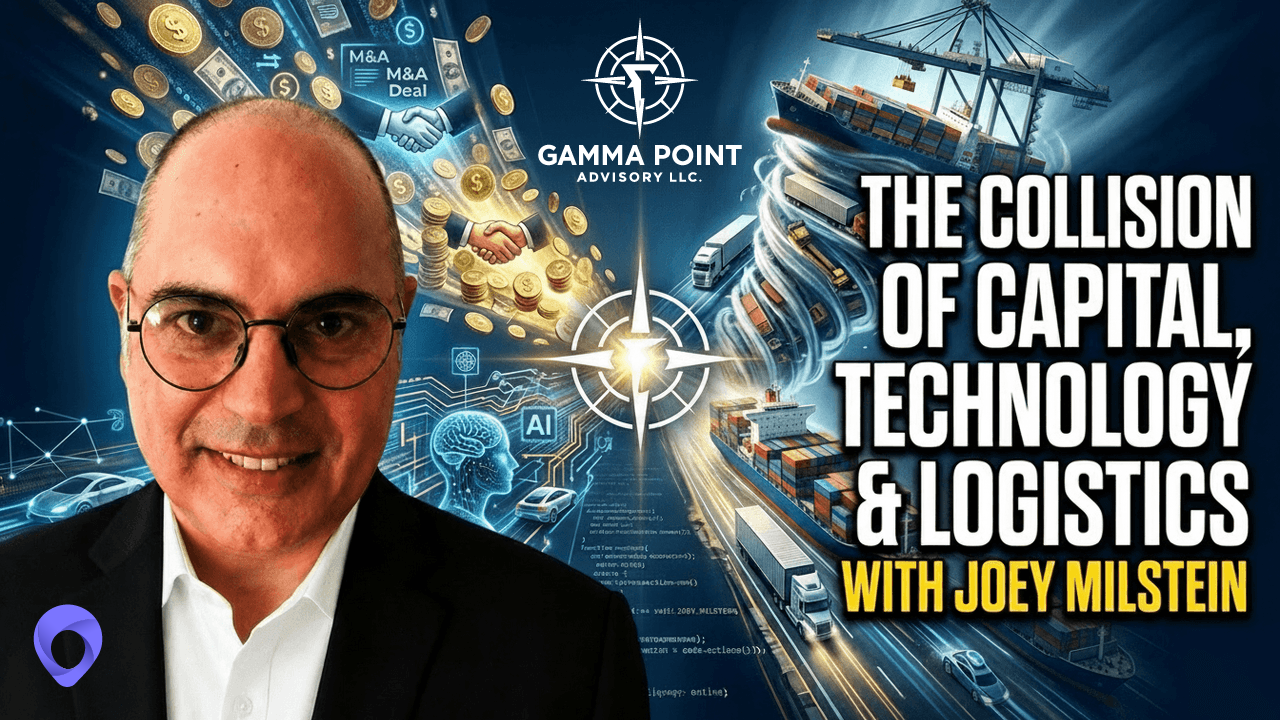
In “The Collision of Capital, Technology & Logistics”, Joe Lynch speaks with Founder & Managing Partner of Gamma Point Advisory, Joey Milstein, about how the intersection of private equity, artificial intelligence, and operational execution is reshaping the future of supply chain M&A.
About Joey Milstein
Joey Milstein has spent more than 35 years inside the machinery of global trade, leading commercial organizations for ocean carriers, freight forwarders, and venture-backed logistics technology companies before moving to the advisory side. Having built businesses, sold technology, raised capital, and led growth from inside the industry, he brings an operator’s perspective to every transaction. As Founder & Managing Partner of Gamma Point Advisory, Joseph advises founders on sell-side M&A and guides private equity firms, institutional investors, and strategic acquirers on buy-side strategy, growth, and logistics technology. He is known for connecting the worlds of operations, innovation, and capital, helping clients identify opportunities others miss and navigate one of the world’s most complex industries with clarity and conviction. Joseph holds both Bachelor’s and Master’s degrees from New York University and serves as a strategic advisor to multiple logistics technology companies.
About Gamma Point Advisory
Gamma Point Advisory is a boutique M&A and strategic advisory firm focused exclusively on transportation, supply chain, and logistics technology. Unlike generalist investment banks or consultants, Gamma Point combines deep operating experience with transaction expertise, giving clients advice grounded in how the industry actually works. The firm advises founder-led businesses on sell-side M&A, capital formation, and strategic growth, while providing buy-side advisory to private equity firms, institutional investors, and strategic acquirers sourcing, evaluating, and executing investments across the logistics ecosystem. Gamma Point also works closely with emerging logistics technology companies to accelerate commercialization and market adoption. Gamma Point sits at the intersection of three worlds that rarely speak the same language: operators who move freight, innovators building the future, and the capital that funds it.
Key Takeaways: The Collision of Capital, Technology & Logistics
- In “The Collision of Capital, Technology & Logistics”, Joe Lynch speaks with Founder & Managing Partner of Gamma Point Advisory, Joey Milstein, about how the intersection of private equity, artificial intelligence, and operational execution is reshaping the future of supply chain M&A.
- The Intersection of Three Disconnected Worlds: Capital markets, technology providers, and logistics operators routinely “talk past each other” at industry conferences. Sustainable progress requires a “translator” who understands the nuances of operational realities, deal structures, and true software utility.
- The “Silver Tsunami” Driving Consolidation: Hundreds of healthy, lower mid-market logistics companies (drayage, family-owned forwarders, customs brokers) are reaching an inflection point. Owners in their 60s and 70s without generational succession plans are seeking capital infusions, mergers, or buyouts to exit.
- Prep Work Directly Impacts Valuations: Founders often lose millions in prospective sale value by going to market unprepared. Spending 3–6 months to audit operations, clean up balance sheets, remove unutilized assets (“dead wood”), and document institutional knowledge transforms potential multiples from 4x to 6x EBITDA.
- Private Equity’s “Buy-and-Build” Playbook: Private equity interest in logistics—especially freight brokerage—is accelerating. PE firms look for established “platform” companies to serve as a base, then execute a “buy-and-build” strategy by acquiring smaller complementary add-ons to build scale rapidly over a 3-to-5-year horizon.
- Adopting Technology to Boost Valuations: Tech adoption is no longer optional for legacy operators. Implementing scalable, transferable software or modern AI tools directly increases a firm’s exit valuation multiple, whereas sticking to outdated manual processes or disconnected legacy tech depresses market interest.
- Evaluating “Real AI” vs. Expensive Demos: With capital drying up for speculative “digital brokers” that subsidized freight rates without long-term profitability, investors and buyers now focus on technology that delivers measurable operational productivity, security, and lower overhead rather than slick, superficial software demos.
- Culture and Team Depth Outweigh Simple Financials: Successful acquisitions require balancing human dynamics and cultural fit alongside pure financial metrics. Founders must build institutional depth rather than centralizing all sales, financial, and operational expertise within a single leader.
Learn More About The Collision of Capital, Technology & Logistics
Gamma Pint Advisory | Linkedin
AI In Logistics | What works and what doesnt
The Logistics of Logistics Podcast
Joe Lynch: [00:00:00] Hello, friends. Welcome to Logistics of Logistics podcast. My name is Joe Lynch. Thank you so much for joining us today. Today’s topic is the collision of capital technology and logistics with my friend Joey Milstein. How’s it going, Joey?
Joey Milstein: Joe, great to see you. Thanks for asking. Everything is going well. I hope you’re having a great summer
Joe Lynch: I s- sure am. So I’m excited to talk to you about this topic. Please introduce yourself and your company and where you’re calling from today
Joey Milstein: Sure. [00:00:30] So I’m Joey Milstein. I am the founder and managing partner of Gamma Point Advisory, and we are based in in New Jersey, about 40 minutes outside of Manhattan.
Joe Lynch: And what do you guys do?
Joey Milstein: So Gamma Point Advisory is a boutique advisory firm focusing primarily on mergers and acquisitions as well as technology advisory every– for everything in supply chain.
So supply chain logistics and transportation. So we advise on mergers and acquisitions as well as helping technology [00:01:00] companies deploy their technology and work with the capital markets to deploy funds.
Joe Lynch: I love it. I love it. We’ll come back to that in a minute. But just generally speaking we had a conversation before we hit the record button, and you pointed out that obviously capital and technology and logistics are all critically important to logistics and supply chain. They are the, the building blocks of it.
But you said the experts all tend to talk past each other. So you might be a logistics [00:01:30] expert and you’ve been running a company or l- leading a company, and you don’t know a lot about mergers and acquisition because you haven’t been doing it for the last 20 years. And meanwhile, the mergers and acquisition guys don’t always know much about the logistics companies other than they buy and sell them.
And then all the financial guys, whether you’re VC or private equity or investment bankers, they also don’t understand these pieces. And so we all have our own expertise, but we don’t necessarily know [00:02:00] what the other guys are doing, and we need to
Joey Milstein: Y-y-you hit it spot on. That’s the, the genesis of how I got started into this. It was, it kind of– Like many things in life things happened serendipitously. I’ve been in the industry for 35 plus years, and, definitely over the last 30 years and have g- going through about 12 mergers and acquisitions, I kept seeing this, this void.
And it was most concentrated over the last two years going to conferences where you have these amazing technologists building great [00:02:30] technology, these brilliant financial minds in private equity, venture capital, and investment banks, and these wonderful operating owners that– managing logistics companies that all talk a lot.
They’re all brilliant, and we all talk about how we, there’s a consolidation, we wanna deploy more technology, we wanna deploy more capital. But especially in the last two years, at every conference and all we talk about is this great technology and all the consolidation. Each l- each leader of a specific company within this specific sects of our industry they’ll just talk [00:03:00] past each other.
And I said there needs to be a translator who can really sit and talk to each, each third of that Venn diagram and be the translator.” So that’s how I got started very slowly and how it just became full-time, and that’s what I do.
Joe Lynch: I love it. I love it. Yeah, so you working with the mergers and acquisition guys to help them understand what they’re buying and selling, and you’re working with the technology companies to help them understand the customer. And and then all these logistics, there’s these… You [00:03:30] mentioned the consolidation.
We see consolidation in the freight brokerage space for sure. We also see consolidation, I believe, in the carrier space. I don’t know if that’s all true for the fulfillment and the warehousing and fulfillment. I’m assuming that’s happening also. And as the deals get bigger, the stakes are bigger, and you need to make sure you’re not missing some of the little nuances of the deal
Joey Milstein: Y-y-you’re you’re spot on, Joe. So my [00:04:00] experience, and again, this is, from my experience, it’s not always the case. But, I realize that, the industry’s always been changing, but definitely in the last five to 10 years, the industry has been going through a huge inflection point.
And this is largely because of technology, largely because of just normal evolution. But everything from gl- large global ocean carriers down to small trucking operations, there’s this huge inflection point of consolidation and and technology that’s just hitting us. So [00:04:30] I spent, 20 plus years living inside operating companies, buying and selling companies, raising capital, realizing there’s all this stuff is happening, but no one’s really capturing it.
So I’m on the outside now capturing it. And the inflection point is largely because there are hundreds and hundreds of, small companies, and this is everything from local pure drayage companies to family-owned freight forwarders to family-owned custom sales brokerages, and as you said fulfillment companies, that’s warehousing distribution that have nowhere to go.
They’re all really [00:05:00] healthy, good balance sheets, good P&Ls great customer g-great customers, but they don’t know what to do next. The, the, the owners are usually, now in their 60s and 70s. Their kids don’t wanna get into, a boring, unsexy industry, so they’re looking for an out, and that could either be through an acquisition, a merger, or through a, a capital infusion.
So the, the combination of the consolidation of the industry and the, the rise of technology creates great opportunity for, for someone like me to [00:05:30] really help an industry that I’ve loved for the last 35 years.
Joe Lynch: I love it. I love it. We’ll come back and talk a lot more about that. We’ll also talk about your book. Wait, I’ll say the name right now, but we’ll come back to talk about it. It’s Move the Weight: How Logistics, Capital, and Technology Converge to Create the Next Generation of Supply Chain Winners. We’ll get into more detail about that in a minute.
I’ll make sure I put a link to that book if you have it in the show notes, and I’ll make sure I put a link to your LinkedIn [00:06:00] profile, link to your website, any of the links you and your go-to-market team give me, we’ll put those in the show notes. Anyway, tell us a little bit about you, Joey. Where’d you grow up?
Where’d you go to school? Some career highlights before you started the juggernaut that is Gamma Point Advisory.
Joey Milstein: So I hate to use the term journey because journey is such an overused cliché word, but I’ve had an unbelievable journey. So I’m born and raised in Queens. I’m a New York City kid through and through. I went to NYU for my undergrad, and I also went there for my graduate degree. My [00:06:30] wife happened to go there too.
They should probably name the building after me, but probably they won’t. The only thing I get out of it is I can get discounted parking in Greenwich Village. So born and raised in New York. I g- I got into this industry right out of college. I went through the management training program at a now no longer around company called APL.
APL was the largest US flag ocean carrier
Joe Lynch: Who bought them?
Joey Milstein: So they were purchased in nineteen ninety-seven by NOL, a Singaporean company. And then in two thousand sixteen, CMA CGM bought the whole thing. [00:07:00] So now it’s part of CMA CGM. So I had unbelievable experience starting with my first year as a management trainee.
Now, mind you, I was a kid, twenty-one years old. I had fifty dollars to my name, and APL came, put me in a management training program, and really got immersed in everything transportation. I went– I lived at the rail ramp. I went to California for six months, lived at the ocean port, went to– did corporate training.
And that really is the foundation of everything that happened for the thirty-five years after. So I worked in [00:07:30] global ocean shipping. I worked for APL as a large carrier. I worked with ZIM, the Israeli national flag carrier, APL Logistics, which was the sister company at the time of APL, working mostly on the domestic side.
So it was all the things that are tangential to the ocean freight: origin consolidation, warehousing and distribution, trucking. But primarily for– when I did– I was living in DC for six years, so I was a government contractor for the US government, and that was Defense Department, USAID, USDA, State Department.
And then I got– then I also worked [00:08:00] for two along the way, not necessarily in this order, two family-owned private equity-backed companies that were incredible. So that’s where I first really started really getting involved in true m-money. So it was private equity mergers and acquisitions. One company we we merged with two other companies then a third, and then we took it public, and then we reprivatized it, and then we sold the whole thing to a strategic partner.
And the second one was a custom– that one was a three PL. It was domestic warehousing, trucking transload, [00:08:30] cross-dock e-e-everything that has to do with domestic transportation. Great company. I spent seven years there. And then later on in my career, I worked with a s- family-owned customs house brokerage company, also private equity backed.
We we had about four acquisitions while I was there. The idea was to flip it. And again, all these times that I was involved in all these mergers and acquisitions, I was within the company. And I could see a lot of the times that there was a lot of things missing. N-no finger-pointing, but I could tell that the people that were investing money or investing capital, [00:09:00] had they had someone like me on their side things could have been a little bit different.
I’m not saying one’s better or one’s worse, but definitely different. And then I was very fortunate. I’ve also been with a couple of technology startups where, remember, I came from a company, w- companies that were billions of dollars and thousands of people, and then I took a leap of faith back in 2018.
I joined my first startup, so I went through– I was with two logistics technology companies, the complete flip side of what I was doing, where we– I was employee number four in one [00:09:30] company, employee number 12 at another company, and the idea was to grow the company both in terms of revenue, it– but also raise capital.
So throughout my career, I’ve literally done everything in terms of every mode and node in transportation, but also e-everything from small startups to multi-billion dollar companies, and along the way, like I said, 12 mergers and acquisitions at a minimum large ones and quite small ones, and l-lots of capital moving, moving back and forth.
Joe Lynch: Yep. This is a theme that’s come up on the [00:10:00] podcast in the past, and I think it’s a universal problem, and it always will be there too unless they talk to someone like you, is the biggest deal of your lifetime if you’re a, an owner of a logistics business or a carrier, whatever, and you decide to sell.
You’re a survivor. You’ve done really well. You know how to sell, you know how to do deals, you know how to lead. And but unfortunately, you’ve never sold a company. If you’re the … Most people never get a chance to sell one company, [00:10:30] let alone multiple. And that’s the biggest deal of your life, and it’s something you’re not necessarily familiar with.
And I’ll go one step further and say that you can’t look at your business and your team objectively, and you need to. And you need to s- you need someone to show up and say, “Hey, you gotta fix this, and this, ’cause you’ll get a lot more money.”
Joey Milstein: 100%.
Joe Lynch: There’s little things, and I- I’ve this is just one example.
If [00:11:00] let’s say you’re a carrier and you say, “Oh, we have four terminals.” Are you using them? Are they useful? The fourth one we closed. We don’t really do much business there, but we might in the future.” You, do you own it? “No, we’re just making payments on it.” So one of the big issues out there is for companies.
Let’s just say I own a logistics company, and I got some family members in it, and I’ve been leading it for many years. This has been my life’s work, and I love what I’m doing, but it’s time to get out. It’s I maybe I don’t have a s- [00:11:30] great succession plan. Kids aren’t of interested or whatever, and it’s time to sell.
Any- By the way, even if the kids are interested, sometimes if you got four kids or three kids if one wants to be in and the other don’t, you s- you’re taking a big risk selling it to just one because that’s the inheritance for the others that could get blown if the, the other one screws that up. So y- you think you are a great businessman, and you are by all [00:12:00] accounts, but you’ve just never sold a company before.
Very few people ever sell one company, let alone multiple companies. And the challenge is you don’t look objectively at this, and you need to. And I don’t think you ever can. That’s why you need an outside advisor, someone like Joey, to come in and say, “Hey, this terminal that you’re not using, sell it.
Get it off your books,” because somebody’s looking and saying, that holds down. Let’s just say you’re paying a million dollars a year [00:12:30] towards towards that building. That comes right off of your profits, and that’s gonna, and you’re gonna, you’re gonna miss out on a multiple. So if you’ll just say you sold it at six times, that’s $6 million.
Not just a million dollars, it’s $6 million at that time. So there’s all sorts of things you can clean up, and I think there’s also, I think a lot of times when, and if you’re, let’s just say you’re a carrier, if you’re mostly in the Northeast and you got a little bit going on in the Midwest, a little bit going on down South, and [00:13:00] you wanna package it up for sale, you gotta find s- a way to kinda become a pure play.
‘Cause somebody in the Midwest and the Southeast might say, “I’m looking for somebody who’s really good at the Northeast.” Not a hodgepodge. Not somebody who’s got a little bit of everything. Or if you’re really good at cold chain and they’re looking for cold chain. So you wanna be that pure play if you can.
Anyway enough of my blather. What do you talk to? What do you say to these companies who are in that position?
Joey Milstein: So what you’re saying, it’s spot on. What I’ve– Again, what [00:13:30] I’ve noticed, again, with the consolidation, a lot of it is generation– lack of ge-generational handoffs. Again, you don’t realize what you know at the time, but when I was in my twenties and there were all of these small operators, family-owned operators very hard workers.
So I was in my twenties, they were in their forties. They’re now in their sixties and seventies. And, there, and there are lots of these people, wonderful people that I’ve met along the way. And then they call me, he’s “Listen, I’m seventy years old. I’ve got this small freight forwarding company.
It’s wonderful. It’s operating at, a few million dollars, [00:14:00] ten to, ten to twelve percent, EBIT EBITDA, which is not bad.” Again, everything is a multiple of EBITDA these days. That’s how we measure the valuation of a company for the most part. There are other things. But so before…
these are all people that I– Most of these people are people I’ve known s- since I was in my twenties, so that means thirty-plus years ago. And the first thing I say is, “Before we go to market, we need to look at, have very clean financial statements.” And these people, a lot of them, they’re, they’ve got great books, but most of the information is in their head.
And I, when you’re selling a company, yeah you’ll stay [00:14:30] with the company maybe for a year for the handoff, but we can’t sell a company with information that’s in your head. So the first thing is let’s, before we do anything, let’s spend the next three to six months really cleaning up the books.
So that means four to five years of really a good story that’s your profit and loss, your balance sheets, all your financial statements and show a steady growth plan. And then of course your customer concentration. Let’s focus on that. But now more and more… And again, having the right starting point can really change the valuation of a company and [00:15:00] change the multiple.
So yeah, you may have a quick sale and you could get three to four to five x as a multiple, but if you spend three to six months on making sure you have
Joe Lynch: Wait, it’s a multiple of what for people who don’t do this every day?
Joey Milstein: a multiple so for a company that let’s say is doing ten million dollars of revenue a year, and let’s just say for argument’s sakes their EBITDA is ten percent or a million dollars.
Let’s say they want a quick sell and they just want to get four X. So they want to get four X meanings four times the EBITDA is the earnings before interest, tax, depreciation, and amortization, [00:15:30] which shows the he- the health of a company. So m- most companies buy and sell on a multiple of their EBITDA.
So if it’s a million dollars, let’s say they want to get four times EBITDA, they’ll sell the company for four million. And what I’m saying is you could probably get five to six million if you show a better story. Same company, but you make sure you have there are no, no questions to be asked post-close there are no skeletons in the closet
Joe Lynch: That’s why you notice a lot of times when companies are getting ready to sell, especially larger companies that know [00:16:00] a lot of what you’re talking about, they’ll say, let’s make sure we don’t have any dead wood on this project because that is going to – it’s not that $150,000 salary that’s hurting you.
It’s the time that it’s going to be times six. So if that $150,000 to your ne’er-do-well brother-in-law, we can say, hey, take an early retirement, dude. We’ll take care of you another way. But
Joey Milstein: Yep. And those are all [00:16:30] things, they’re all things that need to be considered. And y- again, I, again, this is… I take this very seriously and it’s very intim- very intimately ’cause the last thing I wanna do is shortchange or mislead someone that I trust in an industry that I love. But, I would be remiss if I didn’t add that because technology is so important now, adjacent technologies with the sale of a company can actually change the valuation of a company.
So you e- either need to be able to adapt or adopt to technology and not old stuff that’s [00:17:00] just noise, but either have something that’s transferable and scalable that’s not just dead weight, or be willing to integrate something that’s a- adoptable and adaptable. ‘Cause I’ve seen it and I’ve, or I encourage people to really embrace technology and I help integrate that if needed, ’cause that can literally change the multiple of a company.
So 5X on a valuation without good technology could be 6X if you’ve got good technology that can be scaled or you can integrate it with other technologies
Joe Lynch: Joyce, talk a little bit about the team. [00:17:30] And what I mean by that is, l- let’s just say I own a business and I’ve done really and I’ve grown it, but I’m the best at the financial side of the business ’cause I own it, and I’m the best sales guy, and I am the most expert of, in all the operational issues.
And then when I come to sell, are they gonna look and say, “Wait a sec, everybody’s kinda weak around this guy. He hasn’t developed a team.” Is that gonna, is that gonna bite these guys at the end?
Joey Milstein: So it, it all depend– A-again, you talk [00:18:00] about the team. I yes and no. It really depends on each, each circumstance. And I’ve seen success and failure in all. Sometimes what looks like the greatest teams aren’t. Look I’ve been in situations where, small operators took on a table of Harvard MBA, Morgan Stanley, JPMorgan types.
So– And it was j- it’s just a question of because they understood the nuances, they understood the idiosyncrasies they understood the cyclicality of the business, and the people on the other side understood spreadsheets and financial [00:18:30] statements. I don’t– I hope that answering your question, that it– the team the size of the team is less important as the depth of the team.
So if the depth of the team really can talk to, all, all su- all, all quadrants or all points of the Venn diagram, the better. And that’s where I try and deploy my skill set. Look, I am not the smartest man in the room, and I never will be. If I’m the smartest man in the room, I’m in the wrong room.
But I’m, I’ve got lots of battle scars.
Joe Lynch: I’m usually alone if that’s the [00:19:00] case
Joey Milstein: I, I– But I have lots of battle sc- ba-ba-battle scars and, just a a, a, just a, an inventory of experience that probably dwarf most people that are going into an acquisition or an advisory an advisory situation
Joe Lynch: Yeah, when I was young, right out of school, I worked for my dad’s engineering business, and it was a startup. And I worked there for seven, eight years off and on. When he didn’t have projects, I’d go work for somebody else. And at the same time, I grew up with a number of friends who[00:19:30]
I knew a lot of kids who were in dealership school. I went to school at Northwood Institute, so a lot of kids went back, and they went to s- to work at their dad’s automotive dealership. And so now over the last f- 40 years, I’ve seen a lot of guys who took over the family business, and man, that is never easy.
So you think okay, I…” And to an outsider it looks like, oh my God, that’s such a great deal just to be walk into the [00:20:00] family business. I can tell you my dad’s business was never the success that I got to take over. My dad had some health issues. We ended up closing it. But it was a pain in the ass working for my dad.
I lived at home. Like there was never a, a late night where I could call in and say, “Hey, I’m not coming in. I’m- I got the flu.” He’s like, “No, I heard you get in at 3:00 in the morning.” All of my friends who were in their family businesses, they will tell you horror stories about it. It is … So the idea that s- [00:20:30] a family business is just always wine and roses, it’s not.
And so when you’re … So when it’s time to sell you get all those personalities and all. It’s not just the money issues or the technology issues or the business issues. It’s oftentimes personal issues. So y- you definitely need somebody from the outside to come in and say, “Hey I s- I can’t help but notice
Joey Milstein: And that’s for better or for worse, when you come in as a, as an advisor to, to sell a company or for a strategic [00:21:00] that’s looking to buy you’re not just look- coming in there as a financial advisor or a business advisor. Sometimes you’re, you’re the mediator, therapist counselor, and personal counselor because culture is as important as money.
And remember, even if you’re handing off to a, a family member, it changes the dynamics and the culture of the way the company runs. And I’ve seen success stories where, there’s been a generational handoff and the second generation did wonders. But then you see, you see the, the, the flip side where the generational handoff goes off and [00:21:30] goes over and the new generation is not the same customer-centric person that the father or mother was and things go awry.
And a lot of times I… And i- in my career or at least since I’ve been doing this, admittedly there have been times where I’ve told, a, a, a gentleman or a woman “Listen it’s not the right time to sell. Let’s figure out what we’re gonna do with little Jimmy or little Jenny because I’m telling you, if you sell it right now, you’re gonna cause more headaches than it’s worth and the money’s not worth it.
So let’s figure out what we’re gonna do with the [00:22:00] family. In the meantime, let’s start preparing the story and then we work from there.”
Joe Lynch: And somebody else said this years ago on my podcast, but it stuck with me, and they said, “Usually people don’t talk about this type of thing until it’s too late.” And he said, “And there’s the three Ds: divorce, death, and disease.” And he says, so if somebody all of a sudden has health issues or they’re getting divorced or their partner died, and all of a sudden they say, “What are we gonna do?”[00:22:30]
And that’s probably too
Joey Milstein: Yeah. Yeah, 100%. So again I have– I, I speak with owners of companies daily. And I also speak with financial institutions, and I also speak with lots of technologists that are building great technologies. And look, I wanna make money like everyone else. I wanna build a huge, Rolodex of customers.
But the last thing I wanna do is lead them down the wrong path. And usually the– it starts over the conversation. Let’s, let’s put all the cards on the table, let’s see where we are, and let’s build a roadmap. And the roadmap [00:23:00] could be two weeks or it could be two years just depending on what the ultimate
Joe Lynch: But better to get m- better to get you involved years before. And the reason I say that is, so you say, y- everybody thinks they’re gonna be alive forever until the week before they die. That’s…
Joey Milstein: That’s exactly… and the same is for, and the same is for business
Joe Lynch: Yeah. And so if you say, “Hey, look, we got a good team in place, and I’m not going anywhere. I’m here for the next 10 years,” you don’t know that you’re here for the next 10 years.
So better to get that plan [00:23:30] for the future set up well before you need it. So I wanna talk about a few of these industries, and then we’ll talk a little bit about the book, and… so first I wanna talk about freight brokerage. So we’ve seen some recent changes to the law in f- how liability can hit freight brokerages.
People have said on my podcast, and I don’t know how true it is, but they believe that double brokering and some of the other f- fraud issues we have are more associated with brokers. I don’t know [00:24:00] that to be true. I think the very best brokers are some of the best transportation logistics companies out there, so I’m never gonna…
You can’t paint the whole industry with a same brush. But we’ve seen big changes also with technology stacks are getting expensive, and now everyone’s has to invest in AI. So suddenly we’re seeing consult- not suddenly. We’re seeing consolidation in the freight brokerage space, and I’m looking at my notes here.
These are directionally correct. I don’t think they’re exact. [00:24:30] The top 1,000 freight brokers. There’s 25,000 freight brokers. The top 1,000 have 80% of the market. Top 1,000. And by the way, that doesn’t mean the bottom 24,000 don’t have some sensational businesses, I guarantee. ‘Cause some of those 24,000 also own 15,000 trucks some great companies.
They might also own warehouses. But anyway, top 1,000 own 80% of the market. The top 100 own two-thirds of the market, [00:25:00] which is 66%. The top 20 own half the market, and that’s volume. So do you see even more consolidation happening in d- because of all the issues I just described?
Joey Milstein: E-exactly. And it’s not just in, in, in in truck brokerage. It’s everywhere. So there’s regulations. Don’t forget we have tariffs and we have geopolitical issues, geoeconomic issues. All of this affects everything that’s in supply chain and logistics. But speaking specifically about freight [00:25:30] brokerage and there are two things I’d like to touch upon.
One is the capital industries. I would say in the last three months, I’ve spoken to two dozen private equity firms that want to get into this space, and the number one conversation is around freight brokerage. They don’t understand it. They want an education of it. Is it risky? Is it not risky?
We don’t understand how, why the rates fluctuate all the time. The point there is that there’s a huge amount of interest. So w-with that interest from the financial community automatically means [00:26:00] there’s gonna be some consolidation. So what’s gonna happen is, look, we can’t escape it.
Regardless of whether I’m a fan or not of private equity private equity is here and they’re very interested in our industry. So at some point, there’s gonna be a lot of consolidation through the private equity firms that are gonna buy one or two or three, create platforms and then do a buy and build, and it’s just gonna be an automatic consolidation.
And I would predict the next five years you’re gonna see that.
Joe Lynch: S- so you just touched on the, what I was gonna ask you, which is platform. So they have … The way the [00:26:30] private equity guys make their money is they buy a platform company, and then they buy and build. Explain that process and what they’re looking for, first off in the platform company, and then also the add-on businesses that they wanna purchase
Joey Milstein: Yep. And this is, these are the conversations that I have. There are some private equity firms that may already have a logistics company in their platform. But most of them are looking for what we call a platform. That’s really just a base. So what they’ll say is “Listen, I have X amount of dollars that I want to deploy on a [00:27:00] platform company.”
And, the idea ultimately for every private equity firm is to flip it. They want to sell it either to a strategic, meaning a larger company, or to a larger private equity firm. And that’s how all these people make money, including venture capitalists. But the private equity firm, so they’ll– let’s say, “Look, we wanna get into the logistics business,” and they’ll buy a platform company that does warehousing and distribution in three major ports East Coast, West Coast, and Southeast with some trucking attached to it, and they paid forty million dollars for it.
Round [00:27:30] number. They say, “Okay, now let’s buy some complementary businesses that are either adjacent services or adjacent verticals or adjacent services,” and it becomes a one plus one equals five. So they-
Joe Lynch: Yeah. And those first companies, they buy the platform. Those are usually a little larger, to your point, and they paid most likely a higher multiple for that company. And now as they add on the smaller ones, those are not gonna [00:28:00] be… let’s make this up. Let’s just say the first company was eight.
The multiple was eight. Now they’re looking and saying, “We’re hoping that the multiple for these other ones can be five or six or four.”
Joey Milstein: That that’s often the case. It doesn’t have to be, but but yeah, m- more often than not the, the premise is yes, the, the first acquisition is a larger company. It’s the base. So consider it like, pilot fish on a whale. So they’ll buy the whale, and then they wanna get pilot fish that are all gonna eat around the whale, and then you have enough pilot fish where you have two or three whales, and [00:28:30] now you’re– you’ve scaled a company over the last five years that is three times larger than had they been growing individually by themselves, and that’s just how the, the ecosystem works.
Joe Lynch: Yeah. And by the way that’s what Brad Jacobs did, and I think he’s done it in multiple industries. I think he is… He’s written a book about it. And I forgot the name of the book, but it’s something of how to make a billion dollars or
something like
Joey Milstein: Brad Jacobs, I don’t wanna plug Brad Jacobs, but he’s, he’s really almost a maverick when it comes [00:29:00] to M&A in, in logistics. He was doing this before, on a large scale at various levels. And, he’s– he admittedly says, I’ve lost money on some,” but he’s very quick to know what’s a loser, and he’ll sell them even at a loss just to keep the, the enterprise going.
Joe Lynch: He’s gonna be okay.
Joey Milstein: Yes, he’ll be okay
Joe Lynch: And so we’re seeing … and the driver for this consolidation is more fed regs, which is always a driver for consolidation. The tech stack got, [00:29:30] is getting more expensive, and I know people are looking at saying AI. AI is going to create some winners and some losers and maybe give some of the smaller companies
Maybe it gives you some advantages for the ones who’d be using it right. So more expensive tech stack tech- fed regs. And I would also say this is my own sense of it, is if the liability costs go higher pe- for freight brokers, and they have to … That has to be part of their [00:30:00] pricing, maybe they come- become a little less attractive compared to a carrier.
‘Cause I think 70, 80% of our, or 70% of our freight is not brokered.
Joey Milstein: correct. That’s correct
Joe Lynch: And I think most of the time … When I was selling logistic services as a non-asset-based company people go you guys don’t have a truck. You’re a mil- just a middleman.” I would always say, “We can get the trucks cheaper than you can.
So w- so what if I’m a middleman?” I’m also bringing you technology and a team. So I’m not at all against [00:30:30] these companies. I think it, I think for a, the last 10, 15 years, we’ve seen the industry, I’m sorry, but the shippers grow up a little bit in how they view freight brokers ’cause the, the best freight brokers are an unbelievably great asset for
Joey Milstein: Huge. And I, y- you bring up a- an interesting point regarding freight brokers, and we talked about technology. From around 2015 to around [00:31:00] 2020 we saw a huge rise of digital freight brokers. I don’t wanna mention names, but we know them all. And they were unbelievably sexy.
They were raising hundreds of millions of dollars, showing in- incredible stamina. But in the end of the day the, a lot of it fell apart, and most of these companies went out of business simply because they couldn’t sustain the fragmentation of the trucking business. ‘Cause, I learned in my first startup, which was also in the trucking industry, that it’s so [00:31:30] fragmented, and depending on where you are in the life cycle of contracting domestic freight, one year the shippers get their f- pound of flesh, and one year the carriers get the pound of flesh.
And you neg- you spend three months negotiating rates for 25,000 lanes, and then the market shifts, and then one side says, “Wait a minute. The freight rates went down, so you need to honor the new market rate. Otherwise, I’m not gonna ship with you even though we negotiated a year contract.” And then the following year, the rates go skyrocketing, and the carrier said, “Listen, I know we negotiated a year contract, but unless you [00:32:00] give me $500 more, I’m not gonna carry your freight.”
And the digital brokers are trying to keep up with this. And I felt that it, in the end, the digital freight brokers were really, not really using technology because there was so much human interaction that needed to be involved ’cause you’re dealing with shippers and you’re dealing with carriers, and being a a technology, even if you’re using AI it didn’t work.
And, they were trying to show market share, and again, they were just losing money on every load
Joe Lynch: I think in a lot of ways also they were viewing [00:32:30] the … I think some of their investors were saying this is a tech play, not realizing they were investing in a s- a freight brokerage.
Joey Milstein: That’s exactly right. And so yeah, so and the ones that survived were the ones that were the most cost, most customer-centric, that were honest. They weren’t deploying, venture capital to subsidize freight rates to show market share and, that’s just not sustainable
Joe Lynch: Yep. And we should also mention that venture capitals, venture capitalists don’t typically invest in spaces like [00:33:00] freight brokerage ’cause it doesn’t scale fast enough. They, that’s why they love technology. I talked to a lot of venture capitalists on here, and I always kinda tease that you hate the physical world.
And the reason they hate phys- the physical world is because manufacturing slows you down from scaling. Creating properties s- slows you down from scaling. They wanna be in, in, in industries like software where there can be scaling, like, in an exponential way, and that is not necessarily [00:33:30] the way freight brokerages work
Joey Milstein: Yeah. Yeah and ag- so again, like almost billions of dollars were deployed in logistics technology. Now, they weren’t in freight brokers, traditional freight brokers or traditional trucking companies because it’s, like you said, I’m not gonna sp- I’m not gonna invest millions of dollars in a trucking company.
But if it’s a logistics technology company that’s going to be disruptive, with loose quotes around it, that’s going to just, break open the stodgy, stale trucking business, yeah, maybe I’ll get into it. [00:34:00] But there was a big slowdown because a, a lot of it just turned the other way.
Joe Lynch: Joey, I want to get your two cents on this. So I wrote an article a long time ago I think 2017, I think I wrote it. And it was when I was still blogging. So I started the podcast, I stopped writing as much. But I wrote that I thought the freight brokerage business was going to go the way of the stock brokerage business.
And the stock brokerage business, if you watch college football or pro [00:34:30] football, or you out east, if you watch co- pro football on a Saturday twenty-five years ago, all you would see was PaineWebber, EF Hutton, Merrill Lynch, all of these stockbrokers. Most of us didn’t work with them. Stockbrokers were expensive.
I remember doing a trade where it was like, “Oh, we’re gonna get you out of that stock and put you into Dell.” And it was like $10,000, and then $200 to get me out of one position, and [00:35:00] $300 to get me in another. I was like, “What is it?” So I, so me being the big trader over here, I’m parlayed my $10,000 into $9,500.
By the way, that stockbroker was like, “This is a great move, Joe. You’re such a savvy investor,” blah, blah, blah.
Joey Milstein: Yeah, you are, you and I are old enough to know that those days. Current investors like my son, he wouldn’t know what a stockbroker is because he does everything
Joe Lynch: yeah. S- so when we, and so when we looked at the stockbrokers, I always remember being at one of, at
my country club. There’s these guys, [00:35:30] and they were all Merrill Lynch guys, and they were older. This is 20 years ago, and they were like, “This is age discrimination. This … That’s all it is, it’s age discrimination. They’re pushing us out.” And I was like, “Oh, what’s going on, guys?” And they’re like … I go, “What, how are you being discriminated against?”
They go they’re pushing us out because we’re old and we make a lot of money.” And I was like, “They’re pushing you out because guys like me would rather trade for eight bucks.” And they’re like, and they, and by the way, what they would say [00:36:00] is, “Joe, you don’t understand. We’re working with people, and it’s a relationship business.”
That’s what they would say. Very similar to the very best freight brokers will say, “The reason Joey Milestein works with us is ’cause we’ve had a relationship that goes back 25 years.” And will they trade in that relationship if they realize you’re making 40 grand a year off them? Perhaps.
Joey Milstein: So I w– I’d like to make a comment on that because, I often thought or [00:36:30] think still if there’s an opportunity or there’s a, a chance that, our industry will go the way of, like you said, stock or even booking travel. Who goes to a travel agent anymore? You go to Expedia, you go to your airline.
The, the difference is in our industry, especially in, in the, in, in in trucking and less in, in ocean transportation, but especially in trucking y- they say you you date your ocean carrier, but you marry your f- your trucking company. And it’s because, the trucking company is– it’s not transactional.
So like a stock, you make a [00:37:00] stock trade, it’s transactional, it’s not human, it’s not emotion. You– it, it’s done, and then you move on. When you book a, when you book a flight or you book a, a vacation, it’s transactional, you’re done, you move on. In our business, it’s fluid, it’s constant, and, you don’t have one truck move a year.
Yeah, for something like that, it’s great. But if you have a if you have a business that is operating on a on a just in time and you have deadlines to a distribution center or to a, an end customer, and you get a chargeback, if that’s not there between [00:37:30] 10 and 12 with the right labels on it, that’s a whole different world than a just a transactional pressing of the button, click and pay.
I find especially in, in your domestic transportation provider and your customs house broker, that’s really sticky business and you really need to trust. It becomes part of the company.
Joe Lynch: I think I will say that I’m not disagreeing with you on that for sure. I don’t think there’s any one right answer, but I do think overall we’re gonna see a lot more transparency, just like we see with the [00:38:00] stockbroker. So by the way, the old stockbrokers could churn your account, and they, it was often in the news.
You’d see it usually it was the rogues would say, “Yeah, we had this old guy and he had $2 million and we traded him every single day for for five years, and he’s down to $1 million and we got a million dollars worth of fees.” That doesn’t happen today ’cause we’ve kinda moved out of that.
And you think about what replaced the stockbrokers. If you were doing a lot of trading, you probably went to one of the discounted [00:38:30] brokers, and most people I think went to financial planners or did it on their own. So I don’t think that we’re necessarily gonna do it on our own, but I think we’ll see more of “Hey, I’ll manage your freight and I’m going to give you a management fee so you know exactly what we get paid.”
For the larger companies obviously. “And then give me the transparency, give me the insights, give me all the stuff I need, but I want discounted.” I was talking to one of the Lehto brothers over there at Emerge, [00:39:00] and they were talking about Global Trans, where they had at one time, and one of just this wildly successful company, and he said, “This is the olden days.
Some of you would make 1,000 bucks on a load.” And then they run over and there was a bell and they would ring the bell, and guys were doing a victory dance, and they said it became kinda choreographed like they were in the NFL end zone. And I said, “What would happen if they’re walking a new customer through the building?”
And they say, “Hey, what’s going on over here with these three guys [00:39:30] dancing?” “Oh, they made $1,000 by booking a load.” Those days are gone, and they started Emerge really for that purpose, to say
Joey Milstein: Yeah, and Emerges, E-E-Emerges and look, I know Emerged very well, and they’ve been incredible, almost like a reverse auction. It’s a great technology, and, m- the comment that I made is it’s not binary. So technology and transparency and relationships are all ind- independent of each other.
Again, I work with, I speak to AI companies [00:40:00] regularly, and I am an advisor to two technology companies. Without AI in, in the trucking industry, especially the, the carriers have to start deploying technology. If they don’t, they’re gonna, they’re gonna just, they’re gonna die. And that comes along with valuation and scalability and sellability is deploying AI.
So y- the relationships can still be there and deploying great technology. But remember, you can probably discount your $1,000 profit load but your costs are gonna go way down because you’re deploying technology that’s gonna replace lots of redundancy, lots of errors, and lots [00:40:30] of time without necessarily d- displacing people.
You just deploy people in different ways.
Joe Lynch: And I think also we’re getting to this place where we have so much freight fraud and so much cargo theft and cybersecurity issues. I think we’re gonna look at our freight brokerages and probably our carriers in a way that we didn’t not so long ago, which is saying, “I really need you almost to be a security company for us.”
And physical security, n- not just physical security, but also data. How do you — [00:41:00] And right now, Joey, if you and I were put in charge of selecting a transportation partner for a, a very large shipper, I think security would be one of the top things we would talk about in our selection process
Joey Milstein: 100%, yep. And it’s actually one of the– And they’re, the, the very smart owners and operators, when I try and introduce technology to them, their, their– one of their biggest concerns is, privacy security. I don’t want them to be [00:41:30] able to access all this data that’s private. And, the technology companies they’re smart.
They put up firewalls and shields and they deploy third-party technologies within their technol- technology to ensure all of that gets protected, similar to what the, the banking industry does for our savings and checking accounts.
Joe Lynch: Yeah. So we talked a lot about the freight brokerage consolidation. Now, when it comes to carriers I think the largest carrier has 2% of the industry, 2% of the volume, which is [00:42:00] crazy. When you look at other industries, you go, “How many automakers are there? How many…” I think pizza is a weird one, too, because pizza, I think 30% of all pizza places are franchises.
And you go, “Wait a sec. All those Pizza Huts, all those Domino’s, all those Little Caesars, and most of them, and the majority are the ma and pa place that you’ve been going to for 10 years that’s down the street.” But anyway, getting back to it, John Larkin, industry legend, and when it [00:42:30] comes to financials, both private equity and I think he was an investment banker and also VC still out there doing biz.
He said that he thought that he would see– we’d start to see the largest carriers get bigger. So not just have 2% of the market, have 4%. By the way, they’re already the biggest, have a tremendous amount of trucks. But he said they have better economics. They buy better, and they keep their trucks moving better.
They get better [00:43:00] pricing. There starts to be a lot of efficiencies at a certain level. Our industry is still absolutely driven by these owner-operators. But what do you see in that space?
Joey Milstein: So I y- what you’re saying is dead on. And l- I wanna just take a step back. You’re talking about carriers, and we’re talking about obviously domestic trucking carriers. But I wanna add to that ocean carriers. So when we talk about carriers, let’s talk about what’s going on in the world and not just what’s happening with with domestic carriers.
Yeah, I would argue that these large carriers, both [00:43:30] domestic, the C.H. Robinsons and the people that we know, and then the ocean carriers, the MSCs, Maersks and CMAs, they’re gonna continue to get larger because you said they have the economics on their side. They can buy better, they can scale better.
They have, deeper and wider teams. They can deploy technology faster. So it’s like anything else. It’s it’s unfortunate because you have a lot of good lower mid-market companies that could be gobbled up and, who pays the price is the customer. But it’s [00:44:00] inevitable that you’re gonna see these large global ocean carriers continue to buy other assets in supply chain.
It doesn’t have to be another ocean carrier. It could be a domestic carrier, a trucking company, a customs house brokerage. But this is part of the consolidation that I’m talking about. But specifically what you’re talking about, these– the, the 2% of the largest carriers, I think that 2% in the next 10 years is probably gonna– I can’t put a number on it, but it’s gonna be probably 10 or 20%.
Because you’re gonna see all these small lower mid-market and regional [00:44:30] players say, “Yeah, why wouldn’t I sell my company for a certain multiple and just get out and stay on as an employee?” That’s nothing new. That’s Economics 101, but it just goes back to what we talked about at kinda at the inception of our conversation.
There’s this huge consolidation plus technology that’s happening, and it’s just been so accelerated over the last five to 10 years, and I think it’s gonna be even more accelerated over the next
Joe Lynch: Yeah. I was just I was just talking to some friends. I went to a wedding in Poland. It was really fun, but there was Americans [00:45:00] there, and they were from Milwaukee, and one of them said, “Oh, I worked at Pabst.” And I was like, “I don’t know. Does Pabst beer even exist anymore?” And we got to talking about beer, and I said go back f- 40, 50 years ago, every major city kinda had their beer that they liked, that was their b- And so here we had Stroh’s.
Stroh’s was the third largest, fourth largest beer company in the world, and now they’re gone. And and it just became just [00:45:30] consolidation just kept happening, and happening. And so when you’d say that, oh, this m- my beer company is independent,” no, it got bought 15 years ago.
They just look this, like they’re independent. Soon as there was, like, three beer companies in the whole world, what happened? We got a whole bunch of craft breweries that are now good-sized companies being bought up again. So there’s always this consolidation, but you look at the consolidation and say, “Okay, Miller is a big company.
Bud’s a [00:46:00] big company.” But you got a number of friends who will go, “Oh, no, I don’t drink Miller or Bud. I only drink craft beer.” Me, myself, I only drink m- macro brew. If they don’t make a million ba- barrels a day, I’m not drinking it. But anyway, same thing happens in industries. There’s always this, as soon as it gets to a place where you go, “There’s only three big players in ocean shipping,” somebody’s gonna see an opportunity
Joey Milstein: 100%, yep. The… and look we wanna avoid monopolies wherever we can, whether it’s [00:46:30] in the auto industry, food industry
Joe Lynch: There’s only one monopoly and it’s the feds.
Th- they’re always the ones saying, “We need to break the monopolies up.” How about you break up the postal service for us?
Joey Milstein: Yeah. Yeah. Oh, I can, we can spend, we can we can have a whole
Joe Lynch: That’s another topic.
Joey Milstein: Yeah I can talk to that extemporaneously for a day. We’ll shelve that for a beer
Joe Lynch: Yep. So the next thing I want to talk to you about is your, you wrote a book, and I’m gonna say it one more time here, Move the [00:47:00] Weight: How Logistics, Capital, and Technologies Converge to Create the Next Generation of Supply Chain Winners. First off, why did you write this book? And then what is the premise of the book?
Joey Milstein: So yeah, thanks for asking. So I’m hoping… So it’s in its final editing stage, and I hope to have it published by September, by mid-September. Again we talked about earlier, things happen almost by mistake. And about a year ago, at the time they started really doing Gamma Point full-time.
So may-maybe a little mo- I [00:47:30] started thinking about it probably more two years ago, but I started putting pen to paper about a year ago. I’d spent 35 years watching our industry change and not change. And, again, y-you don’t realize how much you learn along the way, and I realized how many lessons I’ve learned watching our industry grow and change and not change.
And I, again, I saw s- three, three points of our industry. I looked at the capital world, the logistics world, and the technology world. [00:48:00] And especially as technology’s now really here and it’s unavoidable for an industry that always really just resisted technology and liked to work on an abacus, and a calculator was fancy, and then they started adapting EDI.
I started just taking notes, and it– the book that I wrote is a, a a strategic framework or a, an industry framework to the approach of what’s going to be f- in the future, but also a memoir. So I just started just writing chapter after chapter about things that I’ve experienced from [00:48:30] the time I was 21 until into my 50s when I started off as a management trainee up to the C-suite, living overseas, working in DC, working in California, and especially in New York.
And the whole idea was to, share what I’ve learned and let it be a lesson for the future of supply chain. So I talk equally about the, the, the venture capital, private equity, and investment banking world, the logistics world, meaning the operators who are building logistics companies, both small and large, and then the technology world.[00:49:00]
And, the lessons that I’ve learned sitting at the table in– you know, it’s the it’s the same conference table just in different buildings. And I realized, a lot of times I didn’t open my mouth, I didn’t share what I knew, but the people across the table, had they had someone who really understood the industry or if it or the other way, if they understood the technology or if they understrew– understood capital there’d be maybe a different circumstance or a different outcome.
So I said, let me write this book.” And, I tried to make it very personal. I sh- I shared with you earlier two of [00:49:30] my passions, and it may be coincidental, serendipitous, I don’t know, but I started judo as a young kid. I grew up in Queens, as a, a small kid in the playground.
Basketball, baseball, and football were just not in my world. So my family was smart. They put me in judo where your size didn’t matter. So I’ve been doing judo since the age of five, and it taught me lessons that were just, you know- y- you just can put a, a price tag on it. And then I st- I’ve been playing bass guitar for most of my life.
I’m in a band. And I chose the title Move [00:50:00] the Weight, which really is an entry point for judo. In, in judo you’re taught you’re not fighting the weight, you’re fighting the angle, because size really shouldn’t matter. It– when you’re the bass guitarist in a band, you’re moving the weight as like the, the underpinning of the band.
No one goes to to watch a band to see the bass player except maybe one or two people. But without the bass player, everything falls apart. And in, in our industry, it’s the same thing. We’re con- we’re just moving weight all over the world. It’s just, it’s containers, it’s boxes it’s trucks and [00:50:30] chassis and railroad cars.
So I found that kind of like a equally relevant topic to the conversation. And that’s how I got started. And the first line of my book starts that the biggest decisions that I’ve seen in 35 years in our industry were made by people who had never been at a pier, have never been on a dock, had never seen a container.
Or they have, but it’s been through a, a tour on a facility by a, by another executive
Joe Lynch: And, Joey, one of the things that’s, one of the reasons I [00:51:00] do this podcast is, I believe that we have a whole bunch of point systems, and people don’t know what happens upstream or downstream of them. They know, but not on a deep level. They know their business like the back of their hand, but they’re not exactly sure what goes on upstream or downstream of them.
And the shippers and distributors and all the companies, manufacturers who count on us want flow, and what do we give them? Point systems. So I feel like breaking down some of the barriers between [00:51:30] what you know upstream of me and what the guy downstream of me knows, we need to break those barriers down.
And also, there’s something to be said for the innovation is between the boulders, right? So
Joey Milstein: Good analogy
Joe Lynch: yeah I didn’t make that up. Somebody else said it on my podcast. That’s probably why I said it. But it’s critically important that we all get a little better at the stuff around us. I know you said d- I don’t know if you said it when we were talking before we hit record or since we started recording, but the private equity guys, the [00:52:00] VCs, the investment bankers don’t always understand completely the the logistics business.
How could they? That’s not where they’re from. The M&A guys don’t understand our business completely, and again, how could they? That’s not where they’re from. But conversely, the technologists don’t always understand logistics as well as they need to, and the logistics guys don’t understand the money guys as well.
And you’ve said to me that y- on your website you have a Venn diagram, and there’s logistics, technology, and capital, and where they overlap is where you’re at. [00:52:30] And
Joey Milstein: G- Gamma Point is at the middle. W– I’m the translator
Joe Lynch: And this has come up on, this has come up on my podcast for when we had a lot of technology I’ll call it, it was a consolidation of warehousing through the technology platforms they were using.
A brilliant idea. Who, who would knew, who would know that, right? But somebody came on the podcast and said, “We have technologists who don’t understand the floor of the warehouse, [00:53:00] and then we have the warehousing guy who doesn’t fully understand the technology that is powering his warehouse.” And we all are becoming hybrids over the last decade.
Joey Milstein: Yeah. And if, when my book is ready, I talk a lot about that on a personal level with ex- specific examples of just that. Yeah, as, as just that. So that’s where I’ve found my niche and and it’s tons of fun. And, I owe… And I talk in my book about, it’s very memoir-esque because I– the lessons that I teach are through [00:53:30] examples of experiences that I’ve had over the last 35 years through trials and tribulations.
As you said, technology companies that are brilliant technologists have great technology, whether it’s AI or other. But you really, you can’t deploy your technology unless you’ve seen, you’ve lived it, you’ve smelt it. You know what the, y- you know what the end product’s use is going to be
Joe Lynch: Yep. I love it. I love it. So Joey, I’m gonna summarize what we talked about then I want your final thoughts on the topic. So I’m talking to my friend Joey Milstein, [00:54:00] we’re talking about the collision of capital, technology, and logistics. So we talked a lot about the, the ongoing and pr- maybe even accelerating mergers and acquisition activity in the freight brokerage space, also happening in the carrier space.
And also you, as you pointed out, also the international carrier space. So the boats and maybe even the air- airlines. We didn’t get into that, but and the, and one of the challenges anytime we’re talking about mergers and [00:54:30] acquisitions you obviously have the owners who are fantastic business people.
That’s why they have the ability to exit a business. But they have families, they have trusted partners, maybe trusted employees. These are not solely financial decisions. These aren’t chess pieces. This is, these are lives, and people are a little irrational. And sometimes, unfortunately, death disease, and divorce enter into [00:55:00] it.
Much better to be prepared ahead of time by talking to people like Joey. So you say, “Yeah, in the event something does go wrong, I’m ready to exit this business and I know I have a plan.” Also when you get ready to sell that business you c- need to look at it objectively, and I don’t think you can.
This is like looking at one of your kids. All is the goodness. All is the greatness, and you don’t see any of the, the challenges that, that a a buyer is going to [00:55:30] see. And I think also, Joey, I know you speak with the mergers and acquisition people, they have to know exactly what they’re looking at.
They can look at the, the numbers, and the numbers might all look really wonderful. You say, “You gotta visit the management team, you gotta visit the facilities, you gotta understand the customer and the context of the business.” So again your whole business is about helping people understand that the, the other groups that they need to [00:56:00] understand, which is where, back to the title, technology capital and logistics.
Joey Milstein: Yeah, you, you– I’ll start with your last point talking about the capital firms, the private equity and the venture capitalists and the investment bankers. Most of these people that I’ve, I’ve gotten to know they’re smarter than I am.
But you can’t due diligence a, a buy or a sell on a spreadsheet in our industry. It’s so nuanced and so cyclical that there’s so many errors that are inevitable. I don’t blame them. It’s [00:56:30] just you need someone who can do a little bit of filtering. So yeah I can start there.
And, my whole thesis, my, my ethos of why I exist is that, I love technology, but I also know what’s real and what’s not real. So I can run point for people that are looking to invest or deploy technology as to what’s real and what’s just slideware. Is this just ChatGPT with a nice ribbon and a nice demo, or is this something really that’s valuable?
So I can help the [00:57:00] logistics people and the investment bankers and venture capitalists who are looking to deploy or invest figure out what’s real. At the same time, I can help the technology people deploy their technology the right way. This is what’s valuable, this is real, and this is how you wanna go to market.
So I help with go-to-market, whether you’re at early stages or you’re much further along. You could be at a a hundred million dollar valuation, but you need to pivot because things are changing in the market. And then and then of course, I work with, most importantly, the logistics operators and even shippers [00:57:30] who’s like, “I know I need to deploy technology, but I know operations.
I know how to move freight. I know how to move my ship. I know how to move my truck. I know how to deploy a warehouse. I get ten calls a day from technology companies. I don’t know what I don’t know.” So I come into– I– that’s where I come in, and I help translate all of this. But most importantly, because of the cons- consolidation, is I can give people lots of ease of mind because of all the battle scars that I’ve worn, knowing if you’re looking to sell a company I’m the right guy that’s gonna take [00:58:00] you to the promised land.
If you’re looking to buy a company, I know what, what looks good and what doesn’t look good, and what the right valuation is, and that’s for both a large company or for an investor, private equity. And then, of course, the, And that’s how I piece everything together, and that’s what Gamba Point is all about.
Joe Lynch: Yeah. And these making the purchase, make- m- selling your business is the biggest deal you’re ever gonna make. And for the some of these companies making these investments, these are not all giant behemoths. One bad investment screws [00:58:30] up their business pretty badly also. So
Joey Milstein: Yep. And I’ve l- and I’ve lived it. I, and again, it all starts with, the, the first check. And if it’s a bad check, it’s gonna be very hard to go to, to reverse course even, again, I, again, we can talk individually about experiences that I’ve had, but collectively I’m not perfect, but, I definitely can steer all sides of the, the ecosystem in the right direction
Joe Lynch: Love it. I love it. Joey, what I’ll do is I’ll make sure I put a link to your LinkedIn profile, link to your [00:59:00] website, any other links you and your go-to-market team give me, I’ll put those in the show notes. And what conferences will we see you and the fine folks from GammaPoint at?
Joey Milstein: Yep. Look, I go to the major ones. So for– the, the two big ones still are TPM, which happen every– the first week of March every year in, in Long Beach. And Manifest is a big one that happens in Vegas every year in February, so I’ll be at Vegas. And then I go to a lot of the regional ones. I go to some of the Northeast industry conferences.
But I also go to a lot of financial conferences focusing on mergers [00:59:30] and acquisitions, where it’s largely investment bankers and private equity companies and people like myself that go and try and talk ab- And again, I promote the industry. It, it– the, the capital industry is so interested, and they wanna talk talk.
I don’t give free consulting, but there’s so much opportunity from the investment community, what we call dry powder, that they’re looking to deploy into our technology. But I think that the private equity and the venture capitalists and the investment bankers are realizing more and more that they need more understanding and [01:00:00] people to translate what’s right and what’s wrong in the industry and what’s a good val- what’s a good investment and what’s not.
That, that answers your question. So I go to, the two big ones are basically Manifest and TPM, and then lots of regional conferences that I go to that’s around the world. I just came back, I just came back from England a couple of weeks ago. I was in Birmingham for the Multimodal Conference, and that was, I learned there that Europe is in a very similar situation, but, it’s a little bit further behind than we are in terms of, at least in technology.
But the, the consolidation is probably faster
Joe Lynch: [01:00:30] Oh, wow. Good to know. Yeah by the way, I should also mention I’m gonna be at some conferences in let’s see. In September, I’m going to the Trimble conference out in San Diego. Always a great conference. I’ve been there the last few years. I’m going to the Automotive Logistics and Supply Chain Conference, which is here in Plymouth, Michigan, not too far from me.
And that’s always a great conference. And then going to the Lodgis and Mergers and Acquisitions yep, going to that in
Joey Milstein: Yeah, so I I know those guys very well. We danced in the same wedding. [01:01:00] I may see you in Chicago. They also doing- hosting one in Spain that they’re– they started I may see you in Chicago. I know those guys very well. Good
Joe Lynch: Yeah. I’m I’m interviewing the keynote speaker over there in front of a live audience, and we’ll also p- publish on the podcast. And then there’s another Last Mile conference coming up here in Chicagoland coming, I think, the end of this month. So I’ll be a busy boy.
Joey Milstein: Great. Yeah. C- conferences are invaluable. They’re not– For those who are listening who think that they’re boondoggles, they are not. They are very valuable. It’s [01:01:30] a way to get, 10 pounds in one pound
Joe Lynch: Yes, and by the way, I’ll see you at Manifest in February. It’s a lot nicer in Vegas. And then I always call it the Super Bowl of logistics, and it’s usually right around the Super Bowl, so that’ll be fantastic
Joey Milstein: it was the Super Bowl. The Super Bowl was on the first day of Manifest this
Joe Lynch: Yep. Anyway, Joey, thank you so much for taking the time
Joey Milstein: Joe, it was great. I really appreciate it. I hope to do it again
Joe Lynch: Yeah, and congrats on the book. Maybe we’ll come back and talk about it once it publishes
Joey Milstein: You bet. I appreciate the time, and thanks for the, thanks for everything, Joe. You’re a good man[01:02:00]
Joe Lynch: Thank you. A- and thank all of you for listening to my podcast. Your support’s very much appreciated. Until next time, onward and upward