
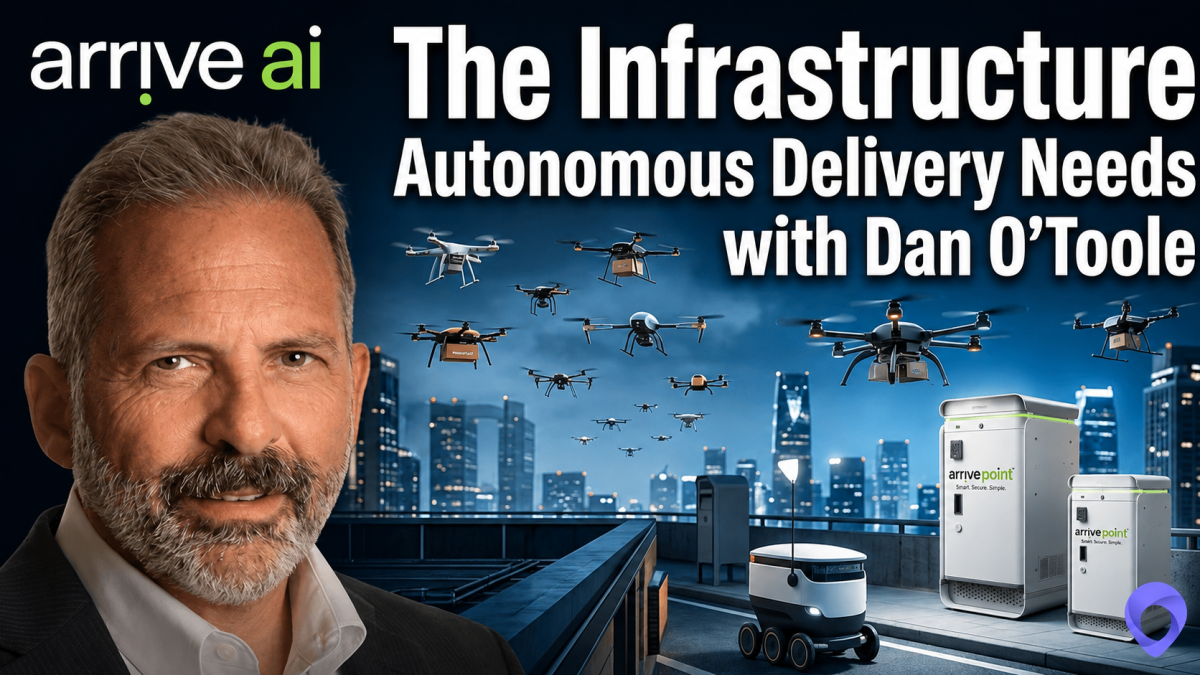
In “The Infrastructure Autonomous Delivery Needs”, Joe Lynch speaks with Chairman and CEO of Arrive AI, Dan O’Toole, about why smart endpoint infrastructure is the missing link to scaling autonomous logistics.
About Dan O’Toole
Dan O’Toole, CEO of Arrive AI, can speak to why endpoint coordination networks and logistics software are becoming the unresolved infrastructure problem—and the most durable value driver—in commercial autonomous logistics. Drawing on clinical-grade deployment data that reveals what the market actually needs to scale, he offers actionable lessons on how these operational insights translate seamlessly from healthcare to the broader commercial logistics ecosystem.
About Arrive AI
Arrive AI (Nasdaq: ARAI) stands apart by addressing the critical gap in autonomous logistics: the endpoint. Its Arrive Points smart hubs and Arrive OS software form a hardware-agnostic, AI-orchestrated network that connects drones, ground robots, and human couriers through verified, chain-of-custody handoffs. Backed by a decade of development, 10 U.S. patents, and international filings in 20-plus countries, this architecture isn’t a feature add-on—it is the essential operating layer that makes autonomous delivery commercially viable. While competitors rush to deploy vehicles, Arrive AI has already proven its infrastructure in high-stakes, live hospital environments—securing a second contract on the strength of its initial deployment—positioning the company as a defensible, revenue-ready infrastructure asset as public markets increasingly reward durable AI networks.
Key Takeaways: The Infrastructure Autonomous Delivery Needs
- In “The Infrastructure Autonomous Delivery Needs”, Joe Lynch speaks with Chairman and CEO of Arrive AI, Dan O’Toole, about why smart endpoint infrastructure is the missing link to scaling autonomous logistics.
- Solving the “Last 50 Feet” Problem: While multimillion-dollar autonomous drones and ground rovers can navigate miles via GPS and LiDAR, deliveries often fail at the final drop-off point. Arrive AI bridges this gap with Arrive Point™ smart hubs, providing a secure physical landing pad and drop-chute for autonomous vehicles.
- Creating an Unbroken Chain of Custody: To combat the 1.7 million packages stolen daily in the U.S. and secure high-value goods like pharmaceuticals, Arrive Points utilize biometrics, RFID, and time-of-flight sensors. The unit stays locked until accessed by an authorized recipient, maintaining a verified digital record from dispatch to retrieval.
- Hardware-Agnostic Infrastructure for Universal Access: Rather than fragmenting the market with proprietary drop zones for different brands, Arrive AI acts as a carrier-agnostic portal. Its open operating layer (Arrive OS) allows drones, ground robots, and human couriers from any fleet to execute seamless handoffs at a single managed endpoint.
- Unlocking Asynchronous Delivery: Traditional delivery requires both courier and recipient to synchronize schedules, leading to costly re-delivery delays. Arrive AI’s smart hubs decouple drop-off times from human availability, allowing 24/7 unattended deliveries and pick-ups without risk of weather damage, theft, or product degradation.
- A Defensible “Napkin to Nasdaq” IP Wall: Founded in 2014 and listed on the Nasdaq (ARAI) in 2025, Arrive AI established a critical first-mover advantage by filing foundational patents before major tech giants. The company now holds 10 U.S. patents and international filings across 20+ countries, creating a robust intellectual property moat.
- Proven Performance in High-Stakes Environments: Beyond residential ecommerce, Arrive AI’s infrastructure has been validated in live hospital settings—where delivery failures carry strict regulatory consequences rather than just operational inconvenience. This clinical-grade reliability directly enabled the company to secure follow-on enterprise contracts.
- Climate Control for Sensitive Payloads: Outfitted with Climate Assist™ technology, Arrive Points can actively heat or cool up to 20 degrees within minutes to preserve perishable groceries and temperature-sensitive medical supplies, while integrated top-door heaters keep snow and ice from freezing the automated doors.
Learn More About The Infrastructure Autonomous Delivery Needs
OpenAI’s IPO filing and the broader public-market rush into AI
The Logistics of Logistics Podcast
Joe Lynch: [00:00:00] Hello, friends. Welcome to the Logistics of Logistics show. My name is Joe Lynch. Thank you so much for joining us today. Today’s topic is the infrastructure autonomous delivery needs with my friend, Dan O’Toole. How’s it going, Dan?
Dan O’Toole: I’m great, Joe. Thanks for having me. Thanks to your viewers, man
Joe Lynch: No, thank you. And I’ve been looking forward to talking to you. We talked, I think, a month ago, and finally I got in. I know you’re a busy man running a busy business. Dan, please introduce [00:00:30] yourself and your company and where you’re calling from today.
Dan O’Toole: Thanks, Joe. Hey, I’m Dan O’Toole. I’m the CEO and founder at Arrive AI. We’re based out of Fishers, Indiana. And we are ite-iterating on what we call Mailbox 2.0 in its simplest form. All this new paradigm of autonomous delivery and pickup is set to happen between drones, robots, unmanned ve-vehicles, as well as conventional delivery and pickup, and we are at the epicenter of that.
We’re facilitating what I call [00:01:00] this new paradigm of asynchronous delivery and pickup or unat-unattended delivery and pickup. And I also wanna say one more thing, Joe. I-I hope you love my shirt. It’s fun shirt Friday here at Arrive AI, and in the spirit of that, I have to have the most fun shirt, right?
I wasn’t thinking obviously when I put my shirt on today about the Joe here, the Joe Show
Joe Lynch: So for those who are listening to the podcast only I’ll just try and ex- it’s a floral yellow shirt. Very very good for Fun Shirt Fridays.
Dan O’Toole: You’re not gonna miss me[00:01:30]
Joe Lynch: yeah. So D- Dan, you guys gonna put it in very layman’s term, you basically created a mailbox that can receive packages, I’m assuming mail from drones, and is it more than just drones?
Is it also other auton- autonomous machines that are gonna be delivering to my home?
Dan O’Toole: Yeah, we are building toward 100% interoperability between drones, robots unmanned vehicles, as well as [00:02:00] conventional delivery of people. We like to say we’re reducing the friction between people, drones, and robots. So yeah, everything will be dropped off autonomously. Everything can be picked up autonomously.
That’s where we’re moving toward
Joe Lynch: Yep. And I think there’s some people saying, “Oh, do I really need that? What do I care?” There are tremendous advantages to having drones deliver to our homes as opposed to, now, by the way, anyone, just look out your window right now if you work from home. There’s an Amazon truck, there’s a [00:02:30] UPS truck and there’s a, what am I missing?
A FedEx truck.
Dan O’Toole: Door, DoorDash
Joe Lynch: Yeah, they’re out on your street right now, and you go, “Oh, no big deal. I don’t care.” When you’re driving home and you say, “What is all this traffic?” That’s it.
Dan O’Toole: And when you’re going over those potholes, you’re saying these trucks cause that. I always say, Joe, better, faster, fresher, cheaper, greener, safer. Those are all byproducts of autonomous delivery and w- we’re gonna get to it in just a minute,
All right, man. I’m sorry I’m so excited
Joe Lynch: I- no, [00:03:00] you’re good. You’re good. I think about this, the porch pirates. I watch YouTube videos and some Instagram way too much, and I love watching when people c- pack garbage and exploding f- confetti bombs for the porch pirates. Porch piracy is such a big deal that there’s a whole bunch of YouTube channels and a whole bunch of Instagram people who their career is saying, “I pack confetti and bombs,” not killer bombs, just confetti [00:03:30] bombs, “into boxes to catch the porch pirates.” And it’s a huge issue. And God, when you watch those, they’ll just be people casually get out of their car and walk over and take $300 off of your porch. Not happening with the drones. Not happening with Arrive AI
Dan O’Toole: That’s it. Right now there’s 1.7 million packages stolen every single day in the US. That’s billions of dollars. And the funny thing is everyone thinks, “Oh, you just call Amazon and they send you a free [00:04:00] replacement.” What people don’t think about is the fact that in every purchase, we are all paying for that every time.
So think about how we could disrupt that
Joe Lynch: We talk on my podcast obviously about the f- you know delivering. That’s what we talk about. Every once in a while I’ll talk about returns. Very important part of our business. Um, the theft, the cargo theft, the cybersecurity. Security has become maybe the number one issue on my podcast over the last six months. And you cannot have [00:04:30] cybersecurity, I’m sorry, you can’t have cargo security without cybersecurity. It’s not so much on the ecommerce stuff, but man, the over-the-road stuff is ridiculous with the fraud and the cargo theft and the cybersecurity stuff. So we’ll come back. Lots to talk about on this.
But, uh, first tell us a little bit about you, Dan. Where’d you grow up? Where’d you go to school? Some career highlights before you built the juggernaut that is Arrive AI.[00:05:00]
Dan O’Toole: Thank you for acknowledging the juggernaut status. That means everything. And when we grow up, that’s what we’re gonna be. So
Joe Lynch: you guys are already publicly traded. I think that’s done growing up. You’re there. You’re there a long time ago.
Dan O’Toole: Yeah. It is exceptional that we made it this far. It’s a miracle. I pinch myself every day. But yeah, me, I grew– I was born in Chicago. My dad, when I was a kid, was transferred to Indiana. I moved to Indiana, grew up in the Indianapolis area. Went to Ball State University for my college degree.[00:05:30]
Joe Lynch: David Letterman went there.
Dan O’Toole: Yeah. When pe-people say, “Who, who went to Ball State?” And I say yeah the, the three famous people are David Letterman, the Pa-Papa John dude, and me.” That’s my joke.
Joe Lynch: I think David Letterman, I don’t know if he still does, but for a long time I think he endowed a scholarship for C students.
Dan O’Toole: He actually did. I don’t know if it’s still there, but it was there when I was there. Thank you, David. No.
Joe Lynch: school
Dan O’Toole: Yeah, great school. A lot of access, [00:06:00] which is hard to so I interrupted you. Tell us more. So you went to Ball State, then what?
Yeah, Ball State graduated there, then came out really started working for a company in in corporate America in the sales s- category.
Was very successful. My third year there, I made more than the president of the company. And then they gave me a huge pay cut, and I could not afford to stay there, so I left to start my own company. At that point, I had a national reputation because I was so successful, and [00:06:30] so I started my own distribution company in the environmental industry.
And I grew that up and I sold that and went on to do some other things. Got into commercial real estate owned a portfolio of industrial warehouses in the Indianapolis sub-market. I, I started a company called Facility Maintenance USA. I identified a niche where, large, sophisticated Fortune 500 companies with multiple locations, they want one company that knows their [00:07:00] brand standards better than anybody else.
And my premise was the company was called Facility Maintenance USA, so I had the Facility Maintenance USA brand promise. That was always to do three things. One, show up when you say you will. Two, do what you say you will. And three, wrap up the result in a bow and say, “Hey, Joe, here’s what we did. Here’s closure.
Take this off your plate.” I also developed a real-time proprietary info center dashboard that any facility manager could use. [00:07:30] If we were at 100 McDonald’s stores and the, the store manager was calling the facility manager, he could pull up in real time and see the evolution of the project. So we really made the facility manager smart, and it was a great solution.
I dealt with corporate McDonald’s, Panera Bread, P.F. Chang’s, J.C. Penney’s, Enterprise Rent-A-Car, a whole portfolio of Fortune 500 companies. I grew that business. When I had the idea for Arive This idea just took hold of me like nothing I’d ever [00:08:00] had in my life, and I knew this was something I needed to focus on.
So I immediately decided to sell that company Facility Maintenance USA. The first thing I wanted to do was make it available to my employees. I felt like that was the right thing to do. I’ve seen a lot of b- business sales over the years, and I don’t wanna be the guy sneaking around after hours, showing the company to suitors a- and ignoring my own people.
So I made it available to them. At the end of the day they loved the opportunity and I made a formula that they could [00:08:30] succeed at that I was gonna share in for 10 years. But at the end of the day, they didn’t feel like they had the wherewithal to get working capital to sustain it, ’cause it was an expensive company to run because it had, so much going on.
So one of our vendors at that same moment became aware that I was selling the company and they approached me and they said, “Hey, we work with you guys all over the country. Love to make it available.” I offered them the same structure that I offered my employees because they were a good partner.
And they said, “You know what? We appreciate it. We wanna buy it all full [00:09:00] stock and barrel right now. We don’t wanna… We think that formula is gonna cause us to overpay over time. We think we’re gonna really get this to the next level.” And that was great for me. I sold it got all my proceeds immediately.
I used that money to fund ArrivAI for the first six and a half years by myself and it all worked out great and, went from one of my buddies, Greg Prime, I always credit people came up with this mantra from Napkin to Nasdaq for ArrivAI. And I [00:09:30] met with him when I had this idea. I literally sketched it out on a napkin one night.
We g- we were getting a pizza and he hit me with that, about a year ago and he goes, “Hey, I want you to use this mantra.” And I go, “Man, that’s awesome. Thank you.” So yeah, it’s a we the people story. We had five thousand pre-public investors on our cap table before we went on the Nasdaq.
We beat Amazon by four days on our foundational patent. When I had this idea, I mentioned how it took hold of me. Being a guy that’s done a lot of business kinda dealings throughout [00:10:00] my career, I’ve lost some substantial races for IP. I had lost a remote control to Sony by one month.
I had a medical device I lost to GM by three months. So when I had this idea, I called my patent attorney on a Friday. I said, “John I’ve got this idea. I don’t wanna dilly-dally around. I don’t even wanna do a patent search. I don’t wanna lose one day. I feel like I’m in a big race.” And I gave him– I said, “Monday, I’m coming in.
I wanna have the whole abstract for the patent with me. We’re gonna go over this, and I wanna [00:10:30] get this filed Monday. Let’s get it going.” So I went in there Monday morning, gave him the idea. We executed. On the way leaving the patent office, he actually called me. He said, “Hey, I’m gonna do something I haven’t done in 25 years.”
I said, “What is it?” He said, “I just looked. There is no prior art in this space whatsoever. You are the very first. You’re gonna get every claim. You’re gonna get very general, broad claims, which is what you want when you get patents. You don’t want them to be very narrow. You wanna protect the world, right?”
He [00:11:00] goes, “I would be willing to do that for a small part of the company.” I said, “John, you’re validating everything I believe. That– Humbly, that means so much. Thank you for that.” But I said, “Here’s the other thing. This isn’t a restaurant where you throw $100,000 in and you own 30%. The– I’m thinking shares, not percentages.
This is the biggest market opportunity in the world that we’re gonna be leveraging, and I want– if you’re open to something like that.” He goes, “I will do whatever you think. I wanna be here.” We forged a [00:11:30] deal together. He came in for a very modest amount. He did a great job. He’s been shoulder to shoulder with me the whole way.
He’s like employee, zero. At some point I was down in Florida with my wife, and I was feeling so good about John and all the effort that he’d put in for me over the first three years or so. I called him, and I actually gave him 2% of the company additional to what he already had on the phone, and he had no expectation or belief.
He couldn’t even believe I was doing it. I said, man, I wanna [00:12:00] reward people that reward me, and the fact that you stepped up and have done everything, I don’t…” I was really proud that I was able to do that. So we have a great long-standing relationship. He’s here in the building with me today.
We’re moving forward like never before and it’s a– we are the we, the people story. We had 5,000 pre-public investors. We did– We raised our money in addition to me capitalizing for the first six and a half years, we did three successive crowdfunding rounds, and during that process, we ga-garnered [00:12:30] 5,000 investors.
P- I gave everybody my phone number that I’ve had for 35 years. If you’re gonna invest in this company, you’re a co-owner with me. You need to hear the good, bad, ugly from me. I don’t want you hearing it on the street. I wanna own it. The buck stops here. It’s not always easy. It’s not always fun.
If you wanna be a vanity CEO, there’s plenty of those guys out there. Everybody can stand here and hold up some big contract or something cool that’s easy and fun. But when, I think when you earn your medals, when you have to tell the [00:13:00] bad or the something that’s disappointing, and I don’t want anybody to ever hear that from anybody but me.
And I tell you, sometimes it’s very hard to do. You have to, test every fabric of your being to do it, but that’s the integrity of what we’re doing here, and I wouldn’t have it any other way
Joe Lynch: I love it. I love it. I my first job I started working at one year of college. I came… My dad owned an engineering business, and we did a lot of patent drawings. And, Man, I did hundreds and hundreds of those. And, Not easy to get. [00:13:30] We were largely in automotive, which is what my dad’s business was mostly, automotive engineering. God, they’d g- they’d patent the tiniest little thing, but it was worth it, and money in that. Yeah, and I love that you took a different route. So a lot of times you’ll see s- people who are in a brand-new space like you guys, they’ll take VC money. And by the way, I will never say that’s not the right thing.
I think VC money is great for some people. Other companies, you’ll see private equity get involved, and that there’s a [00:14:00] reason, and there’s a very good reason y- that you’re in private equity. The nature of it sometimes, though, is can be a little scary. I’ve t- I think the most successful guy from my graduating class in high school said to me, he’s a VC, and he said, “We lose on a lot of deals, so when we win, we get a huge bite.” And he said, “My advice to people is try not to take our money.” But here’s the reason people take it is [00:14:30] y- if you decided I you had some s- some money from a previous success, so you could say, “I, I’m gonna… I can bootstrap this,” and you did for a long time. But if you’re just the average guy who doesn’t have some deep pockets, bootstrapping something like what you’re trying to do and say, “How do I become the market leader quickly?” And we know this is a fast-growing market. That’s why people take VC money. You can’t b- bootstrap and scale really quickly, [00:15:00] and that’s why we see the s- most of it is tech. I joke with the venture capitalists on my podcast that they hate the physical world. And the reason I say that is because, Dan you live in the physical world.
You guys are building boxes that stuff can land in. That’s not as easy as scaling software, which is d- “Did you send the code?” “Yep.” And we s- scale. And so I love that you did a different approach.
Dan O’Toole: You know what? There’s no easy way to fund a company, I’ll just say that. It’s not like you, you list [00:15:30] on a crowdfunding c- platform, and all of a sudden somebody waves a wand and millions of dollars fall at you. Every dollar you raise is a byproduct of your own inertia, and it’s hard.
But VC is not easy either. They wanna own your soul. They wanna control you.
Joe Lynch: And for good reason. I get
Dan O’Toole: Yeah, absolutely. Absolutely. But it’s not glamour and it’s not easy. You don’t walk into a VC firm and they write you a check either, it– and particularly around the time we were doing this, the– everything was upside down.
It was around COVID. Everybody wanted a preferred stack of stock. [00:16:00] I call us the We the People story. It was important to me that I didn’t have shares that devalued anybody else. Everybody in this company has common shares with voting rights, same shares I have. And what was funny, Joe we went to do our second crowdfunding campaign.
Our first one was on wefunder.com, which is the largest platform out there. It went naturally, we had a great successful pla- raise there. In fact, we earned the distinction of being the highest valuation pre-revenue company to ever successfully raise on crowdfunding in history. I think we [00:16:30] still own that, and that was cool.
And at that moment, $1 million was the cap, the max you could re- get. We quickly oversubscribed and intra raised the laws change to be able to get $5 million. So by the time we timed out, we had raised about three and a half million, which at that time was probably the highest amount yet raised. So I’m really proud of that.
But we went back naturally to Wefunder on our second raise like you would because y-you did great the first time. And what they wanted us to do was come back with a preferred offering. They [00:17:00] said, “You did a common offering. Now we want you to do preferred.” I said, “So you’re asking me to undervalue our very earliest investors who are our customers and…
or investors and your customers are investors?” I s- I said, “I’m not gonna do that.” I said, “I will not raise here versus doing that.” And I was true to that, and we didn’t raise there. We ended up going to StartEngine, and they accepted that offering. And then after I had gone through those first two, I said to myself, “When I blow up ArriveAI and we’re [00:17:30] one of the biggest companies out there and I exit the next thing I need to do, I need to start a crowdfunding platform because nobody does it right.”
And what I meant by that was, I’m very customer-oriented. If you need– Everybody has my number. It’s, if you called Meta today and you wanted to talk to Mark Zuckerberg, no way in heck are you getting a hold of him
Joe Lynch: Oh I have his mobile number. I’ll give it to you.
Dan O’Toole: D– okay. Thanks. But the what else I was gonna say is if you call Meta today and you wanna talk to a secretary, you’re not gonna talk to her either, you can’t reach people in this world [00:18:00] no matter who they are. And so that’s not us. So as we were raising, there were a lot of questions coming up, and these crowdsource platforms, they frankly, I don’t wanna say they don’t care, but they really don’t care.
And, I can’t have people that wanna invest in our company not getting to somebody to understand. So on the StartEngine, we actually started our own 800 number that was backing our own campaign. Nobody had ever done that before. And, that’s lost on all these guys. They just don’t get it.
So at the end of the, the end of the story here is the third time we [00:18:30] raised on a platform called pickme.com, pickmecrowdfunding.com, which is now known as Highlander. And these are a couple young entrepreneur brothers that put this company together. They are the ArriveAI of crowdfunding platforms.
They’re agile, they listen, and they implement. And when I said to these guys Chandler Klein is the main guy there, a good guy. Hey, Chandler. I said, “Chandler, thank you.” And he goes, “For what?” I said, “Now I don’t have to go out and start a crowdfunding platform ’cause you guys are doing it [00:19:00] right.” So that’s what I’m saying.
If you’re an entrepreneur out there and you’re looking to do that, go to Highlander
Joe Lynch: I, you mentioned that venture capital sometimes devaluing earlier investors. I worked at a venture capital-backed technology firm out of Mountain View. And I was working in automotive on my own. I was doing some consulting. One of my neighbors kind lived on the same lake, and he built this monstrous house, huge house, and he was a sales guy at this tech company, and that he was a wild man.
[00:19:30] I was always surprised. He was a real rough around the edges, but he was a legend. Unfortunately, he’s passed because of some of those wild ways. But I remember he convinces me to join this company, and the CEO new CEO flew from Silicon Valley to meet me, and this guy’s a, a tech legend. And I was honored that I get to meet this guy, and I have … And he’s showing me pictures of his castle in Scotland. I don’t have one of those [00:20:00] yet. And and he’s talking about the firm. I start a week later, and somebody says, “Oh, the new CEO.” I go, “The guy just hired me.” He goes, “Yeah, he, yeah he didn’t wanna be here.”
I was like, “You sold me on it.” And then he said, he goes, “Oh yeah, and the founder’s gone.” I don’t know that guy’s name. I go, “Wait a sec. What do you mean the founder’s gone?” And then they go this last raise to hire you and,” there was one other guy who got hired, “they raised that [00:20:30] money, and it pushed them out.
He didn’t have very much equity.” And I was like, “Jeez, oh, Pete.” So then a few years ago, I was at Manifest, and I, by the way, I never met that guy in person till he flags me down at Manifest. He goes, “Hey, you know who I am?” He was covering up his name tag. And I go, “No.” And he goes He showed me his name, and I go, “Oh my God, I missed you.”
He goes, “Yeah I left because when they raised the money to hire you.” So that can happen, and that’s a guy who put his blood, sweat, and tears. That was his baby. And by [00:21:00] the way, the company VC was the, the, the venture capitalist who backed us, also it was Te- Texas Pacific Group, one of the bigger boys. They had a massive investment in Google, so they lost interest in what we were doing ’cause we weren’t growing fast enough. And so they took the company private, and the old owner is back in charge. So there is good news on all this. But anyway, you mentioned napkin to NASDAQ. How long did that take from the beginning till the time you went public?
Dan O’Toole: Well, I had the [00:21:30] idea in 2014. I ran to the patent office, filed immediately, and then I proceeded to pa- impa- impatiently wait, right? You’re twisting in the wind. The funny thing was, this is right around the time when Jeff Bezos said, Amazon’s gonna do drone delivery. And I believe that what we’re doing the drone delivery and pickup is not scalable when you’re dropping things on the ground or picking them up from the ground.
You need the infrastructure layer, and that’s us. And I believed that, we’re the [00:22:00] critical pa- piece of, the ecosystem that’s gonna make it all work. And so I would wake up one day and I’d say, “I can’t believe I’ve got the biggest market opportunity product. The– I’m gonna… I own this patent.
I first, I can’t believe it.” Then the next day I’d wake up and I’d say, “There’s no way I beat Amazon, Google, Walmart.” I’m a little guy in Indiana, right? We don’t beat anybody. No offense. But so I oscillated, man. And I, I was so giddy with hope, but then tempered with realism here and there.
But it took three years for the patent to [00:22:30] issue. Along that way, I did make a proto- my first prototype, but I also didn’t know where I stood, so I wasn’t in a position to really throw tons of money at it, th- potentially throwing good money after bad, right? But then my patent attorney called me in 2017, and he said, “Hey, are you…
Sit down, I got something that you’re not gonna wanna hear.” And I was like, “Oh, man.” And he, and I sat down and he goes, “You’re gonna have to write a check.” I go, “What?” And he goes, “Your patent just [00:23:00] issued, and you have to write a check to the patent office.” I’m like, “Are you kidding?” So that was a great day.
Never forget it. And that gave me the impetus to move forward in a big way and hit the ground running. Go– prior to going public, we raised $15 million. Prior to raising that 15 million, I funded the company for six and a half years. And since we went public we had a commitment of $40 million as we went public.
In the aggregate, it’s tens of millions of dollars. And, we’re burning, about a million dollars a [00:23:30] month as a public company. We have, over 50 employees. We’re in a great headquarters that has everybody working here, as well as all the prototyping opportunity and machines, equipment, technicians, all that.
So we’re doing it all here in-house and we’re making a huge difference. It’s a, i- it’s a pinch myself moment every day I walk in the door. I can’t believe from napkin to this,
Joe Lynch: So what, what year did you go public?
Dan O’Toole: We went public in ’25, last year May 15th of last year. We’ve [00:24:00] been public for a year. Ticker symbol ARAI. Our stock isn’t doing wonderfully like I wish it would. We’re in a show me, don’t tell me world. We are an early-stage company. Totally exceptional that we were able to go public as essentially a pre-revenue company, but we needed access to the public market to leverage all of our IP and the dream that we’re building
Joe Lynch: It’s funny, a thing Warren Buffett always says is, “If you absolutely, positively know this is a good stock, what do you care if the rest of the market [00:24:30] doesn’t value it the same way?” I don’t wanna buy it if it says, “Hey, I value it at 20 bucks and it’s going for 80 bucks.” If I know what I’m doing and I m- have the courage of my convictions, I say, “That’s a $50 stock selling for five bucks.”
Dan O’Toole: Heck, Warren Buffett. I love Warren Buffett. I gotta tell you a couple quick stories. When I was a kid Berkshire Hathaway was trading at $900 a share. I told my dad, I said, “Dad, buy 10 shares, $9,000, put it [00:25:00] away.” He didn’t do it. Today it’s trading hundreds of thousands a share. Think what that would be worth.
Then one day I w- I wrote a letter to Warren Buffett. I took a picture of my little family and sent him a letter, and he sent me back a handwritten letter, and I’ll never forget that, and a lot of… He drinks Cherry Cokes, I drink Cherry Cokes. A lot of the
Joe Lynch: I drink the Diet Coke. That’s what the pros drink, man.
Dan O’Toole: Okay I’m not pro yet, man. But Warren Buffett, a lot of his values I share.
Who’s gonna write you a handwritten letter? That’s something I would [00:25:30] do. It’s not something most people would do, especially a Warren Buffett, but I– it’s just amazing. And, that’s… and then here I am, I took a company public, which is something I wanted to do my whole life as a kid.
Kids wanna be firemen astronauts and things. I always had this nerdy, geeky vision of having business meetings in a suit and tie with my buddies, taking a company public on the Nasdaq, and to be able to have that dream and then have that come into reality, that’s like winning 10,000 lotteries in a row.
It’s [00:26:00] just it’s unbelievable
Joe Lynch: So do you consider your N-N-Nasdaq to Nasdaq to– or napkin to Nasdaq, is that 11 years or do you say it’s from 2017?
Dan O’Toole: No, I say it’s from 2014. That’s, that was the idea and,
Joe Lynch: that’s 11 years. That’s pretty good
Dan O’Toole: To be, and to be pre-revenue for that period of time. And a lot of that is because I couldn’t really hit the ground running as hard as I, I wanted to be prudent, right? You don’t wanna throw every dime you made away in case you don’t [00:26:30] get your IP. But once we got that, it went balls to the wall, excuse my language there.
We put the accelerator down all the way. I have a philosophy if you’re iterating on something a- and your gas pedal’s all the way to the floor, if you let up for one second and reapply, you never get back to where you were. And we’re not letting up here
Joe Lynch: I remember my dad telling me this story. Dad worked at Ford Motor Company. He was an engineer, and he bought a business or wanted to buy a business. And my dad pl- and they had the industrial [00:27:00] baseball leagues, and they really played a lot. I remember them playing five nights a week. And was saving money for this, and so he played baseball or soft- it was fast-pitch softball with Mike Ilitch, founder of Little Caesars Pizza. And so Mike Ilitch had one store. And my dad was saving money, and Mike says, “Hey, what are you doing?” He goes I think I’m gonna buy this laundromat dry cleaners.”
And he says, “You should buy my first store. I’m gonna franchise this like McDonald’s is doing.” McDonald’s is still [00:27:30] franchising. It was growing. And my dad’s like, “Oh, maybe.” So he says Mike would come over and dump, “Hey, this is what we made today,” and count out the money. I’m not lying. “This is what we made.” And it was right down the street from my, where I grew up. And and then my dad, my, my dad said, pizza was new.” I never… He goes, “I never even had pizza till high school.” And he goes, “Oh, ultimately decided to buy the laundromat.” So have you heard of s- Snowy White Laundry? Oh, okay.
If you heard of Little Caesars?
Dan O’Toole: Good qui– I like
Joe Lynch: So [00:28:00] to this day, I remember if I was s- me or my sister were sick, I was like, “I don’t feel good.” My mom would go, “That’s fine. I’ll take you to the laundromat.” And I’m like, “Oh, no, I’m good. I’m good.” I was like, “There’s no need to be sick.” To this day, when I walk into a dry cleaner and I smell that fluid, I’m like, “I’m out.
I don’t feel good. I
gotta go home.”
Dan O’Toole: Yeah, I’m with you, man. I’m with you. Whatever happened to the Little Caesars guy?
Joe Lynch: Yeah. Little Caesars, they built Little Caesars, and then they bought the Tigers, and we bought [00:28:30] the Red Wings. And I remember being downtown one night and with my dad, we went… I don’t know where we were at, and there was a hockey game, and he saw Mike. He’s like, “Hey.” He goes, “Hey, Joe, how’s it going?” Came over, and I was thinking, beg him, man.
Beg him to give us a few of those franchises. Anyway, let’s talk about, let’s talk about Arrive AI. So your vision from this was these drones are gonna have to deliver to our homes, and that’s a problem because they can’t go in a traditional mailbox. [00:29:00] Most, it doesn’t work. And I have had t- I’ve talked to people on the podcast before about drones.
I think I had Tom Walker from Drone Up, and he said, “We deliver to backyards.” And they did not have huge issues with porch pirates, but this is the big but I’m gonna throw out there. People can still hop your fence and steal out of your backyard, right? And on top of that, if you got a dog, you say I set this down in the backyard, and maybe I set [00:29:30] it in dog poop, or maybe the dog found it before you got to it. There are issues. And I remember also saying to him can you take a picture of that?” He goes, “We can, but we don’t because potentially there’s kids in the backyard or something that you don’t want people seeing.” So delivering in the backyard was a, is a good deal but not everyone has a backyard. And it’s still not a secure thing.
And if I say, “Hey, I need…” I’m just gonna make this up. I don’t know if we’re [00:30:00] delivering drugs yet. But if I say I got a prescription coming, I can’t have it dropped in my backyard. If I’m having an expensive piece of electronics delivered, I don’t want it in my backyard. I don’t want it getting wet. I need something.
And I’m gonna also assume you have some sort of positive confirmation of receipt.
Dan O’Toole: Absolutely.
Joe Lynch: So tell us about this
Dan O’Toole: Yeah you said earlier at the beginning security is very important. It’s emerged as a big topic in a [00:30:30] lot of your shows. But in addition to security is chain of custody, right? Knowing where
Joe Lynch: all watch the cop shows
Dan O’Toole: Yeah, exactly. Right now if you’re wanting to order a new cell phone or a computer, two things.
One is you might take the day off work and be there to sign for it. But the other one, you might watch something deliver of high value by your Ring camera. And if so- you, and then you also might watch somebody come and steal that high-valued item with the same Ring camera, right? So
Joe Lynch: And by the way, and th- and they’ll [00:31:00] have the hoodie over their face, I’m just gonna
Dan O’Toole: They will. No, they will. Peace of mind, safety, security, I call it a shipping store at your door. Yeah it’s gonna be as important to receive things as it is to be able to ship things. Reverse logistics, you mentioned that a little bit ago. That is literally a $1 trillion market in the US today.
It’s a huge market. People are going to Whole Foods, Kohl’s, the UPS Store. What if you could cut to the front of the line and every arrive point was also a shipping store? What if we had a [00:31:30] marketplace that could shop urgent delivery status the– so you’re gonna get the best level of service and you’re also gonna get the best price?
We see a market where there’s an emerging of, not only the branded top-line carriers of FedEx, Amazon, USPS, UPS, but a whole new delivery category of shippers that are emerging in this new autonomous space. Much like the cyber cab will manifest several new taxis out there that, people own these driverless vehicles that were [00:32:00] never in the taxi business before.
So it’s all changing. It’s kind of an Uber a, a paradigm that we’re putting together. The other thing is what we are doing is universal platform agnostic. There will not be three arrive points in front of your home or business, UPS, USPS, FedEx, whatever. There will be one, and it’s important that one works universally with all shippers and deliverers.
And and we know that’s a concern out there. We also know that [00:32:30] people are thinking finally they’re catching up to where we’ve been, that the notion of, everything you gain through fast, convenient, efficient, cost-effective, autonomous delivery and pickup is lost at the yard, whether it’s in front of your home, in back of it, your business, whatever, chain of custody, things we talked about.
The… If your food is sitting there for five minutes, you never really know what happened or didn’t happen. Did a spider crawl in? Did somebody throw poison on it? Did a rainstorm, right?
Joe Lynch: I’ve thought about this. [00:33:00] S- I get something delivered to the house, and right there’s a big one of those, those squares that you can f- scan. What do they call them? QR code. And I almost ran my phone across this QR code, but then I thought sometimes you do a s- QR code and it’s a scam.
So do you ever wanna walk through a public area and go, “Oh, I scanned that QR code,” only to find out that it’s a scam? Um, and then the next thought I had was if somebody, and I know this has happened, somebody [00:33:30] wanted to do damage to me, they could send me something, and I open it up, and it’s poison. And not that people wanna poison me or th- that’s not a huge issue, but these are the…
These are some of the issues you have ’cause when you s- see something on your porch, sometimes you go, “I think I had a few things coming.” I’m just one guy living here. If I had my daughters or a wife, there’d be stuff on my porch constantly. I was at my daughter’s house. They get multiple packages every single day. They… [00:34:00] So I keep thinking you can lose track, and it’s a… and it’s a vector of insecurity
Dan O’Toole: Hey, you know what? I see a day… I order a lot online, obviously by the nature of my business, right? And I’ll tell you what happens sometimes. I’m waiting in the back of my mind for something, I can’t even remember what it was because I got 12 things, and it doesn’t show up. And then I have to remember where did I get that from so I could check the status.
What if you could funnel all of your commerce and archive it through one [00:34:30] platform, Arrive AI, where if you wanna check on the status of something, it’s all aggregated right there. What if you want to return something and all of your transactional history is archived? You could actually pull up the return icon on your app.
It populates recent purchases. You pick the item you want to send back. It alerts Amazon. It dispatches UPS. You drop that w- in your Arrive point. You don’t print a label. You don’t have to find the receipt. It goes back seamlessly, and you get your money back. You didn’t have to put on your coat, [00:35:00] your shoes.
You don’t have to drive anywhere. It’s done
Joe Lynch: And one thing about our current mailboxes that has always been upsetting to me we- you put a mailbox in your house, everyone has a mailbox. The federal government from the get-go has said that mailbox is only for receiving US mail. And so UPS, FedEx, everybody else who’s delivering a package to your house, even if it’s just an envelope, they put it in one of those bigger envelopes.
Why? Because [00:35:30] they … it’s easier to manage, ’cause they can’t put it in the mailbox. And so this mailbox 2.0 that you talked about, this gives us a chance to get back what we should have never given up in the first place. By the way, I know somebody’s gonna reach out and say, “There’s a reason it’s all just US mail.”
Incorrect. Just don’t call me, don’t send me an email. Incorrect. It’s a horrible system we have right now with the US mail. And again I would like to just write a big note and put it on my [00:36:00] mailbox, “I give permission to anybody to put m- things in this mailbox.” I don’t care if my neighbor puts a note in there, but no, it’s still against the law
Dan O’Toole: Right. Exactly. We say we’re consolidating all delivery to one secure point to include drones, robots, unmanned vehicles, and conventional, and that’s where we’re heading. In fact, we are in discussions with the US Postal Service right now to get the PMG, Postmaster General approval that you see on mailboxes.
We don’t– We believe exactly what you said and to– and we think that [00:36:30] is really a big consolidation that needs to happen in the market
Joe Lynch: It’s so where would this mailbox be? Would it be in my front yard, my backyard, on top of my house? Where am I putting this?
Dan O’Toole: Well, Tom Walker said the backyard, right?
Joe Lynch: He doesn’t have a, he didn’t have a box. He was delivering to
Dan O’Toole: no, I, no I know. But we– the cool thing about ArriveAI, remember I said how early we were and we were able to get every patent we asked for. One of the things we did is we have several configurations. We like to illustrate, we like to [00:37:00] illustrate the arrive point at the curb because that’s where you get the most utility, and that’s easy for people to make the leap from mailbox to mailbox 2.0, right?
So but some other things that we have, an arrive point could be a vault in the ground that raises and lowers. It could be a balcony-mounted arrive point on a higher 25th floor high-rise in New York City. It could take the configuration of a roof hatch on a commercial or residential building. It could be on a military [00:37:30] tank, a boat, RV, camper.
It could be on a commercial vehicle. You have two painters at your house today. They’re on time and materials. You’re– They’re on your clock. They run out of roller covers. They– What do they do? Not one of them, but both of them leave. They’re gone for a couple of hours. You don’t know what happened to them.
You know you’re still paying them. If those guys could sit there, get on their Arrive app pull up the Sherwin-Williams order form, order a sleeve of roller covers, keep working. The [00:38:00] drone comes, finds the commercial vehicle, the arrive point. You get a notification. You walk over, grab those, pop them on, and keep working.
Think of how we can disrupt productivity cost of work, all these kind of things. We’re gonna revolutionize the world in a lot of ways
Joe Lynch: Yeah, I think do you have a commercial commercial version at this point?
Dan O’Toole: We do. In fact, we are B2B right now, so really the versions we do have deployed are commercial boxes which are larger. Yeah
Joe Lynch: So when UPS, FedEx, [00:38:30] whoever else delivers there’s 40 others that we should talk about these days, deliver to my location, um, sometimes you get a, a picture that says, “Here, you received it at 12:07 PM.” Now, if they were supposed to get it there by 1:00 PM, they might… I’m not saying they’re cheating.
I don’t, really don’t think they’re cheating us a lot. But it’s, you guys could give me another confirmation, says, “Hey, Joe, they said that got there at 12:07. We think they got it here at 1:15. That’s what our system says.”
Dan O’Toole: Absolutely. [00:39:00] And then you can go back and get your refund
Joe Lynch: And by the way, we do tons of audits right now. Does that audit get a lot easier when I say, “Here’s what they said. Here’s what we can confirm through our Arrive, uh, system”?
Dan O’Toole: Absolutely
Joe Lynch: This becomes more than a box. It becomes a platform for receiving
Dan O’Toole: Hey, Joe you just hit on one of the things that I say every day. When you have what is to become the gateway to every home and business throughout the world with great connectivity, that little [00:39:30] piece of real estate where every delivery ultimately starts or ends, the amount of use cases we– there’s more that we haven’t thought of than we have, and that’s what’s exciting.
Every day when we come to work, there’s some new use case emerging that you hadn’t even thought of. We could be traffic counting determine, reporting on potholes. Say your house is on fire and CNN wants to report on that, they could beam into the arrive point across the street and see your house on fire for their news story.
We have an [00:40:00] emergency light feature. If you have a police or fire or ambulance need, you can go on your app. It’s an automated dispatch. You press the 911 icon. It says, “What service do you need?” It’ll send out, if you say police, sends it to the police department. It has your address.
Your arrive point starts strobing red and blue lights to denote police. If it’s fire, it’s red. If it’s ambulance, red and white, so first responders can immediately find you. W- they’re not driving around missing a GPS marker. Your neighbor [00:40:30] may see that you’re in distress before first responders. He comes in and saves your life.
Time is life. The perceived value of what we’re offering is gonna be so substantial, you’re gonna wonder how you ever lived without this
Joe Lynch: Yep. And you mentioned chain of custody. So we’ve all watched those cop shows, and they’re in court and they say, “Hey, was the evidence tampered with?” And if you say “We we can’t be guaranteed that this wasn’t exposed, not even [00:41:00] tampered with, exposed to someone who might have tampered with it,” evidence is thrown out.
That, and when we had changes to the Food Safety Modernization Act under, the only update to the FDA under President Obama, I think that was 70 years in the making to finally change some of the kinda they had this antiquated approach, which was all about inspection. Now, if you look at any manufacturing facility, it’s all about let’s get the process right and not have to rely just on inspection. Anyway, [00:41:30] that Food Safety Modernization Act was all about how do we prevent tampering? Once in a while, it’s not every day, but every once in a while, somebody tries to tamper with something, and other times it’s just chain of custody. If I’m a food company and I say, I put it on my… We’re in talking in summertime, on J- July 31st. I put it on my dock for somebody to pick up, and it was out on the dock for 45 minutes before somebody picked it up [00:42:00] and went out of temperature control and potentially vermin touched it. Poten- potentially a crazy person got at it. That’s a risk none of us wanna take. But as soon as it leaves the food company and comes to our, delivered to our home, and a lot of us get food delivered to our houses, we leave ourselves wide open to a risk, and there’s no reason we should
Dan O’Toole: Hey, Joe, the other thing I wanna focus on when you’re talking about food delivery, you just reminded me [00:42:30] there’s a group called Starship, which is these little robots that are about sixty or seventy campuses throughout the US. And what, what is happening in the delivery world right now is what I call the asynchronous problem.
So right now, when you have any kind of autonomy delivering or picking up, two things have to happen. The, the node of pickup or drop off has to be there to meet the recipient. And if they’re both not there at the same time, nothing is happening, right? I call ArriveAI the oil [00:43:00] of the autonomous e-ecosystem.
We are unlocking the last fifty percent of all the value to be gained through autonomous delivery, through what we call asynchronous or unattended delivery. When you have an Arrive point in the ecosystem, everything gets to go in its own motion at its own cadence because we are a mini cross dock that facilitates each node to go on its own, right?
That’s the key
Joe Lynch: You have somebody who, who’s not at the door to pick it up and some things have to be signed for. [00:43:30] So they’re not there to sign, that means the person who’s delivering it is gonna go and maybe come back later today, or they’re gonna take it back to their facility and say, leave you a note saying, “Come pick it up at our location,” wherever that is at, or we’re gonna try and deliver it on the following Monday where we still might not reach you. That’s wasted resources, wasted money. It’s also, and not that it’s the top priority, but sustainability. If you just said, “Hey, how often is that happening? How often is somebody getting in the [00:44:00] car and driving around extra miles?”
Dan O’Toole: I’ll– I wanna say Starship Robots are pulling out of all 67 campuses in the US right now because of what I call the asynchronous problem, which we just described. It’s not scalable, it’s not profitable. It’s kinda like what I would say is the doctor’s office problem. When you go to the doctor and you’re the first appointment at 8:00 a.m.,
the doc’s probably on time and everything’s great. But if you go at the end of the day, the guy’s two hours behind, right? And that, that’s [00:44:30] what’s happening. So here we are, ArriveAI unlocking autonomy
Joe Lynch: Yeah, I love that. And yeah, so definitely you’re solving the porch pirate problem for sure. And this, y- I got some notes here. It’s also this synchronous delivery. I don’t want to have to do synchronous delivery because we get a lot of stuff delivered to our homes. I don’t want to have to d- And by the way, same with my business.
If I’m in a meeting, I don’t want to have to run out of that meeting to sign for something. So it’s not the way we’re supposed to be doing business. [00:45:00] And we don’t have, most companies don’t have a whole bunch of secretaries and clerks waiting to sign for stuff. So before I forget, who are the leading drone companies?
And I’m assuming you work with them all.
Dan O’Toole: No, we, we have– I wouldn’t say we’re working with them all. Here’s the, the plight of this industry is there’s a lot of myopic thinking. And what I mean by that is it’s the same way that I would view the charging network for EVs. When Ford came out with their own EVs, they had their own EV [00:45:30] standard.
GM, their own EV. Tesla. And what happened is it was realized somewhere along the way that without a horizontal network that could benefit all customers, the cost of deploying your own myopic network and then not having ubiquity, if you had two different manufacturers in your own garage, you couldn’t plug in.
The, the Tesla Supercharger network became the standard. We see the same thing for ArriveAI, and we see the market starting to realize that, dropping things on the [00:46:00] ground isn’t scalable. And then if you’re doing your own end-to-end solution, you’re not gonna get the network effect where, Walmart has 10,000 arrive points Google and Amazon, if you have 10,000 each, but you put it out as a network on a platform, now everybody has the benefit of 30,000.
And th- that’s where we see this going
Joe Lynch: So who are the leading drone companies right now, if you-
Dan O’Toole: I would say there’s a number of them. There’s a company called Sky Air. There’s Drone Up, as you mentioned earlier. Google Wing Amazon Prime [00:46:30] Air. There’s Flytrex and others
Joe Lynch: Yeah, so what you described there I think is the, if it’s, is the characteristics of an immature supply chain. You’re new to the business. If you and I went back to the s- to the ’60s, ’70s, and we were in Silicon Valley and we say, “Hey, we’re gonna build a computer.” Oh, cool. W- who’s gonna make the outer box?
Who’s gonna, who’s gonna make the processors? We are. Like [00:47:00] there is not a developed supply chain. Uh, s- today you and I c- probably could start a computer company, and we say, “We’re all g- we’re all about the branding and the distribution and the styling of the box. We’re not the techies who are gonna do the guts.
We’ll make that good enough.” But we can really count on just going and getting it from other supply chain providers. Henry Ford, back in the olden days, he had a completely integrated vertical supply [00:47:30] chain. Why? ‘Cause no one could keep up with Henry Ford. W- not so much that he invented the automobile, but he invented this assembly line that allowed production that no one else could keep up with. He was asking craft-oriented people, “Can you build a carriage for me?” “Oh, yeah, we can do two a day. We’re killing it.” He’s like, “No, I need 200 a day.” They couldn’t do it, so he had to do it all on his own. Ford Motor Company obviously today counts on tier one [00:48:00] suppliers, tier two suppliers. There’s a very developed set of automotive suppliers. Somebody could– brand new could show up and say, “I wanna develop a car, and I don’t want to do any production or any engineering,” and we could still get it done. And that you are just early, that’s the problem. And I think eventually, let’s face it, I wanna go get the Arrive AI box and have it at my house.
Somebody says, “Oh, you’re gonna get the Amazon box too?” No. No, [00:48:30] I want there to be one box, and I want everyone to work with it.
Dan O’Toole: That’s right. And that’s what everybody wants. And people don’t want their pr- property cluttered up. We’re talking to a major mall retailer in the world, and that is very near and dear to them. They don’t wanna see clutter of several different end-to-end, use
Joe Lynch: There can’t be multiple standards. It, that makes no sense
Dan O’Toole: It’s gotta be one standard, and that’s why we’re– our North Star is 100% interoperability, and that’s what we’re building to.
And for the first [00:49:00] stakeholders that are participating with us, they’re gonna have access to being in that 100%. People that come later, maybe they have to conform to what we’re offering at that point
Joe Lynch: by the way, speaking of standards, so we all have keyboards, and, the, the keyboard is a standard. So I know when I l- rest my fingers, I rest them on F and K or F and J, and there’s G, H. That standard everyone uses, it’s very inefficient, deliberately inefficient. Because when there used to be typewriters…
Look [00:49:30] it up on the internet, kids. When there used to be typewriters, if you got really good at typing the letters would stick ’cause you’d be typing too quickly. If it was del- developed efficiently, your fingers would rest on the vowels. They don’t. They make it… This is deliberately inefficient.
So this is the standard, and I don’t… I know Arrive AI is not deliberately inefficient, but there’s an advantage to being early because if you do it right, you become the standard that
Dan O’Toole: Hey, you know what? [00:50:00] We’re the branded leader. We have the IP, and we’ve gotten to go public as the first mover. And I– those are all huge industry moats that we’re building around what we’re doing here, and I’m excited every day
Joe Lynch: When these drones are flying, so I, last time when I talked to Tr- Tom Walker, you can’t fly a drone but a certain distance. I think at that time it was five miles. Has it
expanded?
Dan O’Toole: oh, it’s expanded w- not only in duration, time of flight duration, but weight [00:50:30] that can be carried. Of course, there’s always variables. We’re not the drone that’s not 100% my area. But obviously, air temperature, wind, storms
Joe Lynch: Th- so I remember Tom saying, I don’t remember the exact stat, but he was delivering a thing for Walmart, and I think he said 60% of the population lives within five miles of a Walmart
Dan O’Toole: I think it’s even higher than that, but yeah
Joe Lynch: Yeah, and so if you could go 10 miles, I’m pretty sure I live a mile from both Meijer, which is our Walmart here in Michigan, and [00:51:00] right across the street from there is a Walmart. Yeah, so obviously they could deliver here. Now are they just… can you s- I think it was eight pounds that they could deliver. Is that expanding?
Dan O’Toole: Yeah, actually it was five pounds. It’s gone up. Right now the standard that Walmart is setting is I think seven point seven pounds, which is equal to a gallon of milk
Joe Lynch: was the FAA holding it down,
Dan O’Toole: Well, 55 pounds is the standard for the FAA. The loaded weight of a drone cannot exceed 55 [00:51:30] pounds right now, but they are– everything’s being tweaked, right?
You have airplanes flying which were way lot more than that, so
Joe Lynch: I think they just wanted to make sure that it was done right. I’m not a big fan of regulation, but if there’s no regulation, what I can’t handle, and I said this to Tom and I k- come off of this position is I go for a walk in the morning. If I’m walking and thinking about the world and thinking about what I’m supposed to get done today, and there’s a whole bunch of drones zipping by, uh, you’re gonna upset me and I’m [00:52:00] gonna say I gotta do something about these damn drones. I have this beautiful scenery and I see drones flying over. But he said they’re walking it slow just to make sure that it’s done right. And yeah, no- nobody wants this to be done incorrectly where there’s accidents or issues and then somebody says, “Oh, we’re gonna stop drone deliveries.”
Dan O’Toole: No, it’s crawl, walk, run. That’s the safe way to do it, but once it’s green-lighted, we’re not looking back
Joe Lynch: Yep, I love it. Now do these drones, are they coming in and does it [00:52:30] del- deliver from the top? And how does your d- how does your box open up? How does that work?
Dan O’Toole: Yeah. The drone would come in at an altitude above, there’s differing altitudes of delivery by different, And we have an– or an API, an encrypted message is sent from the drone to our arrive point. It’s authenticated and then the arrive point would open to accept it. Once the item is delivered securely and the winch re-retreats and it’s clear, then it sends an [00:53:00] API call that would close the, close our unit, and the drone can go on.
It’s all time date stamped, recorded
Joe Lynch: and I’m assuming it sends you a message or at least records a me-
Dan O’Toole: You’ll get a notification. Yeah. Yeah. You’ll get a notification of what your item is. So if you got these new groovy AirPods that you’ve been waiting on, you’re gonna get a notification time date stamped and what that item is. So if you’re waiting for a specific thing to show up, you’re not gonna guess, “I wonder if that was this?”
You’re
Joe Lynch: I, this is gonna [00:53:30] be good for all delivery. This
Dan O’Toole: Think about the other thing, Joe. We’re also gonna disrupt mis-shipped items. Think about you’re in your office and a a ream of paper shows up or some office supplies that you didn’t order. Those items never find their way back to where they were supposed to be. And, we’re– So we’re gonna be disrupting porch piracy as well as mis-shipped items document chain of
Joe Lynch: So if it’s, when you say misship, will it not allow, is it checking a SKU to make sure that’s the proper product?
Dan O’Toole: It, it will, if it’s [00:54:00] the, if it’s misaddressed, that’ll be the primary thing that we’re checking. Okay? So that, yeah
Joe Lynch: Oh, I love it. I love it. So I wrote down s- I’m going way over my time with you. So I’m I wrote some things down. So one is drone robots can fly f- 10 miles, but they f- fall, fail in the last 50 feet. Talk about that
Dan O’Toole: Yeah, that goes back to the asynchronous unattended problem, all that. As I mentioned a little bit earlier, everything that you gain through safe, efficient, [00:54:30] cost-effective, effi- fast autonomous delivery, not just drones, you lose at the front door or the backyard of a business, a home.
You have to go all the way. The ecosystem has to have closure and completeness, and that’s the only way you get that is through Arivve AI. We are the last inch of the last mile. It’s the most expensive cost of all delivery is that last inch, and we are holding that up, and in doing so, unlocking that las- last 50% of all the value.
You don’t have anybody waiting there’s no ambiguity, [00:55:00] you don’t have to take off work, all these things at all. It cl- it closes the loop, it puts the bow on it, and that’s autonomy unlocked.
Joe Lynch: Yeah, if you mentioned the last inch. So the last mile from the post office to your house is the most expensive part of the trip, the ecommerce trip. And that’s why we’re still using the mail service ’cause they can deliver to every house i- in the United States, so can DroneUp . As soon as…
Not DroneUp, I’m sorry. [00:55:30] So can Arrive AI as soon as you get that box. Um, Anybody who wants to deliver to you can deliver to you. And
Dan O’Toole: That’s right. That’s how we give the greatest utility, by being universal. We call them arrive points, platform agnostic. You are not gonna live in a world where you only accept deliveries from so and you want everybody to be able to access you. That’s the greatest user experience, and we really see a world where, say, somebody doesn’t wanna jump on our platform, there’s gonna be such in a a compelling reason for [00:56:00] the users to use our product.
They’re gonna pull every shipper and deliver or onto our platform, and that’s what we’re excited
Joe Lynch: Yeah. Now if I right now said I wanna, I want this, I want an Arrive AI box, uh, how does that get onto my house? And how do, and how do I get flagged as being one of the cool kids who has an Arrive AI box?
Dan O’Toole: You’re already a cool kid ’cause y- you saw the vision to have us on the podcast, so congrats on that. We are crawl, walk, run. We want– the thing about what we’re [00:56:30] doing is everyone we-we’re judged, we’re in a failure we’re in a business where I say you’re judged by your failures, not your successes.
The expectation is it’s gonna work every time, not most of the time, right? And so we’re building to that standard, and a big part of that is being in a geographical position where you have three things. One is a willing municipality, one is a demographically rich user base, and three is accompanying autonomous delivery [00:57:00] infrastructure.
And where those three things exist, that’s a market that we’re gonna be in, and those are the things that are all evolving right now. I would say right now Dallas, Texas is ground zero for autonomy, and we are looking at having a presence there and that’s exciting for us and we’re getting some good traction.
But that’s how we plan to roll out. I love that you wanna be a customer, we want you to be. And when we get to your area, Joe, I’m gonna call you, man
Joe Lynch: As we’re talking about it, I was thinking about this as… I was gonna say what about if Jeff Bezos says, “Hey, I wanna do [00:57:30] this”? The problem with that is Bezos says, “I am going to just take a billion dollars and send free boxes to… I’m gonna have them installed at a million houses.” Problem is, does walmart.com want to s- give that business to Bezos? Probably not. Does UPS wanna deliver to those boxes? Probably not. And if UPS says, “We’re gonna have it”… By the way, they got the Teamsters that says, “Are those drones gonna join the [00:58:00] union?”
Dan O’Toole: You know what? We know Jeff Bezos wants it ’cause we beat him by four days
Joe Lynch: So but what’s interesting about that is you almost have to spin that off so it’s not an Amazon advantage
Dan O’Toole: you go. No. Here we are. We are– We’re, we don’t have a dog in that fight. That’s why we’re platform ex-agnostic, universal in, in exactly to your point. You’re not a competitor hoping other competitors use you. We’re Arrive AI
Joe Lynch: You want everybody to have access, so as long as they’re [00:58:30] following whatever best practices are out there, you say, “If you follow the best practices that the FAA says you can deliver, and people want you to deliver, w- we’re gonna accommodate you.” Yeah, that makes sense because again, this, th- there’s a big advantage, that first mover advantage.
Again, I mentioned the keyboard. We have a deliberately inefficient keyboard, and we all use it. I bet my grandchildren use it, and we, it’s the standard now. And th- so [00:59:00] there’s real advantage to becoming that standard, and I guess that’s why you took the company public so you could take advantage of this massive opportunity.
Dan O’Toole: That’s what we’re doing, man
Joe Lynch: Anyway, enough of my blather. I’m gonna summarize what we talked about today, and then I want your final thoughts on the topic. So I’m talking to my friend Dan O’Toole, and today’s topic is the infrastructure autonomous delivery needs. So when we’re talking about autonomous delivery, we really didn’t get into too much beyond the drones, ’cause I think all of us have seen the drones delivering stuff. But [00:59:30] there’s gonna be other probably wheeled vehicles and other stuff that’s gonna deliver to these boxes also. What, probably technology that we don’t know exists yet that is going to be eventually delivering to these boxes. And there has to be a standard. It has to be safe. It has to be able to say confirmation.
I think that just that … I think this is gonna be a receipt confirmation. I’ve said many times on my podcast, the problem with delivering to homes is they’re not professional [01:00:00] receivers. So if you can go to my mom’s house today and try and deliver something, she’s gonna say, “Some guy was knocking on the door earlier, but I didn’t answer.” She goes, “Because I didn’t recognize him.” Uh, there’s beehives. The address is off. This allows homes to become professional receivers, and delivering to a dock at Walmart or Costco or Ford Motor Company, wherever you’re delivering, life is good. They’re professional receivers. They might delay you, but they know what they’re doing. [01:00:30] Um, this, this box allows us a whole bunch of cool stuff. Again, this autonomous I’m sorry, the synchronous where I have to be there, and the guy has to, who’s delivering has to be there, and I have to sign for it. We don’t want that. Obviously, the porch piracy is a huge issue. Also, we didn’t touch on it too much, but if you’re delivering drugs to my house, that’s a security issue. And maybe it says keep it under 65 degrees, and you deliver it to someone’s backyard, and it’s 100 degrees that day. [01:01:00] And by the time I get home, it’s the dog got to it, or it snowed on it or whatever else happened, or it was 110 degrees. We have to get around all this, and I think this is a beautiful solution. Yeah, we talked a little bit about the leading drone companies. You- your position is you’re gonna work with all of them. As long as they are approved to deliver to homes, you guys will accommodate. And as long as the FAA says they’re good to fly, you’re good to receive their goods. Um, [01:01:30] and what am I missing here? I think that was it. Enough of my blather. Put a big old bow on this one, Dan. Final thoughts on the topic
Dan O’Toole: Thanks, Joe. Hey, thanks for having me again to you and your
Joe Lynch: Oh, it’s my pleasure
Dan O’Toole: I really appreciate the opportunity. Arrive AI, NASDAQ ticker ARAI, so proud to be out here. If you believe that autonomous delivery is gonna happen between drones, robots, unmanned vehicles, and that is our future, then you have to believe in the authentic authenticated delivery infrastructure that is [01:02:00] Arrive AI.
The trillion-dollar market caps are all iterating in this space. Walmart, Google, Amazon, and I look at all– everything that they’re doing, the drones, robots, others, as the commodities. If you look at Arrive AI, we are that infrastructure layer that is the gateway to every home and business throughout the world with great connectivity.
That piece of real estate where every delivery will start and end, that is the monopoly part of the ecosystem. So it’s not gonna happen without us. We’re here. I always said if you have a [01:02:30] fut-futuristic idea and people don’t think you’re crazy, you’re too late. People thought I was crazy, so I wasn’t too late.
We’ve been able to accomplish a NASDAQ listing to put a huge, a powerful team together to raise capital to execute on our IP. We’ve got the strongest first position patent portfolio in the world in this space, and absolutely autonomous delivery and pickup will not scale without us in that ecosystem.
I appreciate the opportunity to share our message with [01:03:00] you, Joe, and I hope to see everybody out there. Thanks for considering our company. Thank you so much.
Joe Lynch: Yeah. Thank you. And Dan, I’ll make sure I put a link to your LinkedIn profile, link to your website. Any of the links you and your go-to-market team give me, I’ll put those in the show notes. Wanted to mention one other thing. I was growing up, we had a milk a milk chute at our house. It was to receive milk.
And by the way, my mom and dad always felt like we kinda know the milkman, and we don’t wanna s- we don’t wanna… Everyone’s quitting him, so we’re just gonna keep getting it. [01:03:30] And my mom would say, “When you get home from school, make sure you take that milk in, ’cause it’s gonna go bad.” Our house always had in the summertime warm milk that had gone bad. But we– Houses were built with milk chutes because they were being delivered to our houses. Now I see they’re building houses where your attached garage has a little door to your pantry, so you can say, I walk right from my car, took my Costco, my Walmart out, opened this little door, and pushed it right in [01:04:00] my pantry.
I s- can see a future where they’re building houses and the only place that they’re building houses in a, a lot is in Dallas, and I can see them building this right into your home.
Dan O’Toole: Yeah, absolutely
Joe Lynch: And saying, “This is just, this is something I need, and I think it can be stylized, and I think it doesn’t have to…” The first thought is, “Oh, there, I just have one more box out in front of my house.”
I think these can get to a place where the value added is gonna continue every, every year, [01:04:30] and it’ll become part of the home and part of the, every new business that goes up
Dan O’Toole: It’s there. It’s here today, man. Be on the lookout. Thank you, man
Joe Lynch: Thank you so much, Dan, and thank all… Oh, wait, one more thing. What conferences will we see you and the fine folks from Arrive AI at?
Dan O’Toole: We go to AUVSI.
Joe Lynch: What is that?
Dan O’Toole: It’s the auto-autonomous ve- unman- uncrewed vehicle association. It’s kind of a trade industry internal thing, but it’s kind of the big conference of this [01:05:00] industry. So we do that, and that rotates around. Sometimes we’ll be at NRF Na- National Retail Federation, CES, which is in January in Vegas.
And then, we kinda smatter in a few others along the way that we feel are relevant in that moment. As I mentioned earlier to you, you can make a living going to these shows, and it’s really some point there’s a, a diminishing return with the cost and so forth. So we try to be really diligent about which ones we go to and get the most value out of them
Joe Lynch: I think it’s really important that you [01:05:30] become, or I shouldn’t say become, solidify your position as the market leader here. And then you can start showing up at all the logistics things and saying, “We’re our… You know who we are. You gotta work with us.”
Dan O’Toole: Hey, one other thing. Don’t hold the shirt against me. It’s– if you missed it, it’s Fun Shirt Friday. So this isn’t how I would typically do a, a powerful interview like the J- the Joe Show here. But so
Joe Lynch: nobody cares about our shirts and ties like when I first started working
Dan O’Toole: I hear you, man. Hey, it’s great seeing [01:06:00] you again, Joe. Thanks everybody
Joe Lynch: All right. Thank you so much, and thank all of you for listening to my podcast. Your support’s very much appreciated. Until next time, onward and upward