
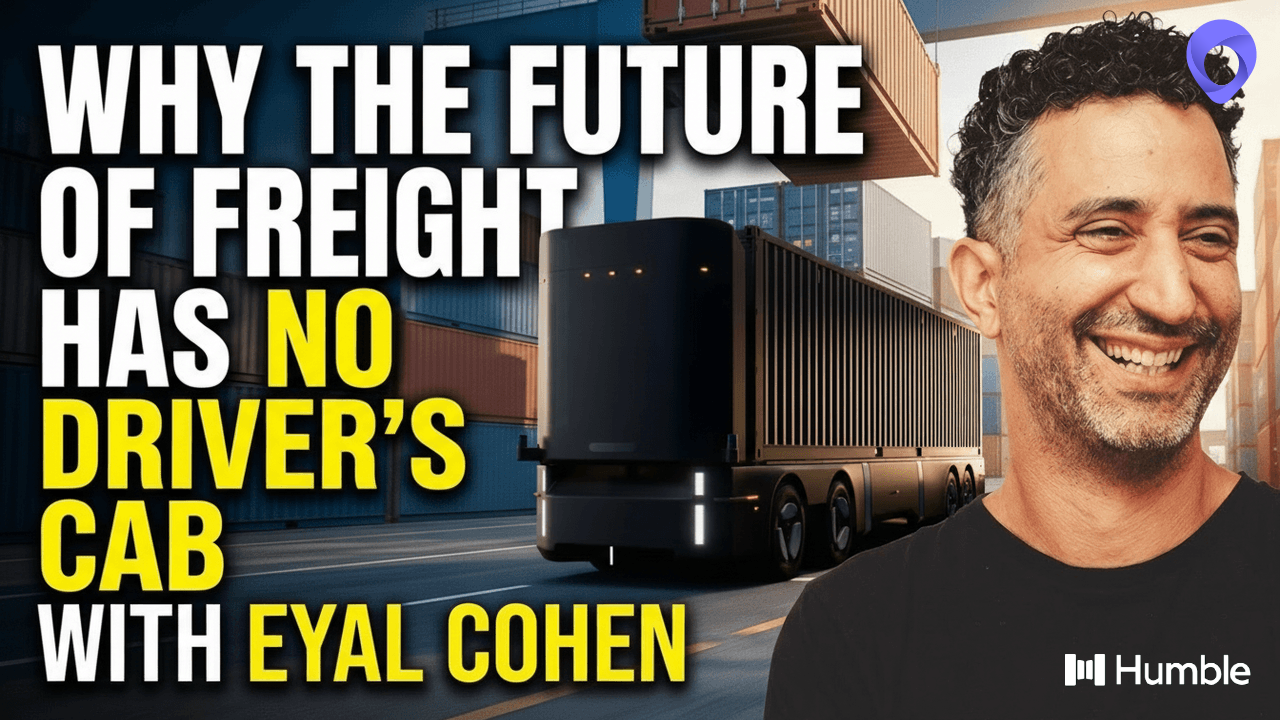
In “Why the Future of Freight Has No Driver’s Cab”, Joe Lynch speaks with Founder and CEO of Humble Robotics, Eyal Cohen, about how cabless, electric autonomous haulers are reimagining commercial logistics from the ground up.
About Eyal Cohen
Eyal Cohen is the Founder and CEO of Humble Robotics, an autonomous electric trucking company that recently closed a seed round and emerged from stealth with the Humble Hauler – a fully autonomous, cabless, electric Class 8 truck built from the ground up. Cohen spent his career at the frontier of autonomous vehicles and electrification: he was inside Apple’s self-driving program in its early days, watched Uber move into commercial freight, executed the world’s first autonomous freight delivery by semi-truck, and sold his previous company to John Deere.
About Humble Robotics
Humble Robotics is an autonomous vehicle technology company reimagining commercial freight transportation through physical AI and zero-emission heavy hauling. The company builds fully autonomous, electric Class 8 haulers purpose-built to handle complex logistics scenarios without a traditional driver cab or diesel tank. By blending vision-language-action (VLA) models with robust, lightweight hardware, Humble Robotics powers a universal platform supporting multiple vehicle configurations. Its cabless, vision-first design is 20% lighter than standard rigs, reaching up to a 200-mile range at 55 mph. Functioning as tractor, trailer, and driver combined, the Humble Hauler delivers a true dock-to-dock solution that lowers per-mile operating costs, eliminates fuel dependency, and streamlines global supply chain operations.
Key Takeaways: Why the Future of Freight Has No Driver’s Cab
- In “Why the Future of Freight Has No Driver’s Cab”, Joe Lynch speaks with Founder and CEO of Humble Robotics, Eyal Cohen, about how cabless, electric autonomous haulers are reimagining commercial logistics from the ground up.
- Shedding the “Driver & Cab Tax”: Traditional Class 8 trucks carry heavy operational overhead due to driver labor, sleeper cabs, and complex mechanical maintenance; eliminating cab infrastructure entirely with a purpose-built autonomous chassis lowers total cost-per-mile across equipment, labor, and maintenance.
- Eliminating the 20% Deadweight Penalty: Standard semi-truck setups waste allowable weight limits hauling heavy engine cabs, fuel systems, and driver amenities. A streamlined, cabless universal platform is 20% lighter, letting shippers maximize payload weight per route.
- Targeting High-Volume, Short-Haul Routes First: While industry focus often gravitates toward long-haul trucking, 87% of U.S. truck tonnage moves under 250 miles; focusing on high-frequency, short-haul moves (like drayage, port transfers, rail yards, and inter-facility shuttling) allows electrification and autonomy to succeed immediately.
- Achieving True End-to-End “Dock-to-Dock” Autonomy: Highway-only autonomous systems leave complex yard maneuvers and loading dock connections to human drivers; an integrated tractor-trailer platform with a universal “lock & twist” interface can navigate yards, haul 40′ international or 53′ domestic containers, and dock without human intervention.
- Deploying Explainable VLA AI Over Rigid HD Maps: Replacing expensive, brittle HD pre-mapping with Vision-Language-Action (VLA) foundation models and 360° sensor arrays (cameras, LiDAR, radar) enables vehicles to fine-tune to new facilities in days while generating plain-language, auditable logs for every maneuver.
- Escaping Fuel Volatility and Carbon Costs: Operating an all-electric Class 8 powertrain with a 200-mile range protects fleets from volatile diesel pricing and rising engine maintenance while helping operators meet zero-emission mandates and secure state incentives.
- Building a Purpose-Built Platform Instead of Retrofitting: Retrofitting legacy diesel rigs with autonomous kits retains structural inefficiency and legacy failure points; designing a clean-sheet autonomous EV from the ground up delivers the necessary system redundancy, field safety, and operational reliability required for commercial adoption.
Learn More About Why the Future of Freight Has No Driver’s Cab
The Logistics of Logistics Podcast
Joe Lynch: [00:00:00] Hello, friends. Welcome to the Logistics of Logistics. My name is Joe Lynch. Thank you so much for joining us today. Today’s topic is why the future of freight has no driver’s cab with my friend Eyal Cohen. How’s it going, Eyal?
Eyal Cohen: It’s going great. Thanks for having me. I’m excited to chat
Joe Lynch: I’m excited that I got your name right just now. So
Eyal Cohen: did great.
Joe Lynch: spelled E-Y-A-L. Cohen we can spell. So
Eyal Cohen: I’ve been, listen, I’ve been I’ve been correcting my name for 42 years now, so [00:00:30] you, you got it almost perfect.
Joe Lynch: You can thank Mom and Dad for that. So Eyal, please introduce yourself and your company and where you’re calling from today
Eyal Cohen: Yeah. So I am Eyal Cohen. I am the founder of Humbl Robotics. We’re a company in San Francisco, and we’ve been we’ve been in business for about a year now. And what we do is we are developing Class A trucks, and notably, they are autonomous, they are electric. And if you’ve seen any of our imagery or videos of the vehicle that [00:01:00] we’re building, it has no cab also, which is a quite an exciting innovation in this space
Joe Lynch: And so y- one of the things you just said is it’s got no cab, and it’s got… It’s electric. So one of the things, when people talk about electric vehicles they always say the same thing. Yeah, you can do it with a car, with a Tesla, with a, a Ford Mustang,” or whatever they wanna call those. But you can’t do it with a Class 8 truck.
And so we know, [00:01:30] all of us but you and your team, we know we can’t make that work, ’cause we need a battery that’s way too big and way too heavy. We also know that, hey, we can do autonomous, but not over the road, not on not with a truck. So you guys have really started in a place where I think most people, conventional wisdom says we’re not ready yet.
But you think we’re ready
Eyal Cohen: The amazing thing about a startup is you get to take conventional wisdom head on, right? And [00:02:00] my background and we’ll get into it in a minute, but I’ve been in trucking now for almost 11 years, 12 years, and I worked mostly on long-haul trucking with diesel. But what I’m trying to automate with Humboldt, what we’re working on is short routes.
We wanna see about freight that is moving relatively short distances and if we can automate those short moves shuttle moves things of that nature. Drayage is a good example. And for short moves, electric actually is a great technology. And, for [00:02:30] long moves, I think electric has some major challenges that are being tackled by the industry, but they’re major challenges.
Joe Lynch: Yeah, I love what you, I love what you guys are doing. And I think there are a whole bunch of very short moves. We’ll get into this, ’cause I know you kind of guys are going after regional freight, after drayage, after… There’s so many moves that we can do with with a smaller, with a battery that has maybe, not the, the mileage to go from city to city yet and without a [00:03:00] driver.
So I love what you guys are doing, and I don’t ever think this was gonna… I never thought that this is all gonna happen in one fell swoop. Every once in a while, somebody’ll ask me about autonomous, and I was like, “Your car parks itself, parallel parks, and you can’t.” And I heard somebody say this this is regarding passenger cars, but they said 40% of the traffic in a major city is people looking for parking spots.
What if a car could just drop you off? I’m in the wintertime here [00:03:30] half the year, and it said, “I’m gonna drop you at that restaurant, and then I’m gonna go park somewhere.” And I say, “Go ahead, car. Go wherever you want. Just be back here in two hours when I need you.” I love that. I love the idea that, maybe the parking lot isn’t in down- town Manhattan or Chicago or Detroit or Philadelphia, wherever you live.
The parking lot’s 20 minutes away, and we’re all good with that. And there’s not a ton of traffic looking for a parking spot, driving around the block 10 times. [00:04:00] So I think there’s so many cool things that are gonna happen with this before we get to a place where we say we feel completely comfortable that truck picked up in LA and it’s going to New York
Eyal Cohen: And we can take your analogy and take it to logistics too, right? If you’re a supply chain manager and you just finished, building your 100 widgets and, you wanna call the truck over and say, “Hey, I just finished, our next fabrication run. Please deliver this to our customer,” and you do that just in time.
That’s a pretty, it’s a pretty exciting future. It’s not the present, [00:04:30] right? But that’s where, all the robotics automation could go in decades, right? That’s the exciting
Joe Lynch: I love it. So who so are you guys actually, do you have vehicles on the road right now?
Eyal Cohen: So we have developed our first prototype vehicle. It is in testing right now, right? If you’re building a piece of equipment that goes on public roads, it has to go through pretty extensive testing. And we are in pilot conversations with many different customers actually.
Joe Lynch: Who are your customers? Are they gonna be the drayage? Is this dray moves? Is this gonna be [00:05:00] yard management? What are… W- who are gonna be your first customers?
Eyal Cohen: Yeah, it’s a great question. We have– we are canvassing the market for where are these relatively short moves that are served well by a battery electric vehicle that is automated, right? And the, the… what I tell people is the shorter the move, the better a candidate is for automation, right?
You want repeatable. Automation is really, robotics is really well served by things that are repeatable in general. It’s not just in autonomous vehicles, but in general, robotics [00:05:30] serves repeatable motion really well. And so we talk to customers about, “Hey, where do you have, where do you have routes that are going from a point A to point B that need to go back and forth day in, day out?”
These are runs that you’re maybe doing twenty or thirty loads a day. They– In some cases, customers we talk to have extremely short moves. The shortest one that I have talked to a customer about is I think a thousand feet. You just go from one warehouse to another back and forth, right?
It’s almost a con- a conveyor belt, right? Yeah. And that’s where we’re trying to [00:06:00] address automation, is finding these relatively short moves and trying to automate them.
Joe Lynch: Eyal, I was down in Laredo just before COVID, and seems like a million years ago, and we were driving from one place to another somewhere in Laredo, and w- I’m not lying when I say this, we passed FEMA trailers. They all said FEMA on the side. It was miles of FEMA trailers. And all [00:06:30] I k- thought about was somebody’s being told, “Hey, go out and get this trailer.”
And then they’d say, “It should be…” That’s the operative word, “It should be here.” And you could drive all over that yard, and I’ve experienced that as an automotive guy in the past where they’re like, “Oh, that prototype? It’s in this lot. It’s should be this parking spot.” And it never is. It never is.
And then you, especially in the winter, then you [00:07:00] tr- trudge back in and go, “It wasn’t there.” Look around. I don’t know where it’s at.” It’s easier now that all of our cars can talk to us with the key fob, but in the olden days, you had to walk around with the keys and try it out. A- anyway
Eyal Cohen: The- there’s actually, there’s– It’s a good story because I think the real world is messy, right? Is what the, what I always tell our team and I tell our customers, right? Nothing is perfect. It’s a real world. There’s equipment that doesn’t work. There’s equipment that’s misplaced. There’s [00:07:30] there’s all those challenges, and you kinda have to account for all these exceptions, right?
And I think that’s a really important part in building technology for customers
Joe Lynch: I love it. I love it. So Eyal, tell us a little bit about you. Where’d you grow up? Where’d you go to school? Some career highlights before you started the juggernaut that is Humble Robotics, and why did you start it?
Eyal Cohen: So if I rewind all the way back to the beginning, I am from New York. I grew up in New York, just outside New York City. I went to s– I grew up in New York. I went to school in New York. I went to college in New [00:08:00] York. And when I was in my early twen- early twenties, I got sent out to California to work on a believe it or not, a battery electric tank, like a military tank.
And this was in, this was, I think this predates Tesla even. So it was, like, early tech at the time, so it was really exciting. I think the project made no sense whatsoever, right? It was like, given– You’re talking about heavy equipment and can we do long haul? Think about a tank, being battery electric, it’d last for [00:08:30] minutes, before it ran out of p- of energy.
But it was a very exciting project and at the end of the project I think that project fell into the k- the kind of typical two-year defense cycle. They get excited, and they
Joe Lynch: two year? It’s 20 year
Eyal Cohen: Yeah, just, they get excited about a thing and then it they get re-excited later. But they canceled the project and they were like, “Okay, Eyal, it’s time to go back to New York.”
And so I quit my job and stayed in California ’cause I loved it so much. It was just really exciting to be around all the technology that was [00:09:00] happening, and I spent the next 10 years of my career working on electrification which was entirely new industry at the time. So we were working on motors and batteries.
I worked on buses. I worked on trucks. I worked on, I even worked on racing motorcycles, battery electric racing motorcycles. Set a couple of s- land speed records with the motorcycles. And so I had a very– I’ve had a very exciting, fun career. And then about 10 years ago I got involved in [00:09:30] a autonomous truck project, and it was probably the first company or one of the first companies to do autonomous trucking.
It was called Otto. And Otto did a pretty famous at the time, a pretty famous event. They drove they drove a, a trailer full of beer autonomously in Colorado over 100 miles with nobody in the driver’s seat. And this was in 2016, predates Way- Waymo’s being around cities and the…
at the time, it was like, “Whoa, what just happened?” This sort of cataclysmic event in, [00:10:00] in trucking. And, that event happened and then, I stayed working on autonomous trucks for the last 10 years. And all of my efforts were around long-haul trucking. We were trying to basically move freight long distances and seeing whether automation technology could serve that use case.
And if you take the culmination of all that career over 20 years th- with this electrification portion or this portion working on automated trucking, my Humble is the combination of all [00:10:30] that, right? It’s like me saying, “Okay, we want to take all that tech and see if we can apply it to to where I think it makes the most sense.”
And I started looking at short haul, these very short moves, and exploring that space and the– that’s where the company was born. So that’s where Humble comes from, is the exploration of the intersection of electrification, autonomous technology, and these relatively short moves.
Joe Lynch: So why the name Humble?
Eyal Cohen: I– it’s a great question. It’s a name that, that, that came to me about a year ago and stuck [00:11:00] but it– I feel like one, one thing that happened in this industry is, there’s a, there’s like it’s almost a trope at this point where, a bunch of people are working in technology, and they look at an industry, and they say “I’m gonna go disrupt that industry,” “i’m gonna go remake that industry,” right? And they don’t know anything about that industry, but they’re gonna go remake it, right? And I think the, the humble name to me is this idea of hey, we… A, I’ve worked in this industry for a while but B, we kinda go with [00:11:30] customers hand in hand.
So we’re talking to customers from day one. It’s not we develop all this tech and then drop it on the customer and say, “Hey, good luck,”
Right.
Joe Lynch: Y- you’re s- you’re starting with a problem as opposed to with a solution.
Eyal Cohen: Yeah, and we just wanted to make sure that, we’re approaching, anything that we do responsibly. And I think that’s– and it’s also a core trait of mine anyway, so that’s where the name comes from. And names have a way of sticking around, I was like, “Oh, we’ll call the company Humble,” and then, it kinda took legs and it grew, and it– and I just, I love the name now.
Joe Lynch: Yeah, I love it too. And it reminds me of those, [00:12:00] if you, if any of you watch the Silicon Valley TV show, I’m sure you’ve seen it , where these guys are doing, solving some itty bitty problem, and then they have this gigantic audacious name like, like We’re Revolutionizing Business With…
And you’re like, “Wait, what does it do?” Like it’s a
Eyal Cohen: gonna, I’m gonna give you, I’m gonna give you and your listeners a confession, which is I- I’ve only seen the show Silicon Valley one time, and I just felt it was too real. [00:12:30] So I said, “I can’t watch this. This is too much reflecting my day-to-day life.”
Joe Lynch: Yeah, it’s it does grab onto some of those things and yeah, every once in a while, like they always overdo it. There was a TV show about Detroit, where I live, and you’re like, “Yeah, that’s real, but not really.” It was like they just… It’s like LA, the way LA saw Detroit, we’re like, “We don’t see us that way.”
So but yeah it’s interesting. You touched on a few things that I thought were interesting. You said yeah, into electrification. When it [00:13:00] was new, most people would think it’s new now, and you’ve been doing this for 20 years, and I think the same with autonomy. It’s been around, it’s just moving very slowly, and I think, there’s that old, it’s a relatively new tr- saying, where, it happens very slowly until it happens really quick.
And I think until we can prove some of these things out, it seems like it’s moving at a snail’s pace. But every once in a while you’ll see an Instagram video or a YouTube video where you’re like, “Whoa, did [00:13:30] you see what these robots just did?” And that’s getting crazier and, it’s funny, before it was like, “Look at this robot.
It picked this thing up.” Now you’re like, “This robot’s break dancing.” So we’re getting
Eyal Cohen: think, technology’s a frontier always, and you’re always pushing on a frontier, and I think that’s in us, as humans to push the frontier. And sometimes just moving that frontier can take not a year or it could– it’s the culmination of like decades of work, right?
And [00:14:00] even before I wor- started working on electrification, there were efforts to make electric vehicles. GM had a famous one that they shuttered that was, in the ’90s. And but, what happens is that the, the attention kind of comes and goes, but the, the engineers or the scientists who are working on the technology, they just keep at it.
I think that it’s like in us to just keep grinding at the frontier until we find the solution.
Joe Lynch: I’m a little biased because I’m an automotive guy originally, and [00:14:30] I remember George Bush the W, the second one, he said one time, and I, by the way, I never listen to the president’s talk. I can’t stand the c- just the way they talk. But I got in the car to drive to work, and I drove one hour to work, and I was going to Chrysler at that time, and I m- I was a consultant there.
And I was driving, and you kept hearing, ’cause it’s Detroit, they kept talking about… He said something about launching, the next engine’s gonna be hydrogen engines, [00:15:00] and I was like, all right.” So then I got to, got to the office and said, “Hey,” to Ken, sat next to me. I go, “Hey, Ken, did you see anything about that hydrogen engine?”
Everyone’s talking about it. I go, so the f- I went to a meeting, first meeting. Before it starts, everyone’s like, “Do you hear that hydrogen thing?” And somebody goes, “Oh, yeah, I called the guys at Ford and it’s not on their product plan. I know it’s not on our product plan.” And their product plan was 10 years out, and their powertrain was even further.
And I was like… Somebody goes, “I talked to Toyota. They’re not doing [00:15:30] anything.” Before the end of the day, everyone had talked to everybody, and nobody knew anything about a hydrogen engine. So I feel like sometimes the government, I don’t know where they hear it, maybe from a university or one person, and they jump on it.
I feel like electric got a little bit of a th- it, they thought it was closer than it was to being the answer. Soon we’re not gonna have any more eng- old-fashioned engines. We’re gonna all have all these electric. And rather than let it [00:16:00] mature at the rate that it was gonna mature at, it just became like, yeah, everyone’s buying a an electric vehicle for 80 grand or 100 grand, and just, yeah, that’s the new reality.
I think it got a bad rap for that reason, and it didn’t need to.
Eyal Cohen: Yeah. Th-there’s some truth in that, right? Do you– you try to get technology out and see how the market reacts, and you learn a little bit about what is exciting to the market and what isn’t, and sometimes you just put the product out there. I think for those electric cars, even though they were expensive, [00:16:30] people really liked, for example, some, some people really liked the ability that they could charge in their house or that, the…
if you ever take a early Tesla out and you floor the acceleration, you get all the torque out of that motor, and it’s actually pretty exciting. I don’t know how often you can use it, but it’s really exciting, right? So the– there’s a little bit sometimes just learning where the technology works, not just it functionally works, but how do, how does it work in the hands of consumers?
And you almost have to try and I think there’s a, there’s always this element in technology, I think, where it’s really important [00:17:00] to… if you wanna get new technology out there to try with your customers, try with your partners, and learn with them what works and what doesn’t. I think for electric trucks, as an example, there’s a lot, there’s a lot to like about removing the volatility of fuel and diesel and out of your budget.
I think there’s a lot to like in the TCO of the, the vehicle. But there’s also questions you have to answer, like, where are we gonna charge
Joe Lynch: Yeah, and T- S- TCO is total cost of ownership, which is…[00:17:30]
Eyal Cohen: Oh, yeah. Sorry, jargon. Yeah, I apologize.
Joe Lynch: I, it’s been on my podcast before, I’d just like to point that out that when you’re looking at fuel, you’re always gonna be looking at total cost of ownership. So if you said, “I paid extra for my electric vehicle, but t- to fuel it or to power it, I don’t need as much cost.”
And that’s the same with, I think, the big pitch with the compressed natural gas, CNG. It costs 70 grand extra, [00:18:00] but the fuel, which is, comes from the US, is pretty stable in price and lower. But it, that, so we always have to look at the total cost of ownership when we’re talking about this. Anyway, I wanna talk to you about five points.
We agreed to these ahead of time, so you can educate me and hopefully my audience at the same time. So the first is freight is a trillion-dollar market. And it’s never had the technology that it deserves. It always is we’re always [00:18:30] in this, this yesterday’s technology. And we’re working, either we do it ourselves or the government’s gonna push us towards less emissions.
But closer to home, ports like Long Beach in LA, which are critical ports for us, we have too much smog in those areas, and they are… And by the way, we always wanna use the old trucks for dredge rather than the new ones. And so we end up with a ton of smog, and they have more asthma there for [00:19:00] their for their kids and for their old people who are at risk.
And so we have to do something. And so talk about the solution to this, this transition.
Eyal Cohen: So as you said freight is this enormous market. It’s underpinning the entire economy of the United States. I always I had a, I had an old boss who used to tell me– who used to say, “Everything around you was basically brought by a truck.” And that’s a very evocative statement when you just think about literally everything around you was brought to you [00:19:30] by a truck in some way, shape, or form.
But you’re right in that it’s a late adopter in tech. And I think, by the way, sometimes that’s just about being responsible, and I think that’s not the worst thing to pilot ideas, see what works, right? Talking about that
Joe Lynch: It’s real, so it can’t move as quickly as your desktop.
Eyal Cohen: Ex– yeah, exactly right. These aren’t just, digital bits, that we’re not just typing in a chatbot kind of situation. This is real equipment. It has real safety implications, right? A lot of people are invested in [00:20:00] making sure that the freight economy moves and moves really well.
And so there’s a responsibility of how you get the technology there. What– the way I think about Humble is that we’re in this kind of interesting point, right? The, we’re out of the freight recession a little bit that occurred the last couple years, right? There’s a little bit of supply
Joe Lynch: Into the tariff problems.
Eyal Cohen: Yeah, we– yeah. You solve one problem for another, right? But there’s an inflection point right now. And for me at Humble, part of the, the [00:20:30] thinking is how do we reimagine– What can we reimagine from the ground up? How do we rethink this the way that freight works? Not for necessarily right this second, but we wanna also intersect with the future.
You talked about battery electric prices and, the, the cost of that equipment. But a lot of… All, all this technology follows a pretty predictable cost curve, meaning it all gets cheaper over time as people continue to invest in it, whether that’s through improving the technology, through making many of it, through [00:21:00] industrialization.
And the– we have this opportunity right now, given where the technology is and given where it’s going, to rethink how we move freight and intersect with f- the, this, this critical inflection point where, maybe there’s a little– there’s less supply out there, there’s less we’re a little bit more constrained than we used to be.
And my view here is that we wanna have the strongest freight system possible. It’s we wanna have a resilient supply chain. We wanna be competitive. [00:21:30] And this is a great time for companies to be thinking about how to do that.
Joe Lynch: Yeah. Yep, and you touched on a great point, which is there’s a lot riding literally on this industry, and the biggest companies in the world aren’t gonna say, “Oh, we just… You know what? This looks cool. Let’s flip to this autonomous electric.” They need to see it proven out, and if you’re General Electric or Ford or whoever, you are a big company.
You’re not going to put up [00:22:00] with any interruption to your supply chain, any interruption to delivering product to your customers. And it is slower, but y- I think the innovation kind of happens at the edges, which is what it sounds like you guys are working on. So when I look at Humble Robotics, who will be your first customers?
Where do you think the use cases make the most sense to start?
Eyal Cohen: We have seen a lot of customer pull from these short moves that I talked about. I think there are– there is way more freight moving short [00:22:30] distances than I, A, people realize, and B, even being in this space for twelve years, I realized. So we, we– when we started the company and we were looking into what, what area we want to tackle, we had a thesis, right?
That we built the company around that there are short moves that could be automated. I didn’t realize how many there were. It’s a, it’s an enormous part of the market. We call it regional freight. We’re talking about moves that are less than, a hundred and fifty miles, kind of that, that general territory.
And a lot of the customers that we have started working with are [00:23:00] generally moving heavy goods these short distances, and they’re moving everything from bottled goods they’re moving containers in the dray situation they’re moving industrial equipment, they’re moving metals. The fun thing about freight for me is always what are we moving?
It’s always there’s always some interesting cargo that we’re thinking
Joe Lynch: Why does it lean towards heavy?
Eyal Cohen: So that’s an interesting question that, that we talked about it right at the very beginning, but the design that we have, it’s electric autonomous, but also we have a option on the [00:23:30] vehicle to not have a cab.
To basically, when you’re autonomous, there’s not really a need to have a place for a driver. By removing the cab, we can take more weight on the vehicle
Joe Lynch: I don’t mean to speak of your competition, but I don’t really think they’re your competition. I’ve seen this in China, where they’ve got vehicles that have no cab. And as soon as you don’t have a cab, it’s not, you’re not just saving the 200 and, 200-odd pounds or whatever it is with the driver. You’re also saving all the [00:24:00] equipment.
And there’s the, I’m sure all of us have seen this online, where the truckers, the long haul guys, they have an apartment in the back of their seat.
Eyal Cohen: It’s very nice
Joe Lynch: Yeah it has to be. And by the way, the average truck driver, the, I’ve research on this, the average truck driver sleeps five hours a night in those back, which is not nearly enough to be driving around in one of these vehicles.
And the average truck driver is also dying at age 61. So
Eyal Cohen: That is a fact. That is a fact that I didn’t know. That’s, wow, that’s a[00:24:30]
Joe Lynch: So there’s a company, there’s a company called Pro- it’s a p- nonprofit, I believe called Project 61. I’ve interviewed those guys. I’ll put a link in the show notes to that just for anyone who wants to look into it. It’s not the healthiest lifestyle. You’re driving a stressful job all day long.
You sometimes are sleeping in a truck. You’re sometimes sitting out in a truck. After you drove eight hours, somebody says, “Hey, don’t… just sit in the parking lot for a few hours until we unload you.” It’s, you’re eating when you can. [00:25:00] You’re eating when you have time, not getting the rest you need. Anyway, getting back to it you guys can haul more because you don’t have this whole infrastructure of the driver.
Now, is the, your powertrain, is it less, is it not as heavy as a traditional powertrain?
Eyal Cohen: You can think of it as the diesel equipment that you would traditionally see the big engine block and the fuel tank gets substituted for a axle that has a motor on it. It’s called an e-axle. [00:25:30] It’s a very cool piece of technology. It’s an axle that has motors that can drive that axle, and it’s all self-contained and batteries.
And the, the trade there is the batteries are probably heavier than the combination of the fuel and the diesel the diesel engine. But the axle, this e-axle itself, is less heavy than the diesel engine. So there’s a little bit of kinda like trading that we do on the technology side. If you’re doing a long-haul move and you’re trying to do that with an electric truck, you will have a enormous amount of [00:26:00] battery on that vehicle to drive hundreds of miles.
If you’re doing a relatively short move you can have less battery in the vehicle, and then you can end up in a situation where it potentially weighs less.
Joe Lynch: There you go. There you go. So what it sounds like is there’s a really good use case for the short haul right now. And and not so long ago I talked to some people about yard stuff. So moving trailers around for those of you who haven’t worked in an industrial or an automotive business, the yards [00:26:30] are massive sometimes, and there’s always stuff that needs to be moved around.
And it’s not an easy job, and it’s, It’d be great if it, if we had some, some level of a cleaner and greener vehicle doing that I don’t have to worry about. And also I also don’t have to worry about fueling it all the time. I just charge it right there at my facility. And the drayage, those dr- what’s the average drayage haul, do you know?
Eyal Cohen: I don’t know off the top of my head. They go sometimes quite far, but so
Joe Lynch: Yeah I think [00:27:00] up to 150 miles, but it’s usually probably less than 50
Eyal Cohen: Yeah. From out of Long Beach, I’ll sometimes go, into the Inland Empire or even up I-5 in California. But often there’s a warehouse very close to the port, right? Capturing that, that
Joe Lynch: For those who don’t do it every day, drayage is when you go pick up a container at the port, and they drop that container onto your truck. Usually it’s just a chassis or a flatbed, and those usually only go, as I said, 150 miles usually at the most. Although more and [00:27:30] more stuff are leaving California going all the way to Phoenix, which is 300 miles away, ’cause it’s 30% cheaper and you can get space there.
But that, I don’t know that they got drayage vehicles doing that, but maybe they do. But anyway, getting back to it, the dray- drayage vehicles, Long Beach and LA have asked this, asked the trucking business, “Could you help us with this smog problem? This is a perfect example how we can help.”
Eyal Cohen: That’s right
Joe Lynch: So I take it you’re talking to those guys over [00:28:00] there at Long Beach and LA?
Eyal Cohen: I was at the Port of LA just yesterday. And it’s it’s, they’re– the port, the ports are composed of multiple terminals that all kinda operate sometimes in unique ways, right? Some are more automated, some are less. But the the coordination down there is impressive to see and how well those ports run is actually really impressive to see.
And they are they are pushing on technology, which is also exciting. They have some automation in those ports. They have in the case of Long Beach, they have these vehicles called AGVs. [00:28:30] They’re these platforms that are moving freight between two stacks at the Long Beach Container Terminal.
It’s a very impressive place to go visit
Joe Lynch: Yeah, I remember reading a book, and it was talking about buying a charger online and through Amazon, and it goes through the Port of LA. And they c- the, the guy who wrote it was from Wall Street Journal. I was actually supposed to interview him. I never did, but maybe I’ll circle back ’cause I… It was a great topic.
It was the supply chain for this charger that you buy. I think it’s [00:29:00] made in Vietnam, goes down the, its Mekong Delta, and then gets out to I think to LA, Port of LA or Long Beach, one or the other. They’re neighbors. It’s one or the other. And they talked a lot about the, the team…
not the teamsters, the longshoremen union. So the longshoremen union for the West Coast, and then there’s also one for the East Coast. You’d think they would get it one union, that would make… If I was doing it, I’d have one union ’cause you got a lot more power. [00:29:30] But they negotiated. You always have to negotiate any automation with them because that potentially takes a job away.
And th- they’ve got a lot of automation, but the newer ports I think Savannah, I have… I was there, but I didn’t tour it. I think these newer ports that are growing, they have a ton of automation, but they’re all looking for the same thing, which is, “Don’t pollute my neighborhood here.” ‘Cause there’s always gonna be businesses and houses and people who are not so far from the port who [00:30:00] say “We have tremendous pollution and smog in the area because all these trucks are idling, waiting to move freight.”
Eyal Cohen: Yeah, that, that’s right. A-and I think we’re gonna see more automation in the ports as, as time goes on, right? There’s the ports need to be competitive also, right? Both b- both amongst themselves in the United States and competitive to even ports internationally, right? When when the supply chain is, organizing around where to ship the goods and how to ship them.
So you’ll see more automation [00:30:30] over time, but there’s a, there’s, there– but I say, what I see in the United States is that the ports are bringing that automation thoughtfully and responsibly.
Joe Lynch: Yeah. And if anyone’s ever done them moving something th- by the way, anything from Asia typically comes in the West Coast, typically. And then they’ll get it off that ship. It’ll be at some warehouse or for some facility. It’ll get in a regular truck, and it’ll go across the country, or that container gets onto rail.
You mentioned our friends at [00:31:00] IANA. More stuff is moving via rail lately, and I think it’s probably ’cause the price jumped up. And so they do in effect compete. So it’s … A- and then you could also take that ship and make it go around the country and d- and deliver it to Houston. So there, there is in effect competition for these ports, but I think they all kinda want the same thing, which is get the stuff out of here as easily and as [00:31:30] cleanly as possible because we had that port congestion that really just slowed the economy down during COVID.
No blame. We just didn’t know that we were gonna have that stress test that, that couple years.
Eyal Cohen: When I was in the Port of LA yesterday, I think that, they stressed that, right? Is they’re trying to figure out these solutions to get to get clean air. They’re trying to figure out how they wanna bring in automation, right? And how they wanna think about that the technology [00:32:00] progression.
But their primary goal is to make sure that the goods come in from the steamship lines and they get out as quickly as possible and efficiently and safely. And that is the way to think about their business.
Joe Lynch: I have a note here and it says you can’t retrofit the future. So I’m assuming that means what we’re talking about today isn’t something where you go, “Hey, I got this kit and I’m gonna convert my 1978 truck into a Volvo Robotics vehicle.”
Eyal Cohen: That’s right. The, the interesting thing about about [00:32:30] trucks is that they’re all a little bit different. The, the, the build sheet for a truck is, is– could be a dozen pages of different components that go into make that truck. And to have the equipment be safe and reliable and especially when there’s a robotic component to it, you really have to understand what it is that you have and have built.
And if you wanna operate in the safest way, you have to be very you have to build on a very consistent platform. So at Humboldt, one of the things [00:33:00] that we’re doing is we’re rethinking the Class A equipment given where we think this technology is going. You– we’re constantly asking the question, okay, if this is an automated system, an automated truck, what do you change about the truck?
What do you need to change about the truck? If a driver has been responsible for doing an inspection around the vehicle, how would you do that inspection, right? And so what you end up with is a changing vehicle. And everybody in automation tends to start [00:33:30] with retrofitting, like basically starting with a kit.
And gradually, that moves to okay, what is the right vehicle for the future that can give us the safety, lower operating costs, potentially reduce weight, improve our visibility, right? There’s all this technology with– that we can bring to bear. And ultimately, we believe freight doesn’t have to choose between economic safety and sustainability.
We can probably have all three, but that’s where the technology development effort goes.
Joe Lynch: Yeah. We need all three. And, when any- whenever we talk about [00:34:00] autonomous, people think about accidents and yeah that, the robot that’s driving that’s gonna run over somebody. And it is a concern because every day, unfortunately, there’s accidents where people die.
But the first time an autonomous vehicle’s in an accident, it’s going to be front page news for a week, and there’s gonna be people demanding, “Get those things off the road.” So the bar is so high, and it’s… So I love what you guys are doing, which is [00:34:30] saying, “Let’s not focus on long haul where this thing’s gonna be, driving across the country.
Let’s focus on the shorts, the short moves that we can have a little more predictability, a little more control, and we’re not too far away.”
Eyal Cohen: Yeah I think there’s a real component to if the technology works perfectly, the equipment still breaks down, right? It-that’s a, it’s a part of the life [00:35:00] of, anybody who’s running heavy equipment. There’s still maintenance and issues. And if you’re doing long haul and that robot is five hundred miles away from home, that’s an operational challenge, right?
And so there’s something very I think we’re trying to be thoughtful about how we’re deploying this technology, and part of it is, make sure that we’re well within the operational landscape that you need to operate a robot.
Joe Lynch: Yeah, and I’m just thinking out loud here for a second. It, it could also run, like if you say this, this is not running with a [00:35:30] person this can run at night. When you say, “Hey, this th- this thing is moving mostly at night when there’s not high traffic because it makes it easier for us,” and it’s also a little opportunity to say, “We’ll spread our wings a little bit here because we can.”
And you don’t have to worry about rush hour traffic. And let’s face it, all of us have done that stop-and-start thing where you’re on the expressway and you’re moving 60 miles an hour, and then all of a sudden everyone slams on the brakes really quickly. Probably the autonomous vehicles will be much better because they aren’t [00:36:00] playing with the radio.
But there are so many opportunities with a 24-hour cycle, also a seven-day cycle. We say, “Hey, we’re moving on Sunday mornings.” Why? There’s no traffic, right?
Eyal Cohen: Yeah. And, the number of drivers that may want to do a 3:00 to 7:00 AM shift probably isn’t too high, right? And going– and I would say rapidly, and I would say rapidly going down as well, right? As as the drivers exit the market. So autonomy has– [00:36:30] autonomy really has that opportunity, I think, to fill gaps in the way that we think about the supply chain, and that’s where it’s best served.
Joe Lynch: Yeah. And so I’m still getting my notes here finally. It says, “The most important miles in freight have been overlooked.” And those are the, that’s the less than 250 miles. And every time I’ve talked to somebody, I made… By the way, I made the same assumption. Oh, we’ll get rid of that long haul ’cause that’s really difficult on the drivers.
It’d be nice if that was the opportunity, but it sounds as if from what you’re telling me, [00:37:00] the opportunity is in the 250 miles and less, and maybe as short as you said, as 1,000 feet. And I think there’s also a selling point where you say, “Hey, this is only going one mile up to another warehouse.
We feel pretty good about that.” And then somebody says, “We’ve been using this for five years on this. I don’t care if it goes 20 miles. It’s fine.” It gives us a chance to get comfortable with all this. So this cabless design, this reminds me about air- airlines. I’ve just been on a lot of flights lately, [00:37:30] and I always think about this is they don’t need windows on jets, but they have them.
And from what I understand, they have the windows on the windshield because no one wants to get on a plane where the pilots can’t see out the window. And he’s not flying it that way, but all of us go no. I need to know that guy can look out the window.” And I think as soon as you take the cab off of this, and I’ve seen similar vehicles, I guess we’ll get used to it.
But, I don’t know that [00:38:00] it’s… i’m pretty sure this is gonna be safer than the driver in the cabs. No offense to the drivers ’cause they do a wonderful job
Eyal Cohen: I think drivers do amazing work and I always say it’s about augmenting kind of the equipment that you have to work with, right? We’re not d- we’re not replacing three million drivers or three million Class A trucks out there, right? There’s a lot of equipment out there. Supply chains don’t work well.
We’re adding a tool to the toolkit, right? That’s the way I always see
it
Joe Lynch: I think, that’s my own ex- experience in automotive when [00:38:30] we got automation. When I first started working way back in the olden days, it’s a lot of very difficult jobs, and when at the end of the day you were tired, you were dirty or sweaty, potentially injured from crouching all day or from standing on your tiptoes lifting stuff that was heavy.
By the time I left automotive, it was completely different. No one was in the plants injuring themselves. No one was doing work that was horrible for them. I can see the same [00:39:00] thing happening with trucking. We have so many issues right now with security and freight fraud, and I can just see the job morphing into something that is more valuable to all the parties and frankly a better job.
Eyal Cohen: It’s changing. Yeah, it’s changing every day
Joe Lynch: By the way, I just listened to the Elon Musk book and by the way I love that book. I highly recommend. I know there’s people going, “Oh my God, he voted for Trump.” Don’t worry about who he voted for. Go listen to the book. It’s a really good book, and [00:39:30] he talked quite a bit in the book about the camera first versus LIDAR w- and more than I wanted to hear, to be honest.
So talk about y- what you guys came up with, LIDAR versus camera first.
Eyal Cohen: So I have been using LiDAR for the last 10 years of developing this technology. It’s a wonderful
Joe Lynch: the way, what is LiDAR before we go any further?
Eyal Cohen: LiDAR is a sensor that we use in autonomous driving, although it has other use cases where it is a sensor that [00:40:00] is sending out lasers, is transmitting light and using the return of that light to understand the world.
And what it– the picture that it paints for us, unlike a camera that like you would find on your iPhone, is one where we can see depth, we can see how far objects are, and we can also see at night just as clear as we see in day. So it is a wonderful sensor. It is an expensive sensor, and there’s been this sort of debate for a long time about whether you should be using [00:40:30] cameras for your autonomous technology.
Cameras are more similar to what a human– how a human sees, right? We’re not, certainly not firing lasers out of our eyes as far as I know. Or do you use this LiDAR technology? And what we do at Humble is we use both. But there is a… A-and the reason we use both is because it’s safer. I think we can use the LiDAR technology as a safety sensor.
But we’re primarily camera-focused, meaning we primarily develop our technology off camera data. And there’s a lot of reasons [00:41:00] for this, but camera, a camera-heavy approach is is where the technology has moved to over time because you can understand the world better through cameras than you can through LiDAR.
Joe Lynch: there is I think if you were to ask the average person outside of this business, they would say, “Oh, no, those things are going by GPS.” GPS is good for us humans, but it’s not exacting enough for driving, and if you’re just a few feet off, that means you hit a curb. It means you [00:41:30] hit another car. You can’t be a few feet off in this world that you’re living in.
So there’s GPS, which I think is from our phone towers, but that’s also from those low Earth orbiting satellites, right? Do you guys use any of that information from those, those sources?
Eyal Cohen: We try to use any information we can because we can make a safer product that way. So we use GPS much like a human would. [00:42:00] But a human uses, they reference the road and signs and lane markings to drive. And so we use the same to position ourselves within that space.
Joe Lynch: So if I forget my password or get to a new software or whatever, it sometimes makes me go through that picking how many of these images have a car in it or have a person in it. And by the way I seldom can get it right the first time. I just gotta keep [00:42:30] doing it. And from what I understand, that is being used f- for this image recognition that AI’s using.
Am I right to say that?
Eyal Cohen: It has been, yeah. There’s a lot of a lot of the way that we train these systems is by looking at images and saying, “Hey, what is in this image?” And training our brain off that, or the our our technology brain off that. And so yes, you may have been helping an autonomous effort somewhere every time that you click or misclick on that
Joe Lynch: I feel like they should pay me to do it because it’s been…
Eyal Cohen: I feel like they [00:43:00] should pay you also, yeah. I’m on your team
Joe Lynch: I remember listening to a book, it was called The AI Superpowers. It’s probably 10 years old now. But it was from the guy who did Sino Ventures c- founder of that company. And one of the things he’s mentioned was, as a human, we have so much context that cameras and light are always trying to pick up on.
And it said, if you have a cat at your house and you see a tail underneath the door, you’re like, “Oh, that’s the [00:43:30] cat.” Would AI make that same determination? Now, if I don’t have a cat and I see that tail, I go what got into my house?” It’s a whole different thought process. But we have that context that how do you make, how do you train…
maybe it doesn’t need the context, but it needs something, doesn’t it?
Eyal Cohen: Yeah, it’s part of all the technology that we develop. There is– We try to add context into the system as much as possible and, the– But the basics of driving [00:44:00] are, when you see an object in front of you, you stop, right? There’s– When you see lane markings, you follow them, and there’s rules of the road there’s rules that we all obey by, and all that goes into the training of the system.
And that’s the– that’s why the technology has taken time, right? It’s complicated. It’s like, what do you do with the ha- person hand-waving you to go forward, right? All that has to be learned over time.
Joe Lynch: So in terms of the economics of this, so let’s just say it’s c- I can carry a little heavier load. I don’t have to pay a driver. Th- the [00:44:30] total cost of ownership, is it higher or is it lower? Or do I… what’s the payback on it if it’s higher?
Eyal Cohen: So yeah, the intent is to have the TCO be lower and as low as possible. A lot of what we’re trying to do is figure out how we can get the cost of moving freight as low as possible.
Joe Lynch: You got to get it right first and then you can go after making it cheaper. Am I right to say that? And I think if you say, hey, the cost is much lower, reliability is not that great, safety is a little [00:45:00] bit of an issue. But other than that, the cost is lower. No one’s going to take, no one wants to hear that.
And I do feel like we’re moving towards a future where we’re not going to drive. And you have a little baby at your house, boy or girl.
Eyal Cohen: Girl, three months old
Joe Lynch: Someday you’ll tell her, when I was a teenager, I drove around in a car and I was in charge of it. And they’re like, didn’t you do stupid stuff? You’d be like, oh, constantly.
Eyal Cohen: [00:45:30] I have wondered, I’ve wondered if she will need a driver’s license. I guess we’ll see.
Joe Lynch: Yeah, you, I hope not. That’s a horrible feeling for a parent. I can say this. As my mother always says “Once you’re a parent, you never sleep right again.” Maybe that’s just her kids. But anyway I’m gonna summarize what we talked about today. And, … Oh but before I forget, when do you see this
You, I know you’re doing pilots, and you will continue to do pilots. When do you see the first yes, [00:46:00] we sold this to our, an official customer, and they are using this as part of their supply chain moves?
Eyal Cohen: Oh, I think we’ll be in pilots within the year and and the commercially within the next one to two years
Joe Lynch: So it’s gonna be most likely 250 miles or less, which is a big chunk of the moves. And so regional and smaller moves, right? And I know we talked about drayage, and we talked about moving from warehouse to warehouse in a [00:46:30] big in, A lot of times, like in where I’m from, something will be like, it’s gotta go to a heat treat facility that’s five miles away.
No big deal. That’s something that this, this system you’re developing is ideal for
Eyal Cohen: That’s correct, yeah. So that, that’s where we are, that’s where we’re focused with our tech. It’s finding it’s finding shuttle runs and dray moves and relatively short hauls that, that have to happen because that’s where I think automation and electrification serve really [00:47:00] right now
Joe Lynch: It, it reminds me this, I can tell I’m getting old when I say things like this. The first time I remember buying something from Amazon, Amazon had at the top, big print, 1-800, some mobile, some phone number. And because they knew none of us trusted going and doing anything online. And I remember I bought something online.
First, it probably took a week to get to my house, and I remember a friend said, “What a dumbass. You just gave [00:47:30] your credit card to the internet.” Like it was I, and I remember it just was like, couldn’t be
Eyal Cohen: What a time.
What a
Joe Lynch: so it took time for us to say, “I trust Amazon. I trust them so much that I don’t even need to know their phone number.
I don’t have to follow up and make sure they got my order. I also trust the internet, generally speaking, to g- take my credit card without stealing it.” So I love your short haul approach because that’s gonna give us the [00:48:00] confidence where somebody says, that’s been moving these short haul moves for a decade.
It’s ready for the next step.” As opposed to, “Yeah, I just let this thing loose, and hopefully it does well six states away from us.”
Eyal Cohen: Hundred percent. Yeah
Joe Lynch: So I’m gonna summarize what we talked about, then I’m gonna ask you to give your final thoughts on the topic. So I’m talking to my friend AL, and we’re talking about why the future of freight has no driver’s [00:48:30] cab, and that’s his vehicle.
By the way, what do you call this vehicle, the Hum- Humble Robotics? What is the name of the c-
Eyal Cohen: We call our vehicle the Humble Hauler. That
Joe Lynch: The Humble Haul– You should have led with that. That’s good. The Humble Hauler. All right. So the Humble Hauler is piloting, and you guys are gonna continue piloting this, and you’re starting to hit some of the conferences in our business and some of the ports in our business, so you can better understand where the opportunities are.
[00:49:00] And we talked about this is a trillion-dollar market, and we have been a little lagging in the technology. We’ve seen all sorts of big upgrades in technology, but trucking just feels like it hasn’t had– Certainly, the interior of the truck has. All the tracking technologies, we have all that.
But the truck itself, only now we’re starting to see, I think we start to see what do they call it? The compressed natural gas engines now. Step in the right direction. I think that’s a transitional technology that we’ll use for a while, and maybe forever for [00:49:30] some applications. And we also talked about you can’t retrofit this, so you can’t re-retrofit the future.
This is not like one of those things where you say, “Oh, I got a kit, and I’m gonna go, and I’m gonna change my existing truck and add Humble robotics to it.” This is a completely new design, clean sheet of paper, purpose-built. And I think we’ve seen this, a lot of the compressed natural gas stuff, though they’re using existing vehicles.
So yeah, you can retrofit ’cause all it is a different [00:50:00] engine. Next, we talked about the most important miles in freight have been overlooked. I’m guilty of this, and I know other people are. We thought we’re gonna get rid of the long haul ’cause it’s really tough on the drivers, and I– it is really tough on the drivers.
But the majority of the miles are not long haul. They’re short haul. They’re two hundred and fifty miles or less, and this is an opportunity to prove itself. But it’s also an enormous amount of the [00:50:30] miles that are driven every year. And we also talked about the cabless design, which is gonna take some getting used to, but I’ve seen some of these.
I saw your prototype. Seeing a truck that has no cab just feels like madness, but we’re there. W-we’re doing pilots for a reason, make sure it does it right. And we just talked about LIDAR versus camera first, and I think correct me if I go astray here, but we don’t need to debate that. You’re gonna do is, you’re gonna take as many [00:51:00] inputs as you can get to make sure this is driven safely and that we don’t run over anything.
So to say just LIDAR, just camera, just GPS, just satellite, that doesn’t make any sense to someone who just wants to get tighter and tighter on the safety. Enough of my blather. Put a big old bow on this one. Eyal, final thoughts on the topic?
Eyal Cohen: Well, first of all, thanks for having me. This was a really fun discussion. I really enjoyed it. Yeah we are very excited about what we’re building here. This is my [00:51:30] dream job here at Humble, building this Humble Hauler. We are excited to talk to anybody about this technology.
We’re excited about exploring more customer use cases than the ones that we’ve had. So short moves are where we are excited to pilot this vehicle. Electrification is where we’re advancing the state-of-the-art here. You can find– we’ll be at various conferences over the coming year.
We’ll be at Manifest. We’ll be at Act. We’ll be at IANA probably next month for any intermodal folks. And so y-[00:52:00]
Joe Lynch: By the way, I highly recommend that one ’cause it is at Long Beach. It’s the center. It’s the place that all the freight’s coming in that we don’t ever visit.
Eyal Cohen: Yeah, so we’re excited to meet we’re excited to meet you if you’re at any of those conferences, please come see us. And then you can find more information about us at humblerobotics.ai.
Joe Lynch: Yep. Hey I’ll put a link to your LinkedIn profile, link to your website, any of the links you and your go-to-market team give me, I’ll put those in the show notes so people can reach out and talk to you. And yeah, I’m excited to see you at… I’ll be [00:52:30] at Manifest. I can’t make it to IANA this year.
I’ll be at the Mergers and Acquisition Club meeting out in Chicagoland, closer to home. But anyway I love what you’re doing. It’s very cool. And if… Man, every once in a while I talk to someone where they’re like, they’re bringing the future, and this is very much you bringing the future.
Thank you so much. By the way, do you have any videos of your Humble Hauler that we can put in the show notes, links to it?
Eyal Cohen: Let’s see what we can get you. Yeah
Joe Lynch: I love it. I love it. Thank you so [00:53:00] much
Eyal Cohen: Okay. Thank you very much. We appreciate it
Joe Lynch: Yep. And thank all of you for listening to my podcast. Your support’s very much appreciated. Until next time, onward and upward