
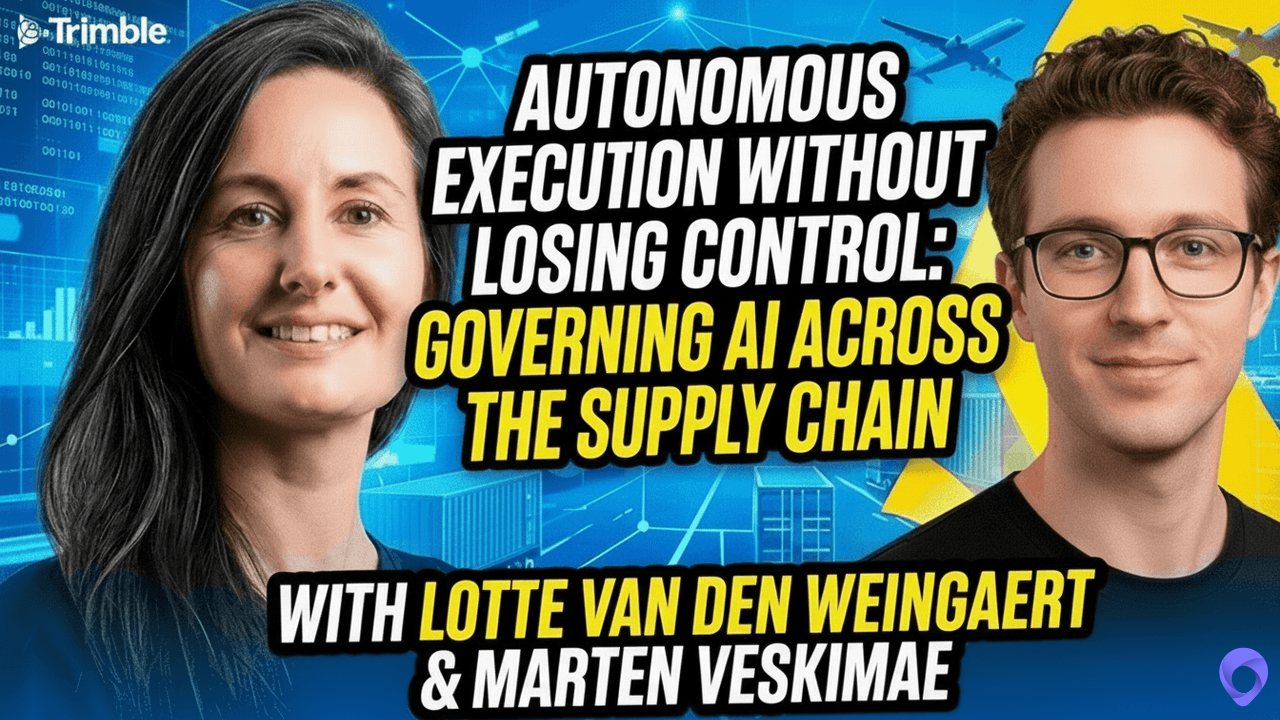
In “ Autonomous Execution Without Losing Control: Governing AI Across the Supply Chain”, Joe Lynch speaks with the Manager of Generative AI at Trimble, Lotte Vanden Wyngaert, and the Manager of Generative AI at Trimble, Märten Veskimäe, about how Trimble Arc Agent automates complex logistics workflows and inbox management while keeping human operators in full control.
About Lotte Vanden Wyngaert
Lotte Vanden Wyngaert is Senior Manager of Applied AI at Trimble, and a hands-on leader who specializes in using technology to transform complex operational challenges into streamlined, scalable systems. Positioned at the intersection of logistics and tech, she leads teams in architecting and deploying production-ready generative AI agents that automate critical workflows. Driven by high ownership, Lotte thrives in dynamic, fast-paced environments where she can turn chaos into tangible business results. When she isn’t optimizing operations, she enjoys traveling the world.
About Märten Veskimäe
Märten Veskimäe is Manager of Generative AI at Trimble. Märten Veskimae has led the technical staff behind Trimble Arc Agent, the agentic AI platform built for enterprise needs. His team builds AI agents that take on real work for both Trimble customers and internal teams, and he spends most of his time on the question of what AI lets a business do that it couldn’t do before. Before Arc Agent he built AI products in transportation software, built data-services product lines and led fraud modeling at a digital bank. He holds a master’s in comparative politics, writes about product and strategy and lives in Northern Italy.
About Trimble
Trimble Transportation provides fleets with solutions to create a fully integrated supply chain. With an intelligent ecosystem of products and services, Trimble Transportation enables customers to embrace the rapid technological evolution of the industry and connect all aspects of transportation and logistics — trucks, drivers, back office, freight and assets. Trimble Transportation delivers an open, scalable platform to help customers make more informed decisions and maximize performance, visibility and safety.
Key Takeaways: Autonomous Execution Without Losing Control: Governing AI Across the Supply Chain
- In “ Autonomous Execution Without Losing Control: Governing AI Across the Supply Chain”, Joe Lynch speaks with the Manager of Generative AI at Trimble, Lotte Vanden Wyngaert, and the Manager of Generative AI at Trimble, Märten Veskimäe, about how Trimble Arc Agent automates complex logistics workflows and inbox management while keeping human operators in full control.
- The Power of a Single AI Agent Model: Rather than forcing logistics operations teams to manage dozens of disconnected AI tools, Trimble Arc Agent uses a unified, single-agent architecture. It acts as a single point of interaction that pulls safely across disparate enterprise systems and databases without forcing users to figure out which tool to use.
- Preserving the “Human in the Loop” and Governance: Autonomous execution requires strict enterprise safety boundaries. Trimble Arc Agent operates under user permissions and security rules—preventing unauthorized data access (such as payroll) and requiring human approval on high-stakes, consequential operational decisions.
- Turning Unstructured Data into Actionable Insight: A massive portion of operational delay comes from static, unstructured documents trapped in emails, PDFs, spreadsheets, and bills of lading. Arc Agent ingests, parses, and maps this messy data into standard TMS structures automatically, removing tedious copy-paste workflows.
- Eliminating the “Morning Exception Chase”: Freight operations managers no longer need to spend their first hours logging into multiple portals or manually tracking late shipments. Arc Agent continuously monitors telematics, tracking portals, and inbox communications to generate a prioritized daily briefing that highlights only high-risk exceptions.
- Autonomous Inbox Management and Follow-Ups: Inboxes consume massive operational capacity through routine status checks, rate inquiries, and missing document requests. Arc Agent autonomously handles high-frequency partner outreach—fetching missing proof of deliveries, track-and-trace updates, and routine quotes while keeping drafted responses ready for human review.
- Standardized Workflows via Reusable “Skills”: Arc Agent learns specific operational procedures through structured “recipes” or skills. By capturing how work should be executed once, Arc Agent performs routines with zero variation across teams, standardizing service-level agreements (SLAs) across terminals and business units.
- Elevating Logistics Roles from Clerical to Strategic: By shifting repetitive administrative burden, system data cleanup, and chasing missing information over to Arc Agent, transportation professionals are freed from reactive firefighting to focus on strategic negotiation, relationship building, and high-value decision-making.
Learn More About Autonomous Execution Without Losing Control: Governing AI Across the Supply Chain
Lotte Vanden Wyngaert | Linkedin
Trimble Transportation | Linkedin
The Logistics of Logistics Podcast
[00:00:00] Hello, friends. Welcome to the Logistics of Logistics. My name is Joe Lynch. Thank you so much for joining us today. Today, I am at the Trimble Insight Conference, and I’m with two good friends here from Europe. I’m not gonna pronounce their names. I’m gonna say Lotte. I know that’s your first name, and Märten.
Lotte, please introduce yourself, and where you’re from, and what you do here at Trimble. All right. I’m Lotte Van Den Weingaert, and I work with Trimble since seven years, and I am senior manager for ArcAgent, [00:00:30] our new product that we’re also gonna talk about in this podcast. And I’m based in Belgium, in Europe.
Very nice. Märten? I’m a product creator for ArcAgent. I’m based in Italy, and also in the company for almost seven years now, six and a half. Very nice. And so the title, I didn’t say the title, I should’ve, it’s Autonomous Execution Without Losing Control. Big big topic here today, and it’s governing AI across supply chains.
And I keep hearing yes, we’re gonna use AI, but we’re [00:01:00] not going to let it run wild. And last year, I interviewed Jona McIntyre, and I remember him using the term ethical crumple zone. And he said I, I always used to say, “Yeah, you can yell at AI, but it doesn’t care, so you have to have a person to yell at if something doesn’t happen.”
And he says, “Ultimately, we have to have a human in the loop on all of these things.” Loti, why don’t you go first and tell us what Arc Agent is in your words, and then I’ll ask Märten to give his version. All right, [00:01:30] great. So Arc Agent is a single, safe, and powerful agent with many skills. That’s like the one-liner.
And each of those words actually are deliberately chosen, and they also have a meaning. So for example, a single agent, it’s a really deliberate design choice for us because I think if you take a look in the market like we used to ask ourselves when you need something, when you’re working in a big company, for example, like us, like sometimes I have to ask myself the question like, “Oh, which help desk do I need?”
And I feel that with [00:02:00] the search of like almost an army of AI agents, you start to ask yourself the question like, “Oh, which AI agent do I need to talk to now?” And that is a very deliberate decision with Arc Agent that we go for one agent. And then obviously safe and powerful because if an agent is powerful but it’s not safe, it can be harmful for your company and for your business.
And also the other way around, if it’s safe but not powerful, then it doesn’t really add value for you. And then the many skills also [00:02:30] connects back to the single agent. It can really do many things. So yeah, that was my short intro for it. Yeah the one thing that I’ve– maybe you could address, Märten, is Trimble has, I’m gonna use the term pillars or suite of solutions, and this is the one agent that can pull from all of those systems if you give it permission, and I think permissions is a, a big part of this.
Michael Kornhauser in his keynote was talking about Arc Agent, and it’s come up a little bit on the podcast, [00:03:00] this whole idea of, first of safety, but let’s make sure that it can pull from all the information it needs. But also, permissions are pretty important, and you don’t want anybody using the tool to say, “Hey, please access payroll and tell me what everybody makes,” or anything else that might be inappropriate.
So talk about that ability, I- I don’t know if that’s the right word, skill, to pull from all these disparate- … solutions you guys have. Yeah. I remember reading [00:03:30] this statistic that, to me, at the time, sounded abso- absolutely crazy, that a an enterprise, a large organization, has something like 400 to 500 different software suppliers.
There’s a lot of software that, that we have to interact with on a daily basis, and Trimble is also a large organization, so it’s not different in that sense. And we started developing Arc initially as an internal tool, ’cause we wanted to gain the expertise in the [00:04:00] technology, understand what are these organizational demands for AI when it comes to safety and compliance.
And our first use cases were exactly that. We have these different software tools that we are using internally. It would be really great to have this intelligent connection layer, and then we can start thinking about automations. How do we connect a workflow that combines a tool from this set and a tool from that other set?
And e- and [00:04:30] exactly the, the permissions. Okay, as an individual, I might m- I might be able to see what my payroll data says, but I shouldn’t- … be able to see what my colleague’s- … payroll data is. And, I heard some conversation about it, and I was asking some questions throughout this, this conference.
By the way, Trimble conferences are always great, and this one’s in San Diego, which it’s a little hot outside on the deck, but it is absolutely stunning here. And, Anyway, when I was having some [00:05:00] conversations about what AI can do for me, and I thought about when I was at a logistics company, by the way, every TMS says, “Oh yeah, just download that.
You get– We’ll give you a report.” And it will. That’s not the problem. The problem is humans were the ones who put the information in there. So if I have a thousand shipments, I can almost be assured that one or 2% are gonna have missing data incomplete data, inaccurate data. And I remember I used to ask my team at a logistics company, before we’d [00:05:30] meet with customers, download all those shipments, clean it up, and then we’ll go and talk about it.
And it’s a tedious job. You’d be pulling information. Some of it would be manual. They’d be going on looking at old emails and stuff. And I asked, could I just ask our agent to go do that that exception work, which is thankless, but also, we’ve got people who are on our team who are saying, “Okay, that was supposed to deliver by noon.
I don’t know. We don’t have a time for it. Maybe [00:06:00] I’ll just put 11:55 ’cause I know it got there,” right? And rather than going getting the data much better to say, “Yeah let our agent do this.” And by the way, at this time, if you ask a young person to go do this, they’re gonna… Shouldn’t AI do that? Yeah.
So I’ll, I ask you that, Laeti, first. I- is that a, a good application for this? Yeah, I think it, it would be, and I think it’s also a good way how people can Okay, sorry. I think it’s actually a good example because I think [00:06:30] it also touches a bit on trust because people understand what a task is.
And as you say they don’t really like to do it, so it’s a great first use case in my opinion to start using an AI agent or Arc Agent to do that with you or for you basically. I like your example of like the missing data and I think a, a practical example is let’s say you have a shipment and you want to make sure that it has all the required documents for example.
A few hours before loading you need to have certain documents in [00:07:00] place, or you need some confirmation from the shipper, from the carrier or from the driver maybe. And right now it’s a human who has to monitor that like throughout the day and so on. They’re probably living in spreadsheets basically.
And I think that’s a great use case for Arc Agent. It can just automatically keep on checking all your missing information send out emails for example- … and ask for that missing information. And I’ll ask this to you, Märten, ’cause I think I know the answer but it’s gonna be Arc Agent.
But the last kind of consulting engagement I worked on, [00:07:30] It was a very big shipper. They spent like $100 million. And I remember the vice president of that, that company, I was advising them on selecting a new 3PL, and then I kinda stuck around for a little while. I wasn’t on the project most days, but I w- I would talk to the v- vice president.
One day he s- called and said, “How much longer are we gonna tolerate emails?” And I said, “Oh, go on.” And he goes, “We have a system of record, but then we have all these emails that are outside the…” And I go, “Yeah, I know.” I go, [00:08:00] “I know there’s gotta be a way to get the emails so they are tied to that.” I said, “But it always happens.”
And then the perfect example is, “Hey, Märten, I’m gonna do that for $1,800. I’m gonna move it from point A to point B.” And you say, “Yes.” And that’s all in the system. And then I call and say, “Hey, Märten, s- lost that carrier. Now it’s gonna be $2,000.” And you write back, “Sh- sure, I understand.” Thank you for being understanding.
And that’s outside the system. And then later on I go, “Oh, yeah remember Märten, I told you?” And you’re like, “Yeah, but there’s no [00:08:30] documentation inside the system.” And I’m assuming that I could use ArcAgent for this Yeah, people have been complaining about emails ever since it was- We love them.
It was invented and y-yet it’s still with us. I had a logistics problem very much related to what you were saying. Preparing for this event here in San Diego, I had to also book flights, book hotels, do all these things. [00:09:00] Those, those requests came in via email, obviously, at different times.
I had other things to worry about- Yeah … in my work life. And for me, it was a struggle. Like, how do I find the right email that says, when do I have to be where? How do I have to prepare for that? And I had my email inbox connected to Arc, and I did actually prepare all these logistics of getting here to this spot, to this conversation with Arc, ’cause I asked “Hey, find me all the relevant [00:09:30] emails.
Give me a timeline. Tell me when do I have to be ready,” and so on and so forth. So you can definitely do it. And then I guess the question is, now if you have access, if you give Arc Agent access to your email and you also have access to your TMS, can you start connecting those things? And the ups– the answer is absolutely yes, you can.
Yeah. And th-I have some points that I wanna talk to you about. And one of the first points is we have all these unstructured data, unstructured documents, so [00:10:00] emails, PDFs, bills of lading, spreadsheets, and I sometimes call those static. They’re just trapped in time. We’re never going to get any good insights from them unless somebody manually opens them up and cuts, copy, paste, whatever they do to put them into the system.
And for a while, we’ve been saying, “Hey, I wanna turn some of that unstructured data into structured data,” meaning now it’s in a spreadsheet format that we can start to gain some insights from. I’m assuming [00:10:30] I’ll ask you this first, Märten. I’m assuming we can do this with our agent. Yeah. You can. Now what does that look like?
Is it… Do you say hey I have a whole bunch of emails related to blank, and I’ve PDFs attached too.” So AI does need to know what your target mapping is. I guess you can- … turn this into a mapping problem where you have either unstructured data on one hand and a structured data on other with specific [00:11:00] values, only allowed values.
So when it comes to Trimble’s transport and log- logistics products, we already have that information of what allowed values are for different products, so we know what the mapping should be. We still, Our, our customers might still need to specify their own terminology that- Right
only they have access to, what is the internal language inside their organization that they’re using. So our, Or no [00:11:30] AI product should try to guess, ’cause these are critical systems. But we have methods of feeding that information, teaching the AI your specific language that you wanna use.
Yeah, I use AI a lot and, It’s knows who I am a little bit, that m- it knows me better than I think. Recently I started using Muse on Facebook, and Muse said, “Hey, whatever AI you’re using, please put this into the give them these instructions,” which [00:12:00] was to pull all my information from- google Gemini to over there. And when I saw what it knew- … I was like, “Why do you know my nephew’s name?” “Why do you know my children?” It felt weird. But I get it. It understands, and we want it to understand. It needs to understand the context of our work, and I guess maybe our, even our personal life.
And and I think I heard Michael Kornhauser say skills. So what are those skills that it [00:12:30] needs to learn? I think if… My favorite way of thinking about skills is to make a comparison with actually a human, is when you have a new joiner in your team, you also teach them how your business works.
You show them how you do things, what the standards are, your way of working, what a good result looks like. So you also teach them, and I think for me, skill is exactly that. You teach, for example, Arc Agent how you want to do something, and I think the [00:13:00] benefit of a skill or the concept of a skill is that it is, y- you can repeat it.
So you capture it once, or you can ov- obviously also improve it over time, and then it executes the same skill in the same way. Because unlike us humans, we probably make some variations along the path. If I explain something to you or to Mertan, both of you might do it slightly different. And I think that’s an advantage of a skill.
You can teach Arc Agent how to do something with which [00:13:30] products or systems to connect, and then depending on what it needs to do that exact thing, it can execute that skill in the right way. Yeah. Ine, maybe I’ll ask you this part of it, Mertan, and I think I know the answer. It seems like no two logistics customers are the same.
There’s always one that says, “Oh, we we can work with you if you give us this field.” And you’re like, “How come the rest of our 60 shippers don’t need that field, but you do?” Of course you don’t say it that way. Yeah. But that’s your [00:14:00] thought. Nobody needs a serial number in there. But there’s always those extra.
So I’m assuming Arc Agent can learn what each of my customers requires and speak their language, so to speak. Yeah. A- another analogy to skills, is commonly people refer to them as recipes. So you can think of a recipe as there are ingredients that you need, and then there are instructions [00:14:30] of how to work within ingre- these ingredients to get to the final outcome.
So you think of a tiramisu. Every household makes it in a slightly different way. Everybody has their own preferred way of how to make it. We don’t make it in my house. It’s just me. But I love tiramisu, so I want somebody to make it. Yeah, it’s– So I’m assuming I can just keep…
It gets better and better over time, which I always say all of us hope to have continuous improvement in our life. AI actually [00:15:00] does. So if you like Arc Agent on, in the first week, you’re gonna love it in the first month, in the first year next thing I wanna talk about is every, every logistics company, every, every big shipper wakes up in the morning and the first thing they do is face the shipments.
Did they arrive? Which ones are late? Which ones need follow-up? And when I ran a logistics company, I used to not come in till 9:30, 10:00, ’cause I [00:15:30] d- I didn’t wanna bother anyone with it. I didn’t want… i’d also wasn’t involved in it. And, but it was a giant pain. And for the ones that were really a problem, I would receive the phone call where they said, “You promised,” or, “Your guy promised that it would be here.”
Usually they did, and my customer didn’t know it was in their facility, which is a whole nother problem- … you guys can help us solve. But can our agent track these shipments first thing in the morning? It’s one of the, one [00:16:00] of the very early use cases we had for ARC, and what we heard from our customers is, “If I come to work in the morning, can I get a a daily brief or a weekend brief of what went on?
What should I focus on? Are there any issues?” Yeah. ‘Cause, because we do have these real-time visibility products where you can see the, all the delays. We have dock and yard products where you can see what’s happening in your yard, and ARC has access to that data. So you can ask and tell me what are the delays?
[00:16:30] What are the ETAs? Do I need to reschedule something in my dock? Because I can see already that the truck is running late- … or maybe, hasn’t been even allocated a, a, a truck yet, I see. I always say you wa- wake up in the logistics business a little bit queasy with some shipments.
You’re like, “I know…” You have in your mind which ones you were worried about. And I’ve just said to somebody when you’re in logistics business, you go home, and as soon as you lay down, you go, “Did so and so move [00:17:00] that? Did they get that?” I… And then they, sometimes your shipments that you did over and over again, so you’re like, “Maybe this is my mind from three weeks ago saying, ‘Maybe that’s happened again.'”
And would be really nice to say, I can just kinda relieve my brain of all that chasing and say let ARC agent…” And by the way, can I use this on my phone? Not yet. Okay. But we think there’s use cases for that. I think there’s probably also some safety issues with this, and I know that’s a priority for you guys.[00:17:30]
Yeah, exactly. I guess it depends, like yeah, you don’t want people to be, for example, typing on the phone when they are driving a truck. Yeah. Yeah. So it’s, there are these interaction methods that we need to consider and- I just hate the idea that I somehow should be at my house and not working 24/7.
That’s right. S- but getting back to it, can it s- it, it can say, these are the ones you should focus on. These are at risk. These are already late. Do [00:18:00] something about it. And the rest are either green or already delivered”? Yeah, exactly. I think that touches on an interesting point because I think nowadays our…
I don’t think our problem is lack of information. I think our problem is almost too much information. You have to, like as a human- Yeah … you have to bust through the weeds basically and what really needs my attention right now? And it’s exactly as you say. Like, all the shipments that are on time, it’s maybe a little sad, but you don’t spend time on those.
Everything that goes well, [00:18:30] that doesn’t need your time basically. And I think that’s a, a great example use case for ArcAgent. In the morning you can also schedule a, a message for that, like the daily brief that Mestan mentioned. So y- when you get in at 8:30, 9:00, 9:30 whatever that you just have this daily brief, and then it immediately tells you these are the three shipments that need your attention right now.
S- so I’m gonna s- suggest this, and I’ve always heard from the transportation management systems, I’ve used a lot of them. I’ve never used Trimble, but I’ve talked about Trimble a [00:19:00] lot. They always say, “Oh, Joe, you don’t have to download it into Excel and have your people clean it up.” And I was like, “I don’t have to.
It’s just I could have a whole bunch of incomplete shipments.” If I can h- first have ArcAgent help me fill those in every night, and then every morning come in and actually have, when I receive that report, it’s actually clean. Yeah, exactly. And good information as opposed to going, “Yes, I got a report, but it’s not actionable.”
It can fetch the data [00:19:30] that already exists, and it can highlight the data that you still need to gather, either from the driver or somebody else. So it can bring to your attention where do you need to still reach out to external- s- so I was talking to- … partners
I won’t mention their name, but a pricing algorithm company that was done very well, and they were … They said I use the term dirty data. And they said 30% of the [00:20:00] information they would ingest would be incomplete, inaccurate, dirty, just whatever you wanna call it, and they were using AI to clean it up.
Because it is something that is often, the informa- like maybe a proof of delivery hasn’t arrived, so it can go fetch that- Yeah … bring it back. It didn’t pull from one system to go to another, and that’s the kind of thing, ideally, I don’t want it to make it up, and then to your point, if the information’s not available, please tell me, and hopefully we [00:20:30] can put some sort of plan in place where we start getting all the data we need.
I think it’s a very important conversation that the shipper and the carrier have to have together. Yeah. Like why don’t we have that data- Oh, yeah … when is it needed? I tell this st- story every once in a while on my podcast. A few years ago, a, a consulting company locally in Detroit area said, “Hey, could you help us with this problem?”
And I was like, “What is it?” And they said a really big electronics g- gaming [00:21:00] company Gaming systems. They s- sell to big box stores. They go, “Big box stores that you’ve been to.” I was like, “All right.” And they said, “And they don’t get proof of delivery.” I go who’s the carrier?” And they said, “A carrier you would recognize.”
And so I’m thinking a really big retailer, really big electronics maker, and a really big trucking company. Between them, they weren’t getting proof of deliveries, and it was costing the company millions of dollars in un- [00:21:30] uninvoiced… You can’t- … invoice it if you don’t have a proof of delivery. By the way, I asked my brother-in-law who’s a CFO, “Would you ever pay a bill without a proof of delivery?”
He goes, “No.” I go, “What if I could prove it was at your location?” He goes, “No.” He goes, “I would fire anyone who did.” He goes, “It’s against, not against the, the best practices.” But it, it- So it’s crazy. Yeah. That can happen even at big companies. Exactly. And it’s, and still a lot of work just to get that overview of what am I missing.
It’s- [00:22:00] And then you have to start, then you know what you’re missing. Yeah. And you have to start chasing everybody to get the- Yeah … to start filling in those missing gaps. You guys have probably experienced this, too. When we talk, when you talk to customers, and I have gotten a chance to talk to Trimble customers generally speaking, happy, but we always think “Oh they’re using the systems as they were meant to be used.”
Yeah. We’re looking in the optimized world. They’re looking in the real world that they live in, and hopefully those get closer and closer every single day. But we still have plenty of missing fields, and hopefully it gotta be nice if you could [00:22:30] use Arc Agent, even if it filled in 50, 60, and then 80, and then eventually 100% of those fields without our he- without our help accurately.
I’m never gonna be happy if I say, “I think it’s just making that up to make me happy.” Yeah, exactly. Yeah, exactly. The, you have to be able to trust it, and the confidence level of the information has to be, of the data has to be high enough. So there’s another point here that I wanna talk about, which is, and we have this fancy header. It called, “The inbox is eating your profit.” And I think [00:23:00] this applies to a few people. So if you’re a broker, you get just tons of requests for quote, requests for a price.
And they’re trying to respond to those… And I know some of the companies out there, some of the brokerages here in the US are now using some sort of AI to respond to those. But there’s also purchasing people and shipping people who are constantly receiving, “Hey, where’s my stuff? Where’s my money?
Where’s my stuff?” And it’s just a never-ending email. And, but a lot of them are [00:23:30] very similar, and but it becomes just the constant chase where you never leave your inbox. And when somebody says, “Hey, what was your top priority today?” Answering the 100 emails I got. And as opposed to having bigger strategic goals that you’re pursuing every day that makes the business better, you’re just in reactive mode.
So what can Arc Agent do for me on that? Very early on and it’s among some [00:24:00] of our own colleagues, they had the similar problem. So they were receiving a lot of emails, especially if they were out for the weekend, or maybe they went- Oh, yeah … on vacation and came back, and then it’s filled with all sorts of stuff, and stuff that you still need to respond to.
It’s, there’s just a lot of it. So early on, we, we created some skills for triaging the email inbox, filtering them based on the type of email and the type of action that you have to take. We [00:24:30] also have a product in in Trimble that allows carriers send automatically quote automatically- Oh, nice
At the, a request that come in. So you can connect Arc with that product, and you can define different rule sets there that, okay, if it’s this customer, this lane way, this is the price that I give out by default. So that can be the opener for a negotiation. But I think there’s also another point to be conscious of when working with AIs, is in the [00:25:00] business that we are in the transportation and logistics relationships still matter a ton.
So I think it’s important to separate this routine automate- automated communication where it’s like status updates or, or- Okay … these requests where you’re not really expecting a, a personalized response- … from those emails where you actually should have this- … human touch, and you don’t want to send out an AI [00:25:30] written- Right
Response. I’ve… This, I had a conversation a few years ago regarding, I was gonna do a podcast on freight fraud, and the person I was talking to before we hit record, she said “What would you do, one thing, to prevent freight fraud if you were a shipper?” And I was like I would talk on the phone to my carrier, carriers.”
And she said Yeah. She goes, “What? We aren’t doing that anymore.” I said we automated it.” And so [00:26:00] I might’ve been working with Loti for t- 10 years, and she moved all my freight, and now we have a system that allows us to automate it. And we’re not going back from that automation, but what we lost in that is the communication that was started as business, but became personal.
And then at some point, I always say, “You never, you’re defrauded by someone you’ve been working with for- … five years.” And to, to your point, Märten, we don’t ever wanna get to the place where you say, “Oh, I got a note [00:26:30] saying so and so’s going away party is ha- happening in…” Yeah. You got an automated AI response saying- Yeah
“Write this on the birthday card or the going away card for me.” Exactly. We do have a, a one cool feature in Arc which helps Arc users to prepare for different negotiations. So you can describe your situation, maybe you’re re- renegotiating some rates or whatever sort of thing you have going on.
You can describe [00:27:00] that scenario, and it will create a plan based on the science behind negotiation. That’s awesome. So you can know what are your goals, what it’s your negotiation plan. Do you have some concessions? In what s- sequence you do those things? So a- and you don’t need to, use AI to come up with the exact script in your conversation.
That wouldn’t work. That would feel fake and artificial. I- But you can still plan- … the conversation. I [00:27:30] noticed I get a lot of emails from people I don’t know saying, “Hey, can so and so be on your podcast?” And a lot of them were from overseas and where English wasn’t their first language.
So some of them had ragged, By the way, their English is better than my version of their language. So I’m not gonna complain. But I noticed I started getting these really well-written emails, and it occurred to me, this is really over the last month, it occurred to me everyone is using AI to write these emails to me.
Yeah. And [00:28:00] it’s sometimes very obvious, and I don’t want that. And I always think, and I’m not to this point myself yet, but- I want, if I’m gonna have an agent write an email for me, I wanted you to leave it in draft so I can make sure I’m happy with it. Yeah, exactly. I think that actually touches on a point what they call human in the loop.
Yes. So it’s basically- Yes … like your control and and it also touches on trust, I think. But also, like, how comfortable are you with which level of autonomy [00:28:30] you wanna give? And I think the email example is a good one, because it’s your decision. Maybe I’m fine with having our agent send automatic-
emails on a few kind of messages maybe. But if you’re sending me a personal email, I don’t want my AI agent to reply to that. Yeah. Leave that one alone, I’ll reply to it myself. Yeah. And for others, I want it to draft the email answer, and I wanna review it- Right
tweak it a little bit maybe, and then send it out myself. Yeah. It’s a … This kind [00:29:00] of reminds me of being a parent a little bit. And I remember I used to tell my daughters, “When you were born, me and your mom made every single decision for you. And by the time you’re 18 or 20, you’ll make all your decisions for yourself, and I’ll just be a financial advisor at that point.”
Yeah. And probably an investor. But the easier you make it for me to let go of that decision-making, the better. If you make it really hard because I gave you too much decision-making [00:29:30] power, I’m gonna take it back, and I don’t wanna do that, and I know you don’t want that. I feel the same thing with AI.
Yes, I want you to very rapidly take over certain tasks- But I have to feel comfortable with it. Yeah, exactly. And I think the complexity is also a factor to it. You probably wanna start with easier tasks, and then you wanna follow up closely, and then you get confidence and trust, and then you’re like, “Okay let’s increase your autonomy on this one.”
And then you might wanna go to a bit a more complex [00:30:00] task. And then you wanna start over again with low autonomy. And I think that’s a, a very interesting and probably also personal journey, because I think everybody’s level of comfort might be different. Oh, yeah, depending on what their job is and- Yeah
yeah, and it, you say, “Oh, my boss’s boss wants to talk to me about my performance,” and you go, “Oh, our agent sent an email already.” Yeah, exactly. Absolutely. Telling him off. Good. Yeah. Thank you. Yeah, exactly. Yeah, so you had a point, Maarten? I just wanted to say that in the last weeks, we’ve had a good [00:30:30] chance of talking with our customers and asking what sort of pain points they are facing when adopting AI products, and one of the things that they brought out is it still takes time to go through that learning curve.
Yeah. So that might be… It might not be that they don’t see the value or it might not be a budget issue, but just taking the time to learn how to best apply that technology in their organization. I think we also have to at least this is true with the, consumer tools that are out there you [00:31:00] have to learn the right way to ask it to do things.
So if you say, “Hey, please use this,” and I just say, I use slang- … and you might, as a European, go, “I don’t understand what he wanted,” AI might not understand what I wanted either. And, you guys have, as Trimble, we have customers everywhere, so it’s really important that the context and the language match up.
We’re trying to make it as easy as possible when it comes to our own products. [00:31:30] Obviously, we know how they work, so we can train our AI, our Arc Agents how our products work. There are a lot of other products out there. We’re very happy to work with our customers to get them also connected, but it still takes a bit of time to understand the specifics of it.
Yeah. Last year when I met with Jonah McIntyre, he used the term ethical crumple zone, which is always the same, was he said, “We need to be able to say to our customers and to our coworkers that, ‘Yes, I am [00:32:00] always in the loop on this, and I’m responsible.'” So we can have c- we can say, “Yes, AI did 95% of this code, but I’m ultimately still responsible for this product.”
That, that means I can’t just say, “Yeah, I took the day off and let AI do my job.” Yeah. At the end of the day, it’s who carries the responsibility- Yeah … of the outcomes. It’s… Y- yeah. And we use a lot of different systems, so God, when we’re here at Trimble, there’s all sorts of companies.
Your partners are all connected to [00:32:30] Trimble, and I’m assuming that you’re gonna be able to pull from virtually all of these if you give it permission. It also depends on what those vendors what their- Yeah … policies are. ‘Cause some companies are very open. They want, regardless of what AI agent you use, they want their product to be accessible, and others are more closed.
If I’m using, like say, Copilot, a driver assistant, if they, if that information is pulled into that, it’s available, so Yeah. [00:33:00] I’m assuming i- if it gets that far, it’s kinda crossed the line, and now it is possible for our agent to access that information? Yeah, we have a roadmap in place.
So in the next couple of months, we will have all the TNL TNL being this transport and logistics- Oh, yeah … section in our company. Yeah. Yeah, this is truly crazy, ’cause this is a digital assistant. This is somebody who’s working, in effect, for you. And if every… Does everybody, say, on [00:33:30] my team get access to one of these?
You mean access to Archagent? Yeah. So if, let’s say I have five people using your systems- … and each one of them says, “Yeah, this isn’t one Archagent for the company, it’s Archagent for everybody who’s got access to it.” Yeah. And- that’s how we look at it. So it’s like you doubled your employees at some point.
Exactly. Exactly. You could almost see that everybody who has access to Archagent gets their, their personal assistant or their coworker, or you can really yeah, as you say, [00:34:00] like double your team. You come in the m- you come in the mor- we all are, as humans, we are going to go home and sleep, but Archagent works all night, I’m assuming.
And it’s going to chase down all the stuff that it can chase down, and at some point you’re gonna say, I would like it if it had a little more responsibility, a little more access at night, so I’m gonna do this, and this.” And then it’s always gonna be, oh my God, more work gets done at night when I go home than when I’m here.
Exactly. And then in the morning you can just have an overview of what it done, what it [00:34:30] has done while you were sitting in the sofa or having a… or sleeping, yeah. Yeah. And, I heard this from a shipper years ago. I was asking them, we were doing an inbound logistics program, and I said, “Why aren’t you using us for all your inbound shipments to my customer?”
And it was also his customer, and I said, “You’re not complying.” And he said, “Joe, we’re a big company. We work with all the major automakers, and we have 12 different portals that we’re supposed to do shipments in.” And he [00:35:00] says, “So we just are– We’re done with that. We’re gonna use one portal. And yeah, we’ll pay, we’ll– if it costs extra to ship it because we didn’t go through your way or if we’re gonna get non-compliance we’re comfortable with that because the old way was 12 portals.
Every, every shipment’s going through a different portal.” You think what we can do now with ArcAgent, I can now manage that. Or on the other side of it, if I have to check twelve portals every morning no, I’m not [00:35:30] checking it. I’m gonna get that information pulled from the portals and put into my system.
I’m not in the same place as doing clerk work. Yeah. I think AI is really good at automating. That’s well-defined work in organizations. And with this concept of skills, you can also be sure that the work is always done the way that you desire. So even if you have, five employees, and they’re all using [00:36:00] AI you don’t want ten different outcomes because you have, five employees- Right
powered by AI. You want still a, a single type of workflow and a verified outcome, and the skills help you get that. I’m assuming there’ll be an AI that manages all the other AIs while you’re at– A babysitter at night to watch the AIs. Yeah. The manager of AIs. Exactly. Exactly. I, This is kinda off topic.
I heard somebody talking about, AI is gonna end the world, and there’s a professor, and he kept saying, [00:36:30] “This is very dangerous.” And then he said “There’s only one, one time in we see in the world that a less intelligent being controls a more intelligent being.” And he said, “And that’s, A baby and its parents.
He said the, the parents are controlled by that baby- Yes … and they do what that baby wants and, but they’re benevolent. They’re like, we’re gonna take- we love this baby. We’re not gonna do anything.” We are going to be in that position before long with AI, where [00:37:00] we say “We…” And of course, we want it to act like our parents.
Not abusive either. Yeah. I think for the time being and for the near future, we still have a role to play in those decisions, and definitely we’re designing Arc Agent in a way where human is in the loop whenever- … there’s consequential action being taken. This is the, this… i’m not just saying this because I’m here at the Trimble conference.
I’ve said this many times on my podcast. There’s a lot of companies who have all of a sudden changed their name to .ai, and I am by the way, all for it. Go [00:37:30] ahead. They make bombastic claims, and they’re growing fast, and they’re, breaking things and moving fast. But the challenge is, are they safe?
And I think the biggest brands and the biggest transportation companies that you go work with at Trimble, they don’t want risk. I’m an ops guy originally, and I always say every ops guy wakes up in the morning and says, “Where is my cost risk? Where’s my quality risk? Where’s my delivery risk?”
Everything’s a risk, [00:38:00] everything’s a worry, and I don’t need extra worry. Yeah. I- it seems right now a lot of the public discourse is around these fantastical stories of whether it will go really great and we will live in this utopia with magical nanobots that will make stuff appear or it’s a dystopia.
I think I just saw, Was it Blackstone? One of the big financial firms. One of the partners gave a presentation and he said, “I believe where we’re at right now is [00:38:30] like 1870.” In 1870, we used candles to light up our night. We lived on farms. Our buildings were all made of wood, and if we wanted to travel, it was by horseback.
By 1900, we had electricity to light our homes. We had trains. We started building skyscrapers, and our economy doubled in those 30 years, and the, the world changed completely in those 30 years, and the same could happen here. [00:39:00] Yeah. I- I think if you already just look back five years, I think so much has happened in the past five years.
So it definitely makes you wonder what will happen in the next five years, and then- Yeah … or the next decade. Yep. Already the technology is way ahead in terms of what is possible versus how are we applying that. So even if the technology’s development stopped today, I think there’s still a lot of progress to be made in the next decade- Yep
just adopting what we have today. Yeah. And there’s one other point I [00:39:30] wanna talk to you. I wanna get you both for your two cents on this. I’m an automotive guy, as I mentioned, and, inside our four walls and inside of our facilities, we would always say we have flow. We have timed out everything, and we understand we don’t want excess inventory anywhere.
And and then we leave our dock, and we s- fall into a whole bunch of point systems. The manufacturing and distr- distribution companies of the world said, “We would like flow,” and the logistics world said, “You want [00:40:00] a whole bunch of point systems? Is that what I heard?” So we developed all those point systems.
And each one, warehouse management system, the ERPs order systems transportation, ma- each one was like, oh my God, this is such a breakthrough. But I think we realize some of the issues now is we have our information all in disparate systems, and suddenly, in one fell swoop we don’t have to worry about that integrate.
Plus3 will integrate. But we can [00:40:30] suddenly pull from these systems almost effortlessly. Yeah, exactly. And that’s also the data fragmentation issue is one of the reasons why we, with Arc Agent, deliberately opted for a single agent. Because if you go for an agent- Yes … per system, you just keep reinforcing those exact same silos of data.
Yes. So yeah, it’s… What’s your two cents on that, Märten? I think it’s even worse because then you have even more systems. You have the- Yeah … AI companion [00:41:00] for- Yeah, we- … everything that you have … we’re compounding the problem. Yeah. So let’s put a big old bow on this. Märten, I want your final thoughts on the Arc Agent, what you, what we should expect, and then I wanna hear from you, OT.
Where I see the, the technology moving is we will have AI using more computer for us so that humans and humans can focus on the relationship building, strategizing, making these [00:41:30] important deciding decisions. And I think we’re on a good path here with Arc Agent as well ’cause it’s already connected to all these different systems as we’ve talked in the past.
The older way of working where you have to log in into five different portals and look up what’s going on and try to match all of that in your head into one coherent story, I think that is increasingly becoming a thing of the past- … where you have [00:42:00] this one interface. You have control over it.
You can define the workflows within natural language, and it will do a lot of that computer work for you. Yep. So I think that’s where we’re heading here. One thing and I’ll let you go, OT, I always remember as a young engineer- I spent so many hours pulling stuff from one system and putting it in Excel spreadsheets, and it was just just accepted that kind of low-grade, tedious work [00:42:30] was for the young people.
And I feel like it’s almost now, when I look back, it’s like hazing. I feel like suddenly we’re taking that away. The young people of tomorrow are gonna come in and say, “Yes, I look forward to coming to the office so I can strategize on improving the business.” You’re like, “Wait, what? Shouldn’t you be copying and pasting?”
So- Yeah … Lotje, your two cents. Yeah, exactly. I actually wanna add on what Maarten said is I also think that what, like how we as you said, [00:43:00] like the nature of our jobs is changing, and I think that’s actually an exciting part ’cause you don’t have- you no longer have to do that tedious work. You can really spend your time on where you as a human actually can make a difference.
It can be the relationship building. It can also be on the ideation. So I think that’s actually an exciting time. But at the same time, you also have to be honest and transparent to yourself, I think. Not maybe for you as a person, but also how your company works because you have to be really critical on how [00:43:30] you work and be honest about what can we actually do better and how are we willing to redesign the way how we work.
So AI’s really a a part of that. So I think that’s also something for the upcoming years- Yep … that people have to yeah, start doing. So final questions for you two, so I’ll ask you Maarten first and then Lotje. You’re here at the Trimble Insight Conference. Obviously, you’ve been to Trimble Insight Conferences before, but what’s the coolest thing about this conference?
What’s been thrilling for you? For me personally, it’s in this [00:44:00] conf- conference, we announced a lot of this modernization effort that we’ve done- Oh, yeah … with the underlying products. I think for me, the exciting part is that we’re not gonna ch- stop here. We have already this path forward, how we’re gonna make the next step, and the next step, and the next step.
So for me it’s really the beginning of a journey. That’s how it feels to me. That’s the emotion I take away from this. Very nice. Lotie? Yeah, and for me, I think the most exciting part is first of all, I’m so [00:44:30] happy we could finally start talking about Trimble Arc Agent. And the second thing is actually being able to speak to so many of our customers because as Märten said we have our path forward in our mind, and it was great to just see those ideas, to bounce those ideas off with customers and get the confirmation that we’re definitely on the right path.
I love it. I love it. Thank you so much for coming all the way from Europe and coming to Trimble Insight. I hope you enjoy your rest of the conference. It was a pleasure. Yeah. Yeah. Thank you very much. Thank you. [00:45:00] And thank all of you for listening to my podcast. Your support’s very much appreciated.
Until next time, onward and upward.