
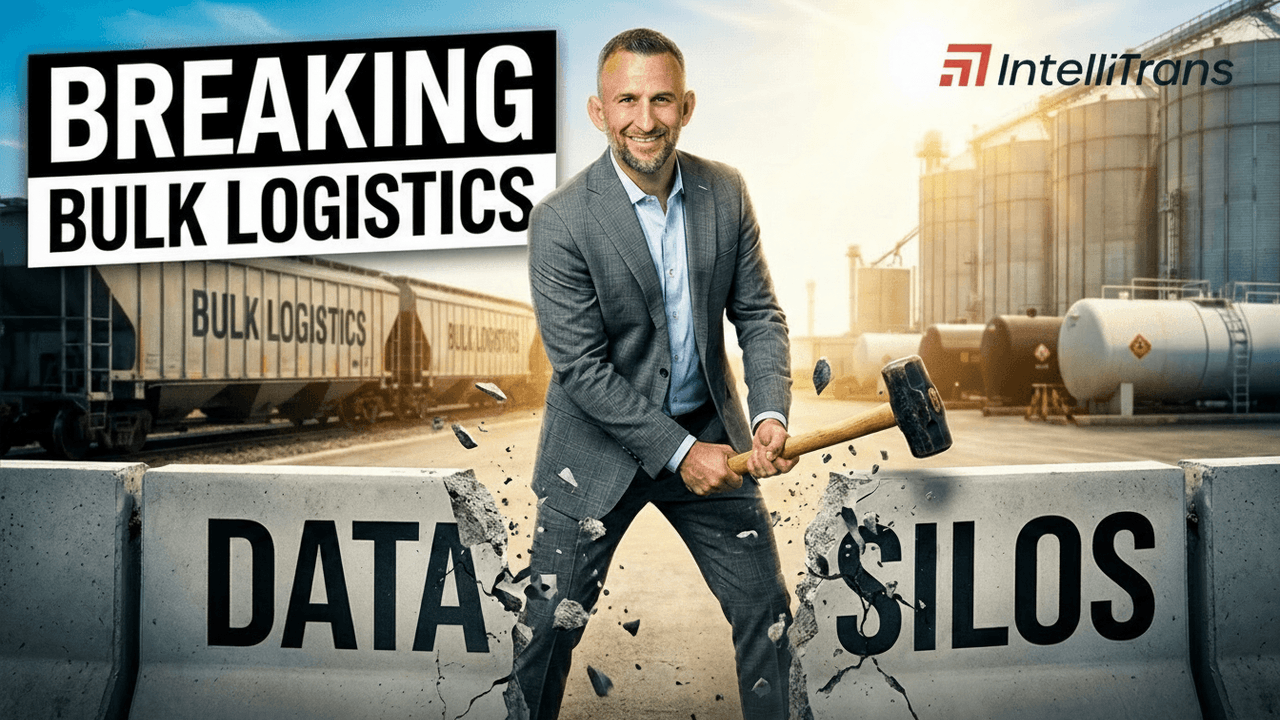
In “Breaking Bulk Logistics Data Silos” Joe Lynch and Matt Everson, Senior Vice President of Sales & Marketing at IntelliTrans, discuss how unifying multimodal freight technology eliminates operational blind spots and optimizes bulk supply chains.
About Matt Everson
Matt Everson is the Senior Vice President of Sales & Marketing at IntelliTrans. He brings more than 15 years of experience driving growth and building strong customer relationships in the transportation and logistics technology industry. He leads the company’s sales and marketing efforts with a focus on delivering measurable value and long-term partnerships that help customers succeed. He leads the commercial and customer engagement strategy that connects shippers with technology designed to simplify logistics complexity and deliver measurable value.
About IntelliTrans
IntelliTrans, a business unit of Roper Technologies, delivers multimodal transportation management solutions built by experts to simplify freight complexities for bulk and breakbulk shippers. By combining real-time data, predictive risk management, and expert support, IntelliTrans provides insights to help shippers reduce costs, prevent disruptions, and deliver with confidence. IntelliTrans’ mission is to keep the world’s goods moving by giving transportation professionals the clarity, confidence, and control to deliver every time. Established in 1992, IntelliTrans is headquartered in Atlanta, with offices in Arkansas, London, and Sweden.
Key Takeaways: Breaking Bulk Logistics Data Silos
- In “Breaking Bulk Logistics Data Silos” Joe Lynch and Matt Everson, Senior Vice President of Sales & Marketing at IntelliTrans, discuss how unifying multimodal freight technology eliminates operational blind spots and optimizes bulk supply chains.
- Serve the Core Bulk and Breakbulk Sectors: Focus technology and operations on shippers of heavy, raw commodities—essentially “anything that comes out of the ground,” including oil, gas, chemicals, plastics, metals, agriculture, and forestry products.
- Dominate the North American Rail TMS Market: Establish market leadership by processing 40% of all North American railcars (excluding intermodal) on any given day and maintaining direct data connections into 95% of Class II short-line railroads.
- Unify Multimodal Freight to Break Data Silos: Eliminate operational blind spots for large Fortune 100 shippers by combining rail, truck, yard management, and barge data into a single comprehensive execution platform.
- Leverage Historical Data Cleanliness for AI Readiness: Utilize decades of specialized operational expertise and human-verified data cleaning to build high-quality datasets, positioning the platform to deliver highly accurate predictive insights as supply chain AI evolves.
- Optimize High-Value Asset Utilization and Fleets: Provide advanced forecasting and analytics tools that calculate a shipper’s exact fleet size requirements, ensuring optimal lease management and minimizing idle railcar costs.
- Mitigate Overcharges and Prevent Demurrage Fees: Protect shippers from costly detention, storage, and demurrage fees by deploying automatic alerts, verifying car placement data, and actively auditing carrier invoices.
- Track Scope 3 Emissions for ESG Compliance: Help shippers meet modern environmental compliance standards through certified state-by-state tracking of mileage, weight, and CO2 emissions across all transportation modes.
Learn More About Breaking Bulk Logistics Data Silos
The Logistics of Logistics Podcast
Joe Lynch: [00:00:00] Hello, friends. Welcome to the Logistics of Logistics Show. My name is Joe Lynch. Thank you so much for joining us today. Today’s topic is breaking bulk logistics data silos with Intellyx Trans and Matt Everson. How’s it going, Matt?
Matt Everson: I’m doing well. How are you doing today?
Joe Lynch: Doing great. Doing great. So Matt, please introduce yourself and your company and where you’re calling from today
Matt Everson: Yeah, hi Matt Everson, Senior Vice President of Sales and Marketing at IntelleTrans. We’re based out of Atlanta, Georgia. I’m actually [00:00:30] out of Nashville, Tennessee. And yeah, we are a shipper TMS. We work in the bulk and break bulk logistics arena, so mainly with organizations and shippers that have a lot of commodity-driven raw materials inbound and outbound from their f- facilities
Joe Lynch: Yep. So Matt, you guys are a different kind of transportation management system, and I didn’t understand it. But tell us the transportation management system that, the type of customers and the type of commodities or products you’re moving.
Matt Everson: Yeah, so [00:01:00] think about it like this. Anything that comes out of the ground, that’s the easiest way I can explain it. So you think oil and gas aggregates, right? Or copper. We have cop- copper customers, gold customers wheat, soybeans, anything on the agriculture side trees, right?
Lumber before it’s made into building products
Joe Lynch: M- I- I’m assuming it’s also milk and stuff that is liquid
Matt Everson: Yeah. Yep. Milk, food grade it, definitely gets moved. But the thing about milk is it’s mainly milk runs. That’s where the term milk runs
come from. And so it’s more lo- more [00:01:30] local than it
is, International I guess all around North America. So we don’t typically see milk on rail cars or, tanker trucks cross-country.
But it can happen. Yeah
Joe Lynch: Yep. And I think most of us are familiar with s- products that can go in shipping containers, containerized freight. And by the way, th- not to confuse it too much, but I know some commodities are traveling in containerized freight or containers right now. But [00:02:00] when you see those railroad, railroads roll by and there’s the tankers they’re all sorts of chemicals, oil, I don’t know what the liquids are.
But I just stopped at a train the other day and I thought, “I’m gonna get out of here. This one’s gonna be too long.”
And I sat and I watched for hearsay, Matt, ’cause I was like, “I know I’m gonna talk to those guys.” I think more than half of the cars were tankers, and we don’t usually think of that type of, [00:02:30] I don’t know is it just called bulk?
Is that what you guys call it?
Matt Everson: Yeah, it’s bulk. It’s bulk and that’s exactly what it is. These so 40% of all North America rail cars, excluding intermodal, come through our system on any given day. So we are the market leader in rail TMS, and it gives us a lot of good data, and we’ll, I know we’ll talk about that a little bit later.
But yeah, that’s exactly what we’re talking about. So there are different types of rail cars, gondolas hoppers box cars, flat cars tanker cars. There you see it on the railroad. There, there’s probably at [00:03:00] least those chains of 100, there’s probably about 40 of them that are running through our system at any given time
Joe Lynch: Yep. So if I’m using the IntelleTrans TMS, where does this start? Where does it stop?
Matt Everson: Yeah. So it’s a full-blown TMS, right? And you think of a TMS, it does everything from, managing the planning, the rates on the front side through the execution, the bill of lading documentation the tracking of the shipment, which is pretty, pretty much the most popular a-and needed function of rail.
And then you’ve got the invoices that come [00:03:30] into you and the reporting analytics. So we’re a full-blown TMS. We do it all. On top of that, though we have modules that are very important to it- rail’s gonna be different than over the road, of course, but on the rail side, it’s managing your fleet, right?
So managing your lease, fleet sizing analytics tool to make sure you, you have the right size of fleet. Yard management is a big piece of what we do, right? So a lot of customers who have the rail yard out in the next to their mill or plant, are gonna have to manage those cars and, separately and individually.
Yeah.
Joe Lynch: Y- yeah. So we’ll [00:04:00] get into that. Those are the class, what, class B, class… Is that what they call them,
Matt Everson: y-yeah, class ones, class ones,
Joe Lynch: oh, I’m sorry. Cl- there’s class ones are the… Class ones are the cross-country ones, and then the,
Matt Everson: The short lines, yeah. We just
call them
Joe Lynch: short
lines are the class two. Is that what you call
Matt Everson: Class two short lines. Yep, exactly. I used to call them class A. I was a military guy so I used to, I used to– Uh, when I first got in, I called them class As, and I was like, “Wait that’s our, that was our uniform in the army.” But
Joe Lynch: I call the class two [00:04:30] railroads the ones that you think are abandoned
Matt Everson: Yeah. There, there sh– there usually– there’s over 500 of them in America these
Joe Lynch: Although it’s critically important and it seldom comes up on my podcast. I’m gonna do a an episode in a f- week or two on it. You- we know about the class one railroads that are going along the expressway and you see the usual names on those. And then there’s these class two that might just go 50 or 100 miles that go [00:05:00] to pick up aggregate stuff, that goes pick up the bulk stuff.
And it’s a fantastic solution if you have volume and certain types of product. And if you don’t, you can call those guys all day. They don’t even answer the phone. I swear they– I, I’ve said to you before we hit record that’s a group that you have to find them and then beg them to, to work with them.
A- and I think part of it is because not everything’s a good fit for them
Matt Everson: Yeah. Yeah. And they are selective on, on [00:05:30] the type of c-commodities and types of customers that they want on those rail lines. But you’re right. There, there’s some two short lines that are five miles, two miles, right? And they’re just going back and forth between a quarry, and the main line.
But it’s a much needed move, right? The thing about rail is unlike truck you can’t just steer off and go off into the corner, and pick something up. You gotta be within the rail.
Joe Lynch: Yeah. It’s it’s a critically important part of logistics that sometimes gets missed, and this is usually not the end [00:06:00] product that you might be receiving from China. It could be the raw goods that are being sent to be processed. The United States, somewhere along the line, we lost the manufacturing, the production, and the processing piece, but kept the agricultural and the I don’t know what you call it, mining mining, d- drilling, all that piece we kept here.
And we know this is a country that is filled with natural resources, so there’s good reason [00:06:30] to do it, and we’re really productive at that. So that is an area that we excel at
Matt Everson: Absolutely. Yeah. It’s it’s a good, it’s a good business to be in, honestly. It’s niche, right? But it’s definitely What people don’t realize is there’s so many nuances within rail, unlike truck that you need to understand about your shipments, right? And so we really help e-evolve the shipper into understanding that it’s, managing your assets and managing your, your the visibility of your shipments in a very tight [00:07:00] format can actually save real hard dollars.
And, we connect into 95% of those class twos. The hard part with those class twos is they don’t they don’t all have the the IT teams or the, the technology, to get data to where it wants to go. But we’ve done a very good job. We’ve been around since 1992, so 34 years of connecting with those class twos, and so we’re at 95% of all the class twos we connect into today
Joe Lynch: Yep. So what who are your customers? Are they the class II railroads? Are they class I railroads? Are they shippers? Who gets, who buys [00:07:30] Intellitrans?
Matt Everson: Yeah. Yeah. Our customers are the biggest customers in America, right? We’re talking the Fortune 100 companies that,
Joe Lynch: the ship, so generally the shippers
Matt Everson: The shippers, yeah. Yep. The shippers, sorry. Yep.
Joe Lynch: I look at the world now as shippers and people who move stuff.
Matt Everson: That’s right. That’s right. So think of the biggest oil and gas companies, think of the biggest chemical companies. Tho- those are our customers
Joe Lynch: So oil and gas anybody who’s got bulk stuff, right?
Matt Everson: Chemicals, plastic, even the forestry [00:08:00] lumber, some of the biggest in North America are with us there.
Joe Lynch: do a-, do you do ag?
Matt Everson: Yeah, egg, some of the biggest egg companies. Yep,
absolutely
Joe Lynch: right. All right. Sounds good. We’ll get more into that in a minute. Matt, tell us a little bit about you. Where’d you grow up? Where’d you go to school? Some career highlights before you joined Intelletrans, and why did you join Intelletrans?
Matt Everson: Yeah. Yeah. Hey, thanks for asking. So I grew up in South Dakota, middle of cornfields and wheat fields America. I know I’m a kind of a unicorn out there, not many of us around. But I,
Joe Lynch: now what happened when you left and moved to Nashville? That must have [00:08:30] been devastating to the state.
Matt Everson: I s- I had a couple stops in between, right? But you’re right, yeah. My family’s still back in South Dakota, so I love going back to visit. I went to school at the University of Minnesota. I actually was a wrestler there.
Joe Lynch: To get out of the cold?
Matt Everson: Yeah, you gotta cold. Yeah, a little chillier, a little chillier there. But no I was an athlete there at Minnesota and got… W- when I was done with school, I had a little stint in the military over in Iraq where I actually, fu- funny enough, I was in logistics there, so we were doing convoy [00:09:00] escorts. So
Joe Lynch: That’s the real, that’s real logistics where p- people, we think our business is life and death. Your business was life and death, and you had to do it while people were shooting at your customers and you
Matt Everson: Yeah. It was definitely a different experience. And, I never, I kinda look back at how I got into logistics and transportation and, y- somewhere along the line, I think, God pointed me in this direction. But it really did start back I was still in college, but when I was over- overseas helping transport trucks from the southern part of Iraq to the [00:09:30] northern part of Iraq through Baghdad and through through that.
And that was in 2007. So that was quite a while ago. But but yeah, I got back from finished school, got back from Iraq, and my first job out of college was at a software company, and I didn’t really know what I was talking about in the beginning. It was at Infor. It actually was called Lawson at the time.
Joe Lynch: Oh, great company
Matt Everson: Yeah. We– I was at Lawson when Infor bought us, and that was down- downtown St. Paul. Was there for a little bit longer before going to Oracle. That’s where I got my first taste in tech- [00:10:00] transportation technology, s- selling Oracle Transportation Management amongst some other edge products.
But started learning that. Met a gentleman there that brought me over to a different company called AFS. I was at AFS for a couple years learning LTL, so different part of, very specific to small package parcel LTL. Left there went to another TMS called, I don’t know if you’re f- familiar with Sterling TMS. Remember the old Sterling TMS?
Joe Lynch: No, I don’t know that one. There’s so many.
Matt Everson: There are so many. Yeah. Sterling got bought by IBM, and [00:10:30] then they–
Joe Lynch: Oh, wow
Matt Everson: then IBM divested it to a company called Kiwe that was based out of Europe. And at Kiwe for just a short period of time, and I was there when they bought Lean Logistics. So Kiwe bought Lean Logistics, so what everybody knows,
Blue
Joe Lynch: that name
Matt Everson: yeah, so Blue J Solutions right, really is Lean Logistics and Sterling TMS together. And and so the Blue J was obviously got sold to E2 open in later years. But I was actually went to a startup company. So I was a a co-founder, um, [00:11:00] of a company called Freightwise out of Nashville, Tennessee, which is what brought me to Nashville ul-ultimately. Uh, so we started the business back in twenty fifteen.
I unfortunately wasn’t an owner but I was definitely one of their very first employee, was there from the very beginning. And so that was an LTL small package parcel business that we grew a lot. In twenty nineteen, we were the second fastest growing company in America- Okay
according to Inc. Five thousand. So we had rapid growth, and I’ve seen, what a [00:11:30] TMS does. So you count the TMSs I’ve seen, the number of them and, you know, we saw it, it was a f- it was a fun period of time, right? And then the business got sold to a PE firm in twenty twenty-two which you was about my cue to start thinking about doing something different, right?
And so I never really got into bulk and break bulk logistics until twenty twenty-four. I’d heard of it. I’ve had conversations with customers, of course, about it, but didn’t really dive deep into it, until I came over to Intelitrans, and that was in late twenty twenty-four. So I’ve only been at Intelitrans a y- almost two years [00:12:00] now. But
Joe Lynch: So what made you join IntelliTrans? You obviously are a TMS veteran and a expert. W- what did, what appealed to you about IntelliTrans?
Matt Everson: Yeah. So IntelliTrans has great technology, and I feel like it’s the TMS that most people haven’t heard of. And honestly, when I talk to our customers, they love it. They love the system, what the– its functionality, what it’s capable of doing. And I really saw that as a diamond in the rough, right?
A really valuable [00:12:30] execution-ready platform that is only gonna grow and enhance. And, th-there’s been– we’re owned by Roper Technologies. And so Roper organization, also owns DAT. Um, so DAT’s our sister company, which I saw as an opportunity. But we, are– worked with Roper, but we’ve got a pathway forward here.
We’re investing heavy into the product and that’s what opened my eyes. I’m like, “Hey, if we’ve got the capital to go make changes and, y-do [00:13:00] something, better than, that IntelliTrans has ever done, and n-having the, leadership team with the insight and foresight to do then let’s do it.
Let’s, Hey, I’m all on board.”
Joe Lynch: Yeah. Matt I definitely have heard about IntelliTrans. I looked it up or said the word and for the last, I don’t know, month or two, I’ve just seen nothing but IntelliTrans commercials on YouTube. And I was like, so I’m hoping this
Matt Everson: That’s from me, Joe. I think I, I think I launched that campaign.
Joe Lynch: I, and I’m just gonna tell you I’m not gonna buy it.
I’m not a, I’m not a [00:13:30] large shipper of oil, gas, bulk, or chemicals. I’m just not.
Matt Everson: Yeah, I have to tweak who who all receives that a little bit, but,
Joe Lynch: I used to see there’s a local jewelry store and it’s got their stuff forever. And I remember I said I’m not getting engaged. Why am I getting all these engagement?” And then a friend of mine goes, “Maybe you are getting engaged. Google knows better about what you’re doing than you do.” I was like, “Oh, you– Good point.
Good point.” I wanna get some definitions from you. I– people hear the term break bulk all the time, and we put that in our title here, say break bulk br- breaking [00:14:00] bulk logistics silos. But first, what is break bulk?
Matt Everson: Yeah. So y-you think of bulk the whole container, right? So the bulk is everything that goes in a tanker truck or tanker car. It can’t really be broken down. But break bulk is s-similar to bulk, it’s just it can be broken down, right? Break bulk would be, “Hey, I’ve got all this rice, and I can take this rice and put it in this bag.”
That’s a break bulk, right? I can take the, all of these chemicals and put it in this tote. [00:14:30] That’s a break bulk, right? ‘Cause you’re breaking it from the bulk
Joe Lynch: So I have a huge t- so I have a huge tanker. At some point it has to become totes of chemicals or bags of rice.
Matt Everson: Or So or yes. Yeah, exactly. Or even on the lu- lumber side, right? You can– it’s bulk when they’re all together, but as one log from the trailer comes off of the bulk, it’s now break bulk, right? So it’s just breaking the bulk into multiple,
um
Joe Lynch: Which is ultimately how we’re [00:15:00] all gonna consume it. We’re not– I’m not buying the entire tanker of oil. I’m gonna buy
Matt Everson: E-exactly. So if you say break bulk, it goes into the same conversation as bulk in most people’s definitions
Joe Lynch: Yep. And you guys say breaking bulk logistics data silos. So we have a huge issue in our business, and it’s not just in this side of the business, it’s everywhere. When companies created transportation management systems, by the way you’ve been in from the [00:15:30] beginning, but I haven’t. I remember the first time I saw one, I was like, “Oh, wow, this is so cool.
We need– I wanna work at this company ’cause they have a TMS.” And when you brought it to shippers, they were like, “Oh, wow.” It was just like, it was fantastic. It was the silver bullet. But what we realized after a while is that we somehow have to connect that to the ERP. For a long time, that was, that integration was expensive and timely and not timely, time-consuming, and you [00:16:00] had to find an expert, and they cost a fortune.
So I, when I worked at a 3PL, they would always say, “Can you connect directly to our ERP?” We would say, “Yes,” and it was like 20 grand or 10 grand or something, and no one ever did it. Now we’re able to connect much easier, much faster, which is good. In the meantime, we have warehouse management systems, and we have some of our data over there, and then we have visibility platforms like MacroPoint or [00:16:30] P44.
And then we also have all sorts of systems that track and see if this is a reliable carrier. We just have all these different systems and all of our information in it, and I think, the big shippers in the world, they want flow for their supply chain, and we gave them a whole bunch of siloed, silos, which doesn’t allow for flow.
And I think now the whole industry is saying, “How do we get to a place where I can see all my data in one place, [00:17:00] so I can actually make decisions without opening 16 screens?”
Matt Everson: For sure. For sure. And it’s definitely evolved even the last y- 16 years that I’ve been in and out of TMS systems, right? It’s evolved y- you know, big time. And you’re right it’s about the data, and there’s so many silos within the data that make it very hard for a shipper to consume and understand, right?
And you might say what do you mean by that?” First of… So inbound logistics is very heavy in bulk, bulk logistics, [00:17:30] right? So inbound logistics is think raw materials coming in for production. And if you, i- if you miss a or delivery’s late and you have what’s called unplanned downtime, that could be a very huge cost to the organization, right? And those are things that y- from a macro level, people understand pretty well, but from a micro level, how is it managed? You’d be alarmed at how many companies, big companies have unplanned downtime in, each year or every other year, right? It’s actually a quite an alarming number. So having visibility is a very key component, and that’s [00:18:00] largely what people have been looking for. But the… What’s interesting and I’m gonna shift a little bit to the truck side here because, some on the road. But when you look at carriers that are able to get commodities to you or even pick up and deliver to your customers, what oftentimes overlooked and I think of TMS as downstream from the WMS, right?
Because you got your WMS order, the order gets converted to a shipment, and you might have multiple orders on a shipment, you might have multiple, et cetera. But from that execution piece on TMS, You ha- you have to understand a lot about your carrier. So there’s a thing called total cost of [00:18:30] ownership from a carrier perspective that, that really needs to be understood. And it’s not just what does my carrier cost me for this particular shipment? It’s what does my carrier cost me amongst the cost of that shipment, but also on-time pickup, on-time delivery, right? OTIF metrics rejection rate percentages. What– how often are they, our loads?
At what time? How quickly, right? All of these start building a carrier performance scorecard that needs to be measured. And, prior to [00:19:00] even most recently with the use of AI and with everything that’s coming in purview there, it was very hard for a shipper to understand all of those metrics, right? With- especially without a TMS, but when you think of what a TMS connects to, it connects to the DAT for benchmarking rates. It connects to, the visibility platforms such as MacroPoint or FourKites or P44 trucker tools, right? And so holistically, you’ve gotta have all of these different data points coming in to help you make a decision based on what is the total cost of [00:19:30] ownership for a specific carrier.
And I think that’s what shippers have been hungry for a long time, and we’re finally starting to get there.
Joe Lynch: Yep. And am I right to say that, I know you, you described probably this five or six different transportation management systems you’ve worked at in the past. Most of those would not be appropriate for people shipping bulk
Matt Everson: The so yes, that is a fair statement. Most TMSs can handle most mo- all modes of transportation. It’s just when you get into the [00:20:00] nuances of requirements within those carriers and the carrier types that you’re the equipment types that you’re trying to connect into, they differ from industry to industry, right?
So CPG and distribution, they have different metrics. On time in full I’d mentioned, right? Versus, somebody on bulk and break bulk that doesn’t have that. There’s metrics that are gonna be important from yeah, so the, from a ca- the type of carrier that you’re moving with, right? So let me, so sorry, I lost my train of thought there, but I got it back [00:20:30] now. Sorry about that. Sorry about that. But, um, when you have equipment type as a very important aspect of your shipment, you wanna make sure you’re connecting to carriers that you have enough data from those carriers, right?
Before you do it. So bulk break bulk carriers are gonna be in a different pool than your dry van carriers. They’re just gonna be different. And so you wanna make sure you have those connections. They’re able to use the system and communicate back and forth with your users.
Joe Lynch: Yep. I remember the, a TMS I was using, and we would do mostly less than [00:21:00] truckload, but also truckload. And we did well with that. That w- the system was made for that. And and then every once in a while, we’d end up doing some ocean shipping, and my team would just make it work. And then every once in a while, someone would say, あ。 they, we had some parcel shipments in there that just didn’t– the system wasn’t meant for it.
And so I always remember thinking like, “Hey, you…” I know s- the nature of transportation management systems to say, “Yes, we can add those fields. [00:21:30] All we have to do is toggle those fields on.” And and r- and by the way when you think about drayage, I know there’s drayage transportation management system.
For those of you who don’t do it every day, drayage is just usually going from the port to a rail head or maybe to a warehouse. They’re the sh- short runs 50, 100 miles no more than that usually. And they’re, sometimes older trucks, and sometimes they’re just picking up a container and d- dropping it off, so it’s a chassis usually, or a flatbed.
And the [00:22:00] drayage TMS companies, and I’m not even gonna dispute this because I don’t know, they would say, “You need a unique drayage transportation. If you’re a drayage company, you need something unique.” And when I talk to other transportation management systems, usually the newer ones say, “Joe, all you gotta do is add these five fields.
When we c- have those five fields, just t- toggle them on.” And it’s it’s a pro- it’s a problem, and it’s always the problem with software. I’ve dev- developed software in the past where people go, that’s [00:22:30] a perfect engineering tool. That’s it. T- but if you added these six fields, it’d be good for manufacturing, too.”
And then as soon as manufacturing starts getting into it, they’re like, “We need this,” and then you say, “Oh, we got a hodgepodge tool again.” And I think it’s really hard to keep a roadmap that makes complete sense and is completely aligned to your ideal customers.
Matt Everson: Yeah. Yeah. And adding to that I agree. I think somebody who’s not deep into the details on how developing technology, yeah, [00:23:00] it’s easy. You have these five fields, it’s simple, right? But it’s the– it’s more than that. And you think about TMSs, they usually start in a single mode and they expand to another mode, right? But the fields needed on- in the database behind it are very different, and the nomenclature is different, right? And so you can’t use the same fields. You gotta add fields, and then how does it interact with each other, and how do you make sense of the data when you’re trying to make sense of it in reports?
And you can’t, you gotta isolate the reports. And so yeah, it’s, it is, it’s very difficult. But I’ll use your drainage [00:23:30] example. I– it’s fun-funny I know this story too well actually. Uh, but it is, you’ve gotta add the, the fields that are needed to bring the containers in the first, the the s- the sail dates, right? When you gotta get, you know, it to, to the port and back and forth, et cetera
Joe Lynch: How many days you have to pick it up, that’s something
Matt Everson: And then you got, and then you got, street drops, street hooks, dropping hooks, right? And so the rates though, now you start thinking about the rates. The rates are usually an all-encompassing rate for both moves. And so do you… Does, is it a multi-stop shipment now? Or do [00:24:00] you stop and then pick it up and send it back?
And so you got live loads, and so it, it gets to be a little bit more nuanced, to where it’s not as easy as adding five fields, and that’s part of the problem because everyone wants to grow. In order to do that, you gotta be able to be smart with how you manage the data
Joe Lynch: Yep. So g-getting back to this, you guys are working with some of the largest shippers in the world, and it is the bulk stuff. It is not you’re not delivering stuff to Target. You’re not delivering [00:24:30] stuff to an assembly plant. You’re more the raw goods that’s came out of the grounds, whether it’s oil or gas or agriculture.
And they have the same issue that the rest of us have, which is we have a whole bunch of data silos, and I’m trying to make good decisions, but my information is in multiple places. How does IntelliTrans help me get all my information in one place so I can make the right decision for me and my customers?
Matt Everson: [00:25:00] First and foremost, I think there’s there’s a lo- lot of TMS systems out there that are either rail or truck, right? When we look at some of our competitors, they don’t have both truck and rail. And truck and rail, especially on the bulk side are very closely related, right? The, the– it’s the same equipment type. One, one has wheels and one has a track. Uh, But it comes down to how much weight you can put on a rail car. It’s usually about four times what you can put on a truck, a regular truck over the road, right? You got weight limits on the road, [00:25:30] and you have much higher weight limits in, in rail. So the decision matrix on whether I should take this amount of qu- this quantity of commodity and inventory, do I put it on rail?
Do I put it on truck and… and what about the days in transit? And then not only what are the days in transit for what we expect and what the carriers tell us, but what are the actual days in transit that all of our customers consolidated together are, are– that we’re seeing in our system.
What we do is we do dynamic ETAs based on what we’ve seen in the [00:26:00] market, as early as l- yesterday or the last week. But we’ll see congestion in Chicago. We’ll see congestion in Houston and say, “Hey, if you’re in there, add another four days because that’s what it’s taking to get out of there right now.”
And so that kind of information is valuable when, c- ta-take it up a level, the decision tree needs to be made at a higher level
Joe Lynch: Yep. I’m gonna ask some more basic questions because again I talk to over the road guys all the time. So I have these class one railroads that go back and forth across the [00:26:30] country. What are some of the names of those big companies?
Matt Everson: BNSF, CSX NS
Joe Lynch: So we all see those Norfolk Southern, CSX, we see all those. But then there’s these, as you call them, class two railroads, which could be very short line. These are the short lines that deliver stuff to the class ones. And they, I, I– there’s one not too far from my house, and I used to always say, “Wonder what this rail, where this rail line went?”
And never, it never made sense. I was like, I [00:27:00] never understood. I would call it abandoned, and then I started this podcast and I go, “Oh, no, it’s one of those class two.” So probably a few days a week when I’m not there, somebody’s moving up and down that class two railroad, and it’s most likely moving to something that is an aggregate, whether it’s a quarry or oil or some sort of processing something.
So we have visibility tools that we use for over [00:27:30] the road, and I can s- I’ll tell you where that driver’s at right now. I can tell you where that load’s right now. I can tell you where that truck’s right now. Do you have the same visibility when it comes to rail?
Matt Everson: Isn’t the answer yes? Yes. So what a lot of people don’t know is rail cars have an RFID reader. All of them have it, and it becomes their license plate for that rail car. And so all across North America, there are readers that are on the tracks that read your rail car as they go past them. And so the, this is owned and maintained and operated by Railinc [00:28:00] actually.
The rail carriers the rail carriers push the information to Railinc, and Railinc is a function of all of the class ones
Joe Lynch: So is RailLink your visibility platform for the rail?
Matt Everson: No. It is the source of it, right? And I think that’s one key component. There’s a lot of companies out there who do some rail TMS through EDIs that come from Railinc. It’s called CLM, Car Location Master, right? That’s the EDI form. But, getting the data isn’t hard.
It’s what– it’s making sense of the data that becomes difficult, right? And take that [00:28:30] data and, not all the time does the carrier update the data. Sometimes something, a car gets what’s called constructively placed next to where it needs to be unloaded which is when it’s called ac-actively placed. And so CP and AP are events within the rail shipment, right? And sometimes when the carriers don’t update the CP data, it can throw off all of your dataset. It can throw off how long is my transit time, right? How when is– what does my turn time look like? How [00:29:00] long does it take to get unloaded, right?
All of those things are very important metrics. But what we do is we actually take, we have some technology to do it, but we also have a team of people that inc- that are included as part of our software that, that go in there and clean the data for all of our customers. And we’ve been doing that since the inception of IntelleTrans, which, now we’re entering the era of AI.
And boy, do we feel lucky because we have a lot of clean data for years and years of all of our customers, all industries, so we can really help understand what is the actual transit time? What actually… And [00:29:30] so it, it really p-projects on to our customers real live insights on what they need to know about moving their fleet cars at any point in
Joe Lynch: So where do the data silos show up in this business?
Matt Everson: Yeah. So I think it’s a lot of different places, right? You’ve got your leases you gotta manage. You know, you’ve got–
Joe Lynch: Leases of what?
Matt Everson: Of your rail cars. Yeah. So it’s common in, in the rail industry for shippers to either own or lease their rail cars. So not un- unlike truck, truck is where, you [00:30:00] basically are renting a car, to come pick up and then take it to its final destination, and then it’s done.
It’s o- you’re over with it. Rail is all about visibility of your fleet, right? And because you have your own fleet, it’s yours. Um, there, it’s a two-way trip down, loaded, back, empty. And so how long does that take, right? In, in the transit time that, that, that does take impacts how many cars you actually need, how many cars you have to go lease, how many cars you have to go buy. And so it’s the [00:30:30] measuring, everything from, all right I mentioned a few of them. Transit time, turn time, how many fleet, your leases, when they’re expiring. When do I have to have maintenance on my own cars? When do I have to have maintenance that is scheduled for even my leases? It all plays a role, right? And so you can see how, if one data point’s off, it really throws off your entire supply chain and what you can move and when and how often
Joe Lynch: Yeah, I can see where if I have to manage leases of rail [00:31:00] cars that’s having my own fleet of c- of trucks, but it’s not exactly, obviously, because of the… I was thinking about this as we’re talking. A truck is going down the expressway, and if if there’s a jam up, an accident in Chicago, you go, “Oh, I’m gonna go around Chicago tonight.”
But with rail cars that are going from New York to LA, I don’t think there’s a whole bunch of just choices where you go, “I’ll just get off, I’ll just get off here and jump on 94 and go that, take it out.”
Matt Everson: So that’s right. That’s [00:31:30] right. And I’ll tell you, you usually have three options or four options, right? You– it’s either, NS to, CPKC to BN or, NS to CPKC to, Union Pacific, UP. Or you– my point is there’s not a lot of carrier s- options that you can take to get it there
Joe Lynch: So I think there’s also, I’m, I’m– correct me if I go astray here. The nature of it is there’s not a lot of players who are these Class 1 railroads and there are not a lot of options on the Class 2. If [00:32:00] you’re at the end of one Class 2 railroad, you’re not at the end of it for two. So I know they somehow have fairness in these agreements because, you’re not gonna ever see a s- Norfolk Southern or CSX say, “No, we’re not taking you out west or out, down south because we want…”
They’re gonna be able to hold you up. How do they manage kinda to k- stay competitive and fair in this business?
Matt Everson: Yeah, I think there there’s governing laws against, monopolies. And you’ve seen a lot of [00:32:30] y- rail carriers try to merge and haven’t been able to. And so it’s, it– they’ve gotta, they’ve gotta be honest with with their rates as per, what the trucking market’s doing, honestly.
Because if it’s cheaper to go truck, then people would do it. And so I think that’s usually the kind of the starting point. And then they– there’s all kinds of interchanges within these rail carriers too, and usually you’re paying for the mileage within those interchanges.
So carriers are still looking for ways that they can get the load versus [00:33:00] having to go a different route on a different carrier, right? So it’s they’re still competitive with each other, but there’s some government laws that kinda keep that– them from collaborating. And of course, the truck market plays a large role in it
Joe Lynch: Yeah, it’s interesting because not everything in the truck market, it’s it’s obviously not apples to apples. The only thing you can move on rail, or not the only thing, you have to have very high volume or it’s not worth it to come over to the rail cars. And I’m also gonna assume that it’s, the trains run when they run and they’re pretty good, [00:33:30] but they don’t want to be– I’m assuming they don’t want anything to do with just in time for any facility just because of the nature of the business.
Matt Everson: And honestly, the the big thing is inbound pipeline on rail too. You gotta know when those cars are arriving so you can get them unloaded. And the quicker you can get them unloaded, the less you’re gonna have to pay for demurrage. If you’re holding onto a system car or a customer’s car or a pool car for too long, you get hit with demurrage fees or detention fees, right?
Joe Lynch: Works just just, it works the same way as if you’re at the board
Matt Everson: Yep, exactly. [00:34:00] Exactly. There’s some things to monitor, and obviously that’s what our system can do and super exciting
Joe Lynch: Yep. So again, you work with large shippers. They’re moving bulk commodities. And I know one of the things I wrote down to talk to you about is sometimes they’re getting– those shippers are being overcharged. O- over– and they don’t have that, they don’t have the tools to say, “Wrong, we shouldn’t have p- we shouldn’t be paying that.
It arrived at this time rather than that time.” Please talk about how you guys help your [00:34:30] large shippers avoid those overcharges, or overpayments I should say.
Matt Everson: Yeah. Yeah. We do a couple different things. Fir-first, we update the events in our system, w- as they become available for us to look at. We u- we have some flags in our system to say, “Hey, why did this event come before that event? And that doesn’t look right, so let’s go back in the system and identify what’s really true.”
So we have a team, an operations team in Conway, Arkansas, a large group of them that’s really managing the data within our [00:35:00] shippers’ platform, like their version of our platform, our, their system, and making sure everything is accurate. And if we can find out that a date that the carrier’s claiming or maybe customer’s claiming that you held onto a rail car that’s not true because we have those dates in our system, that’s one way we can combat it. But we have services too that are above and beyond just cleaning the data. It’s we’ll we’ll go and we’ll go to the carriers on your behalf and fight demurrage charges for you, right? We’ll manage those costs and make sure that you’re [00:35:30] not being overbilled for anything that, that you shouldn’t be billed for
Joe Lynch: Yep. And I’m assuming that’s a big issue because anytime where there’s this many handoffs, there’s always a, it’s m- not just one company. And we ran into this with the ports, especially during COVID, where you might be charged and you say, “I couldn’t pick up my container,” and you w- y- it’s under 30 other containers and, you’re s- or 10 other containers, and you’re telling me that I’m being charged [00:36:00] because I didn’t pick it up.
I can’t pick it up. It’s not ready to be picked up, and yet you’re charging me. And and I think it’s also one of those things where, you know when the the feds got involved, they said, “This is critically important to keeping our competitiveness in the country. We can’t have our ports become a problem where people say, ‘I don’t know what the price is coming in.
I’m I might– I was billed this much, but I think I might be charged 30% more. [00:36:30] I can’t do business with them anymore.'” And there’s not that many… there’s lots of ports, but I’m assuming the same thing is going on here, where you say, “This is a critical resource to the country’s competitiveness.”
Matt Everson: Yeah. Yeah. You gotta make sure that you can get your assets when you need them, right? And a lot of our customers have their own yards where they can manage their own assets. It sometimes does go into storage, and you gotta pull those cars at the right time because the longer it sits in one location, the, the– you’re gonna hit, get hit with [00:37:00] storage fees.
So how are you managing the time in, time out of those assets from a specific location? So we provide services that help you with that. But also our tool does a really good job of saying, “Hey, watch out. You’ve been there 30 days,” or whatever it is. “You need to move this.”
And those alerts are something we set up within our system to help cu-
Joe Lynch: So this is, so you’ll help them with their asset utilization, and you’ll tell them if they say “I’ve got 20 of these cars,” and you say, “Joe, you only need 18. You’re just not using them [00:37:30] properly right now.”
Matt Everson: 100%, right? So d- I think there’s two, two points you made there. The first is you gotta use the assets that you already have right? and you gotta keep them in rhythm. Because if you have– if you’re using the same one over and over and over again, the ones that’s, that are sitting idle are gonna be collecting fees, right?
And so that’s one point. The second point is how many cars do you truly need, and so we have tools in our system that help you forecast, based on our sales forecast and based on turn time and transit time by this location [00:38:00] and this type of car and this kind of commodity, how many cars do we need, in this lane over the next 12, 24 months?
And so we forecast that out for our customers as part of one of our tools that really gives them the… l- I always say it’s the Goldilocks effect. Just, just right, too much, not enough, right? And either, either-
Joe Lynch: Am I also assuming that if I have an asset, let’s say one of those cars, and it’s, I’m leasing it, and maybe it’s either not being used or it’s in the repair yard too often, and you say, [00:38:30] “Okay, Joe, t- time to get a new one. This one’s co- this thing’s costing you money, not making you money.” And if you’re not using your assets properly, you’re gonna need more of them.
That’s just, that’s the problem, and I think that’s where you need kind of network optimization, which you can’t do without a TMS. I guess you can. It would be really hard.
Matt Everson: Yeah, but it is hard. And, you see a lot of customers, that, that try to do it on spreadsheets and they end up like, “All right, I just need help,” right? ‘Cause it’s, it gets convoluted
Joe Lynch: [00:39:00] There’s a lot of moving pieces, and you’re not able to control everything. You’re a cog in a big machine. And so you need outside, outside insights or you’re not gonna be able to make it happen. Yeah this is very valuable, very necessary. And again, I think I, I asked so many basic questions today because I talk to over-the-road guys all the time.
I even talk to the drayage guys a lot. I talk to the rail guys very seldom. And we should also mention while we’re talking [00:39:30] that moving stuff via rail is cleaner and greener and cheaper than, in, in a lot of cases, than moving over the road. And I’ve said this before on my podcast, as I go through, if I go to Chicago and you’re driving on 94 and you go, “God, there’s every truck in America is right here with me.”
And sometimes I go, “Wouldn’t it be nice if they had their own own expressway?” Then you look over, there’s that expressway, the rail right by it. I think that [00:40:00] is a great option that we don’t often think of. I m- I imagine if you’re moving bulk, you have no choice. But even containerized freight’s a good deal for some of this.
Matt Everson: Yes. Yes. You, you don’t have a lot of options over the on, on the rail. That’s truth. But from a CO- from a CO2 emissions tracking standpoint, there, there’s– I’m gonna hit on that with the ESG governance because as companies are starting to pledge, the CO2 emissions, over the last few years, and these laws are [00:40:30] coming into place in California right now I forget, SB 592. I don’t… Are you familiar with that, Joe?
Joe Lynch: No, I’m familiar that they have a smog problem and they’re always trying to do better.
Matt Everson: Well, Illinois is not behind it. New York’s not far behind it either. They have their own initiatives coming up. But ultimately shippers, carriers, they’re gonna have to sub-submit to the state how many miles they’re traveling and how much CO2 emissions that they’ve let off in that state during specific shipments. [00:41:00] And so our system, we are Scope 3 certified for CO2 emissions tracking. And so for almost transportation, rail and truck even ocean, we can track how many emissions you have based on commodity and weight and mileage and all those things. And we even track it by state.
So if you only did 30 miles in this state and 200 miles in that state we’ll tell you how many you did per state. Um, But it’s definitely, yeah, worth noting that you can get four, four truckloads in one railcar. And a railcar doesn’t really let off any emissions.
It’s the one it’s the [00:41:30] lead train
that does it all
Joe Lynch: Yeah, it’s three, th- 300 cars on that on that
Matt Everson: Exactly. Exactly. So it’s a fraction. Yeah, a fraction. So we’re hoping, that, some of these shippers will see that maybe it is a viable solution to do rail, right? Because of that
Joe Lynch: Yeah it’s a great fit for the right stuff. And the others, you’re never gonna deliver to homes. You’re ne- the, you’re, you don’t necessarily wanna be attached to just in time or anything like that. But for the right, right commodities, it’s perfect
Matt Everson: Yeah. Interesting enough I’ll make this note. Beer. Beer gets shipped on the rail, like canned [00:42:00] beer.
Joe Lynch: Oh, can you tell me specifically which ones?
Matt Everson: in America. I don’t know if I can tell you our customer’s name but I can say it’s they put it
Joe Lynch: Just let me know where it’s driving by.
Matt Everson: Yeah, refrigerated boxcars, and they’re delivering to the distributors, and so that’s a, that’s one– an example of a CPG that is being traveled on rail just because of the bulk, right?
Because of the volume
Joe Lynch: If you’re a big shipper and you’re spending millions of dollars a year, it’s definitely worth the conversation to say, “Should we [00:42:30] consider?” Now, I was moving I was a- advising a company that was moving stuff from way 12 hours south of the border in Mexico and all the way to the northeast here. And I remember we started saying, “We should look into the rail.
Just why not? It’s a long way.” And it was a viable solution. Now it’s, it’s not as easy as saying I called a trucking company and they’re gonna go pick it up tomorrow, and this is the rate.” It’s much more involved, but if you’re spending millions of dollars, then this [00:43:00] is this is a way to look.
And y- also, it is greener, it’s cleaner, and sometimes there’s just expectations. Sometimes people say on my podcast, “Oh with the new administration come in, they said it doesn’t matter, whether we have– meet the environmental standards.” Forget Washington. It… you’ll feel better if you do.
Matt Everson: Yeah, that’s right. Yeah
Joe Lynch: Regardless of what any the Democrats say or the Republicans say, it doesn’t matter. What matters is the biggest [00:43:30] companies in America, and probably the world, are saying, “We have… We have a mission to be cleaner and greener, so let’s go.” And that doesn’t change president to president, they don’t care.
And the reason they’re doing it is ’cause their consumers want that. That’s what the end customers want. And most of us, if you go to the store and it says, “Oh, 100% recycled whatever,” you’re like, “All right, it’s an extra 15 cents, what do I care?” So we are buying that way. Your great-grandparents would’ve said, “One penny extra?
Hell [00:44:00] no. What do I care? I don’t– I’m not feeding my kids.” We’re a wealthy country. Doesn’t always feel that way, but we’re a wealthy country, and people will spend a little extra for a product that they think is more environmentally conscious
Matt Everson: Absolutely. They will. They will. And that’s ebbs and flows, I think everybody’s interested in it, but it’s how important is it today versus all the other tasks that they have on their plate. That’s the
Joe Lynch: There’s been not a lot of good options for a while. And by the way, I’m a big believer, I say [00:44:30] this all the time, I’m gonna say it one more time, I love key performance indicators, KPIs minimum, right? So you should have one that is on ti- so you mentioned carrier scorecard. So you have your carriers there, and then it says on-time performance.
That’s simple enough. It’s– And then the next thing you put is some sort of cost measure, then something about damage, and then I like to measure billing accuracy ’cause billing’s sometimes way off. And I always say add one more, which is some measure of [00:45:00] your environmental impact. And we might not be 100% there on measuring that, but get directionally correct.
That’s how it begins. And if you can say, “This is the type of truck that moved us, this is the rail that moved us,” you guys will get very accurate information. Trucking companies increasingly are getting good at that
Matt Everson: Yeah. And I’ll, and I guess I’ll I’ll leave that with this note. CarrierPoint, I don’t know if it… Fun fact our TMS, our truck over the road TMS is called CarrierPoint, and it was made for [00:45:30] carriers originally. And it got transitioned to a shipper TMS when shippers found out, “Oh my gosh, I can work with my carrier so much easier that way.”
But that is the strength of our TMS because we do give good, strong carrier scorecards and KPIs. Because if you think about the other TMSs, I say other TMSs the bigger ones that do a lot of CPG retail dry vans there’s millions of dry van carriers out there. It’s hard to keep track of them all, right?
Especially when you got brokers and stuff. In the bulk world, there’s not a lot of brokers. You don’t need brokers, so it’s all carriers. And so when you have and [00:46:00] manage pretty much all the bulk, break bulk carriers in North America already in our system, you have a really good data set to understand which carriers are performing well across a lot of different customers and industries
Joe Lynch: Yeah. I’m gonna, I’m gonna try and summarize this again. This might be a little weak on my summary here just ’cause I, I’m still under- trying to understand your business completely. But I do know this. There is a TMS that is specifically for people who are shipping bulk, and bulk is not containerized.
So [00:46:30] when you think about an ocean shipping or you think about a rail car that you can physically go in and take product out, that’s not what we’re talking about. We’re talking about those containers that might be a tanker, it might hold grain, might be some sort of chemicals. These– What’d you say?
It’s 40% of all the cars are filled
Matt Everson: Yeah, 40% of all rail cars, yeah, come through our system on any given day.
Yeah
Joe Lynch: Yeah. And so this is a different animal and it d-doesn’t [00:47:00] necessarily… matt has worked in a whole bunch of different transportation management systems. When he says those don’t work for bulk, I believe him. So there’s a reason some of the biggest shippers in America are working with you guys.
And again, when we think of bulk, it is usually the stuff coming out of the ground, whether it’s oil or gas or agriculture, some sort of chemical. This is the stuff that is going to be processed into the goods and services we get. It’s not the stuff that we’re delivering to homes. So a lot of the, what we talked about today is the class one railroads, the very [00:47:30] biggest railroads that are going all the way across the country.
Then there’s the other, the class two railroads. Those are the guys who might be going, as you said, maybe five miles. I think the longest one might be 100 miles. And those are usually going to some sort of processing facility or somewhere where they are offloading the gas onto those rail cars. And those rail cars, they move back to the class one so they, this stuff can be moved across the country.
It is an intricate [00:48:00] dance that’s going on because you’d have limited, It’s like you, you, like you have one road going all the way there. It works really well if you have high volume. That’s what that, this is what we typically are working on. And so you guys have built a unique transportation management system, which is IntelleTrans, and it is really going after companies that specialize in this.
So if you’re in metals, agriculture, chemicals, ag this will help you eliminate those blind spots [00:48:30] across rail truck and barge, and also get to those when it gets to the port. It- this is a tool you’re gonna need. S-separately, they have the same issue we do with the rest of the business, which is these data silos where all of your information’s not in the same place, so you can’t easily make decisions.
IntelleTrans pulls that information in and increasingly– You’ve always cleaned it up manually, and now you’re starting to use AI to clean that up. Hallelujah. Also, in this difficult [00:49:00] business, there are a lot of overcharges, overpayments, and you don’t wanna be paying extra, especially if it’s can’t be proven.
If somebody just says, “Hey, it’s an extra $1,500.” You’re like, “Why? What did we do?” They can help you with that, and they’re gonna get the, they’re gonna do the au- Do you guys actually do the audits, or you just give them the tools so they can do the
Matt Everson: Oh, we audit?
Yeah, we audit. Absolutely. Yep. Yeah, we’ll audit the invoices and everything. Yep
Joe Lynch: I love it. And then optimizing asset utilization. So you’re leasing these rail cars that might come to [00:49:30] your facility or to your vendor’s facility, and those assets they’re expensive. So it’s just like having a truck fleet and you say, “Hey, I got 30, 30 of these cars.” And Matt and his t- Matt and his team say, “Geez, you only need you only need like 13.
You guys are really not using them properly.” And let’s face it if you’re in one of those yards, you might get in the m- mindset of you never know, right? That one I’m using for parts. They– [00:50:00] Who knows what mentality you’re bringing to the party. But we’re all trying to get more efficient, and so if you can say “Matt and his company helped me get rid of a few cars,” I’m assuming it’s gonna more than pay for the IntelliTrans investment.
Anyway, also rail, we should mention cleaner and greener. If you’re trying to meet your environmental impact goals, you should be considering rail. Anyway, Matt Everson, put a big old bow on this one. Final thoughts on the topic
Matt Everson: Yeah, [00:50:30] no and I appreciate it. That was a great summary. We think the expertise we have in these industries is outstanding, right? We’ve been around a long time, and so if you’re having a problem with any additional charges or, maintaining data in a way that you wanna make sense of it, in these bulk and break bulk shipments and, within these industries we discussed, we can help, right?
And we’ve done so so many times and, if you’re not tracking it, you’re not managing it, right? Let us help you. We can help you
Joe Lynch: Yep. Man, I didn’t ask [00:51:00] this, I probably should have. When people come to IntelliTrans, when they finally call you or your team back, finally say, “Okay, Matt,” what is the final straw? Are they coming from like a, “We’ve been using Excel spreadsheets,” or are they using a TMS that wasn’t built for this? What tool are they moving from when they move to IntelliTrans?
Matt Everson: Yeah. Great question. One of two is pr-pretty much most common. First we call them greenfield, not using a system, mainly spreadsheets, mainly emails. That’s, that’s–[00:51:30]
Joe Lynch: Oh, that’s a painful thing right
Matt Everson: That is a painful thing. And the other piece of it is if they’re only using a rail TMS for tracking, right? Um, ’cause there are rail TMSs that do a decent job of tracking the shipment without much insight, of course.
But, um, a full rail TMS should do everything from managing leases, as we mentioned, and maintenance, repair, and your yard and, um, giving you insights on what to do with
Joe Lynch: They’re coming from a little less comprehensive tool
Matt Everson: Yeah, exactly. Yeah. Those are pretty, pretty common
Joe Lynch: [00:52:00] Yeah. Matt, I’ve said this many times on my podcast like a broken record. For a long time, we just wanted visibility, and then when we got visibility, we realized I want to stop I want to stop what’s going wrong. I don’t wanna just see it going wrong. When you see, “Hey, that, there’s gonna be an accident over there,” no, you want to be, the ability to stop that accident, stop that overpricing.
And that’s why you need the comprehensive tool that IntelliTrans brings.
Matt Everson: Absolutely
Joe Lynch: Anyways what conferences will we see you and the fine [00:52:30] folks from IntelliTrans at?
Matt Everson: Yeah. So this year, we go to all the Association of Rail Shippers shows, the NERS, the SWARs, the all of those. But on the truck side, the DAT, our sister company, we’re gonna be at the DAT Shipper Con coming up in September. We’re in the Breakbulk Americas
Joe Lynch: Wait, where is the DTA conference at this year?
Matt Everson: It’s in Atlanta. Atlanta this year
Joe Lynch: Ve-very nice. And that’s in September?
Matt Everson: I believe September, yeah. Yep.
Joe Lynch: I would like to get to that
Matt Everson: Usually early September if I, if memory serves me [00:53:00] right. So yeah, coming up. I just got back from Gartner, the supply chain show last month.
That
Joe Lynch: Oh, very nice. Very nice. How was it?
Matt Everson: It was good. It was good. A lot of good insight but yeah. And then we’ll, there will be like the concrete show, steel show, all those industries that we serve
Joe Lynch: Yeah, if it’s b- big and bulky, you’ll be there
Matt Everson: We’ll be there. That’s right
Joe Lynch: Matt, I’ll make sure I put a link to your LinkedIn profile, link to your website, any other links you and your go-to-market team give me, I’ll put those in the show notes my my audience can reach out and talk to you. Thank you so much
Matt Everson: Thank [00:53:30] you so much. Really appreciate it, Joe
Joe Lynch: All right.
And thank all of you for listening to my podcast. Your support’s very much appreciated. Until next time, on on- onward and upward