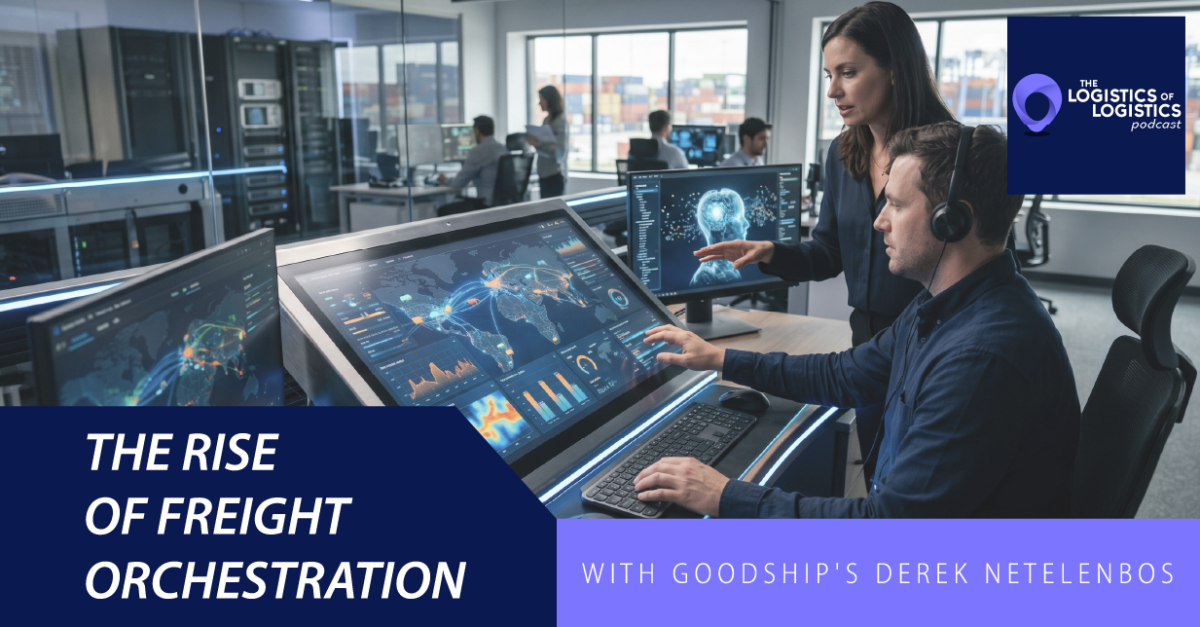
In “The Rise of Freight Orchestration with GoodShip’s Derek Netelenbos”, Joe Lynch and Derek Netelenbos, VP of Partnerships at GoodShip, discuss how an orchestration layer unifies fragmented data to shift logistics from reactive manual tasks to proactive, AI-driven strategy.
About Derek Netelenbos
Derek Netelenbos is the VP of Partnerships at GoodShip, the all-in-one platform for freight orchestration and procurement, built for transportation teams, by transportation teams. Derek brings extensive experience building and scaling partnerships and revenue organizations across the logistics and technology sectors. Prior to GoodShip, Derek held leadership roles at Parade, Metafora, Convoy, Groupon and Expedia, where he built and led high-performing teams across sales, sales operations, business development, account management, and strategic partnerships.
About GoodShip
GoodShip is the all-in-one platform for freight orchestration and procurement, built for transportation teams, by transportation teams. GoodShip unifies freight data, surfaces real-time insights, and helps teams move from reactive decision-making to coordinated, data-driven execution. With the recent launch of Laney, the industry’s first AI Transportation Analyst, teams can ask questions about their network and receive in-depth answers in seconds through an intuitive, conversational interface. Learn more at www.goodship.io.
Key Takeaways: The Rise of Freight Orchestration
- In “The Rise of Freight Orchestration with GoodShip’s Derek Netelenbos”, Joe Lynch and Derek Netelenbos, VP of Partnerships at GoodShip, discuss how an orchestration layer unifies fragmented data to shift logistics from reactive manual tasks to proactive, AI-driven strategy.
- The “Orchestration” Solution: GoodShip acts as an orchestration layer that unifies disparate data from TMS, ERP, WMS, and visibility platforms. This allows teams to move from reactive, fragmented decision-making to coordinated, data-driven execution.
- Automated Scorecarding: One of the biggest pain points discussed was the manual effort required to create carrier scorecards. GoodShip automates this process, providing a “single source of truth” that both shippers and carriers can view simultaneously to ensure transparency and performance alignment.
- Laney, the AI Analyst: GoodShip introduced Laney, an embedded AI agent that allows users to ask complex, unstructured questions about their freight network. Instead of sifting through pivot tables, users can ask Laney to simulate scenarios—like the cost implications of reallocating volume from an underperforming carrier.
- Modernizing the RFP Process: Traditionally, RFPs were “root canal” events done once a year due to their complexity. GoodShip streamlines procurement, allowing shippers to run more frequent (e.g., quarterly) mini-bids with high-fidelity data, which reduces risk for carriers and leads to more resilient pricing.
- Expansion to LSPs and Brokers: While GoodShip started with a focus on shippers, the platform has officially expanded to help Logistics Service Providers (LSPs) and brokers. This helps the “sell side” respond to bids more efficiently and manage their own carrier networks with better intelligence.
- Rapid Deployment via Flat Files: To avoid the long implementation cycles common in logistics tech, GoodShip specializes in ingesting “flat file” data (spreadsheets, scraped emails, etc.). This allows them to go from contract signing to full deployment in just three to four weeks.
- Data as an Asset: Derek emphasized that every company’s historical operating history is a “gold mine” of insights. Orchestration is the process of mining that data to uncover hidden efficiencies that were previously buried in tribal knowledge or disconnected systems.
Learn More About The Rise of Freight Orchestration
Learn more about Shipper offering
Learn more about Broker offering
Meet Laney, GoodShip’s AI Transportation Analyst
Insight to Action with Ryan Soskin