
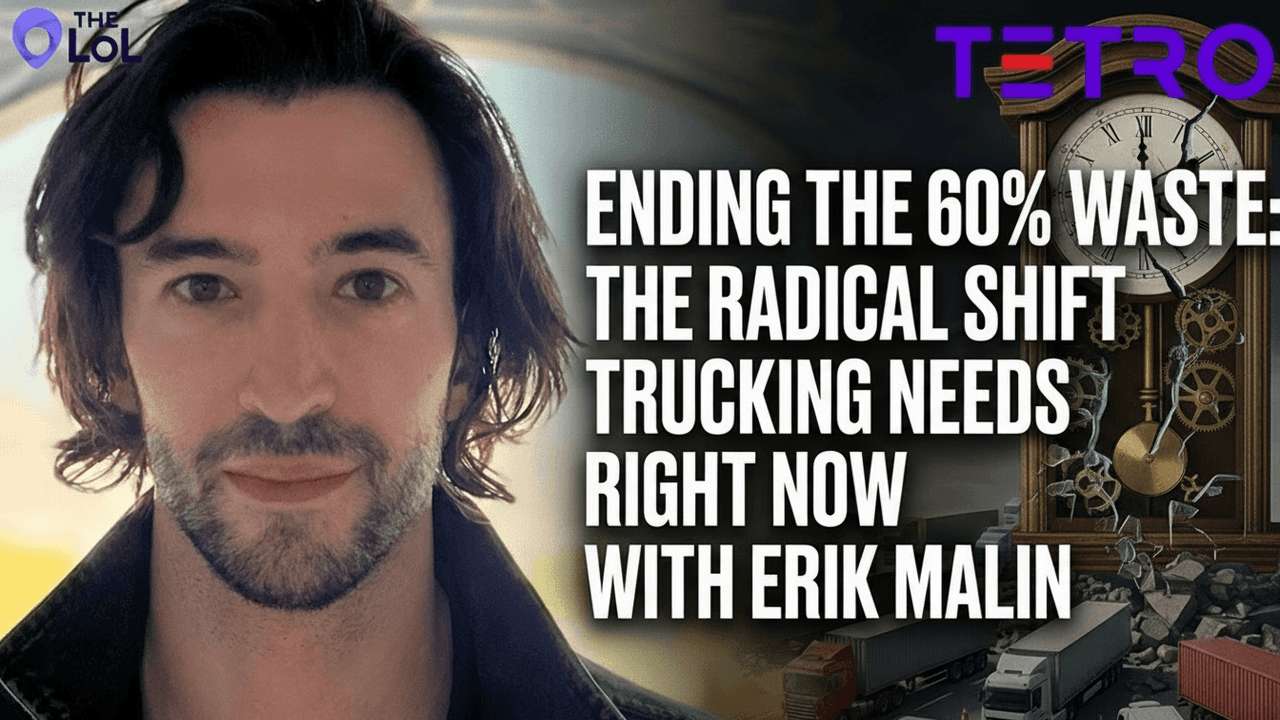
In “Ending the 60% Waste: The Radical Shift Trucking Needs Right Now,” Joe Lynch and Erik Malin, Founder and CEO of Tetro, discuss how treating trucking as a function of time, rather than miles, is the only way to eliminate the massive inefficiencies plaguing drivers and future autonomous fleets. Time is the real commodity.
About Erik Malin
Erik Malin is the founder and CEO of Tetro, a technology company rebuilding trucking for the autonomous era. He has spent his entire career in freight, where his conviction that the industry measures the wrong thing, miles instead of time, became the thesis behind Tetro. Previously, Erik was on the founding team at Baton, a freight-tech startup acquired by Ryder, and led operations at FreightTech unicorn Loadsmart.
About Tetro
Tetro is a technology company that operates its own trucking fleet to recapture lost supply chain time and build essential data assets. Because 60% of time is currently wasted in trucking, the most common job in America has suffered perhaps the greatest wage suppression in history, and autonomous technology will never reach its full potential since a driverless truck still loses that same 60%. By running its own fleet, Tetro is actively building the data asset necessary to eliminate this massive inefficiency and unlock the true potential of modern freight.
Key Takeaways: Ending the 60% Waste: The Radical Shift Trucking Needs Right Now
- In “Ending the 60% Waste: The Radical Shift Trucking Needs Right Now,” Joe Lynch and Erik Malin, Founder and CEO of Tetro, discuss how treating trucking as a function of time, rather than miles, is the only way to eliminate the massive inefficiencies plaguing drivers and future autonomous fleets. Time is the real commodity.
- The 60% Waste Phenomenon: The trucking industry suffers from massive systemic inefficiency, where 60% of potentially productive capacity is completely lost to time leakage across the entire system.
- A Utilization Issue, Not a Driver Shortage: Contrary to popular belief, the core issue in American trucking is utilization rather than a shortage of drivers. Public company financials show that drivers are often only productive for 4.5 hours out of their 11 federally regulated daily driving hours.
- The Flawed Legacy Framework of Miles: The industry still relies on a metric inherited from the Industrial Revolution—paying and planning by the mile rather than by time. This creates a severe misalignment between demand and capacity because the industry remains functionally blind to duration.
- The Autonomous Vehicle Myth: There is a flawed industry assumption that autonomous trucks will seamlessly solve supply chain issues. However, because a driverless truck will still lose that exact same 60% of dead time at facilities, autonomy cannot reach its full potential without solving the underlying time-tracking problem.
- Operating a Fleet as a Mobile Research Lab: Tetro operates its own trucking fleet not to simply be a carrier, but to generate the highly specific, proprietary data asset required to address this waste. You cannot infer or partner your way into this information; it requires proprietary hardware and execution tracking to create.
- Shifting From Miles to Time via AI: Tetro developed an AI forecasting tool that converts traditional commoditized lane rates per mile into a rate per hour before committing to freight. This reveals significant market mispricing, exposing “bad actors” (facilities that notoriously waste time) and highlighting efficient shippers trading at a hidden premium.
- Unlocking Trapped Facility Upside: Internal data shows that 30% to 70% of a driver’s on-site time at a facility is completely dead time where nothing is happening. By quantifying this data, Tetro can partner with shippers to release that trapped time, creating faster inventory turns and reducing the need for costly secondary assets like drop trailers.
Learn More About Ending the 60% Waste: The Radical Shift Trucking Needs Right Now
The Logistics of Logistics Podcast
Joe Lynch: [00:00:00] Hello, friends. Welcome to the Logistics of Logistics. My name is Joe Lynch. Thank you so much for joining us today. Today’s topic is ending the 60% waste, the radical shift trucking needs right now, with my friend, Eric Malin. How’s it going, Eric?
Erik Malin: It’s great, Joe. Thanks for having me. How are you?
Joe Lynch: Doing good. Doing good. So Eric, please introduce yourself and your company and where you’re calling from today.
Erik Malin: Sure. Calling in from Chicago. So you had mentioned my name’s [00:00:30] Eric. I’m the CEO and co-founder of Tetro, which is building the data asset that is needed to recapture that sixty percent you alluded to in the opening
Joe Lynch: And that’s the 60% that’s wasted in trucking. What is it? What’s the 60% waste?
Erik Malin: So that 60% really is the time that could be used productively but ultimately isn’t. Whether that is referring to even just a driver’s clock or it’s [00:01:00] ultimately, it’s across the entire system, so it’s not just driver dependent. So it’s really 60% of productive, potentially productive time that experiences leakage
Joe Lynch: Yep. Eric, you probably have seen all this stuff on LinkedIn that I have, and for a long time, since I got into this business, there has been a driver shortage. And everyone says, “There’s a driver shortage. We need more drivers.” And when you say that you need more drivers, can we [00:01:30] train someone in six, six months?
Yeah, absolutely. Is it a good paying job that you can attract people to? Yeah. Then why do we have any sort of issue? Now, it’d be different if you said, “We are struggling to hire NASA astronauts,” ’cause the education is years and years, or a brain surgeon, years and years. But what happens in trucking is we tend to get people, and then they leave the business.
And I think only in the last year or so, maybe two years, I started seeing Craig Fuller [00:02:00] said, “It’s not a driver’s short- d- a driver shortage, it’s a utilization problem.” And you and many, nah, I shouldn’t say many others. You and some others are saying, “Yes, we have a huge utilization problem for our drivers.”
Please elaborate
Erik Malin: Yeah, so on the first point about driver shortage, I fundamentally agree. I do not believe that there’s a driver shortage. In fact, I don’t think that we have had one. I think that all of the challenges that anybody cite can be addressed Very [00:02:30] cleanly and I don’t want to say easily, but in a non-complicated manner certainly.
But yeah, you can… it’s not a, it’s not a tall challenge to tease out from even public company financials how, drivers are only productive for four and a half hours out of their 11 that they can drive from the federally regulated hours of service limitations. So it’s, it’s– That’s not a shortage
Joe Lynch: What are they doing with that other time?
Erik Malin: It’s a great question.
It’s– And the thing is, it’s not so [00:03:00] much what the drivers are… the drivers are doing what they’re instructed to do. So they’re getting to facilities, they’re waiting. In some scenarios, they’re not even allowed on site, so they go and they stop by the local terminal, whatever it might be.
But what ultimately comes down to it is that it is a misalignment between demand and capacity and supply, and that’s what drives that. And it ultimately, specifically that nobody knows how long anything takes
Joe Lynch: Yeah. And you we’ll get more into this in a minute, but before we hit the record button, you said we even gave up on it.” Just said, “Hey, the world is un- [00:03:30] the world of trucking, the loading, the unloading, driving across the country is so unpredictable that we’re not even gonna try.” And by the way, there are dock scheduling systems and there’s a lot of good trucking companies that say, “We want to minimize the time wasted, too.”
But I think what you’re talking about, you and the Tetro folks are talking about a paradigm shift in the industry, which we’ll get into in a minute
Erik Malin: Yeah, certainly. And that, that paradigm shift, if you wanna pull on that thread for [00:04:00] just a moment it really, it goes back to the fact that miles is a, miles is an inherited framework from the Industrial Revolution when compensation by piecework was the most common method of evaluating productivity, compensating people, and trucking simply has just never evolved, and as a result, has never gone through the process of quantifying time and measuring how long each thing, each event takes.
And so yeah I in fact don’t know [00:04:30] of a single company that says that they wanna waste more time. In fact, everybody I’ve ever spoken to would love to get it back. But reality is that they don’t have the tools
Joe Lynch: E- Eric, I saw a video on a, It was on YouTube, and it was talking about the trucking business and all the different places you can f- be as a trucker. So you could work for Walmart, you could work for one of the large carriers. But there’s also a lot of owner-operators that we rely on. And during COVID, [00:05:00] there was a lot of these drivers that were trying to pick up in Long Beach or LA, and these drivers would sit for six hours, seven hours to get loaded, and then never get loaded and go home at the end of the day, and they’re in business.
So s- so you go home and your spouse says, “How’d you do today?” You say, “I made zero dollars. I got up, I drove my truck, I sat in it all day idling,” or s- it’s probably not turned off or whatever. [00:05:30] “I sat all day and I made zero money.” And she’s I’ve been reading that every, all the trucking companies are getting rich.”
You’re like, “Yeah. Today I made nothing.” Incredibly unfair. And by the way, a lot of those guys are not compensated very well, and they’re business owners. That’s the thing. When you’ve bought your own truck, the expectation is, “I’m gonna go get my piece of the American dream,” and instead, your time is wasted and it’s almost like these are the rules of the game.
You, you don’t get to change the game. You can [00:06:00] switch and go to somewhere else, but these are the rules. You get paid by miles
Erik Malin: Yeah. And so I think actually to, to that point, and by the way I wholeheartedly agree with everything you just said. That, that is– I think that is really a lot of what AB5 was intending to go after in California. Successful or not that’s at least a lot of what its intent was for the trucking industry at least.
But I think that to the point around these things could be changed, and it [00:06:30] goes back to what you’d mentioned a moment ago. The industry just broadly… you talk to anybody, and everybody’s approach has always been you don’t really know how long things are gonna take we can’t plan like that.
We can’t manage our capacity such that it’s, perfectly stacked and there’s no downtime ever.” And that’s– reality is that what our data has shown is this just simply isn’t true
Joe Lynch: Yeah. We’ll get more into that in a minute. But first, tell us a little bit about you, Eric. Where’d you grow up? Where’d you go to school? Some career highlights before you [00:07:00] joined the juggernaut that is Tetro
Erik Malin: I love that you called it the Jughead. That’s great. I– So I grew up in Michigan Southwest Michigan. Went to Michigan State. Fell backwards into the industry. First job out of school didn’t intend. In fact I spent some time in some investment banking internships and so
Joe Lynch: I remember you said that was where you thought you’re a finance guy and you thought you’d end up in that space
Erik Malin: Really loved it. The thing I didn’t– the thing that, that didn’t sit well with me is I just, I wanted to build is really what it came [00:07:30] down to. Fell backwards into transportation at what was then called CarrierDirect, now is Metafora, but working for Jet McCandless and Joel Klum. Learned a ton from both of those guys.
And from there have just have had a, a handful of different experiences at a couple different companies at the intersection of technology and transportation and logistics. Notably was at AFN. I met my co-founder for Tetra at AFN, Gautam Velacha. And after that, [00:08:00] went and ran operations at Loadsmart for a couple of years before joining Baton, where our focus was similarly but not quite the same was eliminating detention, and that resulted in a successful exit to Ryder.
So I was at Ryder for two years, and at some point when you can’t stop thinking about a problem and feel like you’ve figured out the solution, you, maybe this isn’t, global you, but at least I felt like I needed to quit my job and get back to building. So there along came Tetra.
Joe Lynch: So what hole did you see in the [00:08:30] market that made you and your co-founders start Tetro?
Erik Malin: Yeah, so when I was at Baton, I was starting a fleet for the first time, and I remember thinking, our customers are these, the largest fleets in the industry. I should spend as much time talking to them as I can. And one of the things that I’d learned is that the industry doesn’t have an understanding of duration.
The– Spoke about this earlier, but everything has always been in miles. It’s gone [00:09:00] back to the Industrial Revolution, specifically the Second Industrial Revolution, if anybody’s counting. And as a result, when you have no idea of time it is the same sort of outcome as if, let’s say, you’ve gotta catch a flight later today.
You don’t know how long it’s gonna take you to get to the airport. You don’t know how long you’re gonna be sitting in security. You don’t know how long it’ll take you to get to the gate or even how long your flight might be. The likelihood that you make your meeting that you’re getting [00:09:30] on that plane for isn’t super high, and that effectively describes trucking.
And so the gap ultimately is the fact that the industry has never quantified time. And so going back to even, like, why that’s such an important problem, why that needs to be addressed is on the one hand, the most common job in America, which is a truck driver, is getting robbed of earnings potential because it’s never been addressed.
And on the other hand, this vision that everybody has of when [00:10:00] autonomy becomes the norm in trucking, that you’re gonna have these robot trucks whizzing around nonstop, is also a really flawed vision because those trucks are gonna have the same outcome that anybody does now because the problem isn’t the driver.
It’s the fact that time has never been measured
Joe Lynch: And I think, and correct me if I go astray here, Eric, I’ve heard people say “Yeah, we’ll go to…” I think it was a Walmart location. “We’ll go to this one Walmart location [00:10:30] for a dime less per mile because we know we’re gonna get unloaded and loaded quickly there.” And so it’s tribal knowledge, which we talk about with carrier capacity and selecting carriers.
We gotta get away from tribal knowledge where only Eric knows the Atlanta to Chicago lanes really well. Ask him what the price should be. Now we’re asking technology to do that. Right now, I think there’s stories. Drivers hear stuff. I’m sure the [00:11:00] carriers hear stuff. This is a great lane. These guys will get you unloaded.
But we’re– I say it all the time. I think we take advantage of these drivers. And you said something also to me that somewhere along the line they said, “Hey, if you don’t get unloaded within two hours, we’re gonna pay you extra. This is detention.” And you go, “Yeah what about the hour and 59 minutes?”
So you go, “Yeah, don’t worry, Eric. We’re gonna… It, it– we’re not gonna, you’re not gonna get detention.” You’re like, “Yeah, but you took a hour [00:11:30] and 59 minutes of time that I don’t work today. I don’t make any money.” I’m wrong when I say it. I’m working ’cause I’m here. I’m sitting in a terminal, but I’m not getting paid.
Everybody I work with is getting paid right now. I am not. And this doesn’t work
Erik Malin: No it really doesn’t. And so there’s a couple of points I think that are really important to touch on in, in response to that. So the first one is what our data has shown is that anywhere from [00:12:00] thirty to seventy percent of the time that a driver’s on site is actually just complete dead time.
The trailer’s docked, the the freight isn’t on a trailer or is on a trailer, whatever it might be, but there’s just nothing happening for thirty to seventy percent of that time. And obviously, for shippers there’s no compensation, there’s no incentive grading, as we like to say, because if they’re not getting charged detention, if that driver isn’t on site for longer than two hours, then cool, that’s fine.
But the reality is that there’s a ton of trapped upside there [00:12:30] that would have a massive influence on the industry’s available capacity and by extension savings you can pass on to the customer. The other thing I think that’s interesting is ATRI, the American Trucking Research Institute, did this study not super long ago, it may have been in twenty twenty-four, that does a deep dive into detention.
And the fascinating thing about it is it cites these seemingly really large numbers, and when you peel it back it really is a small sliver of that [00:13:00] sixty percent that’s wasted. Which means that the sixty percent that’s wasted is almost exclusively due to not knowing how long anything takes, and by extension, managing and scheduling capacity in a way that is not symmetrical to the shape of demand
Joe Lynch: Yep. It’s, i- and I’ve said this to you before, I think when we talked. If you and I ran a surgery center and we had a whole bunch of surgeons working for us, we would [00:13:30] streamline that surgery center so as those guys came in the morning, guys and gals, I don’t wanna be sexist here. As those guys and gals came in the morning, we would say, “They are not attending meetings.
They are not filling out paperwork. We get paid for surgery, so we … if four surgeries is the maximum they can do that at, in a day, we’re gonna try and develop our surgery center and our procedures around let’s get four surgeries a day out of each one of these guys.” And [00:14:00] somebody says yeah, but Joe, Eric, that’s because th- they’re surgeons.
They’re making 600 grand a year. We don’t do that with a driver.” Yeah, but your truck isn’t worth anything unless it’s driving miles. It’s not worth anything. So we don’t treat our drivers that way because they don’t make 600 grand a year. But my trucking company, if I got a whole bunch of trucks that are not moving because they are sitting way too much wh- while they’re being unloaded or [00:14:30] loaded or waiting to do s- same principle applies.
We have to somehow get people off of this idea that their time isn’t valuable
Erik Malin: Yeah, whole- wholeheartedly agree. And I think what’s interesting about the point you made with the surgery center is it’s– what we would do is we would go through the process of understanding how long does it take to prep the patient, who’s prepping the patient, what needs to be done so that when the surgeon is ready to roll that nothing [00:15:00] else needs to be done, and they’re just making sure that they’re ready to do their job and to perform the surgery who’s doing the post-op care.
And like you, you go through the process of quantifying all of those things, and you would do so accounting for some of the variability. But like you would do the time study so that you knew what the variability was. But somewhere along the way the trucking industry decided that it’s too– it’s un- it’s unpredictable and just never decided to change that.
And the reality is it isn’t unpredictable
Joe Lynch: Yeah, Eric [00:15:30] this was applied to many places, even surgery centers now that I think about it. If I asked you, “Hey, if you had to change a flat tire,” you’d say I’ll call AAA.” “I got ti- I’ll wait.” But if you say, “No, I’ll go out and fix it,” I’d say, “How long did that take you?” You go, “I don’t know, 15 minutes, maybe longer if I can’t get something going right.
If if everything’s right, I can do it in 15 minutes.” And then you go what about a pit crew that is at a raceway? What do they take?” It’s they take 30 seconds.” Why? Because the [00:16:00] driver’s time is critically important, and we don’t often consider their time critically important. If we did, you would see a pit crew-like urgency going on when they, when a truck arrives at your dock.
And and then you– somebody might say Joe, they’re the customer. They can do whatever they want.” But they’re paying extra for– They’re, they should pay extra if they’re gonna delay you a lot. And I think we’ve just said, “Eh, detention’s [00:16:30] 200 bucks.” 200 bucks isn’t a lot of money to most shipping docks.
Erik Malin: No, and so that’s a really interesting point just because– and that’s how we’re thinking about that that on-site waste, which at the end of the day is again, if it doesn’t even exceed two hours, it doesn’t get counted in that sixty percent. And even still it’s a really low amount of the sixty percent of time that’s lost.
But it nonetheless is all gravy for all of the parties that are involved because if you can work with a shipper for them [00:17:00] to release that time, you think of all the downstream effects, right? Like you, you have– you can get faster inventory turn times because you know the drivers are always gonna be making their appointments if you can then reliably predict everything.
You also don’t need to do drop trailers anymore, so you reduce congestion, and you also don’t have to have all the money tied up in that secondary asset. And all of these knock-on, so secondary effect things that would happen if, again, if just if time were quantified, which is [00:17:30] exactly why we’re taking the approach we’re doing and why we’re doing that.
Joe Lynch: So talk about this radical approach that you and your founders are pursuing
Erik Malin: So basically, there’s a– in order to recapture this time, there’s a data asset that you need. And that data asset ultimately spans execution events. So what did you expect to happen? What did happen with the truck? It spans workflow, which is all of the people involved in making those decisions and planning out [00:18:00] that sce- the schedule and the capacity and so forth.
You’ve got facility intelligence, which tells you what is it about this– what are the characteristics of this facility? What is the shape of this facility? What’s the the ratio of square footage to certain other metrics you might have? And then ultimately, you have demand, which is basically like the economic canvas of the market.
What we found is as, as we were starting to build the software, we had realized that the only way to create that data asset is to actually operate the [00:18:30] fleet in order to generate that data. And so that’s what we’re doing, is because this is something that’s been made clear to us that you can’t simply partner into this.
You, you can’t infer your way into this data. You just have to create it
Joe Lynch: Yep. So are you guys a carrier?
Erik Malin: We operate a fleet, yes. I wouldn’t say that we are a carrier just because an important distinction to us we did not decide that we were gonna be a carrier and then say, “Okay we can build better [00:19:00] technology to operate a carrier better.” We instead set out to solve this sixty percent waste problem, realized that it required this data asset, and that the only way to generate that data was by operating the fleet
Joe Lynch: Yeah, so you’re t- techies who need to wear the carrier clothes to understand the business fully
Erik Malin: Yeah, effectively, like Elon couldn’t have given some of the tech to Ford and had the same outcome, and Amazon couldn’t have sold [00:19:30] its digital storefront to Barnes & Noble and had the same outcome. Some problems you just have to solve the hard
way
Joe Lynch: and by the way there’s all sorts of tools out there for optimizing your carrier time. And I think, I heard some– I’ve talked to people about it over time on the podcast, and if I was using AI, we all use AI for something. We used AI to come up with this title today. But if I was to use AI and I know this case ’cause I keep hearing it, sometimes it comes up with [00:20:00] non-intuitive solutions, and they get overridden when it comes to fleet utilization.
They’re like, “No, that makes no sense. I’m gonna do it this way instead ’cause we’ve always done it this way.” And so you guys are gonna, you guys will have a fleet just to prove, just to collect the data that you need to ultimately develop a technology that will do what?
Erik Malin: basically recaptures that 60% waste
Joe Lynch: Yep. Now how are you gonna recapture it?
It’s [00:20:30] still there. Just ’cause you measured it, it’s still there
Erik Malin: So that’s the thing is that it really, it shouldn’t be, and what we have shown is that you can eliminate it. And it’s because the f– because of the fact that it is not structural from the standpoint that it is unavoidable, but it is insed– instead, excuse me, as a result of the fact that when capacity is matched to supply, it is [00:21:00] done on a miles optimization basis rather than a time…
structure of time and fitting them together
Joe Lynch: so are you charging your, right now with your fleet, are you charging by the hour for this?
Erik Malin: We don’t. So we, What we’ve actually done is we’ve wired in to demand such that it’s all via API. We get all of these prices in. We see all these prices. And what we do then is we evaluate them after we get the price in on a time basis. So [00:21:30] we effectively convert it all from a rate per mile to a rate per hour, which i-importantly helps us to see that there’s a lot of mispricing because the industry is effectively completely insensitive to time.
And as a result, allows us to accomplish the things that we’re doing without having to make the entire industry change the commercial conversation
Joe Lynch: So before we hit the record button, we were talking a little bit about this. If there’s a lane [00:22:00] rate from sh- Atlanta to Chicago per mile everybody’s kinda getting the same rate unless you absolutely know this is a w- a shipper who notoriously wastes your time. So everybody kinda gets the same lane rate.
It’s a commodity pricing. So I say, “Okay, this is what that get, that’s gets paid.” And then there’s some shippers the shipper and the receiver, who are really efficient and they say, “Hey, when Eric’s truck pulled up, [00:22:30] we got them loaded right away. And when they went to the receiver, got unloaded right away.”
That guy is subs- basically he’s he’s above average, but he’s paying the average price or the median price because other carriers were late. And so the… I guess my point is you have the bad actors. They’re not horrible people or anything, but they’re delaying you in loading and unloading.
They’re getting a better price than they should, and the guys who are [00:23:00] superior are getting a worse price than they should. They should be rewarded for their good behavior, and they
Erik Malin: Yeah. And, I think that whether it is that they should or shouldn’t be rewarded for their good behavior, the way that we think of it mechanically is that we know those things as we’re evaluating that demand opportunity. So the first AI we developed was one that helps us to forecast exactly how long each event will take.
And so before we ever make a decision of committing to [00:23:30] demand, we know that, like the example you’d said, that one particular receiver is gonna be really slow. What that does is then by extension decreases the rate per hour because you have to s- you have to take that same amount of money that everyone else is getting on that lane, like you’d mentioned, ’cause it’s commoditized, and you’re smearing it across that many more hours.
Whereas the one that’s short effectively for us trades at a premium that the market doesn’t see
Joe Lynch: Yeah. And we know that there’s some locations, as I mentioned, [00:24:00] I’ve heard p- people tell me, “We’ll go to that location for 10 cents per mile less because they’re really good. They take good care of us. Loaded and unloaded really quickly.” And then there’s others, I’m sure the drivers talk and the carriers talk, and at some point they’re like we don’t wanna work with this guy because…”
But this doesn’t even get into the the billing and whether you pay on time or all that. But there’s good actors and bad actors, and they, right now, as you said, they get s- smeared into a commodity [00:24:30] price for a lane. And th- the roads between Chicago and Atlanta are the same for everybody.
The receiver and the r- and the shipper are not the same for everybody.
Erik Malin: Correct. Correct. Yeah, and to that point, the way that we think about it is effectively that time just becomes uncompensated.
Joe Lynch: Yeah
Erik Malin: Like at the end of the day, waste is a f- a factor of compensation [00:25:00] compared to time required
Joe Lynch: So what would you say right now? What should the industry do? So you’ve referenced some of these time rather than miles. How would you like to see the industry work?
Erik Malin: So it’s a really good question. So I don’t think that it’s– in order for your Walmarts of the world, your, your Procter & Gambles to transition to a time-based pricing, excuse me, you’d have to have a fairly [00:25:30] complicated commercial structure for it to make sense because at the end of the day, what you don’t want is you don’t want a company to be penalized because their vendors took longer.
And so from that standpoint, miles isn’t a terrible solution. But the reality though is that what then happens downstream is where everything gets missed. And so what we would like to see is, and what we’re building towards, is a [00:26:00] future where you don’t have that sixty percent leakage because of a bunch of lossy systems, but instead you have a maximally efficient and productive industry, and that is whether it’s drivers that are humans or if you’ve got driver as a service from any of the autonomous company.
The reality is that the problem will persist regardless of that technology, and so it has to be solved either way. And that’s what we’re building towards
Joe Lynch: Eric, I’ve interviewed drivers on the podcast, and one of the things [00:26:30] they say is the beginning of the day, even before you get the, probably the day before you’re thinking about, they’ve done this lane before. They’re planning their day. And then they go, and they’re supposed to be loaded at 9, 9:00 AM, and then they don’t get loaded at 9:00 AM.
They get loaded at 10:00 o’clock, and so they r- replan their day. And then they hit different traffic, so they have to replan their day again. And so everything is always, they said y- plan and replan your [00:27:00] day five times every day. And by the way, I just drove through your beloved Chicago on my way to a wedding in Wisconsin.
When you leave, you know this too, when you leave Detroit area to go to Wisconsin, the only thing you have to worry about is Chicago tra- traffic. And if I get there by 3:00 PM, I’m okay, and I get through, maybe 2:00 PM. But if I get there at 4:00 o’clock, I’ve added a few hours to my drive. [00:27:30] And it would be easy to s- get delayed an hour or two, and all of a sudden I’m hitting Chicago traffic and I got two more hours a- added to my deal.
And am I compensated extra? No. That’s just … It’s unpredictable.
Erik Malin: Yeah. So I think though that even in what you were saying, as an example, so if you knew that if you got to Chicago by three thirty that you’re okay, but if you get there by four is when you’re gonna have a few more hours added, is [00:28:00] within itself not unpredictable. It’s just that it is downstream of other factors that can cascade and you end up with this like Monte Carlo-like simulation where it just, it fans out in both directions.
But the value of a Monte Carlo simulation is that you’re effectively assigning predictability and probabilities to outcomes, which the trucking industry has never done And you can expect an outcome if you do it
Joe Lynch: You can go on [00:28:30] Calci and bet on when a dictator’s gonna die, but not not predict the day-to-day that we do with trucking
Erik Malin: Yeah, the market to that point, the market assigned odds of us, the United States invading Greenland, but trucking doesn’t know how long things take
Joe Lynch: So
Erik Malin: it’s remarkable
Joe Lynch: getting back to this, so like right now I’m, if I’m a shipper and I say, “Hey I called Eric and I wanna get…” You’re gonna charge me by the mile. That, what’s, how are you what looks different for, say, your [00:29:00] customers as you are working on this?
Erik Malin: Great question. So because we’re not transitioning the commercial conversation, then lends itself to the question you asked, which is w-what is different commercially? The thing is that because of hardware that we’re outfitting on the equipment, we get insight into a level of decomposition that occurs once the driver’s on site that you don’t get from GPS only.
Joe Lynch: Oh, I like it
Erik Malin: That– [00:29:30] And so that, that gives us this proprietary data asset. And so when I’d mentioned earlier, you’ve got the events component, the events execution component of that compound data asset, that’s a really big piece of that is the hardware side of it. And so effectively what it means is that the first part of the conversation is like, “Hey, we have a lot of data on your facility if you wanna see it.
In case you wanna see it.” And so far no one has said no. The other thing is that we also are able to say to them “Hey, [00:30:00] although our drivers were on site for less than this two hours, that’s considered free,” which, free is a weird word for that use, but whatever. “Although our driver was on site for only an hour and a half, an hour of that time that was on site is just trapped upside.
And if you release that, we’ll split the upside with you.”
Joe Lynch: I like it. By the way, I’m– I spent most of my career early on in supply chain automotive, and when you’re [00:30:30] an ops guy like I was, which I, by the way, that’s virtually all of engineering, all of manufacturing, all of us are ops guys who are… Look all day, every day at risk. That’s it. Risk. We would do these exercises called failure mode effects analysis, and so you would list every possible failure for a component or for a system.
And you list them all, and then you say, “Okay, this is the failure mode,” and then the effects is kinda like w- what’s, what would [00:31:00] happen? You go that’s a walk home condition,” or, “That’s just an inconvenience.” So you list all those, and then at some point you say, what’s the probability of it happening?”
And so then you go after it accordingly, right? So if something’s obviously gonna occur in death or a walk home situation, you work on it. Anyway, we work all day, every day on failure modes. That’s all what you’re doing. And when you come over to our business, obviously we have ops guys. That’s a big part of our world.
You should be looking at the [00:31:30] risk of cost, the risk of quality, the r- risk of delivery, and like we should add this as a risk. This is a time risk that, I don’t know, we don’t m- we don’t necessarily measure it, it well enough. And, the old saying, what gets measured matters, and conversely, what doesn’t get measured doesn’t matter.
Erik Malin: Or possibly in this case, it does [00:32:00] matter, but it just can’t be recaptured
Joe Lynch: Or just, we just chose not to measure it and say, “Yeah, it happens. Yeah, it’s, it wasn’t detention.” It’s binary right now. Detention or no detention, that’s it. I don’t care.
Erik Malin: So to, to that point, y- and I mentioned this a little bit earlier, but so y-you look back to, you’ve got this industrial revolution where the trucking industry adopted this inherited [00:32:30] framework of piecework compensation, used it to evaluate the business tip to tail. And then the fascinating thing that happened is that each time new technology was introduced…
Believe it or not, at one point in time, the trucking industry was one of the most technologically advanced industries. Like Omnitracs, when they went public, trucking was, I think, fifty percent of their revenue. And they were a tech company doing stuff that was NASA basically like a NASA output.
GPS and all of those and satellite communication. And so [00:33:00] what’s fascinating is that each time that happened in transportation and trucking, rather than the industry evolving the way that it thinks about things, it instead used it to just continue to cement itself into the existing paradigm
Joe Lynch: Yeah. I was at the Trimble conference last year, and I interviewed a lot of their executives. And I forgot which one says this, so I’ll just credit all of their… It was either their CEO or their COO, one of [00:33:30] them said it. They said there’s been four major innovations in the t-trucking technology, and they said number one was GPS number two was the TMS, number three was the ELD, and number four is AI.
And I wanna talk to you first about ELD. So I always believed that as soon as the ELD mandate hit, people would realize how much time was being lost at loading and [00:34:00] unloading and, non, non driving hours. And I thought, “Yeah, we’re gonna see people get paid by the hour.” And people said it on my podcast.
I said it. It was a number of years ago now. I haven’t said it in a long time. Why didn’t that happen?
Erik Malin: You wanna know when the first ALD was implemented? Federally approved even? 1998
Joe Lynch: Wow. Yeah, it was it, so it was obviously, when we talk about when the f- people [00:34:30] over at Trimble were talking about, we were talking about the mass implementation was that six years ago, seven years ago?
Erik Malin: But the mass implementation didn’t generally impact the large fleets, which if there are any that have any sort of control over shifting the commercial conversation, it would be those large fleets. The mass adoption was the smaller fleets
Joe Lynch: Yep. And I think one of the reasons ELD was so important is ’cause it let people put other technology [00:35:00] inside the ELD, like the visibility solutions.
Yeah, I inter- I interviewed Jack Kennedy from Platform Science at one of the Trimble conferences, and I think the title said Telematics. And he rolled his eyes to telematics.
I go what do you call it?” I go, “ELD, telematics?” He goes, “No, I don’t think any of those cover it.” We have a … He’s the founder of Platform Science. So we have that tablet in the car now, or in the truck right now, and at one point someone who says that’s the [00:35:30] ELD, but is it? It’s a tablet that has all sorts of applications.
It’s not just proof of delivery. It’s not just telling me where to go. It’s all sorts of stuff. But getting back to it, the visibility solution’s all plugged into that ELD, making, making, I’ll call it a sub innovation to ELD.
Obviously pretty important, though.
Erik Malin: It certainly is. And that’s actually going back to the fact that [00:36:00] we, we’ve– we have a fleet that we operate, and that the reason that makes sense to us is because each truck generates a lot of data. It helps that we put additional hardware on, but nonetheless, each truck generates a lot of data.
Joe Lynch: So
Erik Malin: So we see them as mobile research labs more than anything
Joe Lynch: I li- oh, I like that. So getting back to it, you started Tetro y- you and your partners, and you’re trying to change the paradigm so we don’t have as much waste. [00:36:30] So what do you envision this being? You have a vision for what you want this to look like. Would it be you guys selling a data product to people, or would it, or the
Erik Malin: Interesting question. Good question. The way that we think about that is that there’s really two outcomes. So the– on the one hand, if we end up being… and a lot of it depends on how our scale intersects or the ramp and the curve of that ramp intersects with AV [00:37:00] deployment speed. So if we end up being the primary user of autonomous technology, then effectively by extension that’s because we’ve already ramped and, we’re continuing to collect so much data.
And so eventually what that translates to is market dramatically consolidated AV fleet. The other outcome is because we’re the only company that is focused on this paradigm shift of quantifying time… Again, remember the stat [00:37:30] isn’t 60% of miles is wasted, it’s 60% of time. And so because we’re the only company that’s focused on quantifying that time, the natural outcome otherwise is the orchestration layer for autonomous trucks.
And the reason that is effectively the same outcome of what is the same strategy is because the need for control now, which is what is so critical in building a data asset, [00:38:00] is a dif– it takes different shape Once the entire operating system is autonomous. Because then control is software talking to software
Joe Lynch: It’s an interest- interesting issue we have here because again, getting back to our brain surgeon analogy, we would freak out if 60% of our brain surgeon’s time was wasted. And by our definition, [00:38:30] wasted is not taking care of patients, customers. We would freak if he said, “Oh yeah, we got 10 surgeons that’s really rocking and rolling.”
He said, “We got Bob over here and he’s only been doing f- 40% of his time on value-added stuff for the customer. The other 60%, I don’t know what he’s doing.” We have to figure that out. We gotta get him out of meetings, out of paperwork. By the way, that, that happened. My doctor, this is… I don’t go to the [00:39:00] doctor a lot, but I have a doctor who’s d- direct primary care.
He doesn’t accept insurance, so I pay him every month. It’s a subscription. And if you talk to him, he’ll say, “Yeah, Joe, when I used to have my own practice I would work, eight, 10 hours, and then I’d go and I would do four or five hours of paperwork.” And he goes, “And it was all insurance paperwork.”
He– and so he’s– since he’s a family doctor, he said, “50 [00:39:30] bucks a month, Joe unlimited visits, one physical a year, and I’m no longer in– no longer talk to insurance companies.” Oh, I your dad’s a doctor, right? I bet your dad would- probably felt this very sim- I don’t know if he’s a family doctor, but I’m sure he has a thing or two to say about insurance.
Erik Malin: Yes. That absolutely, yes
Joe Lynch: added topic for him
Erik Malin: He is not a family doc, but yeah, that’s a… I really like– as you were [00:40:00] laying out this story, I’m like, “I know where this is going. I can see where this is headed.” I really like that
Joe Lynch: Yeah. By the way, I, this is way off topic, but it is, it’s, we- since we’re talking about paradigm shifts. Unfortunately, I was hit by a truck walking across the street. This is many years, like many years ago. And I had to get a few surgeries and do years of rehab, and I’m normal now. But I was… I limped. And I remember w- I had s- I had a, [00:40:30] just a minor thing that wasn’t gonna be covered by insurance, and I was like, “God, you get p- hit by a truck, you kinda think everything’s covered by insurance.”
But anyway my doctor said, “Oh, yeah.” He goes, “You know what I would do if I were you, Joe? I’d fly to the Oklahoma Surgery Center and get it taken care of. Just pay cash.” I go, “What?” He goes, “It’ll be cheaper than what your insurance plus your co-pay is.” So their Oklahoma Surgery Center does surgeries, and they h- accept no [00:41:00] insurance.
And you go that d- that can’t possibly work.” The doctors are paid better at the Oklahoma Surgery Center than they would be if they worked through the traditional method.
Erik Malin: It’s remarkable
Joe Lynch: Yeah. It’s, it just shows you how much waste is in this, that same sys- Maybe that’s your next startup.
Erik Malin: Man, I tell you what, actually, I’ve thought about that before, and I’ve said to myself Eric, not– at least one at a time max
Joe Lynch: By the way, when I go see my family doctor now, it’s not 15 minutes. He’s got an hour. He’s a big, he’s a Sparty. So we talk about [00:41:30] football, we talk about family. It’s, you catch up ’cause he’s got time. He’s not rushing 15-minute increments. But anyway let’s wrap this bad boy up, and then I want your final thoughts on the topic.
So I’m talking to my friend Eric Malin. We’re talking about ending the 60% waste, the radical sh- the radical shift trucking needs right now. And we talked about this waste that is in our system that we don’t really track. We track miles, not [00:42:00] time. And we, I think as an industry, have come to the realization we don’t have a driver shortage.
We have a utilization problem. And by the way, I believe that the driver turnover is, at least we didn’t get into this, but at least part of that driver turnover is because of these guys say, this is crazy. I could be making more money as working in a warehouse or going back to construction or…” If you’re [00:42:30] willing to drive a truck all day, you are willing to put an honest day’s work in, and there’s a lot of companies that want you.
In the past it might have been you don’t have a college degree.” Nobody cares anymore. And by the way, there’s drivers who have college degrees.
Erik Malin: a lot, yeah. I’ve met a lot of them that have college degrees
Joe Lynch: so I think they’re probably a very valuable group of people, and they look and say, “Yeah, I worked all day, but I only got paid for my miles. How many days am I not getting paid properly for my work?”
And I think, depending on what type of work [00:43:00] they’re doing, I think there’s a lot of drivers say, “I don’t have that problem.” But I guarantee there’s a big chunk of the market that is suffering with this 60% waste. Because that 60% waste, a lot of it comes out of their pocket wasted days. We talked about detention.
A lot of times detention is you get the first two hours free, and as you’ve pointed out to me it’s not free. It’s somebody is not being a productive member of s- of of the supply chain, and they’re not getting paid. So it’s just dead [00:43:30] space. And if you’re the driver, you’re like, “What, my f- the first hour and 59 minutes I get paid nothing.
Only on the, only when it ticks over to two hours I’m paid.” And you’ve said this, we really need a paradigm shift, which is to go and actually measure this 60% waste. And again, I’ve said it, I had to make this up, but what gets measured matters. And conversely, what doesn’t matter doesn’t get measured. And right now we, we [00:44:00] treat that time that’s wasted, we don’t measure it, we don’t talk about it.
You’re the first person who’s come onto my podcast and said, “We need a paradigm shift on this.”
Erik Malin: Isn’t that wild?
Joe Lynch: Yeah. It’s f- funny. I talked to the guys from AI Fleet, and I think they kinda look at it similar, but similar but not the same
Erik Malin: They have a similar belief, but it’s still it’s still rooted in miles. And I’m a fan of theirs. Obviously we don’t fully agree with everything that– the way that they’re approaching the problem. Otherwise if we did, there wouldn’t– we would– we’d go and try to work at [00:44:30] AI Fleet rather than starting Tethro.
But at the very least, I think that what they’re doing is important and I think highlights the fact that we’re not the only ones pointing out that there’s a problem. It’s more specifically the approach that it differs. But I think that it’s fascinating to me… Not I think that it’s fascinating to me.
It is fascinating to me that I’m the first person that’s come onto your podcast that has said, “Why is it happening?”
Joe Lynch: got 800 episodes.
Erik Malin: That there’s never been anybody that’s talked about time in [00:45:00] trucking. It’s always miles, and it’s a trillion-dollar industry
Joe Lynch: This and I know you guys are still new, this is why this is such a valuable, such a valuable venture.
Identifying, at least being able to capture where the dollars are wasted in a massive industry. Many ways you can look at a factory. I can– If you and I ran a factory, we can manage every station, right? Got a guy putting a screw in a piece of metal. We got somebody who’s putting a piece on.
Whatever, whatever they’re doing we’re [00:45:30] doing time studies, and we’re saying, “What’s appropriate? I don’t wanna go too fast so they can’t have the right quality. I don’t wanna drive anyone crazy.” Then as soon as the product leaves my factory or my distribution center, we go, “It’s out of our hands.
It’s crazy now.” We all want, and actually demand, on-time performance, but that’s kinda where it ends. I don’t think we, we say, “I want it to be on time, but I’m not gonna pay close attention to every all the lost time that is in the [00:46:00] system.”
Erik Malin: I think that at the end of the day, the fact that’s been the case means that there’s a company here for us to start,
Joe Lynch: Yes, exactly. Exactly. So put a big old bow on this one, Eric. Final thoughts on the topic, and tell us where you think Tetra will be in five years
Erik Malin: Oh, man. Five years in startup land is like
Joe Lynch: Three, three years?
Erik Malin: So final thoughts on the topic. I think that and, we spoke about this throughout the entire podcast, but the fact [00:46:30] that the industry has this sixty percent leakage of the inventory that it sells, which is not miles. Trucking sells time, it just charges in miles.
The fact that there’s this sixty percent leakage of time, but it is never been quantified or explained by the industry at any point in time says a lot. And the reality is that [00:47:00] impacts the most common job in America. It suppresses the earnings potential for the most common job in America, and it also means that this vision that we all have for an autonomous future, where these trucks that are powered by this really advanced, incredible technology are just nonstop moving is not– That vision’s not real. Yeah. And the way to fix it is you have to build this data asset, and so that’s what we’re doing
Joe Lynch: Yep. [00:47:30] I love it. I love it. And who knows we always say that somebody said on my podcast, “Trucking doesn’t move on diesel, it moves on data.” And I was like, “Yeah. Yeah, there’s something to be said for that.” Obviously, it moves on diesel and data, but more and more we expect to have that data. And I love what you said about the autonomous.
I- we expect this, this fully automated supply chain, but we’re gonna find out that, boy, it shows up to be loaded and doesn’t get loaded for a few hours, and you go, “Oh, okay.” The whole [00:48:00] system breaks down. And by the way I’m also convinced that we’re, I don’t know how far away we are from au- autonomy, but right now we have drivers who consistently quit this business.
Tur- driver turnover is just something we’ve accepted for a long time. And by the way some young man, a friend of my daughter’s years ago, said, “Hey, Joe, can you get me a trucking job?” I th- I said, “I thought you were in college.” He goes, “I don’t know what I wanna do. I don’t know what I wanna do, but I wanna
I think I wanna buy a truck and I wanna drive.” I [00:48:30] go, and I said, “You can’t smoke weed.” And he goes, “I don’t.” And, his mom owned a dispensary, that’s why I said it. And he goes, “My mom ha- my mom does.” I said, but I said, “You know what? Ra…” He lives right outside Ann Arbor. I said, “I’d rather you go get a cybersecurity job.
There’s all sorts of cybersecurity companies in Ann Arbor. Just go there.” And I remember him going, “Yeah can you get me…” I go, “I go, I could get you a job easily. There’s a lot of people looking.” I go, “But I’d rather you check that out.” He works in cybersecurity. And I, and by the way, that’s in, in a [00:49:00] way, a little embarrassing that you work in an industry where you don’t want to recommend somebody take that job.
And by the way, there’s a lot of really good dr- there’s a lot of very good driver jobs, but you’re not assured you’re getting one of them
Erik Malin: Yeah I think not even I think, but it is a remarkably demanding job that broadly speaking is not treated well. And that’s part of the thing is that drivers are generally considered second-class citizens, and how much money you make [00:49:30] is a massive input into whether or not you’re considered a second-class citizen
Joe Lynch: Dude, and also I say this all the time, we talked before we hit the record button, you got a little one at home, so you can skip by on five hours sleep. Drivers are oftentimes I think the average sleep in, if they sleep in their truck, is five hours. And then you’re expected to be alert and a safe driver.
We’re … This is incredibly demanding work
Erik Malin: Absolutely it is. Remarkably demanding work. [00:50:00] And I think that there’s an interesting, there’s an interesting thread on too, in the fact that there’s this implicit assumption that when autonomy arrives, that the supply chain will just move freely and there won’t be any downtime, is effectively saying we believe all of this to be the fault of the driver, which is remarkably wrong
Joe Lynch: Yeah, there’s the old rules in automation. I’ve been, I’ve saw it done the [00:50:30] wrong way and the right way. A lot of times people would automate something in a factory, go, “Oh yeah, we’re gonna automate that ’cause it, we have a quality problem there.” And what you realize is we don’t understand how it should, the part should’ve been designed.
So there, so automating it doesn’t make it right. And the American automakers learned this from the Japanese, that they were quick to automate a whole bunch of stuff and then realize we weren’t doing… it didn’t even need automating. In fact, that function didn’t even need to happen. [00:51:00] And I just finished the Elon Musk book with and he talked about this.
He started with automation at Tesla, and then at some point when he wasn’t meeting his production te- goals, started de-automating the facility, and he blamed himself. And so the whole idea that you just go, “Automation is gonna fix everything,” no it makes it worse. It makes it worse initially. You gotta figure out what the function actually needs to look like.
And again I’ll use the same example. [00:51:30] A pit crew changes four tires, I don’t know, in 15 seconds, 30 seconds, because the timer’s, the driver’s time is valuable. Our driver’s time, not the least bit valuable. We then that’s… You can say, “No, it’s very valuable.” We’re treating it like it’s not valuable by letting people sit.
Erik Malin: Correct. It’s not valued
Joe Lynch: Yes. Yes. Yes, exactly
Erik Malin: Yeah, that’s entirely true
Joe Lynch: And we, Eric, I’ll make sure I put a link to your LinkedIn profile, link to your website. Any other links you and your go-to-market team give me, I’ll put [00:52:00] those in the show notes,
and what conferences we see you guys at?
Erik Malin: manifests certainly
Joe Lynch: Yep. That’s the Super Bowl of, and it’s usually right after the Super Bowl of supply chain and logistics. Sh- and maybe something between now and the end of the year
Erik Malin: Possibly. Who knows? TBD
Joe Lynch: Anyway, Eric, it’s always a pleasure to talk to you. Thank you so much for the time.
Erik Malin: It was a pleasure. Thanks, Joe
Joe Lynch: Yep. And thank all of you for listening to my podcast. Your support’s very much appreciated. Until next time, onward and upward