
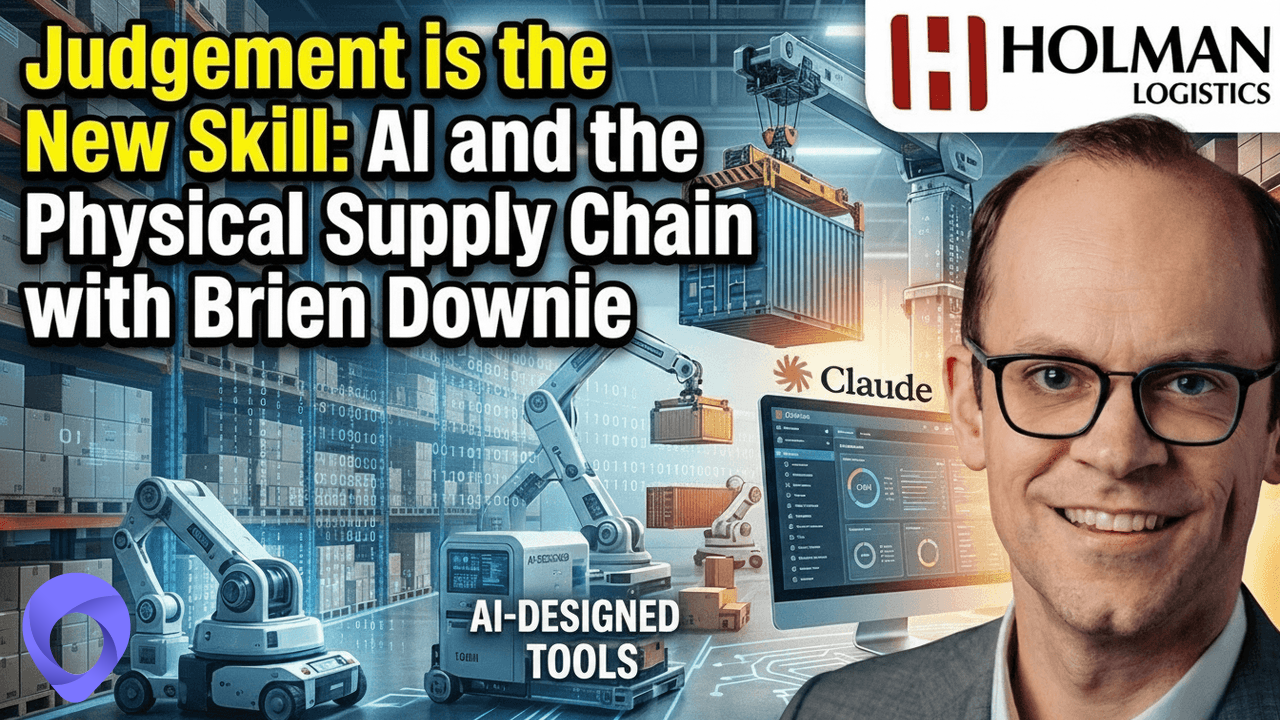
In “ Judgement is the New Skill: AI and the Physical Supply Chain”, Joe Lynch speaks with CEO of Holman Logistics, Brien Downie, about why human judgment is becoming the most critical business differentiator in the age of AI, how “vibe coding” is reshaping enterprise software, and why physical warehousing remains AI-proof.
About Brien Downie
Brien Downie, Chief Executive Officer of Holman Logistics, leads the company’s nationwide network of third-party logistics operations with an energetic focus on extraordinary customer service, long-term strategy, and enterprise growth. Before returning to his family’s business—founded in 1864—as Vice President in 2015, he spent 12 years building expertise in marketing, advertising, and business development at Microsoft, Initiative, AdColony, and UberMedia. After serving as President from 2019 to 2025, Downie stepped into the CEO role, carrying forward the high “Say-Do ratio” championed by his father and mentor, Bob Downie. He fosters a culture of direct executive access and rapid decision-making to treat every client’s business as their own. Downie holds an MBA from the UCLA Anderson School of Management and a BA from Biola University. An active YPO member and church choir singer, he lives in the Seattle-Tacoma area with his wife and four children, guided by their family motto to give their absolute best effort—or go “full-donkey”—in every endeavor.
About Holman Logistics
Holman Logistics is a national third-party logistics (3PL) provider offering multi-client warehousing, manufacturing support, and nationwide transportation solutions. Founded in 1864 and headquartered in Seattle, Washington, the privately held company manages over eight million square feet of distribution space and operates a network spanning 20 locations across nine states. Operating with over 1,400 team members, Holman specializes in high-exacting verticals, including consumer packaged goods (CPG), food and beverage, ingredients, pet food, and major appliances. Its core capabilities range from contract warehousing, plant sub-assembly, and Foreign Trade Zone (FTZ) services to private fleet shipping, dedicated shuttles, freight brokerage, and direct-to-consumer ecommerce fulfillment. Grounded in a culture prioritizing operational safety and long-term customer partnerships, Holman balances its multi-generational heritage with modern operational capabilities—incorporating advanced automation, continuous improvement programs, and AI-enabled site tools to deliver consistent, high-performance execution.
Key Takeaways: Judgement is the New Skill: AI and the Physical Supply Chain
- In “ Judgement is the New Skill: AI and the Physical Supply Chain”, Joe Lynch speaks with CEO of Holman Logistics, Brien Downie, about why human judgment is becoming the most critical business differentiator in the age of AI, how “vibe coding” is reshaping enterprise software, and why physical warehousing remains AI-proof.
- Judgment is the Ultimate Skill in an AI Era: As AI collapses the gap between thinking and doing, technical execution is becoming commoditized, making human judgment—knowing what is good, true, and aligned with core values—the most valuable differentiator in business.
- The Rise of “Build, Don’t Buy” Through Vibe Coding: Rather than forcing unique business processes to fit rigid, off-the-shelf enterprise software, companies can now use AI to rapidly “vibe code” hyper-customized internal tools—such as Holman’s tailored account management CRM, emergency evacuation tracker, and multi-facility customer dashboards—in a matter of hours or weeks.
- “Atoms Don’t Download” Makes Warehousing AI-Proof: While digital workflows are rapidly transforming, physical supply chains remain indispensable because physical goods must still be stored, moved, and handled in the real world—making physical logistics infrastructure a durable, low-obsolescence asset.
- Becoming a “Thinking Company” Beats Massive R&D Budgets: You do not need a $500 million R&D budget to innovate on the warehouse floor; cultivating a culture where frontline leaders and team members actively observe operations and think critically creates far more practical value than chasing flashy tech trends.
- Deep, Multi-Level Relationships Protect Against Customer Churn: Relying on a single point of contact at a client organization leaves a 3PL vulnerable when personnel change; building multi-tiered relationships across an account—supported by tailored tracking tools—ensures long-term alignment and retention.
- Embedded Operational Knowledge Differentiates Logistics Providers: Unlike purely tech-driven freight brokerages that treat shipping as a commodity, asset-based and embedded 3PLs stand out by understanding the nuances of a customer’s plant, job site, and internal receiving preferences.
- 162 Years of Longevity Rooted in People-First Leadership: Founded in 1864 and now led by the fourth generation of Brien Downie’s family, Holman Logistics manages over eight million square feet across 20 locations by replacing outdated, fear-based management with inspiring, supportive leadership that empowers its 1,400+ team members.
Learn More About Judgement is the New Skill: AI and the Physical Supply Chain
Built to Last: Inside Holman Logistics with Mike Gardner
The Logistics of Logistics Podcast
Joe Lynch: [00:00:00] Hello, friends. Welcome to the Logistics of Logistics. My name is Joe Lynch. Thank you so much for joining us today. Today’s topic is Judgment is the New Skill: AI and the Physical Supply Chain with my friend Brian Downey. How’s it going, Brian?
Brien Downie: Going fantastic, Joe. How you doing?
Joe Lynch: Doing great. Doing great. So Brian, please introduce yourself and your company and where you’re calling from today
Brien Downie: Yeah. My name is Brian Downey. I am the CEO of Holman Logistics. We’re a third-party logistics [00:00:30] company and I am coming to you from Federal Way, just south of Seattle, in between Seattle and Tacoma
Joe Lynch: So what does Holman Logistics do for those people living under a rock?
Brien Downie: Yeah. We do three things. We do warehousing, we do manufacturing logistics, and we do transportation. We’ve been around for a few years and we are mostly– Most of what we do is the main, the warehousing and manufacturing support. We’ve got a few trucks but most of what we do is operate the warehouses for big [00:01:00] companies that, that have appliances or pet food or paper products.
Those are the three, three of the industries that we really specialize in.
Joe Lynch: So when you say warehousing, I understand that. Is it warehousing where you’re shipping to DCs and stores or is it like in e-commerce?
Brien Downie: Both. Most of what we do is shipping to customer or distributor facilities. So when we’re shipping out Kimberly-Clark paper products, we’re probably shipping to Walmart distribution centers or Kroger distribution [00:01:30] centers. For Hill’s Pet Nutrition, we do it straight to sometimes individual vets or to their customers like a chewy.com or even to Amazon.
GE Appliances, a lot of that stuff is actually going directly to job sites where apartments are getting built that sort of thing. But we also do some e-commerce. We, we– Our, our bread and butter here is in the Pacific Northwest. That’s where we started and where the… I wouldn’t say the bulk of our operations are here, but that’s where I’m at and where everything we do elsewhere, we do here in the Pacific Northwest.
And so [00:02:00] our customers haven’t really needed to do e-commerce in a big way to date. That said, we’re certainly getting into it and and developing our capabilities around e-commerce as well.
Joe Lynch: Now you also help brands that are selling through the big retail of the big box logistics, right?
Ch- I guess say y- when you say ch- chewy.com, we don’t think of that as big box, but it’s kinda acts like a big box store in some ways
Brien Downie: For for pets, yeah. It is the it’s the amazon.com of pets, basically
Joe Lynch: Yeah, and [00:02:30] it’s interesting because I had you guys on the podcast before, and I know you guys do work with a lot of the big box retailers, and that has become– that was a hard business pre- before e-commerce, that was a difficult business ’cause you always had– you gotta get that, those truckloads of LTL, whatever they were, to those stores.
It was challenging. And now all of a sudden it was like, “Hey, just to complicate things, we’d also like to sell from our website and from Walmart, [00:03:00] walmart.com, amazon.com, TikTok shops.” And all of a sudden, you go, yeah, the difficult just got even more difficult. And and I think now you see companies trying to fence.
They, so they say, “I don’t ever wanna disappoint Walmart or Costco or Target or the, or Kroger. So we’ll make sure we’re good there. But I also, Amazon has real high standards and you don’t wanna, you don’t wanna leave your [00:03:30] own website lacking either. So this went from like chess to three-dimensional chess to three-dimensional chess with blindfolds on.
Brien Downie: Yeah. Yeah, indeed. It would be nice if I don’t know if you’ve– if you or your listeners are fans of Dune, but it’d be nice to get th-that spice melange and to be able to have prescience where, the m-main character Paul can see the future and he can see all the paths. I wish we could do that.
But but yeah. Yeah, it’s, it’s– every-everything’s becoming more, more personalized, and when it becomes more personalized, it becomes more difficult to be consistent
Joe Lynch: [00:04:00] Yeah. And you mentioned the manufacturing. So what kind of ma… Are you supporting manufacturers or are you guys doing some manufacturing?
Brien Downie: Yeah we don’t do the manufacturing, but we do support the logistics of manufacturing.
Joe Lynch: So the inbound logistics
Brien Downie: Yeah, effectively it’s an integrated on-site solution where so for Kimberly-Clark in Maumelle, Arkansas, for example, we support the plant where they make all the Huggies baby wipes for the country.
I’ve got four kids.
Joe Lynch: Increasingly important to
Brien Downie: Yeah, oldest is 13, so I think I [00:04:30] kept the plant kind of single-handedly in business over the last, 13 years or so. But but yeah, so we are embedded in Maumelle. We’ve got people bringing in raw materials, storing the raw material, bringing the raw material from the on-site warehouse or the close thereto warehouse to the production line, prepping materials for production and then bringing finished goods offline.
We do have some people doing some light QA roles on the production line as well, but then taking the finished goods and taking that back to the the on-site warehouse then [00:05:00] taking it to more of the, the mixing center, the distribution center as well. So it’s an integrated manufacturing support.
Joe Lynch: Yeah, and you guys said you, you do s- transportation, but you… So you have your, some of your own trucks, I’m sure that’s where they’re dedicated, and I’m sure you’re using a lot, your brokerage internally too
Brien Downie: Yeah. Yeah, we have a small brokerage. It’s not our, one of our core offerings. Really we do focus on the warehousing and the manufacturing logistics, and we’ll, we will do… Yeah, we’ve got a, a, a, a great operation here in the Seattle [00:05:30] area and we’ve had some kind of dedicated stuff outside of that, so doing milk runs from the manufacturing facility to the warehouse and that sort of thing.
Joe Lynch: I think if you look, there’s 25,000 freight brokers. I think at peak we had 31,000 during COVID. And it’s easy to go, “Oh yeah, the top 100,” which has just a disproportion amount of the work. That’s fine. Are they automatically the best ones? They’re very good, I’m sure. One of the things I’ve always said, though, is the people who [00:06:00] might own trucks and own warehouses, those, those brokerages are really good because of the knowledge of the business. So it’s not easy just to say, “Oh, okay, that’s only– They only do this many loads per week.” It the quality is there because they say, “Hey, if we wanna go buy five more trucks, if we think there’s a need, we will.” If we understand the business better than the average freight broker just because you’re [00:06:30] basically embedded in s- in one of your biggest customers
Brien Downie: Yeah, absolutely. It, this is a, a relationship business because driving a truck, it… the, freight brokerage and particularly the, the tech-focused brokerages like the, the Convoy may she rest in peace and Uber Freight that sort of thing, they treat it like it’s a commodity, like there’s no real differentiation.
But for some of our customers, getting to the job site, getting to the plant, and knowing how to navigate the [00:07:00] parking lot, and knowing how the, the team inside the building wants the freight, that’s the real differentiator for us and for kinda the, the smaller sort of knowledge-based brokers as you
Joe Lynch: Yep. It’s the same old thing where every time we see “Hey, this is the top colleges,” I’m always like, top college is like saying the top wives or the type top girlfriends. Everybody’s kinda has their own unique need. And no offense, ladies, it also means the best boyfriend or best husband. And that’s [00:07:30] why I always think like there’s room out there ’cause there’s different requirements for every co-
Brien Downie: Yeah. What, I already know I’ve got the best wife, so we don’t need to… That, that’s already decided
Joe Lynch: Well, having four kids put you right up at the top of the list. Anyway tell us a little bit about you, Brian. Where’d you grow up? Where’d you go to school? Some career highlights before you joined the juggernaut that is Holman Logistics, and why did you join Holman Logistics?
Brien Downie: Yeah. So I grew up in Bellevue, just east of [00:08:00] Seattle never thinking that I would
Joe Lynch: That’s where Nike’s at, right?
Brien Downie: Oh, it’s Beaverton, Oregon
Joe Lynch: Oh, okay. What’s in Belleville? Is that Microsoft?
Brien Downie: Yeah, Bellevue Redmond. I grew up in the shadow of Microsoft, really. I, I remember driving past the tent that Microsoft had put up when they were launching Windows 95. I think what that… Bill Gates and Jay Leno were presenting on Windows 95, and I thought that was the coolest thing.
But yeah, so I grew up in Bellevue. Went to undergrad at Biola [00:08:30] University in Southern California and knew that I wanted to do something in kind of media and technology and kind of the confluence of that. I loved my dad. I never wanted to be my dad. And yet, fast-forward and now I join Zoom calls and I say, “Hey, who invited my dad?”
“Oh, wait, that’s just me.”
Joe Lynch: We should mention your dad or no, is it your great-grandfather bought Holman Logistics?
Brien Downie: Yes. Yes. My great-grandfather in 1929 bought Holman Logistics from– It was actually from the estate of the second [00:09:00] owner. So it’s been in my mother’s family for 97 years, almost 98 years now. My dad married in so he was an in-law or an outlaw, depending on how you define it. I’m blood see I represent the fourth generation of my family in this business.
It’s certainly an honor to be involved. But but yeah, if you had told 18-year-old me that someday I’d be living in Tacoma and working for Holman and enjoying it, I would’ve said, “Wait how big was the stick?” stick?” “The stick that you hit [00:09:30] me over the head with.” ‘Cause man, that would just not have, it would not have been me.
But but after I worked in website usability consulting for a little bit, and then I worked at a a digital ad agency, which was a lot of fun. It was a great fit for me personally, kinda creativity and data analytics all mashed together, which was awesome. Did an MBA at UCLA Anderson and I interned at Microsoft.
I finally– Microsoft was always kinda like the, the castle. I wanted to scale the walls and get inside and show that, hey, I can work here too. [00:10:00] I can do it. And I did that at the beginning of the internship. It was like, “This place is awesome.” And then at the end of the internship, I was like, “Get me out of here.”
Joe Lynch: That’s what interns- that’s what internships are for though, to see where you fit
Brien Downie: Yeah. Yeah, absolutely. It’s a great company. There were great things going on. I think particularly Satya Nadella, their new CEO has been phenomenal. You look at their stock price, and it’s just pff, through the roof after he joined, frankly. But but yeah, I did a couple of startups after business school, and I just found that what I was doing I was d- [00:10:30] in ad sales.
I was a sales guy for digital mobile advertising. And I just found that thinking about, “Okay what am I gonna be proud of 30 years from now?” And it just felt like the whole thing is just gonna go poof. I’m gonna stop working, and there’ll be nothing left because somebody else will just take over what I was doing.
And so I didn’t want that to be my life story and to be most of what I do with my waking hours. So I called my dad and gave him the shock of his life to tell him “Hey, Dad, what if I came back [00:11:00] and helped you run the family business?” And he said, “That’d be fantastic.” So yeah, I came back in 2015.
And if I hadn’t joined, I would’ve lost the last six years of my dad’s life. He lost a short battle to pancreatic cancer about five, five and a half years ago. Actually exactly… no five, five years and five months. It’ll be five and a half years in December. But yeah, it was great seeing…
what’s funny? I grew up always thinking my dad was smart but then seeing him actually come up with some ideas in our industry that like, “Wow, Dad that’s [00:11:30] actually a really good idea.” Like, why am I surprised? He’s been successful for how many years and, but yeah that’s
Joe Lynch: think it’s, I think it’s to be the goal of every parent to be alo- around long enough for your kids to go, “Oh, they are smart.”
They have… i… ‘Cause, as soon as they hit teenager, they start looking like, “You idiot. You have no idea what’s going on in this world.” So you came back. What was your f- what was the job you came back to?
Brien Downie: Yeah. The first job I had was vice president. Just vice president, not of anything in [00:12:00] particular. It was– I think my dad he wasn’t quite sure what he was gonna do with the business because we haven’t had… In spite of us being in a family for 97 years, I don’t have any siblings or any cousins involved.
It was just my dad, and then it was me. So he wasn’t sure what he was gonna do. He didn’t really have a succession plan. And so I effectively became the succession plan when he was 60 years old. So I was vice president and just charged with learning the business, learning how we do things, learning the Holman way, if you will.
And I came in bringing my marketing and advertising [00:12:30] background, and so I added a lot of, certainly a lot of schwag to the game. And defining what our core values were, ’cause we always had a, a, a set of values but we never really defined what they were. We couldn’t say there are these five things.
And so that was one of the things that I came up with with the help of some some consultants. And yeah. So and then in 2019, I was promoted to president and in charge of running the day-to-day of the business. And the last year and a half, I’ve been CEO. And as [00:13:00] CEO, really trying to chart a course for the future of the company.
I wanna make sure that we don’t get Pan Am’d or Kodak’d or Blockbustered. That’s always what I’ve wanted to do, ’cause, ’cause you think of Pan Am in the ’60s, like they were international air travel. But it turns out people didn’t want what they were actually selling
Joe Lynch: Y- yeah, as you get older, you start to realize this, but I th- there was a book, I think it was “In Search of Excellence,” Tom Peters wrote it. And I remember reading it and everybody read it, and everybody like, “Oh, Tom Peters’ so smart, and then later on he writes another book [00:13:30] saying, “Oh my God, how could I be more wrong?”
And yet he went through all of the “In Search of Excellence” cases and said, “I was wrong here, I was wrong there.” And there was studies like People Express, this is why they’re winning, and then they’re just gone. And it, it– yeah, and I should also mention, or you should mention, I should say, you guys have been in it since 1929.
The company, I think, has gotta be one of the oldest logistics companies in the United States. When did the company start? [00:14:00] I know your family bought it, but when did it start?
Brien Downie: 1864 in in, in Portland, Oregon. So yeah, we are 162 years old. I’ve got a friend who has a, an older company. But yeah, we are one of the oldest, certainly one of the oldest in the Pacific Northwest. Oddly enough, there’s a Holman mortuary funeral home in Portland, Oregon that is also the same…
it was one of the founders of Holman Logistics, and back then it was called probably the Holman Transfer, Holman Drayage, something. [00:14:30] But yeah, it’s the same Holman’s, and so they had staying power,
Joe Lynch: nice. By the way, I gotta tell you this quick story Seattle, and you probably already heard it. I recently saw a video, and it was on Instagram, and it was Howard Schultz, the founder of
Brien Downie: Starbucks
Joe Lynch: Starbucks. And he wasn’t the founder of Starbucks, he bought Starbucks, but he had worked there, left, I think he wanted to do something on his own, and then the founders called and said…
They had probably three or four locations, and called him back and said, “Howard we’d love to sell you the company.” And so he was amassing [00:15:00] investors, and he had no money of his own, and he said he got a call from the Starbucks guys and says, “Hey, one of your investors is calling us, and they have a pretty good deal, and they’re gonna cut you out.” And he’s “Oh my God, what am I gonna do?” And so he was… And so a friend of a friend introduced him to Bill Gates Senior, who’s, was attorney and apparently a towering figure in
Seattle business, and in real [00:15:30] life. I think he’s 6’6″. He’s a really big man. So they, he’s, he was introduced, he went over and he said, “I went to see Bill Gates Senior,” and he said, “Now I’m gonna ask you some questions, you tell me the whole truth.”
And then when they got done, he said, “Is everything you’ve told me true?” He says, “Yes.” He goes, “Come with me.” He goes, “We walked outside, out of the big building, went down across the street into another building, walked over and saw this investor,” and he said Bill Gates Senior went in and said, “You are [00:16:00] not buying this company.
Howard Schultz is buying this company,” he goes. And he’s looking down at this guy, and he goes, I don’t know if he’s threatening with, legal ramifications or physical violence. He goes, this guy’s like yes, that’s correct.” And then as they left, he said, “Me and my son will help you buy Starbucks.”
And I don’t know, I don’t know to what extent that the Microsoft investment helped, but I had never heard this and I just saw Howard Schultz tell it. Yeah, it’s qui- he’s quite the hub there for
Brien Downie: [00:16:30] Yeah. It’s the, yeah, speaks to the power of relationships and and having a core set of beliefs, right? And big, scary lawyers. Yes.
Joe Lynch: Right.
Brien Downie: All those three things.
Joe Lynch: So we have a few topics I wanna talk to you about, and the f- and so there were some ideas that you wanted to talk about, and and when I looked at them, I was like, “These are very disparate, but Brian knows what he’s talking about.” So the first one
is build, don’t buy: the end of enterprise software, which is a big, scary [00:17:00] topic.
So t- tell me, what is the problem with enterprise software, and why did you wanna talk about build, don’t buy?
Brien Downie: Sure, yeah. I think the, the problem with enterprise software is that it’s you always have to adapt your own processes to the software. No matter how much the vendor will say, “Oh, our s- our solution is so customized and so personalized that you, you– we can adapt the software to your processes.”
Yeah, to an extent. But you can’t say, “Move this button over there,” and then it just [00:17:30] happens. You have to play by the rules of the WMS company or the ERP. I, I joke that you you date a trucker, but you marry a warehouseman and you sign a blood pact with your WMS provider when you’re when you’re in this business.
So like for me as CEO one of the things I wanna do is make sure that we have a really strong relationship with all of our customers. And my dad turned me on to the I think at the time it was called Miller Heiman, and now I think it’s Korn Ferry large account management process. At least that’s what it used to be called the LAMP [00:18:00] model.
And it talked about how you wanna have multiple different levels of people connecting with your customers and to make sure that you are not just providing with them with a service that they want, but you are connect with them and influencing their decisions. Which is I would love to be able to get to that level with all of our customers.
And I’ve been looking for a CRM to kinda help manage that, and CRMs are just built for something different. They are built for, Salesforce is a Salesforce automation [00:18:30] tool. You call up Alaska Airlines
Joe Lynch: The original software as a service
Brien Downie: Yeah, exactly. You call up Alaska Airlines and it recognizes my phone number, and I’m sure it, it’s something like Salesforce or something else to where they know that I’m, what, Atmos Platinum they call it now, and they reroute me so I don’t have to punch in any numbers.
I just go straight to the customer service rep. That’s probably built on a CRM ’cause they’ve got thousands or millions of customers. For me, I’ve got right now it’s six core key [00:19:00] customers. Six. And, if I lost all
Joe Lynch: That’s a national business. You have s- what, 20 locations?
Brien Downie: Yeah, it’s a national business and it’s, it’s, that’s double what I used to have. And yet it’s not a million. It’s very few, and yet I wanna be really deep with those guys. So using Claude, I was able to vibe code effectively a CRM to where I’ve got just the, the things that I want.
I’ve got goal tracking, I’ve got meeting tracking, and I’ve customized this thing in a way [00:19:30] that fits for what I want out of the large account management process. I’ve got a charter and objectives that, that map to that as oppo- It’s not built around opportunities and deals. So as I’m building this, I’m thinking, “Man, this is, this was easy.”
It took me, I don’t know, four or five hours in Claude just to vibe code an app that, two years ago, there’s no way I couldn’t have even dreamed of doing something like this. And some people on my team were like, “Man, who’s gonna maintain this?” We’re not [00:20:00] really… You don’t have to maintain it ’cause it’s not just a sp- it’s a glorified spreadsheet that isn’t necessarily something we’re gonna be using every day.
So that’s why it isn’t it’s not a CRM in the classic sense, and it’s not something you could build and I could sell it even, ’cause it’s so customized to me and my situation. But it just makes you think man we spent I don’t know how many, I think we spent we budgeted I think at least a million bucks and have probably spent more on, than that over the cour- last seven years on our WMS.
We’re on Infigos. They’ve been a [00:20:30] good partner. Not perfect but the, in, in many ways they’ve delivered on what we needed. But it’s like millions of dollars
Joe Lynch: Y-y-yeah, you touched on a few things there. The first thing you talked about is building this relationship so it’s not just one guy to one guy, knowing people leave, and knowing that your company is 162 years old. So you need to keep companies… And by the way, I’ve experienced this. I remember the little third-party logistics company that I [00:21:00] went to.
It was a turnaround, and the– one of our customers never would really engage with me, and I would always talk to the owner, and I said what do you– how did we even win this business?” He said they they had a finance guy who came in and turned it around, and he picked us because we were… And he goes, “But they just never warmed up to us. And he keeps saying he’s gonna retire. When he retires, we’re gonna lose that business.” And I was like let’s build that bridge. Let’s get in there now.” [00:21:30] And they weren’t in our same city, which is normal. And ultimately, when he left, we lost the business. And I remember it w- so basically it’s why’d we lose business?
‘Cause we were tied to one guy who didn’t win over the rest of the team when we came in. He just said, “This is a savings. This is a, a company in trouble. We’re gonna use these guys.” And there’s probably resentment. We did a great job, but it was built up res- And we had that business at least five, seven years. When you [00:22:00] have a single point connection, you are asking for trouble
Brien Downie: Yeah. Yeah, absolutely. And we have certainly fallen victim to that. We had a, a, a fairly large customer that unfortunately we lost. They took it in-house. Wish them the best. It was a decent transition when they took it over just recently. But yeah we didn’t have…
So I didn’t have my customized large account management process CRM, and I didn’t have my processes in place,
Joe Lynch: The, yeah there’s another piece to this, which when you say CRM [00:22:30] and you talk about WMS and ERP, we name these so we have these categor- categories. But when you think about it, if you right now say, “I am going to develop what we need here,” are you gonna call it an ERP or a CRM or a WMS or a TMS? You’re like, “No, this is a, this is this is the Holman operating system, and I don’t wanna categorize it ’cause it’s not necessary to categorize it.” And when you de- categorize you somewhat limit what it [00:23:00] is
Brien Downie: Yeah. Yeah, absolutely. I was just thinking, should I call it an RSP, a relationship strategy platform? But that’s too– That’s going back to that, that 12 weeks I spent at Microsoft and I was part of the APS BDBG… No, the OSD APS BDBG. So that was a part of
Joe Lynch: I, I started the logistics of logistics when I came from automotive to the logistics business, and I realized it was much more entrepreneurial and it seemed like a generation behind automotive in [00:23:30] terms of maturity, and I loved it. And I said, “I’m no- never going back.” But one of the things I also noticed was so much jargon.
Oh. And I guess when you grow up in the jargon, I grew up in the automotive jargon you’re okay with it a little bit. But logistics has all this jargon, and it’s useful, but it’s also obscures what’s really going on
Brien Downie: Yeah. Yeah. We all have our shibboleths
Joe Lynch: Yeah. Yeah. So you created your own system, and is that rolled out [00:24:00] across the whole organization or is this kind of more in, in the sales right now?
Brien Downie: For right now, it’s still in the infancy stage. We’re just, I’m just starting it. I think this week I’m gonna be introducing it to my, my president and CFO, and then my VP of biz dev and the director of operations. So I will be able to have me on again in the future, Joe, and I’ll tell you all the amazing breakthroughs we’ve had with this particular thing.
But just, thinking categorically, I’ve got a, a general manager who built a tool for what was it? When you’re doing an evacuation with [00:24:30] a, e- either a real fire or a fire drill, like how do you make sure you’ve got everybody? And there’s various tools that we use, and he was able to vibe code effectively
Joe Lynch: It’s like a crisis management solution
Brien Downie: exactly. And it’s customized to who we are and how we do our own evacuations. And we’ve got with one of our customers, we’ve got an information management system that basically is a dashboard. We operate multiple of their facilities, and it synthesizes data across all their facilities, [00:25:00] and we’re able to relaunch with a, a new version in a matter of weeks.
The old version took years to develop, and this one, just vibe coding it took a few weeks. So yeah
Joe Lynch: Yeah it’s an interesting time with software because we’ve had software that, is 80, 90% margin for a long time, and now people are d- able to develop it much faster. And also it’s not gonna be software as a service, most [00:25:30] likely. It’ll be based on AI, and the cost of AI tokens is going to go lower. And I– It might go higher initially while building this out, but eventually they’re gonna go lower. So we’re at an inflection point. It just feels like it wasn’t so long ago that we started saying software as a service and then automation as a service and robots as a service, and suddenly we’re into a new model.
And the new model always means there’s gonna be new [00:26:00] winners and new losers
Brien Downie: Yeah. Yeah. And if we’re saying that judgment is the new skill, I think thinking is the new currency because the gap between thinking and doing is shrinking. If you can think it, you can do it. I I told my team earlier this year, we had a, a Y- I call it a YBM, year beginning meeting, where I brought all of our general managers across the country, and I gave them a presentation on on why I want us to be a thinking company.
You think about Pan Am, they thought that what they were selling was [00:26:30] luxury and, a, a status and all this stuff. And it turns out like, no, people just wanted to travel, and when they could do it for cheaper, they could do it. And Blockbuster they built a business on late fees.
No one likes late fees. Don’t build your business on something people don’t like. And then Netflix came along, and Netflix is a great example of a company that completely pivoted because they were thinking about what the future was and how they saw themselves. They didn’t see themselves as a company that just [00:27:00] delivered DVDs.
That’s a logistics and procurement operation. They were an entertainment company, and now they are making movies and they’re delivering content. They’re totally technology now and delivering content wherever you are, on whatever platform you can do it. So that, that’s what I want us to be the company that is thinking because if we can think it, we can do it, and thinking is free.
It can’t be taxed. It’s… But I went to the Manifest show in Las Vegas
Joe Lynch: Of course
Brien Downie: and there was a very [00:27:30] large 3PL that was the headlining sponsor, and they get out there and they’re talking about, they’ve got two of their customers out there and it’s go, “All right, it’s gonna be a keynote from the three-letter 3PL,” as it were.
And the, the first question was like, “So what are you, what’s your perspective on robotics?” Really? This is your question? Man, w- if that’s what they’re gonna put into spending half a million dollars on sponsoring this thing, man, I can spend $0 and have a [00:28:00] perspective and come up with interesting solutions, and our team can do that because we don’t need a $500 million R&D budget to look with our two eyes to see what’s happening out in the warehouse floor and think up a better
Joe Lynch: Yep. There was a, a book years ago, and I forgot the full name, but it was basically about learning organizations. And I worked in automotive at that time, and I remember they talked about Toyota. So Toyota, after the war, [00:28:30] they have no market. They have no market. They’re very poor. And they said, “All we can do is just learn from what the other companies are doing.” And so they never got out of that. And I’ve talked to a ton of Toyota people. I’ve done some projects with Toyota. Friends of mine who moved up in the organization said, “The only way you move up in that organization is to keep mentoring and keep teaching.” He says, “Everybody who’s moving up is a trainer and a teacher and a mentor.” And [00:29:00] I remember doing a project at Chrysler, and it was… It’s a long time ago, so I can s- speak out of school now. And it was, they called the Toyota guys in Ann Arbor. It’s not too far from Chrysler, about an hour and away. And just called some friends and say, “We wanna do some benchmarking with Toyota.” And I was, in the room when the question, and the guy goes, “Oh, okay. What are we gonna learn from Chrysler?” And seemed like a good… And it was “Oh, cringe,” right? And [00:29:30] he goes okay. Let… i’ll ask some people around here and see what’s going on.” And then, like maybe four days later, there was an email and a phone call from Japan. The guys in Japan got wind of this and said, “How many people can we bring?” And th- they were just ex- ecstatic for the opportunity. Now Toyota was top of the heap. Chrysler’s near the bottom. And they came in force with tons of questions, with the idea that… and they said, “We [00:30:00] admire the following.” They said, “We like that you can build a car from the tires up.
The… Every product’s brand new.” And Chrysler’s saying, “It’s too costly. You can’t do that. Don’t do that.” We’re copying you because you don’t do that.” And anyway, I guess my point is, even generations later, Toyota had this desire to learn. And, let’s face it, that can be lost in a generation.
It can be lost in a decade. And all it takes is a little bit of success and a little bit of arrogance, and I go, [00:30:30] “Eh, I can’t learn anything. We- w- we’re killing it over here.”
Brien Downie: Yeah. Yeah. I love the story of I think it, some American executives are going over to Japan to look at the production line. And in America, you’d, you make a car and you get a door, you put the door on the frame, and then you got a guy who kinda tweaks the door to make sure that it closes. And they’re asking the Japanese engineers like, “So where’s the guy who makes sure that the door will fit on the frame and will close?”
And he says, “What?” You gotta make [00:31:00] sure that it’ll actually fit.” And he’s like we make the door to fit the frame.”
Mind blown.
Joe Lynch: Yeah, y-y-yeah, it’s– There’s something to be said. The Japanese came in and they just changed everything, and then it wasn’t so long after that the c- suddenly Hyundai and Kia were at top of the heap. And now you see BYD as being looked at as an excellent automaker. There’s just, there’s n- there’s no finish line on this stuff.
Brien Downie: Yeah. [00:31:30] No
Joe Lynch: Anyway, so we talked about build, don’t buy, and this is the end of enterprise software. I don’t think, I don’t think you’re saying, “Hey, effective immediately, we’re getting rid of all software.” But it does start to speak to the idea that do we just make the basic assumption that I have to go buy?
I’m a warehousing company, I need a WMS, I’m– and I need an order management system, and I need this, and I need that. There is gonna be some of this that you c- I thought about this just from my own [00:32:00] business. I saw something and it was, maybe it was Grok Bot, just some of these, one of the simple tools where they’re like you can create an app in an hour.”
And I was like, why am I asking someone to do that internally when an app could pull this information for me?
Brien Downie: Yeah. Yeah, absolutely. I think it’s not quite– if you were gonna go start a 3PL today and you needed a WMS, I’d say, yeah, get one that is, that already has all the integrations all done, so you can do the EDIs, so you can do get your ASNs going, get your, [00:32:30] do your cycle count product and all that.
Yeah, you’re gonna need that. But in the future, I think if these, if the large enterprise software vendors are going to succeed… I know you you’ve got, I’m sure, some enterprise software sponsors and you’ve had them on your show, and I don’t wanna just throw them under the bus saying, “Oh they’re worthless,” ’cause they’re not.
But I think it’ll be table stakes in, frankly, in the very near future to integrate this type of thing into your software, to be able to do the personalization so that we can actually [00:33:00] personalize the software to meet our processes as opposed to change our processes to, to fit the software.
Joe Lynch: Yeah. When software, and this is gonna be, this is an old man thing, apologize. When software first came out, it, there was no adjusting to you. It was just like, “Here’s the software, make your system work.” And then for a while they said, “Hey, we will modify the software in every way for you.” And that was actually coding that they had to do. Now it tends to be toggle switches. We’ll turn this field on and off. Made it much easier. [00:33:30] But nothing stops. There is no endpoint here. So the next iteration might be we’re no longer a software company. And there, y- I hear this every once in a while, someone says, “We’re moving from software to service.” Why? Because they don’t need to buy the software from us.
Brien Downie: Yeah. Yeah, indeed. I I follow a bunch of different people on X, the service formerly known as Twitter, and one of the guys I like, his name’s Doug TenNapel. He was an animator and video [00:34:00] game maker for for my old Super Nintendo homeboys, Earthworm Jim. He’s the creator of Earthworm Jim.
And he posted on X about a tool that he built. He says, “This is a screenshot of Remake Master, an AI movie tool I vibe coded in one hour, and it is the single best tool I’ve ever used in 20 years of digital content creation. Hasn’t had a single bug. It’s more stable than Photoshop.” And like he said, also it’s– what’s amazing, it knows the story that he’s working on, so it, it knows what he’s trying to do.
So it built software built around what [00:34:30] he’s trying to do. And he says, “I could put this out to public for free and it would work, but it wouldn’t help you. It was specifically designed to make just this project because I created it while working.” And then he says at the end, “On my next AI feature movie, I wouldn’t use this again.
I’d dump it and just make a new one that is designed for that project. that easy.” And the screenshot that he’s got, it looks like it’s something for like a, a co- combination of After Effects, Adobe Premiere and script writing. So it’s just custom made for what he’s doing. It’s [00:35:00] incredible
Joe Lynch: Yeah, we’re in a, we’re a brand new era. So the next topic I wanna talk to you is why warehousing is AI proof. So this is your topic. W- what do you mean by that?
Brien Downie: Yeah. AI-proof meaning that th- there, there will always be warehouses, I think. Even as we were joking before we hit record here someday we might have a replicator and I might be able to say, “Tea, Earl Grey, hot.”
Joe Lynch: Like that, like Captain Picard.
Brien Downie: [00:35:30] Exactly. Yeah, may he rest in peace. Until such time as I can do that we’re still gonna need a supply chain and distribution for Earl Grey tea. And even then, if we do have replicators, it’s still gonna have to have the carbon and hydrogen and oxygen, so there will always be a supply chain for something.
So I think supply chain is an old industry, and it will continue to evolve and continue to to go on because we are still physical people, and we like doing physical things. And I love to wakesurf. I love to s- [00:36:00] to snowmobile. I love getting out there and doing stuff in the real world
Joe Lynch: Y- yeah, and y- you had a c- comment here, “Atoms don’t download.” And and there’s another piece to this which I think is fascinating. So you guys have 20 locations around the country, so you do all sorts of different business with all sorts of different kinds of businesses in different regions. And I always think, the challenge is how do I go get a young person and say, “Hey, come here and we’re [00:36:30] gonna make a good life for you here”? And I, I’m sure it’s not “Hey, you can walk or you can walk seven miles a day and lift things. Wouldn’t that be great?” After you get it out– After you realize it’s not necessarily great exercise ’cause it’s hurting your back. How does– So how do you– what is your view of how this works for your team across the country?
Brien Downie: Yeah. I think we, we are in, like I say, we’re in a people business, people and process. And so I think people have [00:37:00] always responded well to good, strong leaders, people who call them to be a better version of themselves people who inspire them. And that, that’s really what I’ve tried to focus on, is hiring good leaders who will go and lead people to a place where they didn’t even know they could go.
So our general managers and really our supervisors across the country are the glue that keeps Holman together and help to inspire the people who do what Holman does. I, I don’t really do what we do, right? I’m a [00:37:30] Outlook jockey, an email warrior. And so the people who are actually doing our work, the lift truck operating and the order selecting and customer service type of stuff hopefully I want them to feel like they are in a place where they are believed in and supported where we help each other to be better.
And and I think that’s– it’s done us pretty well for the last 162 years, and hopefully it lasts for another 162.
Joe Lynch: I was just talking to a mutual– a friend, and we were talking about a mutual boss, and [00:38:00] I said, “If he called you today…” We haven’t worked for him for 10 years. And I said, “If he called you today and said, ‘I need a favor.'” He goes, “I would interrupt him right after that and say, ‘Whatever you need.'”
And I was like, “I feel the same way.” There are, and I can say this having worked for a long time, that there are two or three or four bosses that could ask me to do anything today. Just say, “I need a big favor,” and I’m gonna do it. And then there’s the other 25 where you’d [00:38:30] be like, “Oh, why is he calling me? Ah, shoot. Why? What does he want? Nah, I’m not answering.” And and I always think that’s what you wanna be. And, I’ve talked to a lot of CEOs, a lot of founders, a lot of just, you know, C-suite people and, it’s a challenge. And I was just talking to a friend of mine and she said She was, I said to one of my employees, “Hey, I’d like to see you in my office first thing tomorrow morning.” And she said, “I [00:39:00] just wanted to say, ‘Hey, how’s it going? What’s going on?'” Catch up. And she goes– And they came in with this worried look. She goes, “What’s the matter?” She goes, “I don’t know what I’m, why you have me in your office for.” And she goes… And it occurred to me they didn’t sleep well last night because th- they had fear.
And I was like, yeah, just driving the fear out of the workplace without driving the motivation out. I don’t know how many times I’ve had jobs where I know I did a great job, but if somebody called and said, “Hey, I need to talk to you about something,” I was like, [00:39:30] “Oh, dude, what’d I do? What’d I do?”
And they go… This is human nature, and it, and it’s hard. And the bigger companies get, the more that feels like that’s a challenge
Brien Downie: Yeah. Yeah, my, my first job out of college, I was doing website usability consulting, and a boss that I had, he would never come by to, to talk without frankly, berating me about something. Which is it w- and so every time he came by it was like, “Oh, what’s going on?” So then my [00:40:00] second job, I was in digital advertising, and like this is my boss’s boss came over to talk about something, and so I had that same reaction.
“Okay, what’s gonna… What’s he really gonna be get- getting at here?” And he… ’cause he came by to say, “Hey, that was really cool. That was good.” And then he walked away, and I remember actually thinking I, I literally thought in my head, “Oh, wow. That’s how that can work.” You don’t have to be afraid of people.
You don’t… And you don’t have to berate someone every time you go see them. You don’t have to take them down a notch. You don’t have to say a [00:40:30] compliment but then also say something they didn’t do well. You can actually just be a nice person
Joe Lynch: I don’t want Brian getting a big head, so I’ll have to, a swipe at him.
I joke ab- I joke about it. I, as I’m getting older now, I can say this. I grew up working first for World War II veterans who were old, and then some of the Korean guys, and then the Vietnama- Vietnam guys. And so there were– And there was a big…
if you look at World War II I don’t know if it was most, but a big chunk of the young [00:41:00] men worked. And they learned a leadership style, and it was top-down. And and it was usually, my father told me that when he was working at Ford Motor Company, he’d been in the military.
He goes, “Boss would come by and tell us, ‘Hey your, You need a haircut.'” He’s like, “What? I got a crew cut. What the…” It’s like, “Yeah, but I can see it touching your ear.
You can’t work, you can’t work effectively here if you’ve got that.” And you’re like… And th- those days are gone because people working in a [00:41:30] warehouse, people, they have options.
If they don’t get the sense that they’re appreciated, and that’s more than just a p-paycheck, they’re gonna be gone
Brien Downie: Yeah, absolutely. And I think, speaking of, military leadership, my grandfather landed in Normandy a couple weeks after D-Day,
Joe Lynch: Oh boy.
Brien Downie: He was in the artillery, and I think for… don’t they say that the hardest part of war is the boredom? ‘Cause it’s like you’ve got a few minutes of fighting and then months and months of nothing.
That was his cha- [00:42:00] challenge. But he told me, I think just about every time I saw him in the last five years of his life, he told us the story of when he met Patton. And he, and Patton had, had two ivory-handled revolvers that he walked around with. And tho- those men wanted to serve, live, and die for George Patton.
That wasn’t George, was it? Yeah for General Patton. And so I think, a leader is someone who inspires someone, who calls them to do something they don’t know that they could even do but then also someone who doesn’t ask them to do [00:42:30] something they aren’t willing to do. And I think, crawling around talking or, talking to enlisted men that, that is something that, that General Patton did really well, clearly and gave my grandfather a story that he told for the next 60 years of his life.
And I think the, the same thing goes for for people today if you’re trying to motivate either, when I… Early in my career it was, “How do you vo- motivate millennials?” It’s like millennials and now like Gen Z, kind of whatever generation it is, I think the same [00:43:00] blood still pumps through all of our veins.
The same human needs for connection for inspiration for value and all that. I think that’s, that is how you motivate people. That’s what has always been true of us and what will continue to be true for us.
Joe Lynch: Yeah. And I think also I’m getting old enough so I have some friends who are retired, and I always say there’s a… Suddenly your, you had a meaning in your life. And I’ve worked at when I worked in automotive, you’re working on one little component or f- or a few components for a big [00:43:30] car. You say, “Oh, I’m designing the scuff plates that people step on.” But if you can be made f- to feel like, hey, this we’re on a mission from God, that’s a pretty good feeling. Where you go, we’re making the coolest minivan or the c- coolest SUV or the fastest production vehicle. Whatever you’re working on, you wanna feel like this has meaning.
And,
Brien Downie: Yeah, absolutely. I love the story of John F. Kennedy. I think he… Is it in Houston or Cape Canaveral? Somewhere in NASA when they’re trying to put a [00:44:00] man on the moon at the end of this decade he’s trying to say, right? And he comes across a guy sleeping on the floor and the president says, “And, what are you responsible for?”
Or what are you doing here?” And he says, “Mr. President, I’m helping to put a man on the moon.” And that’s a great story where… And I always particularly try to pay special attention to the people doing sanitation in our warehouses, right? Because a clean warehouse is a fast warehouse and a safe warehouse.
So
Joe Lynch: Oh, yeah. And the crazy thing about warehouses is, I know you’ve been in them for [00:44:30] a long time God, a generation ago, they were dark and they were dirty, and there was stuff on the shelves from 30 years ago that was obsolete for the last 25 years. And that’s not the way we run our warehouses anymore.
Brien Downie: Yeah, no you could almost eat off the floors in our warehouses. Don’t, but but you could
Joe Lynch: I know you guys also have a lot of food customers, so you guys kinda have no choice. The bar is always higher with the people who move food.
Brien Downie: Yeah. Yeah, indeed. So all I have to say, I [00:45:00] think warehousing will continue to be AI-proof because we’re still gonna need warehouses. And so if someone was just starting their career in warehousing I’d say yeah, bring your, bring, bring your thoughts, bring your thinking. If you engage with it, no matter how many robots or automation pieces we might put out in the warehouse, and we- we’re on that journey of automating elements of our operations I think the, the more that you think and the more you can bring ideas again, that, that is what is real currency, that’s real value, is bringing the
Joe Lynch: Oh, [00:45:30] yeah. And I always say that when you look at warehousing, when we got the WMS, you’re like, “Oh, this is it. This is the silver bullet. This is all we ever needed.” And then somebody says, “Oh, I have these warehouse execution systems,” and that’s a little different than the warehouse management system.
One’s an inventory thing, one– And then we started having the automated kind of inventory counters, so we don’t have to d- count products ourselves. And then I heard people say it’s not warehouse execution system. [00:46:00] It’s, it does the same job, but it’s not that.” And and now all of a sudden we’re seeing all the the robots.
That– The robots was a discussion for a generation, and now it’s happening. You mentioned Manifest. I was at Manifest. I, w- I missed it last year. I had a family member who was sick. The year before, though, somebody said, “Hey, if that robot is 70 grand, I’ll buy it, because it’s never gonna take a day off of work.” And used to be like, hey, it’s, what’s the payback period? People are looking at it very [00:46:30] differently. And another thing, and I’m sure you already know this, if you get a job at a warehouse where all you do is walk around and lift things, you go, “Oh, this is going nowhere.” On the other hand, if Brian puts me in a position where I’m using cool digital technologies and then I’m also using automation, now I look and go, “I have a supply chain automation career, and that is going somewhere.”
Brien Downie: Yeah, absolutely
Joe Lynch: The first step the first step on the [00:47:00] ladder.
Yep. So the last topic I wanna talk to you about is, and it’s the, what the whole topic is today, is judgment in the age of AI. So what does that… What– give us your thesis on this, so to speak.
Brien Downie: Yeah. If the gap between thinking and doing is shrunk to where there effec- effectively is no gap and y- I don’t think… In the future, I remember Elon Musk saying this on an interview with Joe Rogan. In the future how we do computing is gonna be a lot different. I’m gonna be [00:47:30] using my microphone probably a lot more than I will my keyboard because y- you can interact with a computer because it’s so much smarter, and it has so much more capability to understand how humans do human, right?
And so if I can do anything that I want to do, how do I know what’s good? And if I don’t know what’s good, then I won’t be able to create anything of value. So I think what is really important in the future is not having [00:48:00] even computer skills. I think of an education system.
Some- someone who was not thinking things through or taking way too much money they spent, I think in LA schools, they spent a billion dollars to give every kid an iPad because they thought kids need computer
Joe Lynch: And then learned that it was the wrong thing.
Brien Downie: Oh my gosh. No. And particularly now where you don’t need to learn how to use a computer.
You won’t need to learn even, maybe 20, 30 years from now, like using a keyboard will be [00:48:30] quaint. Keyboards haven’t always existed, and someday they probably won’t exist. So if I don’t even need to use a keyboard, what’s gonna be really important is judgment, is being able to understand what is good, what is true.
So I think about, pro- for my kids and, what do I help them focus on for their education? Yeah, they, they should have… Like computer science, maybe not. But if you can have an idea, I wanna go into business, but I wanna get a degree in the humanities, [00:49:00] in philosophy, in I can’t stand AI writing. All the LLMs, all large language models, they all spit out the exactly the same type of format. It’s this kind of, I think they call it significance framing, where that’s the problem. Here’s where it gets interesting. Like that sort of stuff. Oh my gosh, it’s so bad.
It’s like I… And I use AI all the time to put my thoughts together particularly. And I will dictate things. I’ve got a tool called Whisperflow, [00:49:30] and I dictate my thoughts, and
Joe Lynch: seen a lot of people using that
Brien Downie: as, as it’s coming on the screen, it’s way faster than typing. And then I’ll have Claude.
I’ve got a no AI filter where Claude will change. Okay, no, none of that significance framing, none of the, the three punchy lists none of it’s not X, it’s Y. That’s another AI tell. But really, what I value is someone who’s going to think about what’s important, to think about what’s good, and to be able to map what we’re doing to our core values so that we can [00:50:00] be more successful with our, so our clients can be more successful, and we can thus be more successful.
I think that, that’s what’s really important.
Joe Lynch: Yeah. I recently interviewed my executive coach and my friend, Anne Holm, and she’s a brain s- brain scientist, but then she– So she worked in s- speech pathology for a long time, so working with people who had brain damage, maybe strokes, injuries. Anyway, sh- so she’s a brain expert, then she became an executive coach, and she would c- use this term “think sandwich,” which was, you can go ahead and [00:50:30] use AI, but first think about it.
And don’t even t- think about it, then add it to AI, get AI, and then afterwards think about it. And she said you’re gonna get better outputs, but also there’s a sense of ownership and a sense that’s mine. I think all of us have used AI and maybe for a PowerPoint or for an email, and then you look at it and you go, “I can’t really even defend this.
This isn’t mine. I don’t…” And so when somebody says, “Hey, Joe, what is this?” You go, “I don’t know. Let me look.” And [00:51:00] again, that’s not to say we’re not gonna use it. We certainly are. And there’s another book, and I always reference it, is Cal Newport wrote a book called Deep Work. And so his whole idea was, is that we need to decouple ourselves from technology. Some of the greatest thinkers in the world, they would’ve been… if you look, go back 500 years, they– We see more words in a day, more information in a day than they would in [00:51:30] decades, and so they had long gestation periods for these ideas.
They were thinking deeper. We… And by the way, cavemen, when I think of them as dumb, they were smarter than us ’cause they were using their brain for hunting, for fishing, for starting fires, for building places, for doing surgery on their friends, right? It was a difficult life where they had to constantly think. We, thank God, we have specialists for [00:52:00] everything, but we need to lean into our humanity as we begin using AI. ‘Cause AI, you go, “All I know is how to prompt AI,” AI is not gonna need you for much longer.
Brien Downie: Yeah. I recently got an email and someone said here’s what Claude says.” I’m thinking like, “Oh my gosh, I can put things in Claude.” What I need is your thinking, your judgment
Joe Lynch: It rem– it always reminds me when I worked in engineering, I worked sitting in my [00:52:30] boss’s office and he got an email, and he opened it. He goes… There was this expe- Excel spreadsheet, and he goes, “What?” I go, “What’s that?” He goes, “Tom sent it to me.” And I go what is it?” He goes, “I asked him for an analysis, and he did the analysis.”
He goes, “What I wanted was him to say, ‘The analysis said this. Here’s my recommendation,’ in the body of the email. I don’t really even need I…” And he wrote back, and I remember he copied me on it, so I think he copied all of his engineers on it, and it was basically saying, [00:53:00] “I don’t want to have to go through the Excel spreadsheet and take out the ideas. I asked you to do that.”
Brien Downie: Yeah, absolutely
Joe Lynch: But that’s again, that’s getting back to what you said is we have to develop good judgment. And I think good judgment is not just technical expertise, it is maybe learning some of the humanities, not just reading the CliffsNotes. I can’t imagine what it would be like right now if somebody said, “Joe, I need you to read Old Man and the Sea.”
I’d be like, [00:53:30] “Oh, God, that’s… This is long and boring, and this guy’s just fishing. He’s fishing.”
Brien Downie: Yeah. Yeah, no, it’s the human experience,
Joe Lynch: and please don’t use AI. I was like, AI was born to read books like this.
Brien Downie: Yeah. I honestly, I think that, you think of the, the classic philosophers like if classic is even the right term, like Plato and Aristotle. I think, they were asking questions of what is the good, what is the true, what is the [00:54:00] beautiful? And ultimately I think that is what is going to be more important than anything i- in an age where if…
so I drive a Tesla Model X, and they don’t make it anymore because they’re gonna be making humanoid robots. Because the model that they used to build the full self-driving is a very similar model to what they’ll use to teach humanoid robots to do things. And Elon Musk d- he just tweeted recently, said, imagine 50 years from now you’ll think why would you need to save for [00:54:30] retirement?
Because we’re gonna be apparently entering into this era of mass abundance to where perhaps productivity will be so good that you won’t even really need to save because w- everything will be so cheap. And so then you think about if everything is so accessible and anything can be done, we’re really gonna need to know what should be done, and people have been asking that question for millennia.
And so let’s go back to the sources of where people find, okay what is good? What should I be doing with my time and my life?
Joe Lynch: Yeah. There’s a video I [00:55:00] saw this, this weekend and it struck me. It was Warren Buffett, who’s currently pro- I’m guessing he’s 95 years old. So Warren Buffett said, “When I was a kid, John D. Rockefeller died.” So John D. Rockefeller was the wealthiest man in the world. He founder s- founder of Standard Oil. So he died in 1937.
I just looked it up. So Warren would’ve been a little kid. And he said he goes, “I live a better life [00:55:30] than John D. Rockefeller. Of course I do.” He goes he goes, “But so does virtually everyone in the United States. Even the very poor in the United States has better medicine, better transportation, better food better entertainment.”
He goes, “The mobile phones, the cars, the heating, the air conditioning.” He goes the hot shower that John D. Rockefeller never took.”
He goes and it hit me. I was like, that’s n- [00:56:00] 1937, that’s a lifetime. And you think about what that’s … That was us moving in slow motion compared to what’s gonna happen over the next next 20 years.
And I heard somebody say this years ago. They said one of the things that we’ll have to treat older people with at some point is, and this is 10 years ago I heard this, is them not believing what’s happening. And so he said … And I worked on CAD systems. I was a [00:56:30] designer, and I always used the CAD system. When you could develop automotive parts in CAD systems, there was guys who were s- old designers and engineers that go, “That’s See it’s not really doing the math. It doesn’t know the math.” And I was like, “It’s doing the math.” And he goes, “No, it’s just giving you the sense ’cause it’s, there’s no way it could possibly process that.”
I go, “It is processing that.” And they never believed it. And I was like And then, and I get it. So I saw that firsthand. They did not believe the CAD [00:57:00] system was that big a jump
Brien Downie: Yeah. Oh, yeah. Speaking of jumps, you think about what is SpaceX gonna be able to do with d- by reducing the cost per kilogram to of getting to space from, what is it, like $18,000 to $200? It’s just, it’s gonna be so cheap to get stuff into space. We’re gonna be manufacturing pharmaceuticals in space because without gravity, you can perfectly sequence the proteins.
What? That sounds nuts.
Joe Lynch: I just heard this, that [00:57:30] there’ll be tons of solar panels up, in space because they can capture the sun’s rays. The sun’s rays right now just go into space and they cool off over time. But imagine thousands, maybe millions of satellites capturing that and sh- sending it back here
Brien Downie: Yeah. And you think about data centers, like terrestrial data centers, and we’re all worried about terrestrial data centers. Why would we need that when you’ve got infinite solar energy and infinite vacuum radiant cooling? And so it’s [00:58:00] silent. It’s not in anybody’s neighborhood, not in anybody’s backyard.
Man I’m really excited about the, the future.
Joe Lynch: Yeah. By the way, I know I know Elon Musk can be a very polarizing guy for some people, but I listened to his book, and if you listen to the book about Elon Musk, it’s relatively new. Same guy, I think, I think the same guy who did John D. Rockefeller did him. And it’s– I think it’s 17 hours long. Yeah, Isaacson. And it’s a very long book, but 17 hours. But [00:58:30] when you’re listening to his childhood, which was wrecked, like he had a wild childhood, and you go, “Oh, I get why he’s that way.” And he– like, he almost is a masochist, and it– and there’s a story about when he uses Twitter a lot and he didn’t like the way…
There was some issues with it, so he’s complaining to t- Twitter executives, and they say, “Come sit on the board.” And he goes, “Oh, maybe I will.” And then his brother says, “What do you mean you’re gonna sit on the board? You know [00:59:00] what a board is? What are you, crazy? You cannot sit on a board.”
And he goes, “Tell them no.
What do you– what– I, I can’t bel- you’re too busy. This is stupid. Tell them no.” And he goes you’re right.” And then the next day he calls up and says, “I think I’m gonna buy Twitter.” And his brother’s “Are you hearing me?” “Are you out of mi-” It’s he goes, “He needs that craziness in his life.”
Brien Downie: Yeah. Indeed. Yeah
Joe Lynch: I’m gonna summarize what we talked about today, and then I wanna get your final thoughts on the [00:59:30] topic. So I’m talking to my friend Brian Downey, and we’re talking about judgment is the new skill, AI, and the physical supply chain. And we covered a lot of topics here. What the, St- to start off with, Holman Logistics, 162 years old. Your family hasn’t owned it since 162 years. You’ve owned it since the ’20s, which is just y- your– the fourth generation being successful in a business is a 1% thing.
That just doesn’t happen very often. Usually somewhere along the [01:00:00] line, a, a, one generation in a business is tough. Four is almost unprecedented.
Brien Downie: It’s a miracle
Joe Lynch: Yep. And so you guys have 20 locations around the country. You do a lot of warehousing manufacturing support for inbound logistics and transportation, both you own some of your own trucks.
And you do, guys, we didn’t get into it, but you guys do a lot of big box logistics, and what I mean by big box is these big brands that suddenly say, “Hey, we finally s- [01:00:30] won the business at Target or Costco or wherever,” and said we need help getting there.” You go, “We do that every day. We’ve done it every day since Costco opened, probably.”
So
Brien Downie: well before
Joe Lynch: yeah. And we talked about a number of topics. So the first topic we talked about was build, don’t buy, which I think is fascinating, which is this whole idea that enterprise software Is suddenly in the AI age something you have to consider. It does– There’s no [01:01:00] exact right answer. Not everyone’s going to create their own. But if you have a, a problem and you go, “There’s not an exact fit for a software, I don’t know what’s gonna work.” You said you vibe coded like basically a, a Holman-centric CRM, and everybody’s business is slightly different. So this is the future, where you suddenly have the choice whether, “Hey, we could buy this, that’s the easy for- thing for us,” but I think also we [01:01:30] can build it ourselves, or I’m sure there’s gonna be a whole bunch of companies that show up and say, “We’ll develop a, we’ll develop a software for you very inexpensively,” walk away.
Brien Downie: Yeah. Yeah, exactly
Joe Lynch: The, it’s a brand-new world. And this means we can add a whole bunch of different kind of value that we didn’t necessarily add. And, to this point, when you say, “I have a WMS,” that’s w- everyone’s got a WMS, I can’t differentiate myself. I bought a WES. Everyone’s buying a WES. Suddenly there is the ability to [01:02:00] differentiate yourself with something that you say, “No one else does this.”
Love it. So the n- second thing we talked about is atoms don’t download, and this is the whole idea of why warehousing is AI-proof. Before we hit the record button, I told you there’s some venture capitalists, believe it or not, who are pursuing this asset class, I guess they call it, heavy assets, low obsolescence, which I’ve j- I’ve t- interviewed d- dozen venture capitalists over the years, and I always tease them, “Is there anything you hate [01:02:30] more than the physical world?”
Because they’ve always wanted to invest in software, ’cause there was always this big payback. Suddenly, not all of them, but some venture capitalists are saying let’s go and invest in a business that has physical assets,” because some parts of the world need to stay physical, and warehousing is that. You– nobody’s gonna say, “Oh, you know what’s so cool is I don’t need a warehouse anymore. We’re doing that with AI.” No, you’re not.
Brien Downie: Yeah, no. Not happening
Joe Lynch: Maybe physical AI, but [01:03:00] that’s a generation away. Not quite a generation, but a little ways away. So the last thing we talked about is this whole idea of knowing what’s good, judgment in the age of AI. We’ve gone from a top-down management perspective, that’s the old way, to a more consensus and team building, and we’re what everybody’s empowered to make a decision. And suddenly, now in the AI age, we are going to have to make [01:03:30] Better decisions because we can do anything.
The AI gives us the ability to execute on stuff that we could only dream of. But let’s face it, maybe we didn’t dream very much because it wasn’t possible. Now what’s possible is probably limited mostly from the way we think. And I think it’s also gonna mean that we’re gonna have to do more time educating ourselves and our kids. And I think it’s also leaning into our humanity a little bit and having– turning off all the noise and [01:04:00] actually thinking. I force myself to go for a walk in the morning without any books or podcasts or music. Sometimes I only last about 30 minutes but,
Brien Downie: you’re raw dogging nature
Joe Lynch: it is good for you. Yeah, that’s– It is good for us.
We need to think.
Anyway enough of my blather. Put a big old bow on this one. Final thoughts on the topic, and please talk about, your ideal customer and why they should consider working with Holman Logistics.
Brien Downie: Yeah. And I think we are [01:04:30] for the customer who wants a 3PL who thinks who isn’t okay with the status quo and who needs a lot of customization and needs personal touch and doesn’t necessarily need a, a global presence that’s our ideal customer. Anything from food to paper to…
we’ve even got some apparel customers and we’re working better, well and better, better every day with these customers because we are the type of 3PL that values people and that [01:05:00] brings kind of our full thinking and our full potential to the process. So that’s that’s why someone should come work with Holman.
Joe Lynch: I love it. I love it. I’ll make sure I put a link to your LinkedIn profile, link to your website, any of the links to you when you go to Marketeam Gimme. I’ll put those in the show notes. I know you mentioned Manifest. I’ll see you at Manifest this year. What other conferences do you guys attend?
Brien Downie: Yeah, we we sent a contingent to the CSCMP
Joe Lynch: I missed it this year, but I got a, I got an email from Mark Beck about this just now today great conference
Brien Downie: Yeah. [01:05:30] Yeah. It’s been historically has been a, a decent place. The– We go to ProMat and MODEX as well. That, that’s, that one’s great ’cause we love getting new ideas and seeing what other people are doing out there. I know the RELA conference, we might be looking into that one.
I would love for us to get into kind of the regional manufacturing type of shows
Joe Lynch: Oh, I gotta tell you, there is the Automotive Logistics and Supply Chain Conference here in Michigan. I missed it this year ’cause it was right between two other conferences. It’s 25 minutes from my house. I should’ve been there. But [01:06:00] fantastic conference, and it’s out at a, a beautiful resort outside the Detroit metro area in Plymouth, Michigan. Used to be a monastery, and now it’s this huge golf course, and
Brien Downie: Okay
Joe Lynch: It’s absolutely stunning. But a- anyway, that’s a good regional one to get to
Brien Downie: Yeah. Yeah, there’s the Ben Gordon Strategic Advisors in
Joe Lynch: Oh
Brien Downie: We’ll we’ll go to that one. So yeah, trying to– we, we– I, I joke that we used to be the best-kept secret in logistics, and I don’t wanna be a secret anymore, right?
Joe Lynch: You guys [01:06:30] have been around long enough. You sh- it’s time to be known. I should also say you guys are one of the top 100 logistics companies. You’re in that, you’re on those lists. So I think it’s, I think it’s significant because, and we didn’t get into it too much, but fraud is a huge issue. The type of investments you can make to prevent the fraud is super important.
And so I’m I’m I will never tell somebody, “Don’t work with somebody smaller,” but I’ll tell you if you’re of a certain size, you need to work with somebody who can make [01:07:00] the appropriate investments in technology and fraud prevention, cargo theft prevention, and all the other preventions that we need.
Brien Downie: Yeah. Yeah. Indeed. And we’re ranked in the top 100 from, on inbound logistics. I think Transport Topics puts us at 35 which is kinda wild to think like we’re 35th biggest in the industry. I, growing up around Holman, I it, it– I thought, nobody ever knew Holman. Nobody ever knew who we were.
And yet we’re, a, a relatively [01:07:30] sized, we’re a decent-sized fish in a decent-sized lake
Joe Lynch: We did not get into it, and I don’t think it’s appropriate to, but you guys work– You have a very blue chip customer roster and I know we didn’t talk about them, but you guys work with the big boys
Brien Downie: Yeah. Yeah, we do. There there’s nobody too big that we can’t work with them, and there are probably people out there that are too small. But our focus is on kind of the mid-market people who need a, a distribution network of three to four nodes where they might need 100 to [01:08:00] 200,000 square feet around the, the country.
That’s our bread and butter.
Joe Lynch: I love it. I love it. Thank you so much for taking the time. I know you’re a busy man.
Brien Downie: Thank you, Joe. It’s been a pleasure
Joe Lynch: Yep, mine too. And thank all of you for listening to the show. Your support’s very much appreciated. I know I always say this. Your support’s very much appreciated. Until next time, onward and upward