
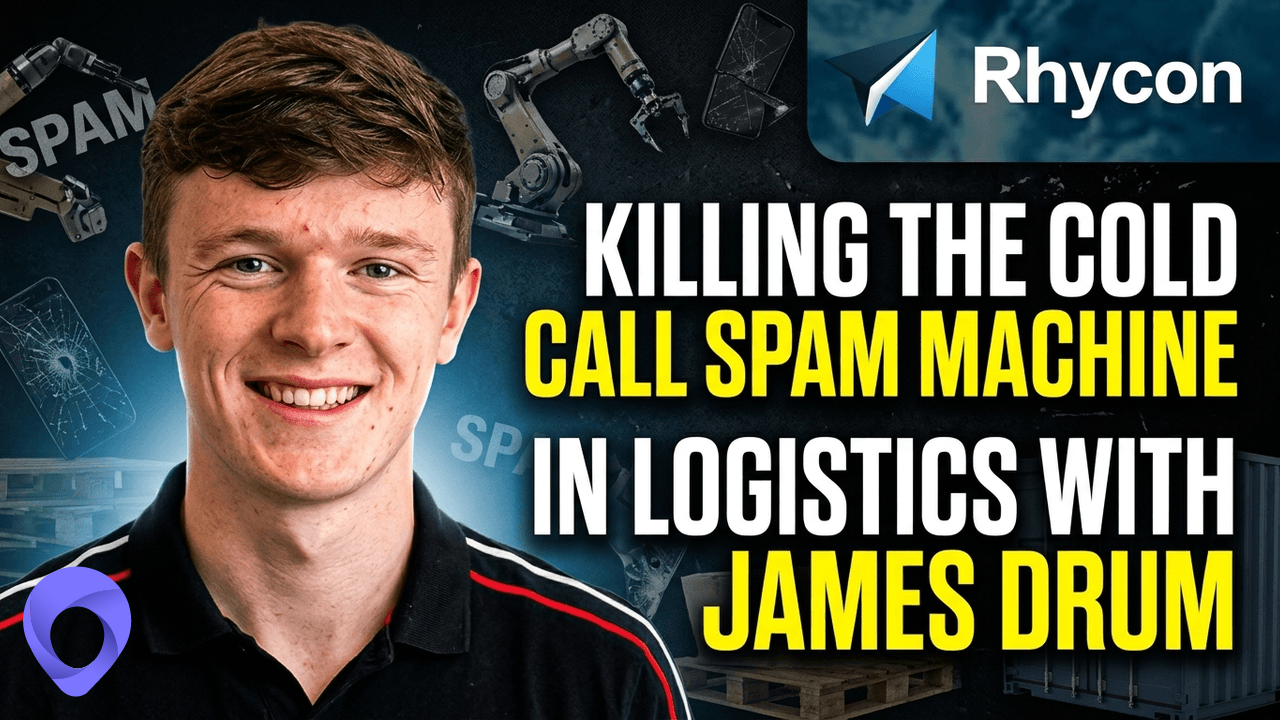
In “ Killing the Cold Call Spam Machine in Logistics”, Joe Lynch speaks with Co-Founder of Rhycon, James Drum, about replacing outdated cold calling and generic spam with AI-powered, signal-based prospecting that fills sales calendars with qualified logistics meetings.
About James Drum
James Drum is an Irish entrepreneur and co-founder of Rhycon. He got his start in sales while he was still in high school, running a D2D sales team and an agency that helped businesses find customers. The agency had eight people using more than 20 tools, yet much of the work was still manual. Someone had to research each company, find the right person to contact and decide what would make a conversation worth their time. That experience gave James and his co-founder the idea for Rhycon. James left school in Ireland and travelled from Dublin to San Francisco to build the product they’d wanted for their own team.
About Rhycon
Rhycon helps sales teams find potential customers and book meetings. A freight broker might want to reach manufacturers opening distribution centres in the Midwest. The broker tells Rhycon which companies it wants to work with and what freight it can handle. Rhycon researches those companies, finds the people responsible for transportation and checks their contact details. It then uses that research to write a relevant first message. For a shipper opening a new facility, that might mean asking which lanes it still needs help covering. Rhycon follows up, handles replies and helps interested shippers book time with the broker.
Key Takeaways: Killing the Cold Call Spam Machine in Logistics
- In “ Killing the Cold Call Spam Machine in Logistics”, Joe Lynch speaks with Co-Founder of Rhycon, James Drum, about replacing outdated cold calling and generic spam with AI-powered, signal-based prospecting that fills sales calendars with qualified logistics meetings.
- Traditional cold calling is losing effectiveness: Decision-makers rarely answer unknown numbers in the middle of the day and live by their calendars, making unscheduled cold calling a major time-waster compared to booking scheduled meetings through targeted outreach.
- Signal-based research prevents “AI spam”: Rather than blasting generic, mass-templated emails that annoy shippers, Rhycon researches companies, identifies the specific people responsible for transportation, and uses real business signals—like a manufacturer opening a new Midwest distribution center—to craft relevant first messages about specific freight lanes.
- Augmenting sales reps, not replacing them: By automating tedious manual prospecting and research, Rhycon increases SDR and BDR productivity by up to 6x, freeing experienced salespeople to spend their time closing deals and building human relationships.
- Speed-to-lead dramatically increases close rates: Slow follow-ups kill momentum because busy prospects quickly move on to other priorities. Rhycon’s AI can be trained on the specific pain points you solve for prospects and common objections to handle replies immediately—aiming for the three-minute golden rule that can boost close rates by nearly 55%—and book meetings directly onto your calendar.
- Authentic voice matters more than robotic perfection: Overly polished, generic AI copy feels unnatural to buyers. Rhycon learns from your existing emails and winning campaign threads to mimic your authentic voice and phrasing while keeping a human in control of targeting and guardrails.
- Dedicated infrastructure protects domain deliverability: Sending high-volume outreach without proper guardrails risks landing your company in spam folders. Rhycon manages separate email infrastructure, runs placement and “aggravation” tests, and adheres to strict email provider rules so messages actually reach prospects’ inboxes.
- Consistent pipeline volume drives sales success: Building a predictable sales engine requires consistent outreach volume first, followed by continuous A/B testing and refinement (such as dropping underperforming regions and testing new ones) to ensure only high-quality opportunities fill your calendar.
Learn More About Killing the Cold Call Spam Machine in Logistics
The Logistics of Logistics Podcast
Joe Lynch: [00:00:00] Hello, friends. Welcome to the Logistics of Logistics. My name is Joe Lynch. Thank you so much for joining us today. Today’s topic is killing the cold call spam machine in logistics with my friend James Trum. How’s it going, James?
James Drum: Joe, it’s a pleasure to be here. Thank you very much, and I’m doing great
Joe Lynch: It’s nice to s- nice to finally hit the record button. We were talking before we hit the record button about what you guys do, and I think it’s fascinating. [00:00:30] James Drumm, please introduce yourself and your company and where you’re calling from today.
James Drum: Yeah. So as I’m James. I’m building Rycon out of California, San Francisco. We’re recently just moved out here from Ireland originally. But Rycon is an autonomous prospecting tool for mainly freight logistics, transport, warehouse, and then the tech companies that spawn from that market as well.
And [00:01:00] what it does is, as the title of this podcast states, we are replacing the need for the cold calling engine. The, the hours that go into calling prospects, and the majority of them are never gonna answer. W- what we do is we win back those hours for your reps who are way, way better suited at actually closing deals, sitting on a call using their actual voice to close that person.
So we– we’re largely through the email channel. We run through multiple other channels as well, but it’s all [00:01:30] artificial intelligence prospecting in the background. Researching the prospects, running our prediction algorithms on each one, seeing are they worth targeting in the first place. And then our infrastructure layer underneath that to make sure that when we do mainly send them emails, they get read and they get seen by the prospects that we’re trying to reach in the first place.
And obviously you can get much larger volume from it as well, Joe, as, as
Joe Lynch: yeah. It’s interesting because we’re starting to use AI to do cold outreach, and if you think about the logistics and the [00:02:00] transportation warehousing company and all the freight tech companies that serve them 10 years ago everything was cold call. If you said, “Oh, I’m gonna, I’m gonna…” People didn’t even invest in websites until maybe 15 years ago.
It’s an industry that kinda just didn’t adopt the l- the newer technologies. But let’s face it, making phone calls doesn’t work quite the same now as it did 10, 15, 20 years ago. And we have guys– Yeah. We have guys who are my age who’ve been wildly successful who started their companies, their own [00:02:30] freight brokerage or their own transportation company because they excelled at sales calls.
They could make those cold calls. They didn’t mind the rejection, and they got pretty good at it, and built relationships, and built books of business, and eventually built businesses. However what worked then doesn’t work nearly as well now. I always say it. When I was young, before we had the mobile phones, Satan could call your house and you had to answer.
Now, you look and go, “Oh that’s a [00:03:00] number I don’t recognize. I’m not answering.” And that’s just the way the world works. So we’ve started using email marketing, which is a little different than cold outreach. And I think what we’re trying to avoid with the cold outreach, I know you guys are, have a solution for this, is I don’t wanna send a whole bunch of AI slop.
I can’t have my company getting quickly thrown to the spam folders. I can’t have everybody blocking me because I am sending [00:03:30] kinda clueless messages around the internet. So we have to do it right. And there is a right way to do it, and it doesn’t mean I c-can’t use AI. You most certainly want to use AI, but you have to use it responsibly.
James Drum: Yeah. Like to touch on your earlier point there, Joe, like these people who excelled in their career at picking up the phone and using their voice to sell, like we– in no ways do we wanna stop that. But these people are way more [00:04:00] efficient when their calendar is stacked and they do nothing but talking to prospects all day without any intervals or gaps where they’re like not talking to prospects, where they’re ringing and wasting their time.
That’s the time killer. And in the day and age we’re in, it’s about augmenting people as much as possible and making them way more efficient. That’s just how things go or careers change. And like in this day and age as well, people hold their calendars just like to their heart. They, they abide by their calendar and nothing else.
They’re not gonna answer a phone in the middle of the [00:04:30] day. They’re just not gonna do that. And if you wanna pay your reps to be calling at the end of the day when people are actually on their way home from work, you’re paying them extra and the chance of them answering it that day are still slim. So unless that person actually accepts that they’re gonna join your call and have a chat with you at that time you’re not getting anywhere with them o-other than that
Joe Lynch: Yeah, exactly. So we’ll come back. We’re gonna talk a lot more about this in a moment. Again, the name of the company is Rykon, and we’ll get back to all of these points in a [00:05:00] minute. But first, James, I know that is not a San Francisco accent. I’ve talked to people there. That is from somewhere else.
So where are you from? Where’d you grow up? And give us some career highlights before you started Rykon, and what was the hole you and your partners saw in the market that made you start Rykon?
James Drum: Yeah, I grew up, as I’m sure 90% of your audience can probably tell in Ireland from my thick Irish accent. And I originally grew up in a rural area of Ireland called County [00:05:30] Meath. I miss the green, the greenery a lot now that I’m in the Bay Area here in San Francisco. But, the Bay Area is beautiful.
It’s just the one thing I miss is the greenery. But yeah I then moved to, to the city, to Dublin where my career eventually started in lead generation prospecting, but on a manual basis. We were, like, pieing together multiple different tools to achieve the end result of prospecting for companies.
And as soon as the tech became available on the market, we were the first adopters push it out there and build, built a solution that we would have wanted to [00:06:00] use ourselves
Joe Lynch: Yeah. So you started as a kind of a lead generation company, and at some point you said, “You know what? This should be a tech company.”
James Drum: Exactly. Exactly. And it worked out well. It’s not like one of those situations where we’re like, “Oh, we’re gonna follow the trends here,” and all that. It’s because we– what we were doing was there was a lot of demand for the service we were offering. But when we could give the exact same results to our clients as we were doing by hand on a done-for-you service, we gave the exact same results, so even [00:06:30] better now, some would argue.
But we could also lower the price by two, three X because a large portion of the work that we were doing by hand is now done by AI on our side. So we made ourselves way more efficient, and that’s what we’re trying to get pass on the baton to our customers now, making them way more efficient and helping them scale
Joe Lynch: I’ve seen the tool and I’ve used the tool and I love it. It’s it– You s- you touched on something earlier, which is just fill my calendar. So I’ve had a lot of people say this to [00:07:00] me over the years, “Oh, I’m an excellent sales guy. I’m an excellent sales guy.” And what they aren’t good at is the prospecting or the SDR, the sales development work or BDR, business development.
So what they mean is, “Get me in the room, get me on the Zoom call, and I can close those deals. I feel very comfortable with the product and the problem that we’re solving.” But what they oftentimes could be an excellent salesperson who says, “I [00:07:30] hate the drudgery and the sometimes rejection that comes with the SDR work.”
So I think SDR and BDR is the kind of work we want automated. And lots of people g- in the last decade have probably gotten their start in that. But it is a tough, it is a tough gig, and I don’t think anyone wants to do grunt work. And by the way, not all of it’s grunt work. So the best BDRs, best SDRs [00:08:00] are th- they’re golden.
They br- bring so much value. But I think most of us would say, “James, just fill my calendar with high quality opportunities and I’ll do the rest.”
James Drum: Exactly. That’s what anyone who goes into sales, their dream is not to be booking meetings onto someone else’s calendar. Their dream is to be s- closing deals and putting cash in their pocket and in the company they work as pocket. Like, when I started in sales, I think I would’ve got a bad taste in my mouth if I was booking [00:08:30] meetings for a closer.
What I done was I started off knocking doors i- in my neighborhood when I was quite young, and we were doing pressure washing and that kind of stuff, and that is where you learn the skills by getting that
Joe Lynch: What were you doing?
James Drum: We were selling pressure washing services door to door back-
Joe Lynch: Pressure washer. Okay
James Drum: Yeah. But that there was when I learned rejection and how to handle sales objections and that kind of stuff, which is that’s the real skills that you’re learning.
You’re not– SEO is just the entry level stuff [00:09:00] that, you’d be learning way quicker if you’re actually put on the sales call. The issue is these companies don’t want to give you sales calls, and that’s your issue. You’re not learning. So I would argue to SEOs who feel like, “Oh, you’re coming after my, my, my lunch, dinner and…”
We’re like: No. We’re gonna give you the leads for you to just sit on the call and learn from real people
Joe Lynch: I hear it all the time now is you are not going to be replaced by AI. You’re going to be replaced by another person using AI. And I think all [00:09:30] the companies I talk to, logistic company, transportation companies, these are low margin businesses in a lot of cases. And e- and everybody’s looking for an edge.
Everyone wants to automate to the ex- the extent that they can without degrading their service. And I think ideally you say, “We grew 10% last year without hiring anybody new.” That’s a beautiful thing if you can get there, and this is the type of tool that allows you to get there
James Drum: To an extent. [00:10:00] We don’t stand behind the topic of having to hire less people or having to cut jobs or whatever. If someone comes on and that’s their main goal, they’re not like they’re not the right person to be dealing with ’cause they’re not the right business man or woman.
We want someone who wants– who looks at their company and they’re like, “We’re generating this many leads with our SDRs. We wanna give Wrycon the tool to our SDRs, our BDRs, our sales teams as a whole, our– whoever they are, and we want to make them way [00:10:30] more efficient.” They can send out this many prospecting emails, LinkedIn, whatever, in a day.
With this tool, they can now send out 6X that, keep their pro- their exact productivity, just augment way more, and that’s what we wanna deal
with
Joe Lynch: th- what that leads to is moving people into roles that are probably better roles m- building the relationships and I think a lot of what we’re seeing in the logistics business is moving people out of grunt work or clerk work [00:11:00] into analysis, where you start looking and saying, “We’re looking at some trends w- with this customer.
We’re looking at– We’re doing really well with this type of customer. Let’s pursue some of these.” It, it– When I s- say grow ideally, y- people are– Some of these companies are really struggling ’cause w- we’re in a very competitive space, regardless whether you’re a trucking company or a logistics company, freight brokerage freight forwarder.
So they’re always looking for that edge, and I don’t see… I know some companies are gonna lay off ’cause they [00:11:30] use– get more efficient. Others just say, “We’re gonna move, we’re gonna move this guy, this gal into a role that is higher value,” which is usually what
James Drum: Yeah. And Joe, I always bring it back to this kind of like picture, something you can picture in your head. If you look back to the Industrial Revolution, I grew up on a farm originally. That’s where I’m from in Ireland. But years and years ago, there was a horse and a plow, and that’s what done the farming, and you needed a load of people to manage a farm.
Then the tractor came in, and it was [00:12:00] how much more efficient it’s on– It’s hard to even measure. These people didn’t just lose their jobs. No, they went and they upskilled, and they became way more efficient and arguably worked way better jobs as well. No one wants to be out d- like hoeing the ground, that kind of stuff, so that’s the way we look at it. Like we are, we’re making the boring, mundane work automated and simple as that
Joe Lynch: Yeah. I like it. I like it. By the way people listening to my podcast in America, [00:12:30] you sound Australian, English, and Irish, ’cause we can’t tell the difference. I know that’s painful for you. I was just at a wedding in Ireland, and there was some British people there. And they go… They said something, I go, “Oh, where are you from?”
And they go, “England.” I go, “Oh.” And then somebody goes, “You can’t tell?” And I was like, “None of the Americans here can tell that guy has an English accent.”
James Drum: When I came over first, Joe I laughed at a guy I met who was, had no idea the different countries of Europe and all that, and I laughed at him. [00:13:00] Within a week of me talking to different people from Michigan, Florida, New York, Ohio, different places like that, I was like, “Okay, I don’t know the main city in your state, so maybe you not…
maybe that guy the other day not knowing where Bucharest was or where other places like that, maybe it makes a lot of sense.” ‘Cause Europe and America they’re as big as each other. It’s just we look at America as being one singular country
Joe Lynch: Yeah. It’s like a, like 50– I was just talk- I was– At that same wedding, I saw my niece’s [00:13:30] husband, and he’s from Ireland, and he said… I said, “How many countries have you been to in Europe?” And he goes I don’t know, 30-some.” I go, “I didn’t even know there was 30 countries in Europe.” I go, “I can name most of them, but I didn’t know there…
I guess I, I’d have to sit down and think about it to get to 30.” Anyway. Anyway, let’s talk about some of the problems you go- this guy solved. Let me first talk about just some of the history of the logistics business. There’s always been– This was a [00:14:00] industry of cold calling until probably 10 years ago.
We started seeing more emails, and we started doing webinars, and pe- a lot of people come on my podcast for opportunities and other podcasts like mine. And we go to conferences, and we collect cards, and we go try and meet people. There’s all sorts of great opportunities to get beyond call, sales call, calling on the phone.
That became a pain for a lot of customers, and they just, they stopped answering the [00:14:30] phone. So we just got over an election here in Michigan. I was getting a dozen phone calls a day that I didn’t take recently, and I think most of them were just pollsters saying, “Who are you gonna vote for?
Make sure you vote.” Whatever they were gonna say, I didn’t need to hear it. And we are very used to the idea that I don’t have to pick up the phone if I don’t recognize the number. And people get– I was at a conference the Transportation Marketing and Sales Association conference. [00:15:00] Great o- great organization.
And they had two shippers up there, and big shippers, and they talked about all the emails they received every week from people. And one of the things they talked about was kinda s- spammy. Like they go, “The- I got the same email that everybody else got. They don’t understand my business at all. They don’t understand my freight that we’re moving at all.
I got the same email. I’m just a, I’m a name on a list. They’re gonna [00:15:30] email me. They’re gonna call me,” and no research into what we need. And they resent it after a while. And, also, I think there gets to a place where you say, “I’m moving thousands of shipments a week. We’re a very sophisticated shipper.”
And somehow your very ambitious, young cold caller gets ahold of that guy. He’s not doing you any favors at that moment ’cause he’s gonna say, “Hey, we can save you 5% on your freight.” It’s like, “Ugh, [00:16:00] please.” “Oh, we have a transportation management system.” It is counterproductive
James Drum: There’s two parts to that. There’s one like… two problems with the cold calling part there. And one is when you’re calling someone up, you’re waiting for them to answer, and the chances of them answering are low. When you send out an email, you’re not waiting for them to answer. It’s gone out there.
If they respond, happy days. If they don’t. Same with the cold calling as well. When you ring someone up, are you gonna do 30, 40 seconds of research on this [00:16:30] person before you r- call them up? Are you gonna find out why your services actually have any value to them other than, “Hey, you’re in this industry, we’re targeting this industry.
Match”? No. It’s just not r- there’s no proper relevance. If you like genuinely had a story, “Hey, I’ve been researching you for the last like while. I think you really might be experiencing this pain point. Are you? Question mark. Can we solve it with our solution that we’ve been building for the last few w- few years?”
There we go. You can do that with email. [00:17:00] You can do that with email through the power of AI, where by scraping everything about these companies on the web, everything about the person, it’s all publicly available information. You’d be surprised. Search up what’s out there about you. I know there’s a lot about me, probably a lot about you, Joe, but there’s a lot.
And if you find like an actual problem that the particular prospect is or could be facing, and you bin the rest, and you just keep a specific list of like people who are actually facing a genuine issue that you built your original product or your [00:17:30] service to cater for. And then you reach out to them on that premise, not on a premise, “Hey, you’re on my list.”
That there is value
Joe Lynch: I’ll give you a perfect example, and I’ve said this many times on the podcast, but not lately, so people hope you’re not hearing it for the fourth time if you’re listening. So if you go to a company and you get there your first day and you’re– they’re asking you to grow the sales, and you say what do we specialize in?”
And they say, “We work with brands that, that ship to the big box stores, the Targets, the [00:18:00] Costcos, the Walmart all the big retailers. And right now we’re only working with four of them, but we wanna work with the rest.” You can go and write an email that has– that shares some of this knowledge that says, “Hey, we work with the largest retailers and some of the best brands.
We understand the problems,” and maybe even list some of those problems. And now instead of blasting the whole world with, “We wanna [00:18:30] move your freight, we have a TMS, we’re 5% cheaper,” you’re– now you’re leaning into an expertise that you have. And I think it’s more likely to be received in a way where they’re like, “Oh, okay, our current 3PL, our current broker, our current whatever doesn’t seem to have the knowledge they want.”
And I say this all the time: don’t let them learn on your dime. I don’t want, I don’t wanna work with someone who has never moved that type of [00:19:00] freight. And yeah, I talked to some young man, he called me and he said, he says, “I’m trying to do better in sales.” And I talked to him for half an hour on the phone and I said what does your company move?”
He goes, “Just big s- big stuff that’s really big.” O- m-m… I go, “Oversized?” He goes yeah, oversized a-and over-dimensional.” I go, “Okay.”
James Drum: If you think that’s gonna sell to an executive, like
Joe Lynch: But I said, “You need to have the right language. It’s over dimensions. It’s a large load. It– Is it going on flatbeds?” He’s like, “Yeah.”
I go, [00:19:30] “Is it is it housing materials? Is it building materials?” He goes, “Yeah, that’s mo- Yeah, bu- building materials.” I said… He goes, “I don’t really know mu- much about building materials.” I go, “I’m looking at your LinkedIn. You used to sell tile floors.” I go, “You’ve done nothing. You’ve done nothing in your career that’s not building materials,” I said.
So I guess my point is, if that’s what your company’s doing, go after other people who are moving building materials, as opposed to saying, “Hey, I would like to move your Hostess cupcakes from your [00:20:00] facility to a, a retail location.” Lean
James Drum: issue was lack of training job and that’s like
Joe Lynch: Well, a lot of times small companies, you don’t get that training.
It’s like, “You’re here, get going.”
James Drum: That’s the issue, and like on, on the SDR or BDR side, like he was obviously an SDR or something like that. Like those guys are being thrown into this role because they’re practically free. Some of these guys are pure, purely on commission basis. And like it, when you aren’t paying that much for someone in that [00:20:30] role, you’re not gonna go through the trouble of training them up to a high standard.
It’s good for your company in a way where you can, the survival of the fittest, but it’s also, they are taking up head space. They’re there in the office
Joe Lynch: They a- they also could give your company a bad reputation
James Drum: Yeah, exactly. Bad in multiple ways. It, it- it’s not good. You wanna like find good sales guys and get them on, trained up properly, let them like the main sales, the actual closers, let them be [00:21:00] shadowed and eventually have them become closers as well. Meanwhile, your pipeline’s being fed and being kept healthy by an engine that has a singular brain like ours and learns from your company and is a lot smarter than an entry-level person who might embarrass your company on that, on your dime
Joe Lynch: y- yeah it’s it’s important that we get the sales, and I’ll tell you, I, if you can get the sales by using some technology that allows us to speed up that process, [00:21:30] oh, hallelujah. Now, and I want to talk about the second problem, which is a lot of times sales reps and the SDRs are, yeah, now every company’s organized slightly different.
Sometimes we have these cradle-to-grave companies where they say you’re responsible for going and doing your own grunt work, y- and then you have to close the s- sale, and then you also have to manage that freight. That’s cradle to grave. Other companies are just seg- segmented, where you say, “I got SDRs, BDRs up front, I got a sales closer, and then I have an [00:22:00] account management team.”
Regardless of what you have, there is this upfront piece where somebody in your organization, whether it’s the sales rep, they’re doing manual grunt work, and they don’t enjoy it. And I’ve done my share of it at my own company. And it– you almost feel guilty that you’re not making more phone calls, you’re not making more stuff happen, you’re not making, sending more emails, because the research and the getting the email and then crafting the [00:22:30] email just right takes so damn long.
And it’s it, we’d love to say that was valuable, important time, but boy, if I can use AI not only to craft that much sooner, but to do some of the research for me, and then to send out those messages. If you can send out more than the onesie-Tuesdays that I’m sending out, hallelujah.
James Drum: It’s the lie, Joe, that business owners tell themselves, and I am a culprit of this as well, of being busy [00:23:00] equals value. That you’re pr- providing value in some way. Having a long to-do list doesn’t always equate to putting dollars in the bank account or in some way moving your company forward.
Oftentimes, it’s just there to keep you busy and when there’s better solutions out there, and that may be coming from the guy who’s selling the solution, yes. But if you think about that, if like really from first principle, it’s very true. A lot– Think about your calendar. Is there one or two things today that you could have knocked off?
Yes. Did updating the [00:23:30] CRM when it could’ve been done automatically, did, did that actually move anything forward? Did writing that email out when you could have streamlined it or you could have had a bit of a template ready to go? In some way, there’s a lot of ways to speed up that mundane jobs and tasks you do every single day.
So I will say if Rykon isn’t the move forward, you’re still like looking busy isn’t always the way to go. And yeah, that would
be my-
Joe Lynch: I think there’s also when I’m using, I’ll call it an autonomous SDR tool like [00:24:00] yours it can get to know your voice and you can, if you’re not comfortable with the email, don’t send it. You can’t let… I’ve done that, by the way. I have a vi- video that I made, and it was just for my portal for people who are coming on the show.
And I’ve… was in a hurry, so I just let AI write out this thing, and I kinda looked at it as I read it, and then later on I looked at this video and I was like, “Oh, I don’t talk like that.” That is truly ridiculous, and I have to redo it now because I [00:24:30] let AI write it. And if, had I said, “Please write this in my, in Joe Lynch’s voice,” it would.
And it would hopefully sound more like me, and I wouldn’t be embarrassed and have to take that video down and redo it. We have to get beyond the idea that there’s either all AI AI is not slop. If you don’t do the right thing though, it will be slop. If you say, “Oh boy, I did this in 15 seconds.
This is so easy.” You’re probably creating slop, right? So
James Drum: It’s what [00:25:00] you put in there, it’s, it really is like your input, the, the time, the skill level of what you’re putting in is what you’re gonna get out. It’s that simple. But yeah we’re also coming to the point, I know you mentioned the, the text being generated and that kind of thing.
It’s like we’re at a stage nearly where AI can craft such, like beautifully, like zero errors in the text or whatever. No, like spelling, punctuation, exactly. People don’t wanna read that, like your [00:25:30] authentic writing has some, some messy bits in it, you go off on a tangent here and a tangent there.
And with our system, we can copy exactly how you speak. Exactly how you speak if you upload your emails into our tool. We mix them about a bit and write like you. Or we also we train our models on what’s working. So we down- download all the different threads from our own campaigns, like our ones that we run for our company.
We look at what’s working, what’s not working, and then we [00:26:00] spit them in as the default baseline to we know this works, this is what you’re getting
Joe Lynch: I think, there’s something to be said that you look at music. So we have the ability to produce music so flawless now, and yet you have a whole bunch of artists that I like, like Jack White or The Black Keys, and they are like deliberately don’t make it too pretty.” The, the imperfection is what we like, and I think that’s th- that’s why your voice has to come through ’cause your voice is [00:26:30] unique, and hopefully it comes off and they go, “Oh.”
‘Cause we’re all still looking for the know and trust, and if you let AI do all of the work then they’re never gonna get to know and trust you, and that’s
why we have
James Drum: people buy from people, as simple as that
Joe Lynch: th- at this p- at this point.
James Drum: Yeah. Like you can say one day it’ll be bots buying from bots or whatever, but let’s leave that to another conversation. Right now, like me personally, I buy from a human. I buy from a [00:27:00] person at a shop. I buy from a person over their phone or on a meeting like this. I don’t necessarily buy anywhere near as much over like a checkout on a website or something like that.
And so that’s really what we’re trying to advocate. We aren’t trying to sell anything over… we’re trying to sell a little bit, but we’re not trying to actually take money out of someone’s bank over email. We’re trying to spark that conversation and be that intermediary where we set that meeting
Joe Lynch: Now you work with B2B companies and, one of the market segments just [00:27:30] happens to be logistics, transportation, warehousing, and all the freight tech that serves it. And there’s n- the next point I wanna talk about, which is the slow follow-up. So when you send out a email, and by the way, I have noticed this, you send out an email and somebody responds, and you don’t respond back really quickly, they’ve moved on.
And not necessarily to another supplier, they just moved on to another problem. I have noticed this where somebody will come to my website and say, “Joe, I want this, and this.” [00:28:00] I respond the next morning, and they don’t answer. They’re gone. And I think we’re getting to a place where you have to q- quickly get a follow-up, w- and very quickly, a follow-up that puts them on your calendar somehow.
And I think that’s, again, you can use AI to say what’s working to move them from an email to get them then on your calendar. And we have to do that. The whole idea that you can lose an opportunity because you just went to bed and woke up in the [00:28:30] morning, and they wanted an answer in the middle of the night.
I’ve seen services now that say w- they quote research that said, “If you respond within five minutes, the sales is much more likely than if you wait an hour.” And I was like, “Five minutes?”
James Drum: more likely. I think it’s three minutes is nearly the golden rule where if you hit them back in three minutes and you’re still in their mind, you nearly have a 55% chance higher of the close rate. Not [00:29:00] just like them replying again, but like of the actual close rate. So like you’re upping your chance a lot and to have pay someone on the payroll to be there ready to go, write that message as quick as possible it is difficult as well.
If you’re sitting on a call or if you’re on your lunch break or whatever, no, you need to be ready to go and we do that for
Joe Lynch: So does Rykon, they, if they send out an email and somebody responds with some, some question or some, “Hey, what’s ne- next steps?” Rykon [00:29:30] can craft that message? Is it asking for my permission, or how’s that work?
James Drum: It sure can. W- Wrike on there’s options, okay? So you can manually craft your replies if you wish, but you can also turn on auto-reply and you do that after you’ve trained the system. So our system is like a, it’s like a puppy at the start. You need to train this on how to sit, how to stand, how to follow do different things.
And so you give it, these are the common objections we face on a day-to-day basis, and you upload the data that you have in your head, your sales team’s head, [00:30:00] different stuff like that. Put it in our tool. You give it things not to say. You give it, these are pain points we’re solving, this is what customers might say, and you give it all that information just like a load of text into the brain that we call it the brain, and it breaks that data down and it pulls from that data as needed.
So if someone asks that question, it knows, okay we have that bit of data there and we can answer that. So you can have auto-respond on, and i- its aim then is to book that meeting into your calendar and propose, [00:30:30] “Hey, I’m free at 9:00 AM on Thursday morning. Are you free?” The prospect will reply yes, and then it sends a calendar invite to that person.
Bingo. Now all you have to do is just go jump on the call. And like we, we used to face this issue so much where when we were done– doing a done-for-you service, some threads could go 20 emails long, 25 emails long before you actually find that time in two weeks where both parties are in a stable location where they can jump on a call and they’re both in the [00:31:00] right headspace.
That’s not what humans were designed to do back and forth timekeeping and calendar setups,
Joe Lynch: and there’s another aspect to this, and I think this applies to all of it, but it– with this follow-up also. As we start using AI, I think at some point we’re gonna say, “Okay, I have this sales function,” and there is some number of, I don’t know if you wanna call them bots or AI services that we’re using, which is fine.
You’re still gonna have somebody who’s responsible within your group, [00:31:30] so you can never… you don’t have to get to this idea that, wow, AI is running wild without us. Now, we can put whatever checks, and I heard somebody use the term ethical crumple zone for AI. So meaning we use– we code with AI, and it does a wonderful job, but we check it.
And so we’re completely comfortable saying, “Yes, of course, we’re using AI,” ’cause that makes sense. I get so much more done, and… [00:32:00] But I have a human responsible, so no one– You’re never gonna have something where somebody says, “Oh God, the AI ran wild and offended one of our customers.” That’s just not… it’s really not even possible unless some human let
James Drum: user error, to be honest, Joe. If that happens it’s down to the user and what targeting it gave to the agent. It’s prompt engineering when it comes down to that. What you tell it to do and what the data you give it, the guardrails you set, that’s what’s gonna happen. And much, much like now that you bring up [00:32:30] coding with AI, for our like users who use AI, that’s really the route we’ve taken them down where h- we tell them, “Hey, you don’t need to use our platform or learn our platform.
You just need to log on to your ChatGPT in the morning, and it’ll feed you a summary. It’ll be like, ‘Hey, California’s really underperforming this week. Let’s kill California from our campaign.’ And I’ve been researching two new locations, Ohio and Nebraska. I recommend adding these in and A/B testing them.”[00:33:00]
And you read through this, you make your recommendations. You’re like, “Okay, that looks good. I like the data it came back with on that. Let’s add that in.” So it makes these suggestions on what to kill, what to add in based on it can go and scan other things. You’ve got that brain that it doesn’t have.
Y- you have that final decision on wh- what happens
Joe Lynch: It’s interesting it r- because I’ve got all these gray hairs, I’ve e-experienced the new technologies many times, and I always think about this. I was at a drive-through pizza p-place. I [00:33:30] was getting a slice of pizza, and my phone came on and it was from my friend Chip, and he wrote, “Hi, Joe.”
And I interpreted that as Chip’s phone had contacted my phone. And so I called him and I said, “Hey, your phone sent my phone a message.” He goes, “Yeah, I sent you a text message.” I was like, “Oh, I… What is that?” He goes, “Yeah, it’s messaging. You can text me back.” I go, “Why would I do that?” And we’re talking on the phone.
He goes, “No, but sometimes you wanna [00:34:00] text.” I go, “Why would I just not pick up the phone and call you?” He goes, “‘Cause sometimes it’s more convenient to text.” Keep in mind, I had not sent a text message at that moment, and I think he said that was one of his first, right? So none of us really understood what was appropriate for
text messaging
James Drum: I think you have another good story as well. The, before we jumped on the call, the fax machine story you were telling me as well. That was I was saying I’d never even touched a fax machine. I didn’t know how it
Joe Lynch: [00:34:30] No, there was, we, I worked at a company and it was an engineering company. We were very high-tech, so we had a fax machine, and the secretary told me it was broken because it kept… She’d put paper in it, and it would just go out the back. And I said, “I think that’s what it’s supposed to do.” She’s like, “It’s supposed to send it.”
And I was like, “I think it just is scanning or something.” And all these engineers who are there going, “Joe, what are you talking about?” I was like, “I don’t think it’s wadding this up and somehow sending it across town.” But anyway, g- getting back to it, [00:35:00] we learned what’s appropriate for text messages, and I, when I ran a logistics company, I used to say, “Hey, did you call James and tell him that his shipment’s going to be four hours late?”
I would get, “Oh, I texted him.” I said, “No, that’s a place where you call because he might be angry.” I go, “What did he say?” He said, “K.” This K, we’re not working with you anymore, or K, that’s fine, I don’t care. You [00:35:30] pick up the phone and call. And I think the same is gonna be the the case with AI. We’re going to use it some places, and I think it, the application we’re talking about right here, perfect scenario.
Get us out of the grunt work, get us out of the manual research, allow us to reach a whole bunch of our ideal prospects with the right messaging in our own voice, and if there’s follow-up that has to happen quickly, I have that tool. So even if I’m on [00:36:00] calls all day, I have an AI assistant that is taking care of business.
This is done right, this is perfect. Done wrong, and I’m sure you’ve probably chastised customers along the way, that it’s not a silver bullet. You have to work with it to make it. It’s simple. It’s just you have to do the work to set it up.
James Drum: You, you really do. When you’re sending emails, you’re sending on the rails of other companies. You’re sending through Gmail’s rails, [00:36:30] Yahoo, Outlook, who’s Microsoft, all these different companies. You’re using their infrastructure. If you mess about, you do something wrong, you break their rules, you’re out.
You like you’re not gonna get any results and you’re gonna waste your money, you’re gonna waste your time. And that’s because like you’re basically renting that kind of stuff off them. They own that s- that stuff. Imagine like the, they’re the pigeon. You put your note in there and it goes to the end destination.
That so yeah we understand the rules. We have the experts on our team [00:37:00] who understand it. We get you the best results because we built it to abide by the rules, not break anything, and have best standard operating
Joe Lynch: Speaking of rules, so if I’m using Rhicon, and I should point out it’s spelled R-H-Y-C-O-N.AI. I will make sure I put a link to your LinkedIn profile, link to your website, any other links to you and your go-to-market team, give me, I’ll put those in the show notes. But if I’m using Rhicon, you guys have a separate email for me, so I don’t…
If I’m [00:37:30] sending a lot of emails and talk about this whole idea of warming up emails, but also about, not getting thrown to spam.
James Drum: Yeah. If you’re in spam, like you’re not gonna get any replies. ‘Cause I pose this question to anyone who’s listening to this today. Who, who’s checked their spam folder in the last couple weeks? And if you have, have you responded to anything in there? ‘Cause I certainly haven’t. And so if you’re sending a, a templated message en masse to thousands of [00:38:00] people and you’re not checking are you ending in spam with placement tests, if you’re breaking rules, sending too much, sending to people you have no right to be contacted in the first place not checking the email before you go out for…
We built a tool where we– it’s basically testing aggravation. If someone reads this and you’re making these claims, how annoyed will they get and what’s the chance of them hitting spam on that? And we make these calculations on everything before it goes out purely to protect the infrastructure that we [00:38:30] buy out on our customers’ behalf so that, like we, we manage all that infrastructure.
We don’t give it to the customers so they can, in case they like set it up the wrong settings or whatever
Joe Lynch: got you got some guardrails for us so we’re not going off the road.
James Drum: Exactly. Like le- leave it to the experts that we- we’ll handle that and you bring your offer and your targeting to the table, and we’ll bring what we bring, what we do best to the table as well. And, that’s where the best results are made. When you don’t try and control everything, you control what you’re good at, we control what we’re good at, and then [00:39:00] th- yeah, that that’s when things go
Joe Lynch: Yeah, this, th- this is such a cool tool and I’ve, again, I’ve used it, so I can say this is a, it’s a fantastic addition. And again, everybody’s looking for that one extra sale, that one extra sale that puts them over the top this month or this week. And y- let’s face it, your competition’s, y- your competition might already be using Rykon, so you have to…
this is a little bit of an arms race. Are you going to be using the latest and greatest technology, or are you going to be [00:39:30] saying, “Oh, we don’t do it that way. We don’t use AI because somebody was upset about something that ha- Oh, I saw the hugging f- hugging face attack, and we’re not using AI.”
Okay, good for you. AI is a tremendous tool. I heard somebody describe AI as discovering fire from the gods, like in ancient times where you go, “Yeah, it’s great. It can burn down my, my, my home, but it also can heat my home. It’s just how I’m using it.” So [00:40:00] anyway, I’m gonna summarize what we talked about, then I want to get your final thoughts on the topic, James.
So I’m talking to my friends, friend James Drum, and I’m– we’re talking about killing the cold call spam machine in logistics. When I say cold call spam machine, that is the email spamming, but also the cold calling that we all have traditionally done in this business and having less success every single year.
James and his co-founder have created Rycon, and they solve a lot of the [00:40:30] problems that we have in this business, and the first one is generic sales spam that a lot of these guys, a lot of our prospective customers are receiving. They receive a lot of emails. You wanna get to a place that you’re sending an email that is of value that ideally builds your authority.
That where they go, “Oh, I’m getting an email from James, and James specializes in what I move.” He specializes in the problems I have.” [00:41:00] So Rycon uses AI, but it’s signal-based, it’s personalized, so they’re getting it to the place where it’s not going to be embarrassing your company, it’s not gonna be hurting your reputation, and it’s definitely not going to be landing your domain in the spam folder.
Secondly, we talked about sales reps and SDRs. They spend so much time on painful manual grunt work that nobody [00:41:30] enjoys, and it is taking away from the time that you could be on the phone with customers, and it’s taking time away from you. Rather than sending out thousands of emails in a week, you’re sending out dozens.
And still, you gotta have the right quality, but this gets to be a numbers game. You o- once you get to the right level of quality, it becomes a numbers game. Last but not least, we talked about slow follow-up. People are busy, and I’ve noticed this in my own business. When they wanna [00:42:00] talk to you, they wanna talk to you then, right now, and the next day they’re like, “I don’t know why that guy keeps calling me.”
So we need immediate follow-ups. Again, those can be personalized through Rycon. So ideally, we move that person from interested to on my calendar. And, If we can do it this way, you’re just gonna… If the more, it really comes down to in our business, the more conversations you have with prospects, the more business [00:42:30] you have.
And what we’re talking about here is how do I put more people onto my calendar? And I could tell you this just from my own experience, when my calendar is full, I do well. When it’s not full, I don’t do as well . So
James Drum: When the pipeline’s healthy, I’m happy. So that’s what we want to give to everyone else,
Joe Lynch: yep, and there’s an– Somebody said on my podcast a few years ago, and I really like it, and he said, “Before you can be good, you must be consistent.” And so if you’re consistently getting [00:43:00] two dozen people on your calendar a week, you’re like, “That’s good. That’s all I can do,” right? Two dozen that’s perfect.
But now I wanna improve the quality. I’m already consistent, so I can tweak and tweak till I get to the place where he said, “I’m only getting the right people on my calendar.” Now it’s, now rather than 24 people being on my calendar, but only 15 are good, now I got 18 or 20 that are good.
You gotta be consistent before you can be good. Put a big old bow on this one, James [00:43:30] Drum. Final thoughts on the topic
James Drum: For me? I’d agree with your last point there anyway, Joe. Consistency, and it requires volume to create that consistency. As I’m sure a lot of your listeners who are kinda around the sales industry, you do so much volume and it’s gonna be impossible for you to not win, not hit your targets.
Yeah, and that’s where we come in as, as a whole company. You scale Rykon up as you need that volume. You scale it down when you can’t handle it. But I’d be [00:44:00] looking at you twice if you were like, “Hey, we can’t handle any more volume.” So yeah. I think it’s a really good fit and we’re working right across the industry with multiple people across freight and logistics especially, and on the tech side, specifically the tech side.
Those, those guys are really performing well at the moment, so it’s only an upward trend from there.
Joe Lynch: Well usually it’s the B2B and a lot of the SaaS guys that kind of lead. I know that’s one of the reasons you guys landed in San Francisco, ’cause you knew you wanted to work with a lot of tech companies. And [00:44:30] I’m telling you, there’s a lot of companies now in the logistics space that look very much like tech companies and vice versa.
So we’re all becoming hybrids. But anyway as I mentioned earlier, James, I will make sure I put a link to your LinkedIn profile, link to your website, any of the links you and your go-to-market team give me, I’ll put those in the show notes. And I– look I kn- I don’t think you guys have signed up for any conferences yet, but I hope to see you at Manifest in V- in Vegas this this February
James Drum: Yeah. Yeah we’ll have to go to that. I haven’t been [00:45:00] before, but I’ve heard it’s good, so you can count me in on that one
Joe Lynch: All right. Thank you so much for taking the time, James
James Drum: Amazing job. We’ll chat to you again. See you then
Joe Lynch: I look forward to it. And thank all of you for listening to my podcast. Your support’s very much appreciated. Until next time, onward and upward